Arithmetic that is fast and reasoning that is calm.
SATs maths rewards two different skills: accurate written methods on Paper 1 and patient problem solving on Papers 2 and 3. Our tutors train both, from your child's current level.
 Start here
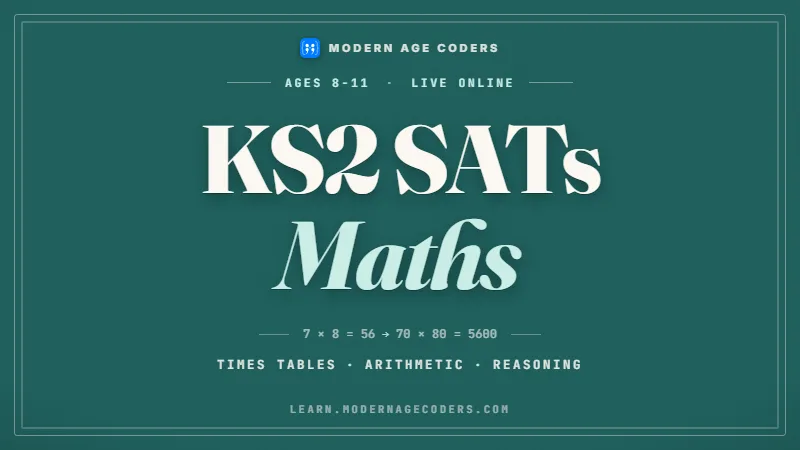
KS2 SATs Maths: Arithmetic, Reasoning and Times Tables
Year 6 SATs maths: the arithmetic paper's written methods, reasoning papers practised in time, and times tables kept fluent.
$100/mo group · $150/mo one-to-one
View course and enrol
Elementary Maths, Years 1 to 6
Primary maths from Year 1 to Year 6 for a child who needs gaps closed before SATs practice makes sense.
$100/mo group · $150/mo one-to-one
View course and enrol
Middle School Maths: Pre-Algebra and Geometry
For a confident Year 6 ready to move on: pre-algebra and geometry that lead straight into Year 7.
$100/mo group · $150/mo one-to-one
View course and enrolFind your Year 6 child, then follow the row.
| Your child now | What we would suggest | Start with |
|---|---|---|
| Loses marks on Paper 1 arithmetic | Written methods for long multiplication, division and fractions, practised until they are accurate first time | KS2 SATs Maths |
| Freezes on worded reasoning questions | Reading a problem into a plan: what is asked, what is known, which operation, then a check | KS2 SATs Maths |
| Gaps from Years 3 to 5 | Place value, times tables and fractions rebuilt first, then SATs-style practice | Elementary Maths |
| Already secure, wants a stretch | Harder reasoning and the bridge to Year 7 maths | Middle School Maths |
One arithmetic paper, two reasoning papers.
| Paper | What it tests | Marks | Time | 2027 date |
|---|---|---|---|---|
| Paper 1: arithmetic | Confidence with the range of mathematical operations | 40 | 30 minutes | Wednesday 12 May |
| Paper 2: reasoning | Fluency, problem solving and mathematical reasoning | 35 | 40 minutes | Wednesday 12 May |
| Paper 3: reasoning | Fluency, problem solving and mathematical reasoning | 35 | 40 minutes | Thursday 13 May |
| Total | The whole key stage 2 maths test | 110 | 110 minutes | 10 to 13 May week |
The tests are taken on paper. The equipment list for Paper 1 is a pen or dark pencil, a ruler and a rubber; for the reasoning papers it adds a sharp pencil for drawing, a protractor and a mirror. No calculator appears on the list.
The two reasoning papers have no significant differences in format, and questions in each paper are placed in an approximate order of difficulty, so the hardest questions tend to come at the end.
Where the marks come from
Across all three papers, number, ratio and algebra carry 83 to 93 of the 110 marks (75 to 85%). Measurement, geometry and statistics carry the other 17 to 27 marks, all on the reasoning papers. Paper 1 is entirely number.
From the key stage 2 mathematics test framework, Tables 10 and 11.
Why 56 marks out of 110 meant 100 in 2026.
Each child's marks from the three papers are added to make a raw score out of 110. Because the papers change every year and may be slightly easier or harder, the raw score is converted into a scaled score so results can be compared across years.
Scaled scores run from 80 to 120. A score of 100 or more means the child has met the expected standard; 99 or less means they have not yet met it. A child also needs a minimum raw score to get any scaled score at all. The expected standard itself was set by panels of teachers in 2016 and has been held steady since.
The raw score needed for 100 moves a little each year with the difficulty of the papers. If the test is harder, fewer raw marks are needed; if easier, more.
2026 maths conversion, selected rows
| Raw score (out of 110) | Scaled score |
|---|---|
| 0 to 2 | No scaled score |
| 3 | 80 |
| 56 | 100 |
| 80 | 106 |
| 100 | 113 |
| 109 and 110 | 120 |
From the Standards and Testing Agency's 2026 key stage 2 scaled score conversion tables. The 2027 table will be different.
Three questions we wrote: two arithmetic, one reasoning.
346 × 27
346 × 20 = 6,920
2,422 + 6,920 = 9,342
A formal written method, set out so every step can be checked.
2/3 + 1/4
1/4 = 3/12
8/12 + 3/12 = 11/12
A common denominator first. A frequent slip is adding the denominators.
A school packs 500 pencils into boxes of 45. How many boxes are full, and how many pencils are left over?
check: 11 × 45 = 495, and 495 + 5 = 500
11 full boxes, 5 pencils left
Divide, then decide what the remainder means in the story: here it is the pencils that do not fill a box.
Four habits that protect marks on the day.
Arithmetic little and often
Paper 1 is 40 marks in 30 minutes. Short daily practice of written methods builds the speed that a single long session cannot.
Show the working
On longer calculations, a clear method shows exactly where a slip happened, which makes it far easier to fix in practice.
Read reasoning questions twice
Underline what is being asked. A common slip is a correct calculation that answers a different question.
Check with the opposite operation
A multiplication checked by division, or a subtraction checked by addition, catches errors before they cost marks.
Accurate methods, calm reasoning, and a plan for May.
In the first lesson the tutor works through arithmetic and reasoning questions with your child and sorts every lost mark into a gap, a method slip or a reading slip. You see which paper needs the most work.
From there the lessons follow a plan to May: written methods drilled until they are accurate, reasoning questions read into steps, and timed practice only once methods are secure. Every lesson is live with the same tutor, after school or at weekends in UK time.
We never promise a grade or a score. Results depend on the starting point, the time available and the practice done between lessons, and we say so at the start.
"Very good classes. Makes learning very easy and interactive."
Vineeta Shyamsukha, parent · verified Google review
Year 6 SATs maths: what parents ask.
How many maths papers are there in Year 6 SATs?
Three: Paper 1 arithmetic, and Papers 2 and 3 reasoning.
How long is each KS2 maths paper?
Paper 1 arithmetic is 30 minutes. Papers 2 and 3 are 40 minutes each, so the whole maths test is 110 minutes.
How many marks is the KS2 maths test out of?
110 marks: 40 on the arithmetic paper and 35 on each reasoning paper.
What is a good scaled score in KS2 SATs?
A scaled score of 100 or more means a child has met the expected standard. Scores run from 80 to 120.
How many marks do you need for 100 in KS2 maths?
It changes each year. In 2026 a raw score of 56 out of 110 converted to a scaled score of 100.
When are the 2027 KS2 SATs?
From Monday 10 May to Thursday 13 May 2027. Maths Papers 1 and 2 are on Wednesday 12 May and Paper 3 on Thursday 13 May.
Can children use a calculator in KS2 SATs maths?
No calculator is on the equipment list for any of the three papers. The list is a pen or dark pencil, ruler and rubber, plus a protractor and mirror for the reasoning papers.
Are SATs and key stage 2 tests the same thing?
Yes. The government calls them key stage 2 national curriculum tests and notes that some people refer to them as SATs.
What topics come up most in SATs maths?
Number, ratio and algebra carry 75 to 85% of the marks. Measurement, geometry and statistics carry the rest, and only on the reasoning papers.
Can you help my child prepare for SATs maths?
Yes. Book a Priority Demo: a full live class of about 45 to 60 minutes with a mentor reserved for your child. After the class the mentor sends a written skill report and a personal learning roadmap on WhatsApp.
See where your child stands before May.
In one live class a tutor works through arithmetic and reasoning questions with your child and shows you which paper is costing marks. If you enrol, the demo fee is adjusted against your first month's fee.
Sources, read in October 2026.
- Standards and Testing Agency, Key stage 2 mathematics test framework (Tables 1, 10 and 11).
- Standards and Testing Agency, 2027 key stage 2 national curriculum tests: information for parents (September 2026).
- Standards and Testing Agency, Understanding scaled scores at key stage 2 (July 2026).
- Standards and Testing Agency, 2026 key stage 2 scaled score conversion tables (July 2026).
- Department for Education, Primary assessments: future dates (September 2026).