Table of Contents
Area and perimeter are taught together, measured with similar numbers, and confused by almost every child at some point, and by quite a few adults. The formulas are easy to memorise. What is harder is knowing which one a question is asking for, and understanding that the two are genuinely independent: two shapes can have exactly the same perimeter and very different areas.
This guide explains the difference with one simple picture, shows why the units are different, works through rectangles, compound L-shapes and circles, and covers the surprising results that make the topic click, calculated by short Python programs whose real output is shown. It is written for students and for parents helping with homework.
The difference in one picture
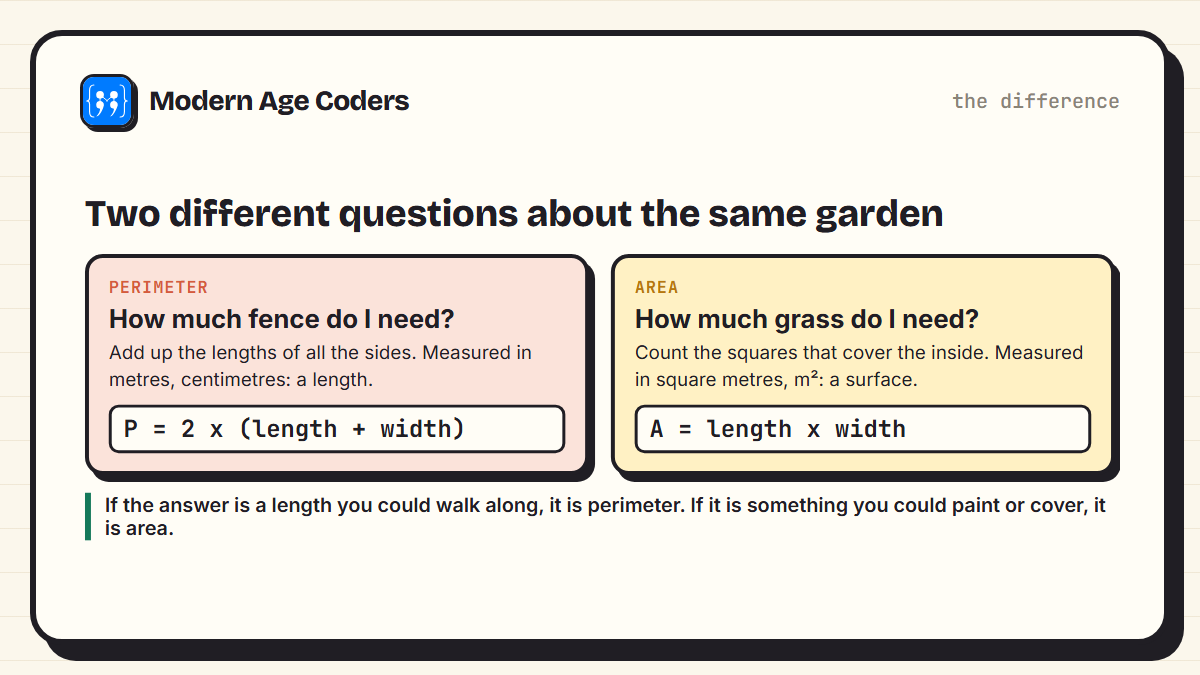
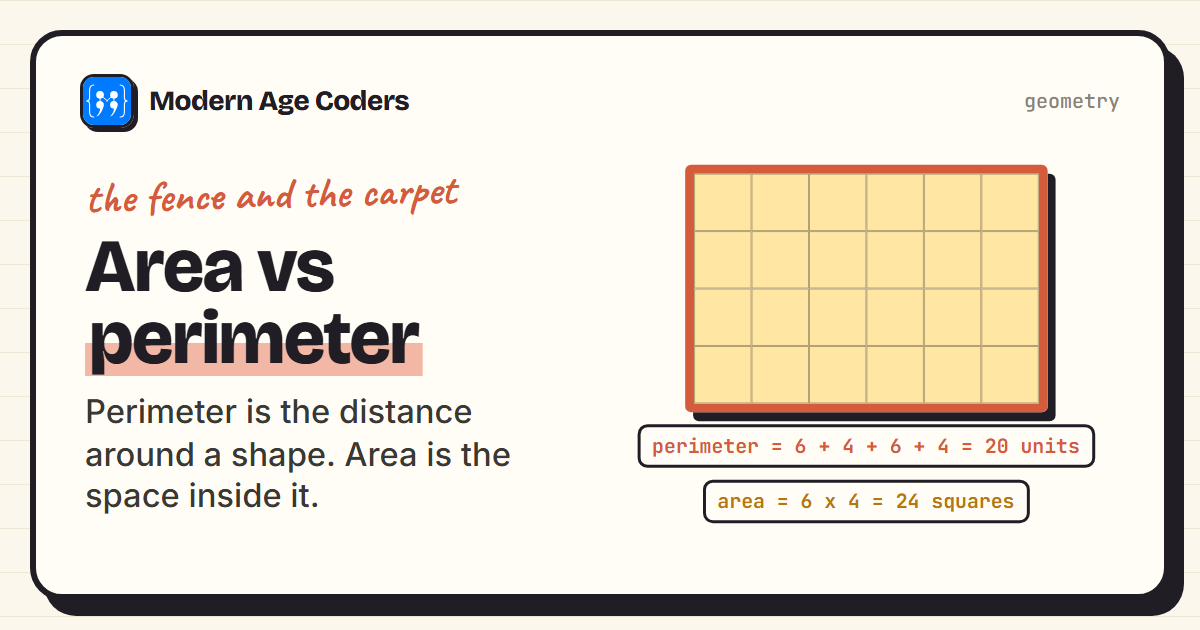
Imagine a rectangular garden. The perimeter is how much fence you need to go all the way round it. The area is how much grass you need to cover it. They are two different questions about the same garden, and they have different answers in different units.
- Perimeter is a length. Add up all the sides. A 6 m by 4 m garden needs 6 + 4 + 6 + 4 = 20 m of fence.
- Area is a surface. Count the unit squares that cover the inside. The same garden is 6 x 4 = 24 square metres, written 24 m².
A quick test for any question: if the answer is something you could walk along, like a fence, a border or a frame, it is perimeter. If it is something you could paint, tile or cover, like a floor, a wall or a field, it is area.
Why the units are different
Perimeter counts lengths, so it is in cm or m. Area counts squares, each 1 cm by 1 cm or 1 m by 1 m, so it is in cm² or m². Writing the right unit is not a formality: it tells you, and the examiner, which question you have answered.
The formulas for rectangles and squares
| Shape | Perimeter | Area |
|---|---|---|
| Rectangle | 2 x (length + width) | length x width |
| Square with side s | 4 x s | s x s = s² |
| Triangle | add the three sides | ½ x base x height |
| Circle with radius r | 2 x π x r (called the circumference) | π x r² |
For children, it is worth building the rectangle area formula from counting before using it. Draw a 6 by 4 rectangle on squared paper and count the squares: 4 rows of 6 is 24. Once they see it is really rows of squares, length x width stops being a rule and becomes obvious.
Same perimeter, different areas
Here is the result that surprises most students, and it is the best way to show that area and perimeter really are different things. Take a fixed length of fence, 24 units, and make every possible rectangle with it:
# every whole-number rectangle with a perimeter of 24
print("width x height   perimeter   area")
for width in range(1, 12):
    height = 12 - width                 # width + height must be half of 24
    if width <= height:
print(f"{width:>5} x {height:<5} {2 * (width + height):>9} {width * height:>4}")width x height perimeter area
1 x 11 24 11
2 x 10 24 20
3 x 9 24 27
4 x 8 24 32
5 x 7 24 35
6 x 6 24 36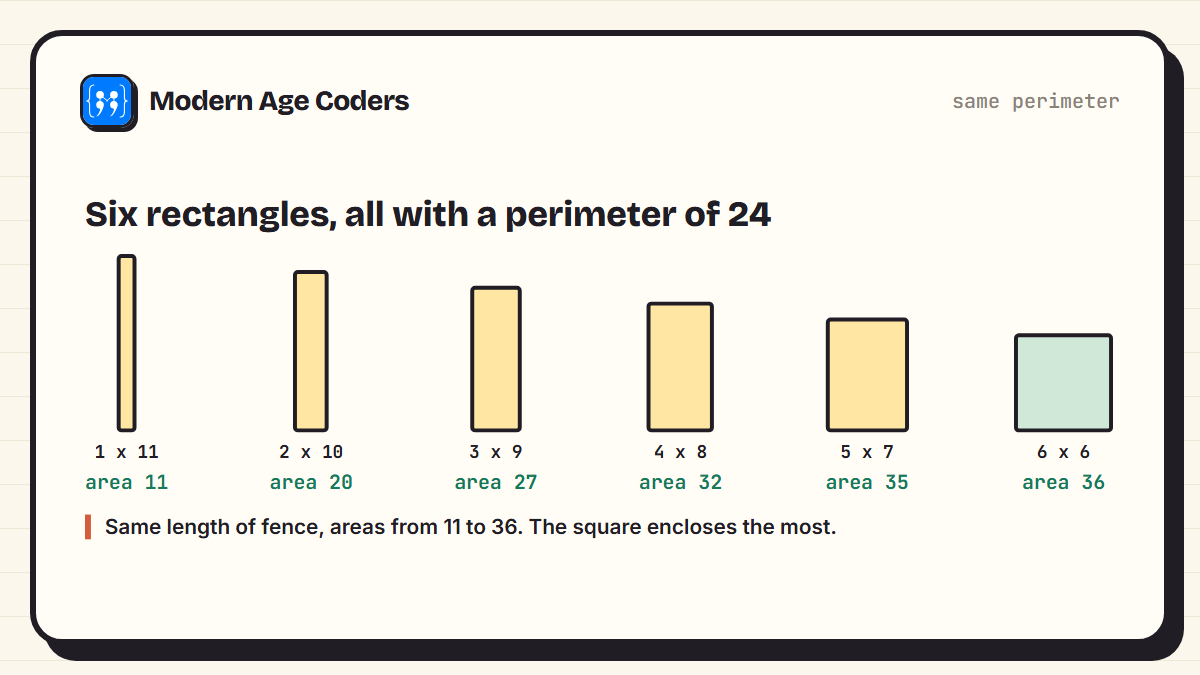
Every one of those rectangles uses exactly 24 units of fence, but the space inside ranges from 11 to 36. The long thin 1 by 11 rectangle wastes most of its fence on the two long sides. The more square the shape, the more area it encloses, and the square, 6 by 6, gives the most. (If you allow any shape at all, a circle does even better, which is one reason bubbles, pipes and many tanks are round.)
Same area, different perimeters
It works the other way round too. Fix the area at 36 square units and look at the perimeters:
# every whole-number rectangle with an area of 36
print("width x height   area   perimeter")
for width in range(1, 37):
    if 36 % width == 0 and width <= 36 // width:
        height = 36 // width
print(f"{width:>5} x {height:<5} {width * height:>4} {2 * (width + height):>9}")width x height area perimeter
1 x 36 36 74
2 x 18 36 40
3 x 12 36 30
4 x 9 36 26
6 x 6 36 24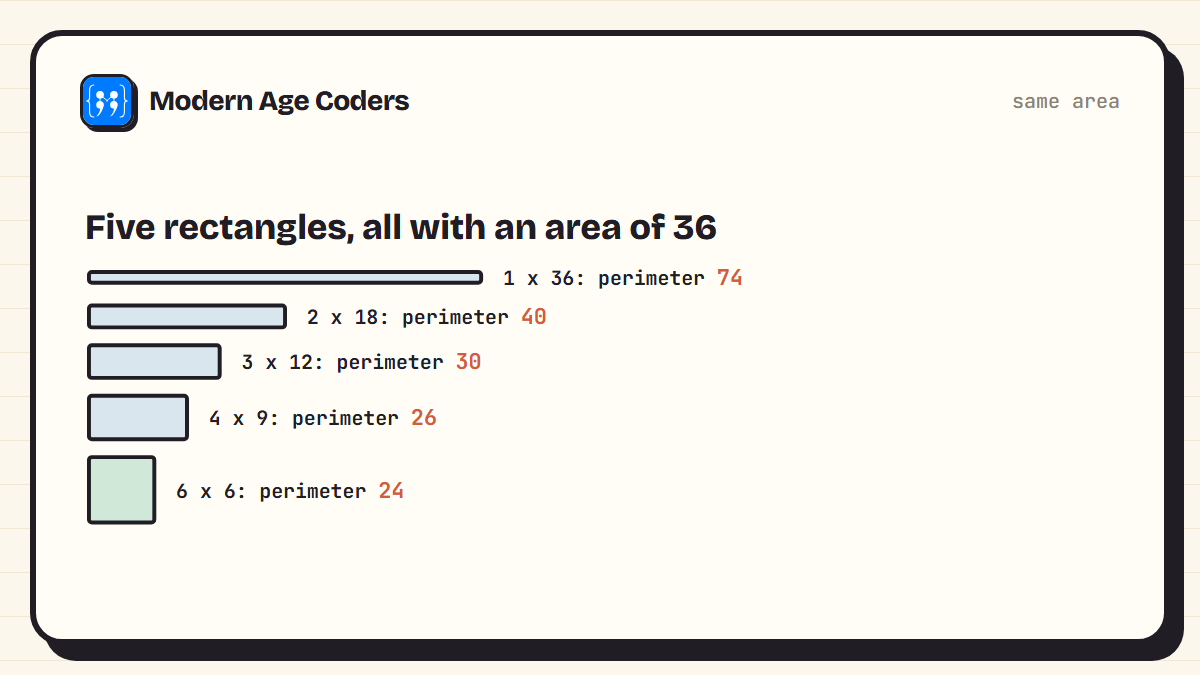
The same 36 squares of carpet could need 24 units of edging or 74, depending on the shape. Again the square is the most efficient. This matters in real life: builders, farmers and packaging designers all use this to save material.
Compound shapes: the L-shaped room
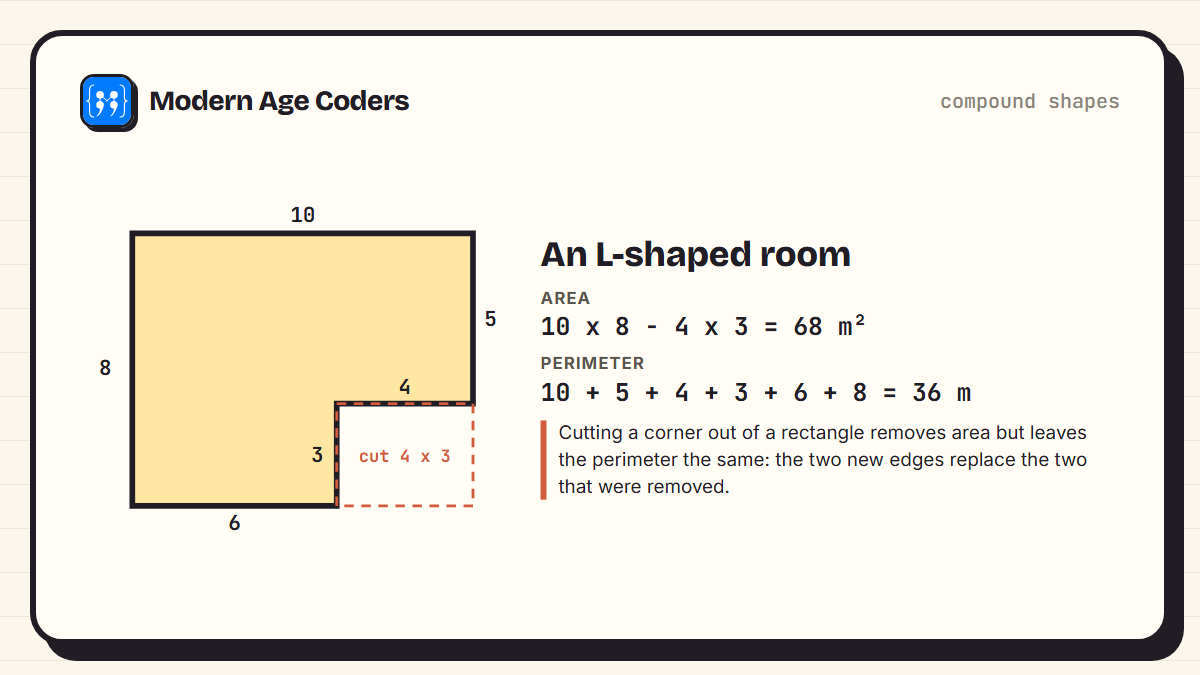
Exam questions love L-shaped rooms, because they test whether you understand both ideas rather than just the formulas. For the area, split the shape into rectangles, or take the area of the full rectangle and subtract the missing corner. For the perimeter, walk all the way round the outside and add every edge, working out any missing lengths from the ones you know.
# an L-shaped room: a 10 x 8 rectangle with a 4 x 3 corner cut away
big_area = 10 * 8
cut_area = 4 * 3
print("area:", big_area - cut_area, "square metres")

# walk round the outside: the cut corner does not change the perimeter
sides = [10, 5, 4, 3, 6, 8]          # going clockwise from the top-left corner
print("sides:", sides, "-> perimeter:", sum(sides), "metres")
print("same as the full rectangle:", 2 * (10 + 8))area: 68 square metres
sides: [10, 5, 4, 3, 6, 8] -> perimeter: 36 metres
same as the full rectangle: 36The last line is a lovely surprise. Cutting a rectangular corner out of a rectangle reduces the area, but the perimeter stays exactly the same, because the two new inside edges are the same total length as the two outside edges they replaced. Many students add or subtract edges here and get it wrong, so it is worth showing on squared paper.
Circles: circumference and area
For a circle, the perimeter has a special name, the circumference. Both formulas use π (pi), which is about 3.14159: the number of times a circle's diameter fits around its circumference.
from math import pi

r = 5
print(f"circle of radius {r}: circumference = 2 x pi x r = {2 * pi * r:.2f}")
print(f" area = pi x r^2 = {pi * r ** 2:.2f}")circle of radius 5: circumference = 2 x pi x r = 31.42
area = pi x r^2 = 78.54A common mistake is mixing the two formulas up. One way to remember: area is measured in square units, so its formula has a square in it, r². Circumference is a length, so it does not.
The most common mistakes
- Using the wrong one. Always ask "fence or carpet?" before calculating.
- Adding only two sides for perimeter. A rectangle has four sides: length + width is only half the perimeter.
- Forgetting square units. 24 cm is a perimeter. 24 cm² is an area. They are not interchangeable.
- Mixing units. A garden measured as 3 m by 50 cm must be converted first: 3 m x 0.5 m = 1.5 m².
- Assuming a bigger perimeter means a bigger area. The rectangles above show it does not.
If geometry homework is where things go wrong, our guides to Pythagoras' theorem and helping with maths homework without solving it may help too.
Ask: could I walk along it, or could I paint it? That one question fixes most area and perimeter mistakes.
How we teach it
In our live online maths classes, students are encouraged to work out a formula before they are handed it, which is the heart of the approach on our how we teach page. Area and perimeter lead on to circles, volume and surface area, which build directly on the same two ideas. Classes are one to one or in small groups of 5 to 10.
Frequently asked questions
Perimeter is the total distance around the outside of a shape, like the length of a fence. Area is the amount of surface inside the shape, like the amount of grass or carpet. Perimeter is measured in units of length, and area in square units.
Add all four sides, or use perimeter = 2 x (length + width). A rectangle 6 cm long and 4 cm wide has a perimeter of 2 x (6 + 4) = 20 cm.
Multiply the length by the width. A rectangle 6 cm by 4 cm has an area of 24 cm², which is the number of 1 cm squares that would cover it.
Yes. Rectangles with a perimeter of 24 can have areas from 11 (1 by 11) to 36 (6 by 6). For a fixed perimeter, the closer a rectangle is to a square, the larger its area.
Because area counts how many unit squares fit inside a shape. Each unit square is, for example, 1 cm by 1 cm, which is 1 square centimetre, written 1 cm².
Split it into two rectangles and add their areas, or find the area of the full rectangle around it and subtract the missing corner. For the perimeter, add the length of every outside edge.
The circumference. It equals 2 x π x radius, or π x diameter. The area of a circle is π x radius squared.