PRE / FUN / 01
AP Precalculus
Function families at an exam standard.
Open the syllabusBritish Columbia · Grade 11 · Pre-calculus 11
Grade 11 is when algebra in BC gets serious. Pre-calculus 11 takes the exponent and factoring skills of Grade 10 and pushes them into radicals, rational expressions, quadratic functions, inequalities and non-right triangles, all in one year. Each topic leans on the one before, so a gap in October shows up again in March. This guide walks through the course as BC’s curriculum lists it, works a quadratic in context and a radical equation with a trap in it, give twelve original questions with answers, and suggest a plan for the year. We teach alongside the school course; we do not grant provincial credits.
Teaching live online since 2020 · 10,000+ students · algebra taught so it stays learned
In short
Pre-calculus 11 is British Columbia’s Grade 11 pre-calculus course. Its curriculum covers rational exponents and radicals, polynomial factoring and rational expressions, quadratic functions and equations, linear and quadratic inequalities, and the sine and cosine laws. Modern Age Coders teaches Pre-calculus 11 to BC students live online, in a group batch or one to one, using our High School Mathematics course.
Learn it with a teacher
The first is the Grade 12 course this year leads into; the other two are the courses we use for Pre-calculus 11 itself and for the algebra under it.
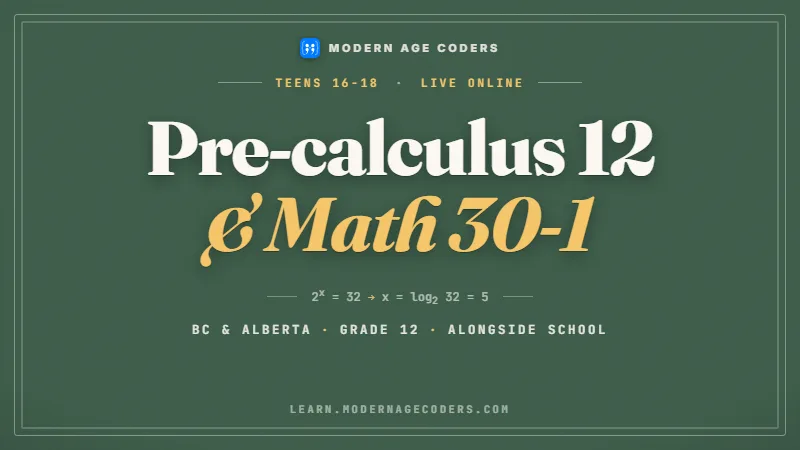
PRE / 01
Ages 16 to 18. Pre-calculus 12 alongside school, for the year after this one. We grant no credit.
Open the syllabus →
PRE / 02
Grades 9 to 12. The course we pace to a Pre-calculus 11 outline: radicals, rationals, quadratics, trigonometry.
Open the syllabus →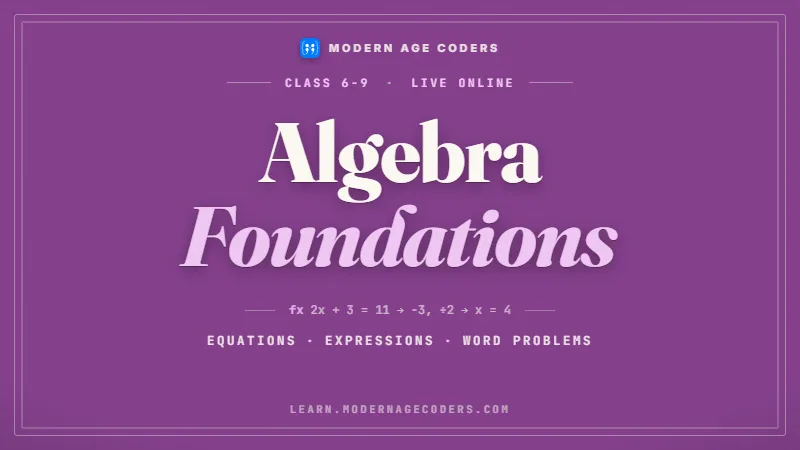
PRE / 03
For students whose Grade 10 factoring and exponents need rebuilding before Grade 11 moves on.
Open the syllabus →The BC curriculum
The BC curriculum page lists Pre-calculus 11 content under seven headings. The table quotes the parts students meet in tests and adds what we see students do with each.
| Topic | What the curriculum lists | In practice (our reading) |
|---|---|---|
| Real number system | Real number classification | Sort numbers into natural, integer, rational and irrational |
| Powers | “positive and negative rational exponents”; exponent laws; order of operations; numerical and variable bases | Read 27−2/3 as a root, a power and a reciprocal |
| Radicals | Simplifying radicals; “ordering a set of irrational numbers”; operations; “solving simple (one radical only) equations algebraically and graphically”; “identifying domain restrictions and extraneous roots of radical equations” | Isolate, square, then check every answer in the original |
| Polynomial factoring | Greatest common factor; trinomials of the form ax2 + bx + c; difference of squares | Factor before anything else in a rational or quadratic problem |
| Rational expressions and equations | Simplifying and operating; “identifying non-permissible values”; solving and identifying extraneous roots | Write the excluded values first, then simplify |
| Quadratic functions and equations | Graph characteristics, multiple forms, function notation; “solving equations (e.g., factoring, quadratic formula, completing the square, graphing, square root method)”; problems in context | Pick the form that answers the question: vertex form for maximums, factored form for zeros |
| Linear and quadratic inequalities | “sign analysis: identifying intervals where a function is positive, negative, or zero”; “symbolic notation for inequality statements, including interval notation” | Find the zeros, test each interval, write the answer in interval notation |
| Trigonometry | “use of sine and cosine laws to solve non-right triangles, including ambiguous cases”; “angles in standard position: degrees”; “special angles, as connected with the 30-60-90 and 45-45-90 triangles”; the unit circle | Solve any triangle, and know when there are two |
The first big idea says algebra allows us to generalize “relationships through abstract thinking.” The second says that, as with numbers, “operations extend to powers, radicals, and polynomials.” The third says quadratic relationships “are prevalent in the world around us.”
A fourth statement frames the trigonometry: “Trigonometry involves using proportional reasoning” to solve indirect measurement problems. The elaboration gives a lovely example: “calculating the width of a river using the distance between two points on one shore and an angle to a point on the other shore”. That is a sine law problem, and a very BC one.
The sample inquiry questions point straight at test traps. “What is the connection between domain and extraneous roots?” is the radical-equation lesson in one sentence. “How do we tell if a mathematical solution is reasonable?” is the habit that catches them.
Two more make good revision prompts: “How is the cosine law related to the Pythagorean theorem?” and “When would we choose to represent a number with a radical rather than a rational exponent?” A student who can answer both in their own words understands the trigonometry and powers units.
Source: BC Pre-calculus 11 curriculum; we read its big ideas, content and competencies from a raw copy saved on 23 October 2026. We are an independent tutoring service, with no tie to the province’s education ministry or to any district.
Grade 10 to Grade 12
Pre-calculus 11 is the middle of a three-year line. Seeing what comes before and after explains why some Grade 11 topics feel familiar and others feel brand new.
| Course | A content item from its page | How it connects (ours) |
|---|---|---|
| Foundations of Mathematics and Pre-calculus 10 | “types of equations of lines (point-slope, slope intercept, and general)”; systems solved “by inspection, substitution, elimination” | Linear relationships, the base that quadratics then curve away from |
| Pre-calculus 11 | “solving equations (e.g., factoring, quadratic formula, completing the square, graphing, square root method)” | Quadratics in five ways; the first real choice of method |
| Pre-calculus 11 | “angles in standard position: degrees” | The unit circle begins, in degrees only |
| Pre-calculus 12 | “examining angles in standard position in both radians and degrees” | The same circle again, now in radians too |
Pre-calculus 11 assumes a student can factor a trinomial, apply exponent laws with integer exponents, and work with lines and their equations fluently. When those are shaky, Grade 11 feels like learning two courses at once.
Our first lesson with a new Grade 11 student includes a short Grade 10 check: three factoring questions, three exponent questions, one line through two points. Whatever wobbles goes on the plan for the first month.
Almost everything in Pre-calculus 11 returns in Pre-calculus 12: factoring becomes the factor theorem, rational expressions become rational functions with asymptotes, and the degrees-only unit circle becomes the radian one. Our Grade 12 math comparison shows where Pre-calculus 12 sits among the provinces’ courses.
Students choosing between Pre-calculus 11 and Foundations of Mathematics 11 should know that many UBC programs list Pre-Calculus 12 for BC applicants, Science among them. The Grade 11 choice keeps that route open or makes it longer.
Worked problem 1, ours
This problem is ours. It touches four Pre-calculus 11 skills in one story: completing the square, reading a vertex, solving a quadratic inequality by sign analysis, and restricting a domain to what makes sense.
The problem. A ball is launched upward from a platform. After t seconds it is h(t) = −5t2 + 20t + 1 metres above the ground. (a) Find the greatest height and when it happens. (b) For how long is the ball at least 16 m up? (c) When does it land, and what domain makes sense for h?
| Interval | Test value | t − 1 | t − 3 | Product |
|---|---|---|---|---|
| t < 1 | 0 | negative | negative | positive |
| 1 < t < 3 | 2 | positive | negative | negative |
| t > 3 | 4 | positive | positive | positive |
Step 3 divides an inequality by a negative number, and the inequality sign reverses. Forgetting that turns the right answer, [1, 3], into its opposite: t ≤ 1 or t ≥ 3, which says the ball is high up before launch and after landing. Reading the answer in context catches it immediately.
That is the inquiry question “How do we tell if a mathematical solution is reasonable?” in action: the algebra produced an answer, and the story decides whether to trust it.
The formula h(t) is defined for every real t, but the situation is not. The curriculum lists “domain and range restrictions from problems in situational contexts” for exactly this reason. A negative time or a negative height has no meaning here.
Students who write the restricted domain before solving tend to reject the negative landing time without a second thought, and the marks for interpretation follow.
Worked problem 2, ours
The curriculum asks students to solve one-radical equations “algebraically and graphically” and to identify extraneous roots. This problem of ours does both, and uses a few lines of Python as the graph.
The problem. Solve √(2x + 9) = x + 3. State the domain restriction, find every candidate, and decide which candidates are real solutions.
# sqrt(2x + 9) = x + 3: test both candidates, then scan the graph (ours)
import math

def left(x):
    return math.sqrt(2*x + 9)

def right(x):
    return x + 3

for x in [0, -4]:                      # the two candidates from squaring
    print(f"x = {x:>2}: left = {left(x):.1f}, right = {right(x):.1f}",
          "keep" if math.isclose(left(x), right(x)) else "reject")

# Scan the domain x >= -4.5 in steps of 0.5 for places where left - right changes sign
xs = [-4.5 + 0.5*i for i in range(20)]
for x1, x2 in zip(xs, xs[1:]):
    d1, d2 = left(x1) - right(x1), left(x2) - right(x2)
    if d1 == 0:
        print(f"graphs meet exactly at x = {x1}")
    elif d1 * d2 < 0:
print(f"graphs cross between x = {x1} and x = {x2}")x = 0: left = 3.0, right = 3.0 keep x = -4: left = 1.0, right = -1.0 reject graphs meet exactly at x = 0.0
One meeting point, at x = 0. The graphs never meet near x = −4, which is what extraneous means.
This is the curriculum’s inquiry question about domain and extraneous roots, answered with one example. Squaring is not reversible: it erases signs. Any value that makes the right side negative can sneak through the squared equation, and the domain restriction on the right side names exactly those values.
Students who write both restrictions in step 1 can often reject an extraneous root before they compute it, and they still check, because checking is quicker than losing marks.
Algebra produced two candidates and the graph showed one crossing. When the two disagree, the graph is telling you something real about the original equation. Graphing technology is named in the curriculum’s competencies for exploring relationships, and a short program does the same job.
Our scan uses steps of 0.5, which would miss two crossings very close together. For a test, the algebraic check is the proof; the scan is the sanity check.
Practice, ours
Twelve questions of our own, not lifted from any classroom, district test or exam. They move through the year in order, powers first and triangles last. Try every one on paper before looking below.
Answers, ours
We confirmed every result by computer algebra (SymPy 1.14) or by running Python. Read the reasoning even when your number matches; it is what the marker looks for.
# The ambiguous case of the sine law: A = 35 degrees, a = 7, b = 11 (ours)
import math

A, a, b = 35, 7, 11
sin_B = b * math.sin(math.radians(A)) / a
print(f"sin B = {sin_B:.4f}")
if sin_B > 1:
    print("No triangle: side a is too short to reach")
else:
    B1 = math.degrees(math.asin(sin_B))      # the acute answer
    for B in (B1, 180 - B1):                 # and its supplement
        C = 180 - A - B
        if C <= 0:
            print(f"B = {B:.1f}: rejected, angles already exceed 180")
            continue
        c = a * math.sin(math.radians(C)) / math.sin(math.radians(A))
print(f"B = {B:.1f}, C = {C:.1f}, c = {c:.2f}")sin B = 0.9013 B = 64.3, C = 80.7, c = 12.04 B = 115.7, C = 29.3, c = 5.98
If sin B came out above 1, there would be no triangle at all; if the supplement left no room for C, there would be only one. The program tests both conditions, as you should by hand.
A plan for the year, ours
Because each topic depends on the last, Pre-calculus 11 rewards steady work more than end-of-year cramming. This plan is ours; fit it to the order of your teen’s course outline.
| Part of the year | Secure these | Warning sign |
|---|---|---|
| First month | Grade 10 check; powers and radicals | Rational exponents still feel like a trick |
| Second month | Factoring and rational expressions | Non-permissible values forgotten |
| Middle of the year | Quadratic functions and equations | Only one solving method used |
| Later in the year | Inequalities and sign analysis | Sign not flipped when dividing by a negative |
| Final stretch | Trigonometry and a full mixed review | The ambiguous case skipped |
Credit and the BC clock
Pre-calculus 11 credit is a school matter. Here is what we do, what we do not, and how class times work from BC.
We do not grant high school credits, award marks or write report cards. Pre-calculus 11 credit belongs to the school that teaches and evaluates it, which may be the teen’s own school, a summer course run by a district, or an online school.
Questions about which Grade 11 math a diploma needs belong with a school counsellor. We could not load the provincial graduation page during our research, so we do not state those rules.
We teach the course alongside school: explain the unit the class is on, build the skills it rests on, and practise until the student can do it alone. The student does the homework; we make sure they understand it.
Many families start in the first term of Grade 11, when radicals and rational expressions arrive. Others come in spring, before the trigonometry unit and the final.
| Region | Clock | Hours behind India | A 4:30 pm BC lesson on the teacher’s clock |
|---|---|---|---|
| BC outside East Kootenay and Golden | UTC-7, no changes | 12.5 | 5:00 am, next day |
| East Kootenay and Golden | UTC-6, no changes | 11.5 | 4:00 am, next day |
Since 8 March 2026 BC has kept one clock all year, so a lesson agreed for a BC afternoon stays at that BC time through the winter. Other provinces still change; our Canada time zones page has them all.
Where your teen is now
Our placement stages for Pre-calculus 11 students.
| Stage | What it looks like |
|---|---|
| 1. Step-copier | Follows a worked example closely, loses the thread on a new question |
| 2. Factor-first | Factors before anything else and spots common factors quickly |
| 3. Method-chooser | Picks the quadratic method or triangle law that suits the question |
| 4. Answer-checker | Writes restrictions, solves, checks, and explains any rejected root |
Ask your teen why one answer to their last radical equation was rejected. If they can explain it, they are past stage 2.
Gaps in Grade 11 compound. A small fix in October saves a lot of stress in May.
Write the restrictions before you solve. It takes ten seconds and saves whole questions.
When a test question looks new, ask what it looks like that you have seen before.
The catalogue
Live lessons with one regular teacher, in a class group or one to one.
PRE / FUN / 01
Function families at an exam standard.
Open the syllabusPRE / FUN / 02
Data, chance and distributions.
Open the syllabusPRE / FUN / 03
For students applying to US universities.
Open the syllabusPRE / CON / 01
CEMC-style problem solving.
Open the syllabusPRE / CON / 02
Harder problems and real proofs.
Open the syllabusPRE / CON / 03
Logic and algorithms with code.
Open the syllabusPRE / COD / 01
Check your algebra with your own programs.
Open the syllabusPRE / COD / 02
A second language for BC senior coding.
Open the syllabusPRE / COD / 03
Fit quadratics to real measurements.
Open the syllabusHow classes run
Weekdays or weekends, flexible: choose your batch, or for a very personalised plan choose 1-on-1 at your convenience, weekend mornings or weekdays.
Weekdays
After BC school hours, at a batch time you choose.
Weekends
Saturday or Sunday, before lunch on the BC clock.
1-on-1
Fitted around unit tests in the Grade 11 year.
Continuity across a building-block year.
Checked in the first lesson.
Written before every solve.
Each quadratic solved twice.
One old unit revisited.
Fifteen to twenty students, or one.
Student work
A few projects from students who learn math and code with us; the complete set is on the student labs page.

AI and ML
An AI nutrition coach that reads what you eat and works you toward a target.

AI and ML
A chatbot that answers mathematics and programming questions, built and deployed by a student.

AI and ML
An assistant that helps a young person recognise unsafe situations online.

Web app
A weather forecasting site with live conditions for any location.
Fees
You pay nothing for the first class. Regular lessons cost a monthly fee for eight live classes, displayed in your local currency, and you can leave when any month ends without a term commitment.
Group batch
$140 CAD
a month, eight live classes
One to one
$210 CAD
a month, eight live classes
What families say
Families and students reviewing us on Google, in their own words.
★★★★★
"The one step solution for my son. Modern Age Coders make learning coding so simple that kids love it. The teachers explain complex concepts clearly with practical exercises and interactive content."
Ria Mukherjee
Parent
★★★★★
"Modern Age Coders has been a game-changer for me. I struggled to grasp IT concepts and coding before joining, but their classes transformed everything. I can now confidently write complex programs with ease."
Samriddha Mondal
Student
★★★★★
"One of the most wonderful education centres out there. Education is not limited to school syllabus but focuses on skill development."
Vansh Agarwal
Student
★★★★★
"My child Dhairya is really enjoying the Modern Age Coders classes. This is his first online class and he eagerly looks forward to it. I can already see his improvement, and the teachers are very cooperative."
Sonam Oswal
Parent of Dhairya
★★★★★
"Modern Age Coders have wonderful teachers who teach in a clear, easy and practical way. The teacher boosts students' confidence and inspires them to learn without hesitation."
Sonu Goyal
Parent
★★★★★
"I highly recommend this computer coding class! The teachers are incredibly knowledgeable and passionate about coding."
Ritu Kedia
Parent
Questions from BC families
In BC's curriculum, Pre-calculus 11 includes the real number system, rational exponents, radicals and radical equations, polynomial factoring, rational expressions and equations, quadratic functions and equations, linear and quadratic inequalities with sign analysis and interval notation, and trigonometry with the sine and cosine laws, including ambiguous cases.
No, we do not grant provincial credits. Our lessons run beside the school course. To earn Pre-calculus 11, a student enrols with a school that teaches and marks it: their own secondary, a district summer course, or an online school.
They are different rather than simply harder or easier. Pre-calculus 11 is heavier on algebra: radicals, rational expressions and quadratics. Foundations of Mathematics 11 includes logical reasoning, optimization, statistics, scale models and financial topics. The right choice depends on the courses a student will need in Grade 12.
Universities usually name Grade 12 courses. For BC applicants, UBC listed Pre-Calculus 12 for Science and several other programs on 22 October 2026, and Pre-calculus 12 builds on Pre-calculus 11. So Pre-calculus 11 is usually the route to those programs. Check each program's page.
In our lessons, students most often struggle with rational expressions, because they need fluent factoring and careful non-permissible values, and with the ambiguous case of the sine law. Both improve quickly once factoring is secure and every triangle is sketched before solving.
It is a value that solves a transformed equation but not the original one. In Pre-calculus 11 it appears when squaring both sides of a radical equation or multiplying through a rational equation. Checking every candidate in the original equation finds it.
The BC Pre-calculus 11 curriculum lists angles in standard position in degrees. Radians appear in Pre-calculus 12, whose curriculum lists angles in standard position in both radians and degrees.
Fix Grade 10 gaps early, write domain restrictions before solving, check every root, solve each quadratic two ways, draw a sign chart for every inequality, sketch every triangle, keep a mistakes page, and review one old unit every week.
Weekdays or weekends, flexible: choose your batch, or for a very personalised plan choose 1-on-1 at your convenience, weekend mornings or weekdays. BC no longer changes its clocks, so a time agreed on Pacific time holds all year.
Your first class is free. After that the fee is monthly and covers eight live classes; there is no term contract, so you can stop when a month ends. The fees section shows today's group and private figures.
Elsewhere on this site
More for BC students in Grades 10 to 12.
Pre-calculus 12 beside other provinces.
Where the pre-calculus line ends up.
Coding in Grades 11 and 12, the BC way.
Grade 11 math for home-educated teens.
All our BC classes in one place.
Function skills for any curriculum.
Grades and courses across the country.
Our Canada pages, listed.
Inside a live lesson.
Start here
Let us know the current unit and the next quiz date. The first lesson begins with your teen’s own homework.
Want more detail first? The High School Mathematics syllabus sets out the topics, and how we teach describes a lesson.
WhatsApp us · +91 91233 66161 · connect@modernagecoders.com
Lessons happen live on video with teachers in India; nothing happens in person and there is no BC address. A WhatsApp message gets the quickest reply.
A priority demo is a full class of about 45 to 60 minutes. After the class the mentor sends a written skill report and a personal learning roadmap on WhatsApp. If you enrol, the demo fee is adjusted against your first month's fee. Share your demo Order ID with us on WhatsApp and we take it off.
Book a priority demo