Pick the course. Start this week.
Every mentor teaches from a structured programme, adapted live to your child. Open a course to see the full syllabus and enroll in minutes, or start with a Priority Demo and let the diagnostic pick the level for you.
 Best fit
High School Mathematics Mastery
Algebra through precalculus and calculus readiness, with exam craft for the courses that decide admissions.
$100/mo group · $150/mo 1-on-1
View course & enroll
College Mathematics Masterclass
Calculus, linear algebra and the mathematics behind engineering, computer science and data careers.
$100/mo group · $150/mo 1-on-1
View course & enroll
AP Calculus AB & BC Exam Prep
Three ideas taught like ideas, then trained against real FRQ rubrics. Score 5 goal.
$100/mo group · $150/mo 1-on-1
View course & enrollA good calculus tutor does three things: teaches the three ideas as ideas, the limit as approach, the derivative as instantaneous rate, the integral as accumulated change, before any rule tables; repairs the precalculus the course silently assumes, especially function composition and the unit circle; and meets your student's actual course, school calculus, honors, AP AB or BC, or college Calc 1. That is what we do: live one-hour classes in small groups (8 a month) or private 1-on-1, priced for your country and shown in your local currency, Priority Demo first. Preparing specifically for the AP exam? See our dedicated AP Calculus AB and BC page.
The techniques are easy. The ideas are the course.
Here is the strange truth about calculus: the computations are mostly easier than Algebra 2. The power rule is one line. What defeats students is that the course runs on three genuinely deep ideas, and most classrooms, racing a syllabus, teach the rules and hope the ideas arrive by osmosis. They rarely do.
A student who knows forty derivative rules but cannot say what a derivative is, the speedometer reading of any changing quantity, will differentiate flawlessly on Tuesday's drill and freeze on Thursday's related-rates problem, because related rates asks about the idea, not the rule. Every "hard" calculus topic, optimization, curve sketching, the Fundamental Theorem, is hard only when the underlying idea is missing.
The second saboteur is precalculus debt. Calculus differentiates functions, so weak composition makes the chain rule a lottery; shaky unit-circle trig makes half the problems unreadable; algebra slips bleed points everywhere. Most "calculus problems" on a graded exam die in the algebra, not the calculus.
Our approach: build the three ideas with pictures and stories until they are owned, repair the precalculus inline exactly where it fails, and only then drill technique to speed. Students taught this way describe calculus, honestly, as the most satisfying math course they have taken. That sentence is achievable, and it is the goal.
Nine signs a calculus student needs help now, not later.
Rules without a referent
Can differentiate x³ instantly but cannot say what the answer means about the curve. The whole course hangs on that meaning.
Limits are plug-and-pray
Substituting and hoping, with no sense of "approaching", makes every 0/0 case a crisis instead of a signal.
The chain rule misfires
Chain-rule errors are composition errors wearing calculus clothes, a precalculus debt being collected.
Related rates get skipped
The classic tell: technique intact, idea missing. These problems ask what the derivative is, not how to compute it.
The FTC is a mystery
Using the Fundamental Theorem daily without any sense of why area and slope are inverse operations means the course's punchline was missed.
Points die in the algebra
Right calculus, wrong simplification, lost marks. The fix is targeted algebra repair, not more calculus drill.
Trig questions are auto-skipped
Half of calculus problems wear trig. A unit-circle debt makes them unreadable regardless of calculus skill.
Notation panic
dy/dx, f prime, Leibniz versus Lagrange: if the notations feel like different subjects, the unifying idea underneath never landed.
The first exam was a shock
Homework fine, exam disastrous is the signature of pattern-matching without ideas, and it is fixable fast once named.
Three or more of these? A diagnostic hour finds whether the gaps live in calculus, precalculus or algebra. A Priority Demo doubles as that diagnostic: a full live class, with a written skill report afterwards.
Ideas, repair, then speed. In that order.
The derivative as a speedometer
Instantaneous rate built from average rates over shrinking intervals, felt in stories before f prime is ever written.
The integral as accumulation
Adding up infinitely many slivers, distance from speed, area from height, so the FTC arrives as a discovery, not a decree.
Limits as honest approach
What the function is heading toward, seen numerically and graphically before the algebraic techniques compress it.
Precalculus repaired inline
Composition, trig and algebra debts get fixed exactly where the course exposes them, without a shameful detour.
Course-matched pacing
School calc, honors, AP AB or BC, or college Calc 1: the mentor aligns with your student's syllabus and exam calendar.
Live, interactive, out loud
One full hour of predicting, sketching, computing and defending, with "what does that mean here?" as the reflex question.
The derivative, discovered before it is defined.
How fast is it falling at exactly t = 2?
The rules version: differentiate, get h′(t) = −10t, plug in 2, answer −20 m/s. Fast, correct, and the student has no idea what just happened.
How our mentor teaches it, once, before any rules: speed is distance over time, but "at exactly t = 2" gives zero time and zero distance. So sneak up on it: average speed from t = 2 to t = 2.1, then to 2.01, then to 2.001…
[2, 2.01]: avg speed = −20.05 m/s
[2, 2.001]: avg speed = −20.005 m/s
The answers are APPROACHING −20. That target is the derivative.
One table and the student has met the limit and the derivative as one connected idea: the instantaneous rate is what average rates approach. Every rule learned afterward is a shortcut to a number the student knows the meaning of, and related rates stop being a separate mystery, because they were never separate.
Every unit, and what mastery looks like in each.
| Unit | What mastery actually looks like |
|---|---|
| Limits and continuity | Reads limits from graphs, tables and algebra, resolves 0/0 forms with technique and understanding, and connects continuity to the intuitive "no lifting the pen". |
| The derivative: definition | Owns the shrinking-interval story, computes from the limit definition once or twice, and reads f′ as slope and as rate interchangeably. |
| Derivative rules | Power, product, quotient and chain rules fluent, with the chain rule understood as composition unwrapping, layer by layer. |
| Implicit differentiation and inverses | Differentiates relations and inverse functions, including the inverse trig family, knowing why the technique works. |
| Applications of derivatives | Related rates set up from pictures, optimization argued from candidates, curve sketching driven by f′ and f″ as behavior reporters. |
| The definite integral | Builds integrals as Riemann accumulation, estimates from tables and graphs, and reads ∫ as "add up the slivers". |
| The Fundamental Theorem | States and uses both parts, and can explain in one sentence why accumulation and rate are inverse operations. |
| Integration techniques | Substitution as the chain rule reversed; for BC and college students, parts and partial fractions on the same principle-first footing. |
| Applications of integrals | Areas between curves, volumes of revolution, and average value, each set up from the sliver picture rather than a formula sheet. |
| Differential equations, first taste | Separable equations and slope fields, with exponential growth and decay recognized as old friends from precalculus. |
AB, BC and college syllabi weight these differently; the mentor matches your student's actual course. For the AP exam itself, pacing, scoring, calculator strategy, see our dedicated AP Calculus page.
The chain rule, taught as the onion it is.
The formula version: "outside times derivative of inside", chanted, half-applied, producing cos(3x²) or 3x²sin(x³) or other casualties. Chain rule errors are the single biggest point-loss in first-year calculus.
How our mentor teaches it: the function is two machines in a row: x³ runs first, sin runs second. To undo the change through both, peel the onion from the outside, differentiating each layer and leaving the inner layers intact until their turn.
outer layer: sin(·) → cos(·), keep the inside: cos(x³)
inner layer: x³ → 3x²
f′(x) = cos(x³) · 3x²
Notice what this requires: seeing the composition. That is a precalculus skill, and students who missed it there fail the chain rule here, which is why we repair composition the moment the diagnostic exposes it. Fix the seeing and the rule becomes almost impossible to get wrong.
A journey with a map, not an endless subscription.
Weeks 1-2 · Diagnose and stabilize
The Priority Demo maps the three ideas and the precalculus underneath. If a test is imminent, we stabilize for it first, then rebuild.
Month 1 · Limits and the derivative idea
The approach story, the shrinking-interval discovery, and the rules attached to meaning, aligned with the class calendar.
Month 2 · Derivative fluency and applications
Chain rule from composition, implicit differentiation, then related rates and optimization taught as idea questions, which they are.
Month 3 · Integration and the FTC
Accumulation built from slivers, the Fundamental Theorem earned as a discovery, substitution as the chain rule reversed.
Ongoing · Exam runway
AP students shift to exam pacing with our AP track; college students align to midterms. Monthly billing throughout.
Who this genuinely fits, and who it does not.
A strong fit if…
• Your child is behind on the three ideas taught as ideas, precalculus repaired inline, and the exam calendar respected, not re-drilled.
• Your child is coasting at school and needs depth and challenge before boredom becomes a habit.
• Homework has become a nightly negotiation and you want a calm expert to take over the teaching.
• You want one mentor who knows your teen, not a rotating cast or an app with streaks.
Honestly not the fit if…
• Your child cannot yet engage with a screen and a teacher for a full hour. By grade 4 nearly every child can, provided the hour is genuinely interactive, and ours are.
• You want homework done for the child. We teach the child to do it, which is slower on night one and far faster by week four.
• You are looking for a test-cram sprint. Calculus is three deep ideas; drilling technique before the ideas is how prepared students drown and we will say so.
The courses behind the tutoring.
Every mentor teaches from a structured curriculum, adapted live to your teen. If you prefer to see the full syllabus before you start, these are the programmes calculus students join.
Premium teaching. One honest price.
You are paying for a real teacher, live, for a full hour, twice a week, the same format US tutoring centers charge $300 to $450 a month for. Our cost base is global, so the price is not.
1:1 Private Mentorship
$150 / month
- 8 live one-hour classes a month, 2 per week4 live one-hour classes a month, 1 per week
- A dedicated mentor who knows your teen by name
- Diagnostic-led plan against the full calculus plan
- Class recordings for revision · cancel any time
Small-Group Class
$100 / month
- 8 live one-hour classes a month, 2 per week
- A handful of children at the same level
- Same teaching method, gentle peer energy
- Recordings included · cancel any time
That is $18.75 per dedicated hour of 1-on-1 teaching, or $12.50 in a small group. No registration fee, no contract, and you can see a full class first with a Priority Demo. Read our zero-risk promise or compare with what US math tutoring costs in 2026.
Mentors who teach the why, in classes kids wait for.
Our mentors are trained in one method: understanding before procedure, concrete before abstract, the child talking more than the teacher. They teach both maths and coding, which matters more than it sounds, because a mentor who can turn "4 groups of 6" into a game your teen wants to build has engagement tools a worksheet never will.
And because the same mentor stays with your teen month after month, teaching compounds. They know that your daughter rushes when unsure, that your son shuts down after two wrong answers, and exactly which idea to revisit before it becomes a gap.
"My child Dhairya is really enjoying the classes. This is his first online class, and he eagerly looks forward to it. I can see his improvement."
Sonam Oswal, mother of Dhairya · verified Google review
"My son struggled with math for years. Integrating it into coding projects has transformed his understanding and confidence. Highly recommended!"
Shewta Singh, mother of Ishan · verified Google review
Your real options for a calculus student.
| Option | Typical cost | What it really is | Best for |
|---|---|---|---|
| Modern Age Coders | $100–$150 / month | Live one-hour classes with a dedicated mentor, concrete-first teaching | Rebuilding understanding and confidence, sustained progress |
| Mathnasium center | $300-$450 / month + enrollment fee | Drop-in worksheet floor with rotating instructors | Children who focus better out of the house |
| Kumon | $150-$220 / subject / month | Daily worksheet packets, brief check-ins, no taught lessons | Building a drill habit and calculation speed |
| Local private tutor | $35-$80 / hour | Quality varies; twice-weekly quickly costs $280-$640 a month | Short-term help when you have found a gem nearby |
| Math apps | $10-$20 / month | Gamified practice, no teacher, no accountability | Casual practice between real lessons |
Competitor figures are typical published US prices as of July 2026 (tutors.com, brighterly.com). See our full comparisons: vs Mathnasium · vs Kumon · best online math tutoring 2026.
Everything families ask about calculus tutoring.
Is this for AP Calculus or regular calculus?
Both, and college Calc 1 too. The three ideas are the same in every version; what differs is pacing, depth and the exam. We align with your student's actual course, and students targeting the AP exam specifically get our dedicated AP Calculus AB and BC track for pacing, scoring and calculator strategy alongside the concept work.
My student did well in precalculus and is suddenly failing. What happened?
Two usual suspects. Either precalculus was survived on memorization and calculus is auditing the account, especially composition and trig, or the course is testing ideas (related rates, meaning of the derivative) while the student only owns techniques. The diagnostic separates the two in one hour, and both are very fixable.
Most of my student's lost points are algebra slips. Can you help?
Yes, and this is more common than genuine calculus confusion. We track exactly where points die, and when it is algebra, simplification, fractions, exponents, we repair those specific habits inside calculus problems, where the repair actually sticks.
How long until the grade moves?
Exam-facing stabilization: two to four weeks, since we teach to your student's test calendar. Idea-level ownership, the kind that makes the final and the AP feel fair, takes a term. Monthly billing means you watch evidence and re-decide every four weeks.
Do you teach BC topics and college Calc 1?
Yes: series, parametrics and polar for BC; and the proof-adjacent rigor college courses add. The mentor matches the syllabus in front of your student.
What does it cost?
The fees for private 1-on-1 and small-group classes are shown in your own currency in the pricing section of this page. Billing is monthly, there is no contract and you can cancel any time.
Who teaches calculus?
Mentors who teach both mathematics and programming, and at this level the pairing is unfair advantage: derivatives become gradient descent, integrals become physics engines, and students who code meet calculus as the living tool it actually is. Meet the team on our team page.
My student wants to see calculus in code. Is that possible?
It is one of our favorite things to teach. Numerically approximating a derivative, watching Riemann sums converge in a loop, plotting slope fields: ten lines of Python each, and the ideas become permanent. Many calculus students here add the programming track for exactly this reason.
Can you rescue a student mid-semester before the final?
Usually, yes. Calculus finals reward the three ideas plus technique, and a focused six-to-eight week arc, ideas first, targeted technique second, past-paper pacing last, moves grades meaningfully. The honest exception: if the algebra base is deeply broken, we will tell you what is achievable by the final and what needs the summer.
Can we try a class before enrolling?
Yes. Book a Priority Demo: a full live class of about 45 to 60 minutes, today or tomorrow, with a mentor reserved for your child. After the class the mentor sends a written skill report and a personal learning roadmap on WhatsApp. If you enrol, the demo fee is adjusted against your first month's fee.
More math help from Modern Age Coders.
Watch one full hour of real teaching. Free.
Book the demo class. Your child gets a real lesson with a real mentor, you get a diagnostic against one full hour of real calculus teaching, free. If your teen does not leave the hour lighter about math, walk away with our thanks.
Real student projects
What our students actually build
Every one is a real, live project shipped by a Modern Age Coders student. Explore more in Student Labs.
 GamePalm Arcana: Summon the ElementsOpen your palms to the webcam and computer vision turns your gestures into real magic, the left palm throws a fireball, the right crackles with lightning. A wild blend of hand-tracking AI, creative coding and pure imagination, vibe-coded into a playable browser experience.by AarushOpen the live project ↗
 Web AppLumenFX: AR/VR Photo Effects StudioUpload a photo and transform it with cinematic filters, AR face effects and the wildest trending edits, the same looks blowing up on TikTok, Reels and Snap, with 240+ one-tap presets. Raayan vibe-coded the whole studio from an idea: prompted the concept, then built the effects engine and gallery UI by hand.by RaayanOpen the live project ↗
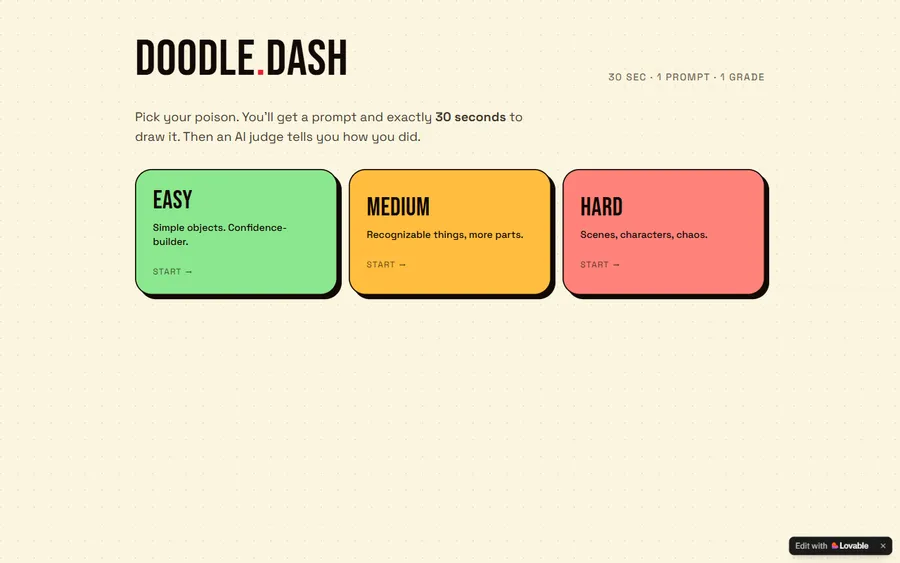 GameDoodle Dash: 30-Second Drawing ChallengePick a difficulty, get a prompt, and you have exactly 30 seconds to draw it, then an AI judge scores how close you got. Three modes from easy objects to chaotic scenes. Shubh vibe-coded it idea-first, wiring real AI image grading into a fast, addictive drawing game.by ShubhOpen the live project ↗