A-Level Maths: Pure, Mechanics and Statistics
Two years of the hardest school maths there is, taught in order, at a pace that holds, with past papers at the end instead of panic.
Syllabus updated August 2026
Questions? WhatsApp +91 91233 66161 or email connect@modernagecoders.com
Recordings are free with a Google sign-in. These recordings show how we teach, not the exact syllabus of this course.
Our promise
The world's best learning experience, open to everyone.
- World-class instructorsEvery class is taught by an instructor who specialises in that exact field.
- No compromise on qualityEvery lesson, project and piece of feedback is held to the highest standard.
- Education for everyoneLearners aged 6 to 67, from first-time beginners to working professionals, in 25+ countries.
If you want the highest quality, Modern Age Coders is the right choice.
Book a Priority DemoHow long this course takes
This course runs 18 months (72 weeks), joinable any month at 2 live classes/week + 3-4 hours practice, rising to full timed papers in the final phase. The range allows for background and pace: a complete beginner uses the full span, and a student with prior knowledge finishes sooner. The syllabus below is planned to the shorter end, with margin kept for revision.
For personalised duration planning, call +91 91233 66161 and we'll map a schedule to your goals.
At a glance
- Who it is for
- A-Level students (Years 12-13 or equivalent), Edexcel, AQA and OCR.
- Prerequisites
- A strong GCSE or IGCSE Maths pass, ideally grade 6 or above. The week 1 diagnostic finds any gaps and we patch them inside the course
- Format
- Live, interactive classes with a real instructor, never pre-recorded videos. Live classes run about one hour.
- Language
- English or Hindi, depending on the batch.
- Duration
- 18 months (72 weeks), joinable any month
- Weekly commitment
- 2 live classes/week + 3-4 hours practice, rising to full timed papers in the final phase
- Class size
- Group batches of 5 to 10 students, mini batches of 3 to 4, or 1-on-1.
- Certificate
- Course-completion certificate from Modern Age Coders
- Watch first
- Free recordings of real classes for ages 13 and up, free with a Google sign-in. These recordings show how we teach, not the exact syllabus of this course.
- Live demo
- Optional. Enrol directly on this page, or book a Priority Demo: a full live class of about 45 to 60 minutes with a mentor reserved for you.
- Questions
- WhatsApp +91 91233 66161 or email connect@modernagecoders.com.
How we teach
Deep understanding. Real projects. Expert guidance.
Learn coding, AI and maths through careful explanations, practical demonstrations, and hands-on problem-solving. Our instructors guide you from the foundations to advanced ideas, helping you understand what happens, why it happens, and how to build it yourself.
You will explore concepts step by step, write and improve code, investigate mistakes, ask questions, and apply your knowledge to meaningful projects. Lessons are designed around active participation, thoughtful feedback, and growing independence.
Expert-led live teaching, with practical participation built into every lesson.
- Students explain their thinking.
- Instructors demonstrate, then guide practice.
- Learners code, solve, or build during lessons.
- Questions and misconceptions get attention.
- Assignments receive useful feedback.
- Progress is checked before advancing.
How to join A-Level Maths: Pure, Mechanics, Statistics (Edexcel/AQA)
Four steps from this page to the first class. See a full class first with a Priority Demo, or choose a plan and enrol today.
Rated 4.9 across 547 Google reviews. Monthly billing, cancel any time.
How enrolment works
See a full class first (optional)
Book a Priority Demo: a live class of about 45 to 60 minutes with a mentor reserved for you, today or tomorrow. After the class the mentor sends a written skill report and a personal learning roadmap on WhatsApp. If you enrol, the demo fee is adjusted against your first month's fee. Share your demo Order ID with us on WhatsApp and we take it off.
Book a Priority DemoDemo fee ₹499Choose a plan
Group batch (5 to 10 students), mini batch (3 to 4 students, India only) or 1-on-1 with your own mentor. Every plan is live online, and each class runs about one hour. The cards below show classes per week and the monthly fee in your currency.
Enrol and pay the first month
Press Enrol Now on your plan, fill in the student's name, email and phone, and pay through secure Razorpay checkout: UPI, cards or net banking in India, and debit or credit card from any other country.
Fix your class timings
After payment, message us on WhatsApp or call +91 91233 66161 with the student's name, the course and your preferred time slot. We confirm the batch, send the class link and schedule the first class at your chosen time.
Billing is monthly and you can cancel any time.
International Students (Outside India)
Billed monthly in US dollars, the same price in every country. Contact us with any questions.
Questions before you enrol? Talk to our team.
Ask about class timings, the right level for your child, what they need to know already, or payment. Parents and adult learners can reach us on WhatsApp, by email or by phone.
Program Overview
A-Level Maths is a linear qualification: every exam comes at the end, and the content is set nationally by the Department for Education, so Edexcel, AQA and OCR students all study the same mathematics. What differs is how each board arranges its three two-hour papers, and we adjust practice to your board when the paper phase arrives. This 18-month live course follows the natural AS then A2 structure. The first nine months cover AS content: the pure core of algebra, coordinate geometry, trigonometry, exponentials and logarithms, first calculus and vectors, followed by AS statistics with the board's large data set and AS mechanics with kinematics and Newton's laws. Months 10 to 16 cover the A2 material where most grades are won and lost: functions, sequences and series, the full trigonometric toolkit, parametric equations, advanced differentiation and integration, numerical methods, the normal distribution, moments, friction and projectiles. The final two months are given entirely to structured revision and past papers under real timing, marked against official schemes.
Classes are live and small, so the teacher sees your working, not just your answers. Method marks decide grades at A-Level, and we treat how a solution is written as seriously as whether it is right.
What Makes This Program Different
- Built around the real qualification: linear assessment, three two-hour papers, roughly two thirds pure and one third applied, with your board's paper structure driving the practice phase
- AS content is finished and consolidated with an AS-standard mock before A2 begins, so the second year is built on checked ground rather than assumed ground
- The large data set is taught from the first statistics week, because boards write exam questions that assume familiarity with it, and students who meet it in the exam hall lose easy marks
- Calculator technique is taught explicitly: statistical distributions, iteration and equation solving on the calculator are part of the syllabus, not an afterthought
- Two full months of past papers under real 2-hour timing, marked against official mark schemes, with an error clinic after every paper
- Method-mark discipline throughout: solutions are written the way examiners award marks, with working shown at every step
Your Learning Journey
Career Progression
Detailed Course Curriculum
Explore the complete week-by-week breakdown of what you'll learn in this comprehensive program.
Topics Covered
- Diagnostic paper on GCSE essentials: algebra, trigonometry, graphs
- Laws of indices including negative and fractional powers
- Surds: simplifying, expanding and rationalising denominators
- Quadratic graphs, completing the square and the turning point
- Solving quadratics by factorising, formula and completing the square
- The discriminant and what it says about roots
Projects You Build
- Question bank entry: 15 solved exam-style questions on indices, surds and quadratics, written to full method standard
Practice & Assignments
30 mixed problems across indices, surds and quadratics, with every quadratic solved by the method the question rewards
Topics Covered
- Simultaneous equations: linear pairs and linear with quadratic
- Where a line meets a curve, algebraically and in a sketch
- Linear and quadratic inequalities with set notation
- Representing inequality regions graphically
- Proof by deduction and by exhaustion
- Disproof by counter example, with the write-up done properly
Projects You Build
- Proof portfolio opened: four short proofs written out to exam standard, checked line by line
Practice & Assignments
20 simultaneous and inequality problems plus 6 proof questions, working shown in full every time
Assessment
Month 1 test: a 40-minute paper on all algebra so far, marked with method marks the way an examiner would
Topics Covered
- Algebraic division and the factor theorem
- Factorising and sketching cubics and quartics
- Reciprocal graphs and their asymptotes
- Graph transformations: translations and stretches, alone and read from equations
- Points of intersection between curves
- Interpreting sketches: what a question actually wants from a graph
Projects You Build
- Sketching sheet: 10 polynomial and reciprocal curves sketched with intercepts, turning behaviour and asymptotes labelled
Practice & Assignments
25 problems on the factor theorem, division and transformations, each sketch drawn before any algebra is checked
Topics Covered
- Gradient, midpoint and distance between points
- Equations of straight lines in all three forms
- Parallel and perpendicular lines, with proofs of perpendicularity
- The equation of a circle, centre and radius by completing the square
- Tangents, chords and the perpendicular from the centre
- Modelling with straight lines: interpreting gradient and intercept in context
Projects You Build
- Question bank entry: 12 solved coordinate geometry questions, including one full circle-tangent problem
Practice & Assignments
22 line and circle problems with a labelled sketch for each, plus 2 modelling questions answered in context
Assessment
Month 2 test: a 40-minute paper on polynomials and coordinate geometry with one unstructured multi-step question
Topics Covered
- Factorial notation and nCr, on paper and on the calculator
- Pascal's triangle and where the coefficients come from
- Expanding (a + bx)^n for positive integer n
- Finding a specific coefficient without expanding everything
- Using expansions for numerical approximations
- The sign and power slips that cost marks, and how to catch them
Projects You Build
- Question bank entry: 10 solved binomial questions, including two find-the-coefficient problems worked two ways
Practice & Assignments
20 binomial problems, each coefficient answer checked by an independent second method
Topics Covered
- Sine and cosine rules and the area of a triangle
- Graphs of sin, cos and tan, and exact values worth memorising
- The identities tan x = sin x / cos x and sin squared plus cos squared equals 1
- Solving trig equations in degrees over a given interval
- Quadratics in sin, cos or tan
- Finding all solutions: the CAST diagram and graph methods compared
Projects You Build
- Solution-count drill: 12 trig equations where the number of solutions in the interval is predicted before solving
Practice & Assignments
28 trig problems from triangle work to multi-step equations, every lost solution traced back to its cause
Assessment
Month 3 test: a 45-minute paper on binomial expansion and trigonometry, marked for method as well as answers
Topics Covered
- The graphs of a^x and e^x, and why e matters
- Logarithms as the inverse of exponentials, and the log laws
- Solving equations of the form a^x = b
- Natural logarithms and equations with e
- Exponential modelling: growth, decay and interpreting the constants
- Reducing relationships to linear form with logs, and reading data plots
Projects You Build
- Modelling write-up: one exponential growth or decay problem solved and interpreted in three or four written sentences
Practice & Assignments
24 log and exponential problems including 4 modelling questions where the interpretation carries the marks
Topics Covered
- The gradient of a curve and differentiation from first principles
- Differentiating powers of x, sums and constants
- Tangents and normals to a curve at a point
- Increasing and decreasing functions
- Stationary points and their nature, using the second derivative
- Simple optimisation: setting up and solving maximum and minimum problems
Projects You Build
- First-principles proof: the derivative of x squared and x cubed derived and written out to exam standard
Practice & Assignments
26 differentiation problems ending with 4 optimisation questions set up from scratch
Assessment
Month 4 test: a 45-minute paper on logs, exponentials and differentiation with one modelling question
Topics Covered
- Integration as the reverse of differentiation
- Indefinite integrals of powers of x and the constant of integration
- Finding the constant from a point on the curve
- Definite integrals and what the answer means
- Areas under curves, including regions below the axis
- Areas between a curve and a straight line
Projects You Build
- Area problem set: 8 shaded-region questions where the region is sketched and decomposed before any integration
Practice & Assignments
24 integration problems, definite integrals checked for sign sense against the sketch every time
Topics Covered
- Vector notation, magnitude and direction
- Adding vectors and multiplying by scalars
- Position vectors and the vector between two points
- Distance between points using vectors
- Geometric problems: parallelograms, ratios and collinearity
- Where vectors reappear: a preview of their role in mechanics
Projects You Build
- Question bank entry: 10 solved vector problems including two geometric proofs
Practice & Assignments
20 vector problems with a diagram drawn for each, plus a mixed AS Pure warm-down set of 15 questions
Assessment
Phase 1 milestone: a 90-minute AS Pure paper covering all five months, marked against an official-style scheme
Topics Covered
- Populations, samples and why sampling method matters
- Simple random, systematic, stratified, quota and opportunity sampling
- The large data set: what your board pre-releases and how exams use it, with Edexcel's weather-station data as the worked example
- Histograms, frequency polygons and cumulative frequency diagrams
- Box plots and comparing distributions
- Outliers: the standard rules and when to clean data
Projects You Build
- Large data set field notes: a one-page profile of your board's data set in your own words, variables, units and quirks included
Practice & Assignments
18 data presentation problems plus a guided exploration session inside the large data set itself
Topics Covered
- Mean, median and mode from lists and grouped tables
- Quartiles, percentiles and interpolation
- Variance and standard deviation, by formula and by calculator
- Coding data and what it does to mean and spread
- Scatter diagrams, correlation and interpreting a regression line in context
- Writing statistical conclusions in sentences, not just numbers
Projects You Build
- Comparison write-up: two groups from the large data set compared on location and spread, in four marked sentences
Practice & Assignments
20 location and spread problems, calculator statistics mode drilled until it is faster than the formula
Assessment
Month 6 test: a 40-minute statistics paper with one large-data-set question in board style
Topics Covered
- Venn diagrams and tree diagrams done cleanly
- Mutually exclusive and independent events, and how to test for independence
- Discrete random variables and probability distributions
- The conditions for a binomial model, checked in words
- Calculating binomial probabilities on the calculator
- Cumulative binomial probabilities and careful inequality reading
Projects You Build
- Model-check drill: 8 scenarios judged binomial or not, with the failing condition named each time
Practice & Assignments
24 probability and binomial problems, inequality direction stated in words before the calculator is touched
Topics Covered
- Null and alternative hypotheses, written correctly
- One-tailed and two-tailed tests and significance levels
- Critical regions and actual significance level
- Carrying out a test and stating the conclusion in context
- The wording that earns the final mark, and the wording that loses it
- Common traps: wrong tail, wrong inequality, conclusions that overclaim
Projects You Build
- Question bank entry: 8 full hypothesis tests written to exam standard, conclusions in context every time
Practice & Assignments
14 complete hypothesis tests, each conclusion checked against a mark-scheme model sentence
Assessment
Month 7 test: a 45-minute paper from probability through hypothesis testing
Topics Covered
- SI units and the standard modelling assumptions: particle, light string, smooth surface
- Displacement, velocity and acceleration as vectors
- Displacement-time and velocity-time graphs, and what areas and gradients mean
- The suvat equations: where they come from and when they apply
- Vertical motion under gravity
- Choosing a positive direction and sticking to it
Projects You Build
- Graph story set: 6 motion graphs translated into written descriptions of the trip and back again
Practice & Assignments
22 kinematics problems, the suvat quantities listed and the equation chosen before any algebra
Topics Covered
- Why suvat fails when acceleration changes
- Velocity and acceleration by differentiation
- Displacement by integration, with limits or constants
- Maximum velocity and turning points of motion
- Sketching motion from its equations
- Mixed problems that decide between suvat and calculus
Projects You Build
- Decision drill: 10 motion problems sorted into suvat or calculus, with the deciding clue underlined
Practice & Assignments
18 variable acceleration problems plus a mixed set of 10 where the method is not announced
Assessment
Month 8 test: a 40-minute kinematics paper mixing graphs, suvat and calculus methods
Topics Covered
- Force diagrams drawn before anything else
- Newton's laws and F = ma along a line
- Weight, tension, thrust and normal reaction
- Connected particles: cars and trailers, lifts and scale pans
- Pulleys: the standard setups and their equations
- Forces written as vectors in i and j form
Projects You Build
- Question bank entry: 10 solved force problems, every one opened with a complete labelled diagram
Practice & Assignments
20 forces problems, the diagram marked before the algebra is even read
Topics Covered
- Structured revision across all AS pure and applied content
- Mixed problem sets that do not announce their topic
- A full AS-standard mock under real timing
- Marking workshop against an official-style scheme
- Error clinic: every miss classified as concept, method or accuracy
- The A2 map: what changes in year two and what carries over
Projects You Build
- Personal error log formalised: every mock miss classified and matched to a drill
Practice & Assignments
Redo every mock miss untimed with full working, then one targeted drill set on your weakest AS topic
Assessment
Phase 2 milestone: full AS-standard mock, marked and reviewed one to one
Topics Covered
- Proof by contradiction: the irrationality of root 2 and the infinitude of primes
- Simplifying algebraic fractions
- Algebraic division revisited with remainders
- Partial fractions with distinct linear factors
- Partial fractions with a repeated factor
- Where partial fractions pay off later: series and integration previewed
Projects You Build
- Proof portfolio extended: both classic contradiction proofs written from memory to exam standard
Practice & Assignments
18 partial fraction decompositions checked by recombining, plus 4 proof questions
Topics Covered
- Mappings, domain and range stated precisely
- Composite functions and order of application
- Inverse functions, their graphs and the line y = x
- The modulus function: graphs of |f(x)| and f(|x|)
- Solving modulus equations and inequalities
- Combined transformations applied in the right order
Projects You Build
- Question bank entry: 12 solved function questions including two full modulus problems with sketches
Practice & Assignments
24 function problems, domain and range written for every inverse found
Assessment
Month 10 test: a 45-minute paper on proof, partial fractions and functions
Topics Covered
- Arithmetic sequences and series, and the standard formulae
- Geometric sequences and series
- Sum to infinity and the convergence condition
- Sigma notation read and written fluently
- Recurrence relations: increasing, decreasing and periodic sequences
- Modelling with series: savings, loans and depreciation
Projects You Build
- Modelling write-up: one savings or loan problem solved with a series and explained in plain sentences
Practice & Assignments
26 series problems including 4 modelling questions and 4 sigma notation translations
Topics Covered
- Radian measure and exact values in radians
- Arc length and sector area
- Solving trig equations in radians
- Small angle approximations and where they come from
- Secant, cosecant and cotangent: graphs and identities
- Inverse trig functions and their restricted domains
Projects You Build
- Question bank entry: 10 solved radian and sector problems including one segment area question
Practice & Assignments
22 problems across radians, sectors and reciprocal trig, calculator mode checked before every set
Assessment
Month 11 test: a 45-minute paper on series and radian trigonometry
Topics Covered
- Compound angle formulae and where they come from
- Double angle formulae and their rearrangements
- Writing a sin x + b cos x in R form
- Using the R form for maxima, minima and equation solving
- Proving trig identities with a clear strategy
- Choosing the right identity: a decision routine for messy equations
Projects You Build
- Identity toolkit card: every identity on one page with a note on when each earns its keep
Practice & Assignments
24 identity and equation problems, each proof annotated with the identity used at every step
Topics Covered
- Curves defined parametrically and why anyone bothers
- Converting between parametric and Cartesian forms
- Trig parametrics and identity-based conversion
- Sketching parametric curves and finding intersections
- Points where a parametric curve crosses the axes
- Parametric modelling questions in exam style
Projects You Build
- Question bank entry: 10 solved parametric problems including two conversions each way
Practice & Assignments
18 parametric problems, every conversion checked by substituting a point
Assessment
Month 12 test: a 45-minute paper on advanced trigonometry and parametrics
Topics Covered
- The chain, product and quotient rules, and how to spot which one
- Derivatives of trig, exponential and log functions
- Implicit differentiation
- Parametric differentiation
- Rates of change and connected rates
- Tangents and normals on harder curves
Projects You Build
- Method map: one page routing any function to its differentiation method, tested against 20 unseen functions
Practice & Assignments
30 differentiation problems climbing from single-rule to mixed-rule questions
Topics Covered
- Standard integrals of trig and exponential functions
- Integration by substitution
- Integration by parts
- Integrating with partial fractions
- Areas between curves and the trapezium rule
- Differential equations with separable variables, solved and interpreted
Projects You Build
- Question bank entry: 12 solved integrals labelled by method, including one differential equation in context
Practice & Assignments
28 integration problems, the method named in the margin before each attempt
Assessment
Month 13 test: a 60-minute calculus paper across both differentiation and integration methods
Topics Covered
- Locating roots by change of sign, and when that argument fails
- Fixed point iteration and rearranging into iterative form
- Staircase and cobweb diagrams
- The Newton-Raphson method and its failure cases
- Iteration on the calculator, done quickly and accurately
- Numerical integration revisited and error direction from sketches
Projects You Build
- Root hunt: one equation solved three ways, change of sign, iteration and Newton-Raphson, with results compared
Practice & Assignments
16 numerical methods problems with calculator iteration technique drilled to fluency
Topics Covered
- Vectors in three dimensions: notation, magnitude and distance
- Geometric problems in 3D
- The binomial expansion for negative and fractional indices
- Validity intervals stated every time
- Expansions built through partial fractions
- Using expansions for approximations, with accuracy discussed
Projects You Build
- Question bank entry: 10 solved problems split between 3D vectors and general binomial expansions
Practice & Assignments
20 problems across 3D vectors and the general binomial, validity written before any expansion
Assessment
Phase 3 milestone: a 90-minute A2 Pure paper across all five months of this phase
Topics Covered
- Set notation for probability and the conditional probability formula
- Conditional probability from tables, trees and Venn diagrams
- The normal distribution: shape, parameters and what they control
- Calculating normal probabilities on the calculator
- The inverse normal: finding values from probabilities
- Standardising and finding unknown mean or standard deviation
Projects You Build
- Question bank entry: 10 solved normal distribution problems including two unknown-parameter questions
Practice & Assignments
22 probability and normal distribution problems, a sketch of the shaded region drawn for every normal question
Topics Covered
- When the normal approximates the binomial, and the continuity correction
- The distribution of the sample mean
- Hypothesis tests for the mean of a normal distribution
- Correlation coefficients and what they do and do not claim
- Hypothesis tests for zero correlation using tables of critical values
- Large data set questions in A2 style, revisited
Projects You Build
- Question bank entry: 8 full hypothesis tests for means and correlation, conclusions written in context
Practice & Assignments
14 complete tests plus one large-data-set question under a 15-minute clock
Assessment
Month 15 test: a 45-minute A2 statistics paper
Topics Covered
- Resolving forces at angles into components
- Equilibrium of a particle under coplanar forces
- Motion on an inclined plane
- Friction and the coefficient of friction
- Limiting equilibrium: on the point of moving
- Connected systems revisited with angles and friction
Projects You Build
- Question bank entry: 10 solved problems on inclined planes and friction, every diagram complete before the algebra
Practice & Assignments
20 resolving and friction problems, components table filled in before any equation is written
Topics Covered
- Moments and the conditions for equilibrium of a rigid body
- Rods on supports and tilting problems
- Projectile motion: splitting velocity into components
- Time of flight, range and greatest height
- The projectile modelling assumptions and their limits
- Motion in two dimensions with vectors and calculus
Projects You Build
- Question bank entry: 10 solved moments and projectile problems, including one full tilting question
Practice & Assignments
18 moments and projectile problems plus a mixed mechanics set of 10 with no topic labels
Assessment
Phase 4 milestone: a 60-minute A2 applied paper across statistics and mechanics
Topics Covered
- Rapid re-teach of the weakest pure topics, driven by each student's error log
- Mixed pure problem sets that do not announce their topic
- Formula booklet fluency: what is given, what must be known
- Proof rehearsal: contradiction and identity proofs rewritten from memory
- Algebra accuracy audit: the slips that cost each student marks, named and drilled
- Show-that questions: working backwards from a given answer honestly
Projects You Build
- Revision sheet set one: student-made single pages for every pure strand
Practice & Assignments
One mixed pure paper of 50 marks self-timed, plus a targeted drill on your two weakest strands
Topics Covered
- Statistics mixed sets: distributions, tests and interpretation together
- Mechanics mixed sets: forces, moments, projectiles and kinematics together
- Large data set refresh: the facts worth having cold
- Calculator technique final pass: distributions, iteration, equation solving
- Your board's paper structure: exactly which content sits in which paper for Edexcel, AQA and OCR
- Time budgeting: marks per minute across a 100-mark paper
Projects You Build
- Revision sheet set two: single pages for statistics and mechanics, completing the personal revision pack
Practice & Assignments
One applied sectional paper self-timed plus 20 calculator-technique drills
Assessment
Month 17 checkpoint: two sectional papers marked against official schemes, error logs updated
Topics Covered
- A full past paper from your board in one timed 2-hour sitting
- Marking against the official scheme, method marks understood
- Error clinic one: concept gaps separated from timing and accuracy losses
- A second full paper under timing
- Question selection: order of attack and when to park a question
- The unstructured problem: making progress when no method is named
Projects You Build
- Mock file opened: each paper filed with its marked script, error classification and one-line fix per miss
Practice & Assignments
One additional past paper at home under honest timing, brought marked to class
Topics Covered
- Two final full papers under strict conditions, spaced for recovery
- Error clinic two: closing the last recurring mistakes
- Presentation final pass: notation, working, exact answers where demanded
- The last week: what to revise, what to leave alone
- Exam-day routine for a three-paper series, walked through calmly
- Course close: the mock series reviewed with each student and family
Projects You Build
- Completed mock file: the full paper series with scores charted, kept by the student as evidence of readiness
Practice & Assignments
Light targeted drills only, set individually from each student's final error log
Assessment
Course milestone: final full past paper marked and reviewed one to one, plus certificate review
Projects You'll Build
Build a professional portfolio with A complete self-built revision system: question bank, proof portfolio, revision sheets, error log and marked mock file real-world projects.
Weekly Learning Structure
Certification & Recognition
Technologies & Skills You'll Master
Comprehensive coverage of the entire modern web development stack.
Support & Resources
Career Outcomes & Opportunities
Transform your career with industry-ready skills and job placement support.
Prerequisites
Who Is This Course For?
Career Paths After Completion
Course Guarantees
Real students. Real moments. Real joy.
These are our actual student meetups. No stock photos, no filters. Swipe through and meet the community you'll be joining.







































What families say
Straight from the parents and students who learn with us. Rated 4.9 across 547 Google reviews.
“Mivaan enjoys the class. He understands the concepts and completes his tasks with excitement. He started taking interest in coding… truly amazing class.”
“I absolutely love it here! I made new friends and learned important valuable coding skills while having the fun of my life. It's not just coding here, it's outings, bonding and most importantly preparing you for your future. Definitely five stars.”
“What stands out most is how excited my son is before every class. He looks forward to learning, problem-solving, and sharing what he's built. I've noticed a big boost in his confidence!”
“Modern Age Coders has been a game-changer for me! I struggled to grasp IT concepts and coding before joining, but their classes transformed everything. I'm now the topper in my class and can confidently write complex programs with ease.”
“Modern Age Coder have wonderful teachers who teach in a clear, easy and practical way. The teacher boosts students' confidence, keeps them updated with technology, and inspires them to learn without hesitation.”
“The one step solution for my son. Modern Age Coders make learning coding so simple that kids love it.”
“Coding classes here make learning very interesting and conceptual. The teachers teach us in a very easy-to-understand and efficient manner.”
“One of the most wonderful education centres out there. Education is not limited to school syllabus but focuses on skill development. Learning here has been a wonderful journey and still continuing.”
“I highly recommend this computer coding class! The teachers are incredibly knowledgeable and passionate about coding. They make every session engaging and insightful.”
“My child Dhairya is really enjoying the Modern Age Coder IT classes. This is his first online class, and he eagerly looks forward to it.”
“Very good classes. Don't worry about coding. They teach the best, especially Shivam sir.”
“Very good classes. Makes learning very easy and interactive.”
Hear it from our students
Real parents and students in their own words, on our public YouTube channel.
Straight answers about A-Level Maths: Pure, Mechanics, Statistics (Edexcel/AQA)
- Who should take this course?
- A-Level students (Years 12-13 or equivalent), Edexcel, AQA and OCR. It suits students beginning a-level maths who want the full two years taught in order, with revision built in rather than bolted on; students whose school sets the exams but whose classroom teaching is rushed, oversized or patchy; students taking a-levels outside the uk, at international schools or as private candidates, who need structured teaching across the time zones.
- What will they learn and build?
- A-Level Maths is a linear qualification: every exam comes at the end, and the content is set nationally by the Department for Education, so Edexcel, AQA and OCR students all study the same mathematics. What differs is how each board arranges its three two-hour papers, and we adjust practice to your board when the paper phase arrives. This 18-month live course follows the natural AS then A2 structure.
- How deeply are topics covered?
- The course runs 18 months (72 weeks), joinable any month at 2 live classes/week + 3-4 hours practice, rising to full timed papers in the final phase, across 5 phases listed week by week in the syllabus below. A structured, well-paced curriculum taught step by step, with hands-on practice in every session.
- Who teaches it?
- Modern Age Coders mentors, who teach the live classes themselves. You can watch them at work in the free class recordings before you decide.
- How do practice, feedback and assessment work?
- Weekly exam-style question banks, an AS-standard mock at month 9, and a full marked past-paper cycle: real knowledge, really tested. Doubt support between classes over WhatsApp, so you are never left stuck. A course-completion certificate backed by a marked mock file that shows the real grade trajectory.
- What does it cost?
- Three monthly plans: a group batch, a mini batch and 1-on-1. Prices are shown in your currency in the plans section. Monthly billing, cancel any time.
- When can classes take place?
- Live classes are scheduled around your week. Group batches meet at a fixed weekly slot; 1-on-1 students choose their own. International students are scheduled in their own timezone. Ask on WhatsApp for the current slots.
- Can I watch the teaching before deciding?
- Yes. Full recordings of real 13 and up classes are free to watch, free with a Google sign-in. These recordings show how we teach, not the exact syllabus of this course. Some classes are in English and some in Hindi; everyone follows at their own pace. Watch a class end to end, like you are in it. Sessions are interactive and each moment builds on the last.
- Can I enroll without a live demo?
- Yes. Choose a plan on this page and enrol directly; a demo is not required. If you would like to see a full class with a mentor first, book a Priority Demo.
- How do I reach you with a question?
- WhatsApp +91 91233 66161, email connect@modernagecoders.com, or call +91 91233 66161. Tell us the student's age and what they have learned so far, and we will point you to the right plan and batch.
Common Questions About A-Level Maths: Pure, Mechanics, Statistics (Edexcel/AQA)
Get answers to the most common questions about this comprehensive program
Still have questions? We're here to help!
Contact UsRelated Courses You May Like
Continue your learning journey with these recommended programs
 Exam Board Mathematics
GCSE Maths: Foundation & Higher (9-1), AQA, Edexcel, OCR
GCSE Maths course for AQA, Edexcel and OCR: Foundation and Higher tiers, non-calculator Paper 1 flue...
Explore Course Exam Board Mathematics
IB Maths AA & AI: SL & HL, Live Online with IA Coaching
Live online IB Maths course for AA and AI, SL and HL: syllabus-exact teaching, paper-specific techni...
Explore CourseRelated Articles & Guides
Deepen your knowledge with these hand-picked articles
 Mathematics
9 min read
Mathematics
9 min read
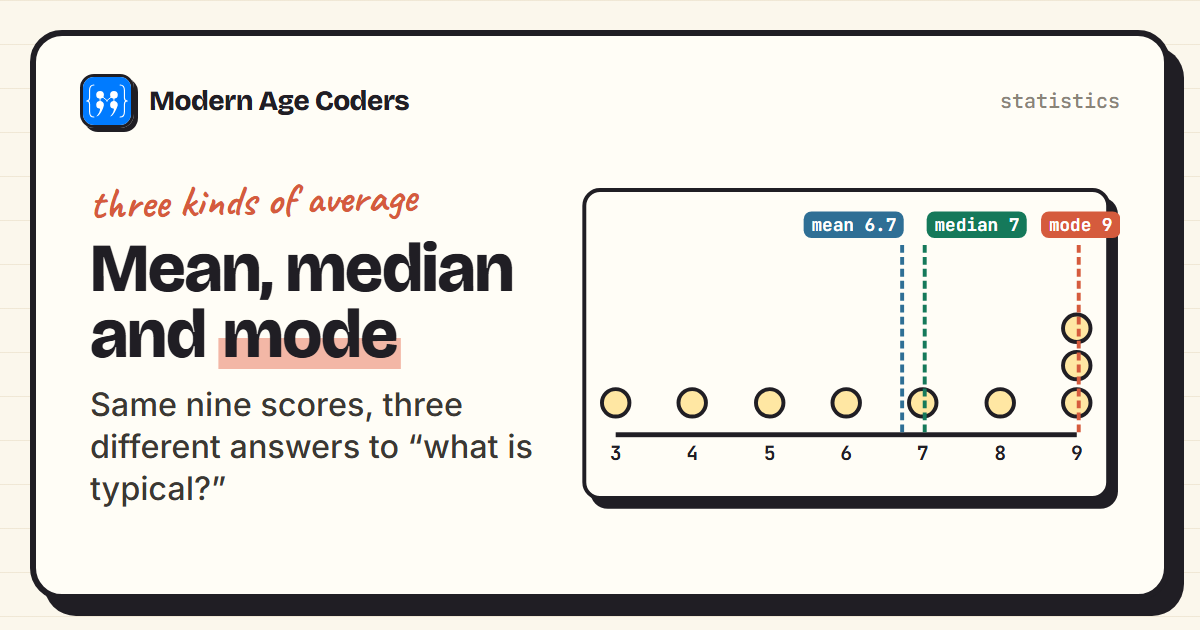
Mean, Median and Mode Explained, With Examples
Mean, median and mode explained with worked examples: how to find each, the median of an even set, m...
Read Article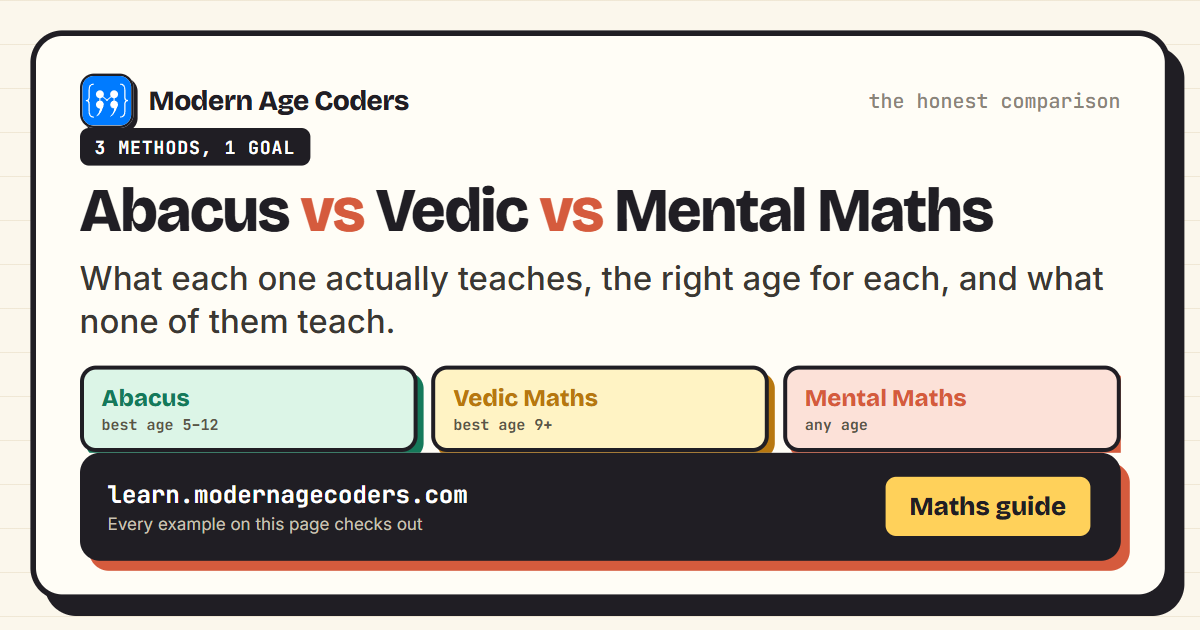 Mathematics
8 min read
Mathematics
8 min read
Abacus vs Vedic vs Mental Maths: A Clear Comparison
Abacus, Vedic maths, and mental maths compared: what each teaches, the right age, real worked exampl...
Read ArticleReady to start A-Level Maths: Pure, Mechanics, Statistics (Edexcel/AQA)?
Book a Priority Demo to see a full live class with a mentor reserved for you, today or tomorrow. Or choose a plan and enrol now.
Questions? WhatsApp +91 91233 66161 or email connect@modernagecoders.com