FCP / A / 01
Early maths foundations
Playful and concrete, for ages four to seven.
Open the syllabusUnited Kingdom · Ages 6 to 11 · Seven competitions compared
A parent who notices that their eight-year-old likes numbers, or will not get off the computer, eventually asks what there is to enter. The answer in Britain is more than most people think and harder to reach than it should be: there are at least seven things a primary-age child can take part in, several are free, one of them had more than half a million entrants last year, and almost all of them are entered by a school rather than by a family. This page compares them honestly, including who actually has to sign the child up, and names the two that a parent can enter on their own.
Every figure read at the organiser with the date · No fees in pounds · We enter nobody for anything
In short
Seven competitions are open to primary-age children in the UK. The Primary Maths Challenge is for pupils aged 9 to 11 and runs from 9 to 20 November 2026, 25 questions in 45 minutes. The UK Bebras Challenge is "open to all young people aged 6 to 19", is "entirely free to enter", takes 45 minutes and runs in the same fortnight; more than 526,000 UK students took it last year. The Primary Kangaroo is "a 20 question multiple choice paper aimed at students aged 9-11" on 18 March 2027. The Scottish Mathematical Challenge has a Primary division for P7 with three rounds a year. Astro Pi Mission Zero runs a child's Python program on the International Space Station in about an hour, free, by 22 March 2027. Coolest Projects shows every checked entry in a gallery, at any age. FIRST LEGO League Explore is "suitable for children age 6 to 10". Five of the seven are entered by a school; two are not. We teach the maths and the coding: the first class is free, a group place is USD 100 a month and one-to-one teaching USD 150.
Where to start
None of these is a competition course. All three build what the competitions happen to reward.
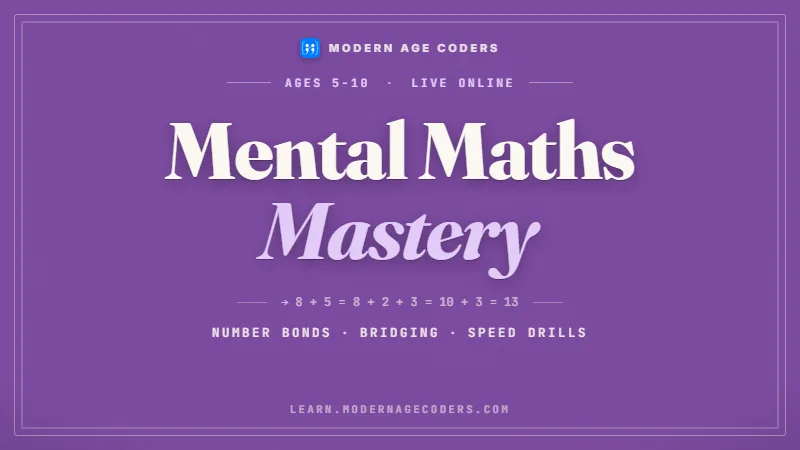
FCP / 01
Number sense rather than tricks, which is what makes a timed paper feel calm instead of rushed.
Open the syllabus →
FCP / 02
A first language and, more importantly, a first finished thing that somebody else can use.
Open the syllabus →
FCP / 03
The whole primary ladder, taught until the arithmetic stops costing thinking time.
Open the syllabus →The seven
Each row was read at the organiser's own site on 20 September 2026 while we were writing the page behind it.
| Competition | Ages | When and how long | Cost |
|---|---|---|---|
| UK Bebras Challenge | "All young people aged 6 to 19" | 9 to 20 November 2026, 45 minutes online | "Entirely free to enter" |
| Primary Maths Challenge | Aged 9 to 11, in primary school | 9 to 20 November 2026, 25 questions in 45 minutes | Schools buy packs of ten papers |
| Primary Kangaroo | "Students aged 9-11" | 18 March 2027, 20 multiple-choice questions | A follow-on round, entered through a school |
| Scottish Mathematical Challenge | Primary division, mainly P7 | Three rounds across the year | Entered through a teacher |
| Astro Pi Mission Zero | "Age 19 and under" | About an hour, by 22 March 2027 | Free |
| Coolest Projects | All ages | Entries open, shown in a gallery or at an event | A showcase, with no ranking |
| FIRST LEGO League Explore | "Children age 6 to 10" | A season of club sessions | Through a school or club, delivered by the IET |
Two things jump out of that table. The first is the November fortnight: the UK Bebras Challenge and the Primary Maths Challenge occupy exactly the same two weeks, 9 to 20 November 2026, and they ask for opposite things. One is arithmetic against a clock; the other has no arithmetic and no programming in it at all. A Year 6 child could reasonably sit both.
The second is the scale of Bebras. More than 526,000 UK students took it last year, which makes it the largest computing competition in British schools by a distance, and most parents have never heard of it because it arrives inside an ordinary lesson.
Not everything here is a competition in the ranking sense. Coolest Projects checks every entry and then shows it, with no elimination at all, and Astro Pi runs every valid program on the space station. For a child who finds competition unpleasant, those two are the ones to look at first.
Every page linked from this one carries the organiser's own words, the date we read them and a link to their site. We do not print entry fees, because they are published in pounds and every price on this site is in dollars.
Sources: the organisers of each competition, read on 20 September 2026 and cited in full on the individual pages linked throughout. Modern Age Coders is not connected with any of them.
The finding
This is the question parents actually ask, and almost nobody answers it in one place.
| Competition | Who registers the child | Can a parent do it alone? |
|---|---|---|
| Primary Maths Challenge | A school orders packs of ten papers and runs the paper | No |
| UK Bebras Challenge | "A teacher must sign up as the main school coordinator" | No |
| Primary Kangaroo | Through a school, as a follow-on to a challenge | No |
| Scottish Mathematical Challenge | Through a teacher, who downloads the problems and entry form | No |
| FIRST LEGO League Explore | A school or club team | No |
| Astro Pi Mission Zero | A mentor, who may be a "teacher, educator, parent or code club leader" | Yes |
| Coolest Projects | An adult registers a child under 13 | Yes |
A parent who wants to encourage a keen eight-year-old finds five closed doors and two open ones, and nothing online tells them which is which until they have filled in a form.
Astro Pi Mission Zero and Coolest Projects. Both are run or co-run by the Raspberry Pi Foundation, which is not a coincidence: it is a charity whose purpose includes reaching children outside school structures.
Ask the school, in September, in writing, and name the competition. Most primary teachers have never heard of the Primary Maths Challenge and will say yes if asked early.
We have not found a single UK page that sets this out, which is why it is on ours. It also changes the advice we give. If a family asks what their nine-year-old can do this term without involving the school, the honest answer is two specific things, and both take about an hour.
The home-educated position is slightly better than the table suggests in one case: UK Bebras contacts home-educated students directly about its follow-on coding round, so a family outside school is not wholly shut out there.
None of this is a criticism of the organisers. Running a paper in a hall is a school-shaped job, and entering thirty children is far easier than entering one. But it does mean the answer to "how do I enter my child" is usually "you cannot, but their teacher can".
And a teacher who says yes to one competition usually says yes to the next, so the first ask is the expensive one.
Each entry route in the table is taken from the organiser's own pages, read on 20 September 2026 and quoted in full on the page for that competition.
Choosing
There is no ladder here and no right order. There is a child who enjoys one kind of thing.
| If a child | Start with | Because |
|---|---|---|
| Likes number puzzles and is quick | Primary Maths Challenge | Twenty-five graded questions, and the last five have no options to choose from |
| Is thoughtful rather than fast | UK Bebras Challenge | Forty-five minutes, no arithmetic, and it rewards noticing a rule |
| Wants to make things | Coolest Projects | Every checked entry is shown, and there is no ranking to fall out of |
| Finds competition upsetting | Astro Pi Mission Zero | Nothing is judged: a valid program runs on the space station and gets a certificate |
| Likes building with others | FIRST LEGO League Explore | A team activity across a term, from age six |
| Is in Scotland | Scottish Mathematical Challenge | Three rounds spread across the year, and marks for explaining |
| Has already done the Challenge | Primary Kangaroo | The follow-on, on 18 March 2027 |
The honest advice for almost every family is to start with whichever one the school already does, and only go looking if the answer is none. A child sitting a paper alongside their friends in an ordinary lesson has a much better time than one entered specially.
And a low score is not information about a child. The Primary Maths Challenge is graded so that the last five questions are hard for everyone, and a nine-year-old who gets ten right has done well at something most adults would find awkward.
What a parent can usefully do at home is smaller than a competition and more valuable: twenty minutes a week of puzzles, out loud, with somebody listening to the reasoning rather than checking the answer.
The full year for every age, with each organiser named and each date checked, is on the competitions calendar.
Getting ready
Nothing here is preparation for a competition. It is what makes a competition enjoyable if one turns up.
| Stage | Rung | The sign it is secure |
|---|---|---|
| Years 1 to 2 | 1. Number sense | Sees that six and four make ten without counting |
| Years 3 to 4 | 2. Recall | Tables and halves arrive rather than being worked out |
| Year 5 | 3. Unfamiliar shapes | Reads a wordy question and can say what kind of maths it is |
| Year 6 | 4. Answers with no options | Produces and checks a number with nothing to choose from |
Do nothing special. These papers are designed to be sat without preparation, and a child told it matters does worse.
If you want to do something, do one past question together, slowly, with no clock.
Secondary school opens the olympiad ladder, which is set out on the junior olympiad.
A child who enjoys the puzzles usually enjoys writing them as programs, which is what maths through coding exists for.
The full list
Grouped by what a child is ready for, with the syllabus behind every card.
FCP / A / 01
Playful and concrete, for ages four to seven.
Open the syllabusFCP / A / 02
Every primary topic, taught to automatic.
Open the syllabusFCP / A / 03
Number sense rather than tricks.
Open the syllabusFCP / B / 01
Questions that hide what they are about.
Open the syllabusFCP / B / 02
From first beads to calculating with none.
Open the syllabusFCP / B / 03
Sixteen rules for calculating faster in the head.
Open the syllabusFCP / C / 01
A first language and a first finished thing.
Open the syllabusFCP / C / 02
Games, apps and a first look at AI.
Open the syllabusFCP / C / 03
Real code in a world a child knows.
Open the syllabusFCP / D / 01
The first typed language, taught patiently.
Open the syllabusFCP / D / 02
Programs that show why a method works.
Open the syllabusFCP / D / 03
Where a Year 6 goes when primary stops stretching them.
Open the syllabusHow lessons run
Teaching is live on video from India, five and a half hours ahead of the UK in winter and four and a half in summer. Primary children take an early evening slot, agreed in UK time.
Early weekday evening
While a child is still fresh enough to think.
Saturday or Sunday morning
For households where weekday evenings are gone.
School holidays
Little and often, rather than one long session.
A child says why before saying what, which is the habit every one of these competitions rewards.
Written by us. We do not reproduce any competition's questions in a lesson.
Enough to hear a better method than your own, few enough that nobody stays silent.
A short honest note after each block, not a score to put on the fridge.
For a child far ahead of their year, or one who freezes in a group.
Every competition here is entered by a school or a parent. We teach, and that is all.
Student work
Four published projects by students at our school, most of them older than this and all of them once eight. The student labs page has more.
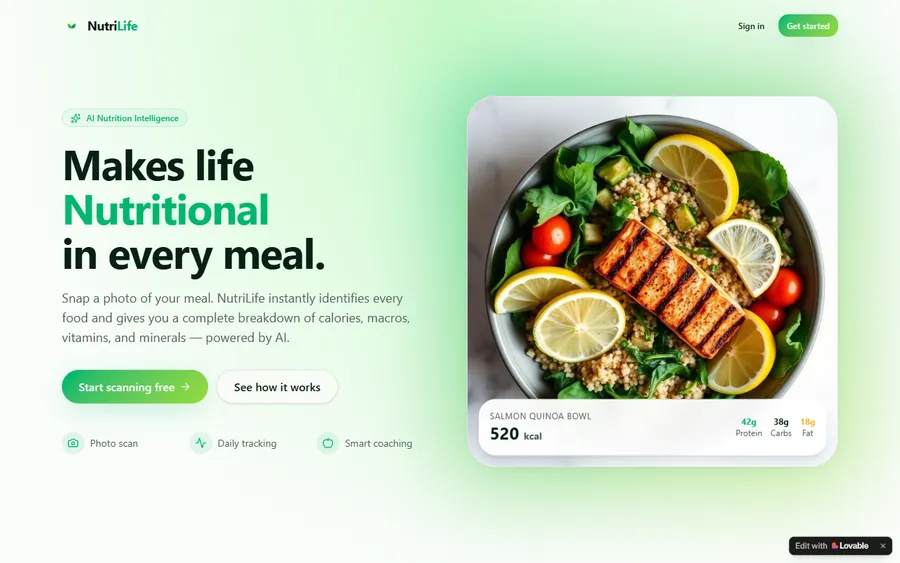
AI and ML
An AI nutrition coach that reads what you eat and works you toward a target.
AI and ML
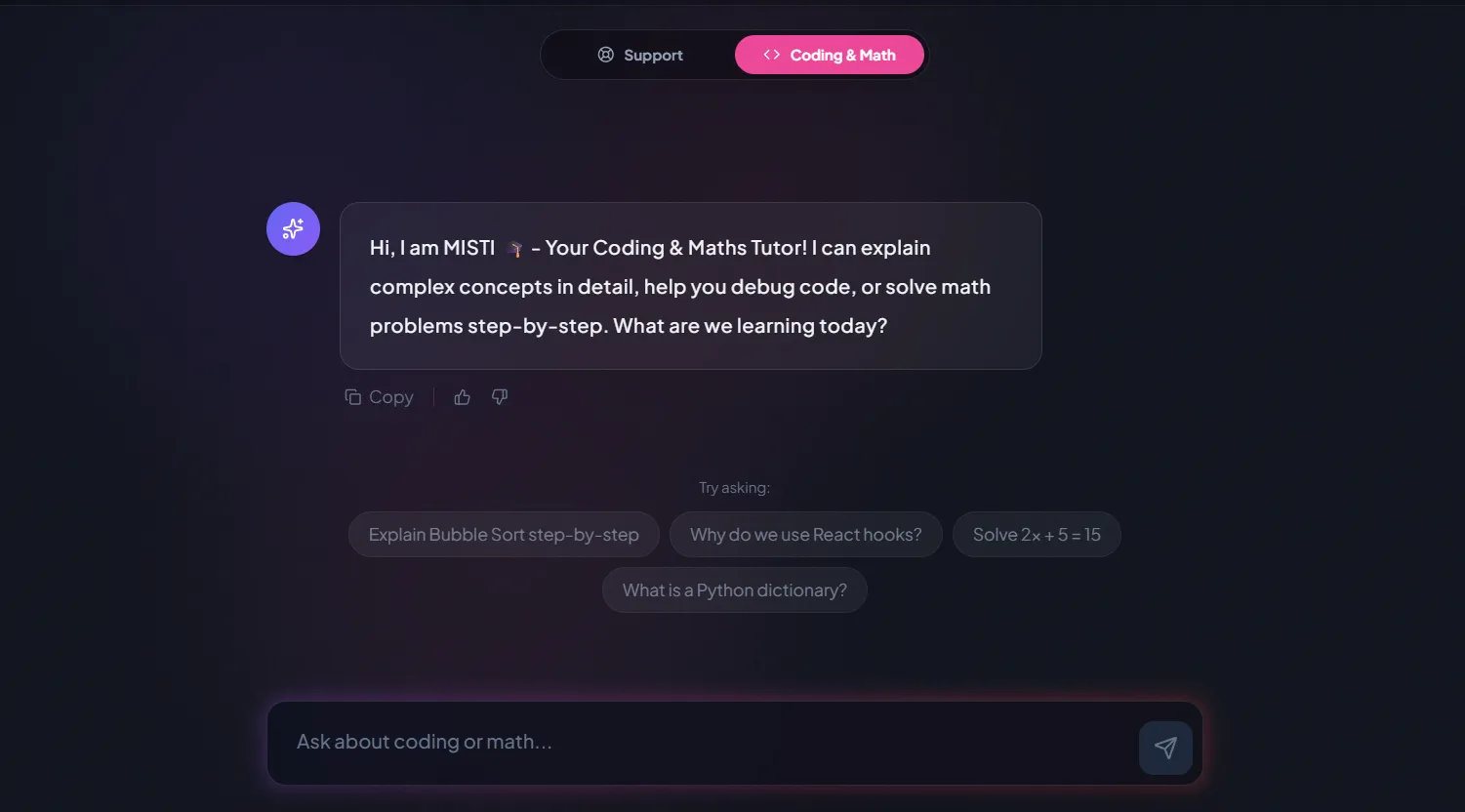
A chatbot that answers mathematics and programming questions, built and deployed by a student.
AI and ML
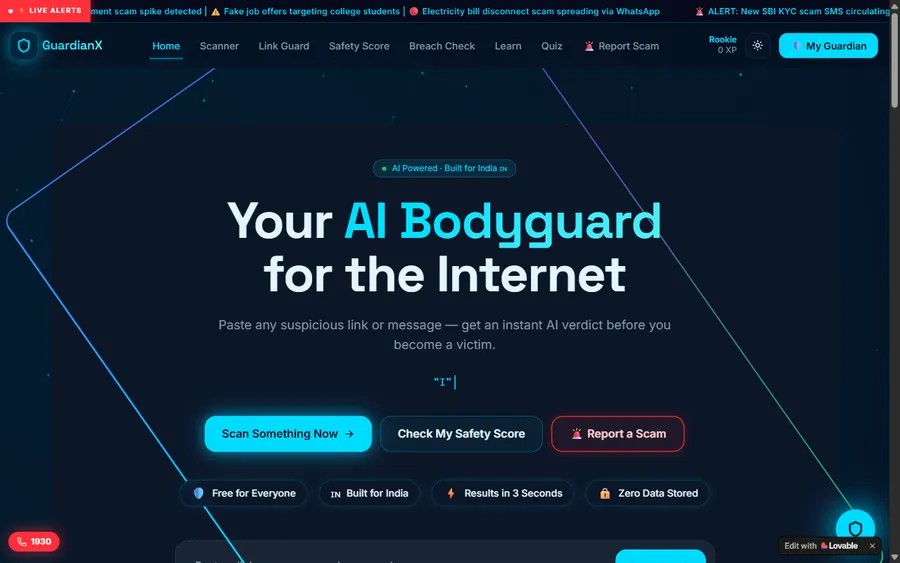
An assistant that helps a young person recognise unsafe situations online.
Web app
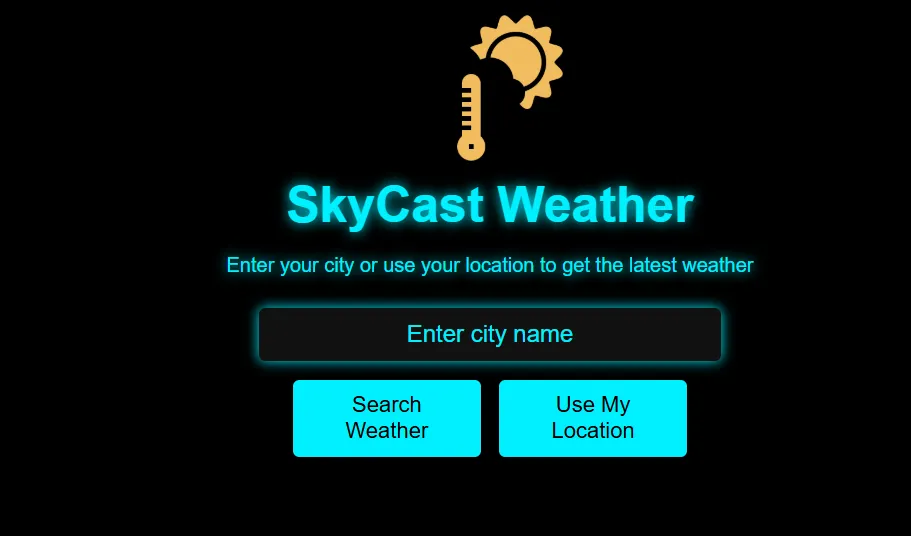
A weather forecasting site with live conditions for any location.
Fees
A monthly rate in US dollars, the same in every country outside India, with nothing to join and no fixed term.
Free first class
USD 0
no card required
Group batch
USD 100
a month, billed in US dollars
One to one
USD 150
a month, billed in US dollars
What families say
What parents have written about us on Google, word for word.
★★★★★
"The one step solution for my son. Modern Age Coders make learning coding so simple that kids love it. The teachers explain complex concepts clearly with practical exercises and interactive content."
Ria Mukherjee
Parent
★★★★★
"Modern Age Coders has been a game-changer for me. I struggled to grasp IT concepts and coding before joining, but their classes transformed everything. I can now confidently write complex programs with ease."
Samriddha Mondal
Student
★★★★★
"One of the most wonderful education centres out there. Education is not limited to school syllabus but focuses on skill development."
Vansh Agarwal
Student
★★★★★
"My child Dhairya is really enjoying the Modern Age Coders classes. This is his first online class and he eagerly looks forward to it. I can already see his improvement, and the teachers are very cooperative."
Sonam Oswal
Parent of Dhairya
★★★★★
"Modern Age Coders have wonderful teachers who teach in a clear, easy and practical way. The teacher boosts students' confidence and inspires them to learn without hesitation."
Sonu Goyal
Parent
★★★★★
"I highly recommend this computer coding class! The teachers are incredibly knowledgeable and passionate about coding."
Ritu Kedia
Parent
Primary competition questions
At least seven: the UK Bebras Challenge, the Primary Maths Challenge, the Primary Kangaroo, the Scottish Mathematical Challenge, Astro Pi Mission Zero, Coolest Projects and FIRST LEGO League Explore.
For two of them. Astro Pi Mission Zero allows a mentor who may be a teacher, educator, parent or code club leader, and Coolest Projects has an adult register a child under 13. The other five are entered by a school.
The UK Bebras Challenge. More than 526,000 UK students took it last year, and it is entirely free to enter.
Bebras and Astro Pi Mission Zero are free. The others involve a school buying papers or running a team, and entry prices are published by the organisers in pounds, which we do not print.
Six, for the UK Bebras Challenge and for FIRST LEGO League Explore. Coolest Projects has no lower age limit at all.
Yes. Coolest Projects checks every entry and then shows it with no elimination, and Astro Pi Mission Zero runs every valid program and issues a certificate.
Yes. The UK Bebras Challenge and the Primary Maths Challenge both run from 9 to 20 November 2026, and they ask for opposite things: one is arithmetic against a clock, the other has no arithmetic in it.
Barely at all. These papers are designed to be sat without preparation. Twenty minutes a week of puzzles talked through out loud, with somebody listening to the reasoning, is worth more than any drilling.
Ask in September, in writing, naming the competition. Most primary teachers have not heard of the Primary Maths Challenge and will say yes if asked early enough to plan.
The first is free. A group place is then USD 100 a month and one-to-one teaching USD 150, with nothing to pay to join.
The pages behind this one
Every row of the table above has its own page, with the organiser's words and the date we read them.
Twenty-five questions, and the five with no options.
Free, 45 minutes, no programming at all.
An hour of Python that runs in space.
Seven categories and no ranking.
Explore from age six, delivered by the IET.
Marks for the explanation, from P7 upwards.
Start here
Tell us your child's school year and what they enjoy. The free lesson teaches something real, and afterwards we say plainly what we saw.
Rather read first? Each course keeps its syllabus on its own course page, our approach is on how we teach, and the roadmap shows what follows what.
WhatsApp us · +91 91233 66161 · contact@modernagecoders.com
WhatsApp is free from a UK mobile and reaches us soonest. Our number belongs to India, which we say on every page, and no British office exists.