UK / CM1 / 01
GCSE mathematics
Every strand, at Foundation and at Higher.
Open the syllabusNorthern Ireland · CCEA GCSE · Years 11 and 12
CCEA's GCSE Mathematics works differently from the English boards. Every pupil sits exactly two units: one from M1, M2, M3 or M4, and one completion test from M5, M6, M7 or M8. Each pairing comes with a fixed range of grades. A pupil entered for M3 and M7 can be awarded a B and no higher; only M4 and M8 open the way to A and A*. So the most consequential decision in a Northern Irish pupil's maths GCSE is often made by the school, before any paper is sat. CCEA's 2025 Chief Examiner's report shows why it matters: of one Higher paper it wrote that "Some candidates with very high scores would be better suited to the M8 papers and those with very low scores to the M6 papers." This page explains the pathways, the C* grade, what the 2025 examiners saw, and how to prepare for whichever units a pupil is entered for.
Live teaching since 2020 · 10,000+ students · From CCEA's specification and 2025 Chief Examiner's report
In short
CCEA GCSE Mathematics is assessed through two units. Each pupil takes one of M1, M2, M3 or M4, a calculator paper worth 45 per cent, and one completion test from M5, M6, M7 or M8, made up of a non-calculator paper and a calculator paper, worth 55 per cent. The pairings form four pathways with fixed grade ranges: M1 with M5 gives D to G; M2 with M6 gives C* to G; M3 with M7 gives B to E; and M4 with M8 gives A* to D. Northern Ireland uses nine grades, including C* between B and C. Foundation units M1 and M2 can also award Functional Mathematics. The 2025 Chief Examiner's report said most candidates were entered at the right level, but noted some who would have been better suited to a higher or a lower pathway. Modern Age Coders teaches CCEA GCSE Maths at both tiers, and helps families understand the pathway a pupil is on. The first lesson is free, then USD 100 a month in a group or USD 150 one to one.
Start here
We teach the CCEA specification through courses that serve more than one curriculum. Each card opens its syllabus.
CM / 01
Foundation and Higher content across number, algebra, geometry and statistics.
Open the syllabus →
CM / 02
Extra algebra and geometry depth for pupils aiming at the M4 and M8 pathway.
Open the syllabus →
CM / 03
For pupils rebuilding foundations before M1, M2 or a move up a pathway.
Open the syllabus →The four pathways
From the CCEA GCSE Mathematics specification, version 2, for first teaching from September 2017.
| Pathway | First unit (45 per cent) | Completion test (55 per cent) | Final grades available |
|---|---|---|---|
| Foundation, option 1 | M1: calculator, 1 hour 45 minutes | M5: non-calculator 1 hour, then calculator 1 hour | D to G |
| Foundation, option 2 | M2: calculator, 1 hour 45 minutes | M6: non-calculator 1 hour, then calculator 1 hour | C* to G |
| Higher, option 1 | M3: calculator, 2 hours | M7: non-calculator 1 hour 15 minutes, then calculator 1 hour 15 minutes | B to E |
| Higher, option 2 | M4: calculator, 2 hours | M8: non-calculator 1 hour 15 minutes, then calculator 1 hour 15 minutes | A* to D |
The first units, M1 to M4, are sat at the same time, so a pupil can enter only one of them in any series. The completion tests are timetabled together on a different day, with the calculator paper straight after the non-calculator one. At least 40 per cent of the assessment must be taken at the end of the course, so the completion test is usually the final exam.
Northern Ireland reports GCSE results on nine grades: A*, A, B, C*, C, D, E, F and G. C* sits between B and C.
It matters here because the M2 and M6 Foundation pathway reaches C* at the top, so a strong Foundation pupil is not capped at C.
The Foundation units also award Functional Mathematics: Level 1 through M1, and Level 1 or Level 2 through M2. A Level 2 appears as an endorsement on the GCSE certificate.
It is a practical qualification in its own right, which some pupils and employers value.
Source: the CCEA GCSE Mathematics specification and the Chief Examiner's Report, Mathematics, Summer Series 2025, each downloadable from the CCEA GCSE Mathematics pages.
Entry level
The single decision with the biggest effect on the grade, and the one families are least often told about.
Because each pairing has a fixed grade range, the pathway works like a ceiling and a floor. A pupil on M3 and M7 cannot be awarded an A however well they do, and a pupil on M4 and M8 who struggles may fall below the range. The 2025 report was generally positive about entries, "Where candidates had been entered at the appropriate level, which was usually the case", but it named both kinds of mismatch.
| Paper | The comment |
|---|---|
| M71, Higher non-calculator | "Some candidates with very high scores would be better suited to the M8 papers and those with very low scores to the M6 papers." |
| M81, Higher non-calculator | "some candidates were clearly entered at a level above their ability span" |
| M4, Higher | Marks on the papers the supervising examiner marked ranged from 1 to 100 |
| M51, Foundation non-calculator | Marks from single figures to the forties, showing candidates of very different abilities entered for the same paper |
Which pathway is my child on, and which grades does it allow? When was that decided, and on what evidence?
If my child's results improve, is there a point at which a move up to M4 and M8, or M2 and M6, is still possible?
A higher pathway demands harder content and offers a lower floor. A pupil entered too high can end with a worse grade than the lower pathway would have given.
The right answer depends on secure performance on the harder content, which is what our first lesson tries to measure honestly.
What examiners saw
From the Chief Examiner's report across the eight units and their papers.
| Issue | What the report saw |
|---|---|
| Following instructions | Asked to estimate, some candidates calculated exact answers on a calculator and received no marks |
| Money notation | Answers to one decimal place for money, or 441 pence written as if it were pounds |
| Multiple answers | Where more than one solution is left without a clear answer, the worst solution is marked |
| Handwriting | Digits such as 1 and 7, or 0 and 6, sometimes indistinguishable |
| Higher algebra | Brackets in algebra, and simplifying and adding algebraic fractions, caused problems on M4 |
| Higher reasoning | Circle theorem reasoning, bounds, histograms and estimating the median stretched even able candidates |
The multiple-answer rule is worth learning by heart. The M4 report states: "Candidates should be reminded that if they leave multiple solutions to one question without writing an answer in the answer line then the worst solution is marked." A pupil who tries two methods and leaves both is marked on the weaker one. Crossing out the abandoned attempt, or writing the chosen answer on the line, protects the better work.
Examiners repeatedly credited method marks where the final answer was wrong. Working is not optional insurance; it is where many marks come from.
Estimate means round and approximate first. Show means demonstrate the result, not just state it. The 2025 papers withheld marks for ignoring both.
Two decimal places for pounds and pence, and a sense check that 4.41 is not 441. Foundation papers in particular lost marks here.
Preparing
Content differs by unit, so preparation should follow the pathway.
| Stage | Focus | Practice |
|---|---|---|
| First unit, M1 to M4 | A long calculator paper across the unit's content | Full timed papers at the right unit, with efficient calculator use |
| Completion test, paper 1 | Non-calculator number and algebra | Short daily practice by hand: fractions, percentages, estimation |
| Completion test, paper 2 | Calculator questions, straight after paper 1 | Back-to-back timed practice, since the papers run consecutively |
| Moving up a pathway | The extra content of the higher unit | Secure the new topics before any change of entry is discussed |
Some units contain content pupils elsewhere never meet. The Foundation completion test M6, for example, includes converting numbers between decimal and binary, which pupils who also study computing will recognise. Past papers for each unit are on CCEA's site, and practising the exact unit a pupil is entered for, rather than generic GCSE questions, is the most efficient preparation.
Teach the content of the pupil's own units, at the right tier, with past papers from CCEA for each unit.
Give families a frank view of whether a pupil is secure on their pathway, or ready for the next one.
The authority to change a school's entry, or certainty about which pathway is right. That is a decision for the school, informed by evidence.
A course written only for CCEA, or a guaranteed grade. We teach the specification through broader courses.
For computing, see the CCEA Digital Technology programming page. For younger children, the transfer test maths page covers the Year 7 test, and the Northern Ireland page the wider system.
Progression
Placement follows secure performance on a pupil's own units, and on the next pathway up.
| Rung | When | What should be true |
|---|---|---|
| 1. Secure on the current units | Year 11 | The content of the entered first unit and completion test, done accurately |
| 2. Non-calculator fluency | Year 11 | Number, fractions, percentages and estimation by hand, for paper 1 |
| 3. Exam habits | Before the first unit | Working shown, instructions followed, one clear answer per question, money written properly |
| 4. The next pathway, if suitable | Year 12 | The extra content of the higher unit secured, with evidence to discuss with the school |
The report's habits take weeks to build and protect marks on every paper.
Pupils who also code may like the coding roadmap.
A move up is only sensible when the harder content is secure. We say honestly when it is not.
Lessons lighten around each series.
The catalogue
By tier and purpose. The free lesson sets the starting point.
UK / CM1 / 01
Every strand, at Foundation and at Higher.
Open the syllabusUK / CM1 / 02
Harder algebra and geometry for M4 and M8 candidates.
Open the syllabusUK / CM1 / 03
Gaps from earlier years closed before M1 or M2.
Open the syllabusUK / CM2 / 01
Quick, reliable number facts for the non-calculator papers.
Open the syllabusUK / CM2 / 02
Calculation techniques for pupils who enjoy number patterns.
Open the syllabusUK / CM2 / 03
Histograms, medians and probability, which stretched 2025 Higher candidates.
Open the syllabusUK / CM3 / 01
The next step after an M4 and M8 pathway.
Open the syllabusUK / CM3 / 02
Reasoning problems, like the circle theorem questions that stretched M4.
Open the syllabusUK / CM3 / 03
Number patterns explored in code as well as on paper.
Open the syllabusHow lessons work
Our teachers are in India, which never changes its clocks, so Northern Ireland is four and a half hours behind in summer and five and a half in winter. Lessons are timed in UK hours.
After school
The usual slot in Years 11 and 12.
Evening
Around sport, music or jobs.
Saturday
Room for a full paper under timing.
Practice from CCEA past papers for the exact units a pupil is entered for.
Completion papers practised consecutively, as they are sat.
Abandoned attempts crossed out, so the better work is the one marked.
Estimate, show and explain treated as instructions, never as decoration.
A clear view of whether a pupil is secure on their pathway or ready for the next.
Five to ten pupils at one rung, on the same pathway.
Student work
A handful of things students built during ordinary lessons, nothing assessed. The rest live in student labs.

AI and ML
An AI nutrition coach that reads what you eat and works you toward a target.
AI and ML
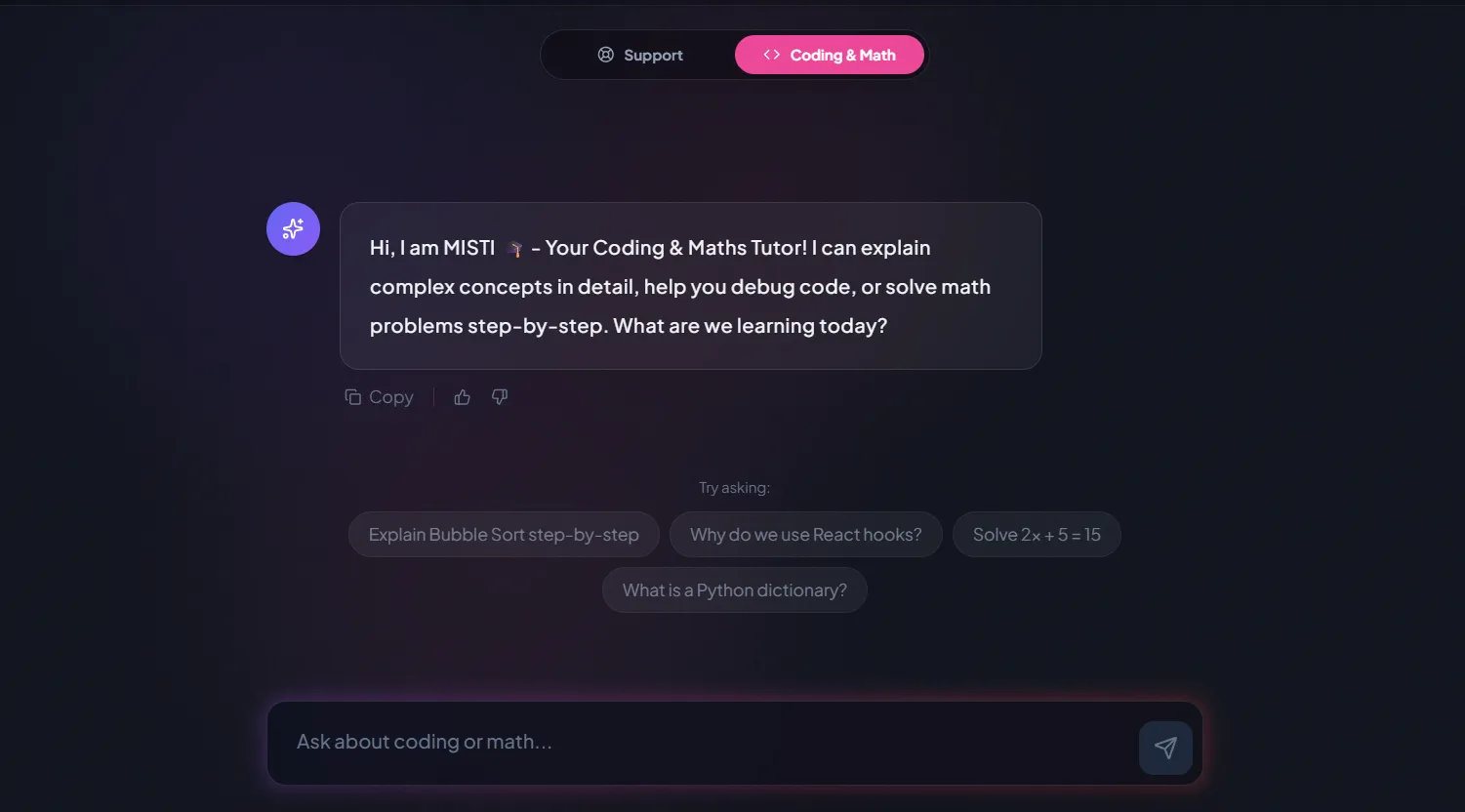
A chatbot that answers mathematics and programming questions, built and deployed by a student.

AI and ML
An assistant that helps a young person recognise unsafe situations online.
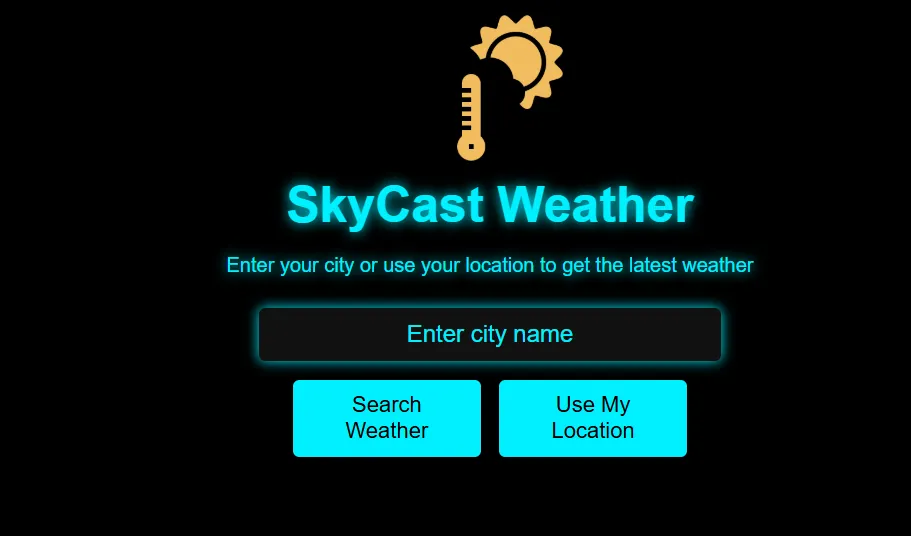
Web app
A weather forecasting site with live conditions for any location.
Fees
One monthly fee in US dollars, at the rate all families outside India pay. The first lesson is free; we bill only once a course and a weekly time are in place.
Free first class
USD 0
no card required
Group batch
USD 100
a month, billed in US dollars
One to one
USD 150
a month, billed in US dollars
What families say
Parents' Google reviews, as posted.
★★★★★
"The one step solution for my son. Modern Age Coders make learning coding so simple that kids love it. The teachers explain complex concepts clearly with practical exercises and interactive content."
Ria Mukherjee
Parent
★★★★★
"Modern Age Coders has been a game-changer for me. I struggled to grasp IT concepts and coding before joining, but their classes transformed everything. I can now confidently write complex programs with ease."
Samriddha Mondal
Student
★★★★★
"One of the most wonderful education centres out there. Education is not limited to school syllabus but focuses on skill development."
Vansh Agarwal
Student
★★★★★
"My child Dhairya is really enjoying the Modern Age Coders classes. This is his first online class and he eagerly looks forward to it. I can already see his improvement, and the teachers are very cooperative."
Sonam Oswal
Parent of Dhairya
★★★★★
"Modern Age Coders have wonderful teachers who teach in a clear, easy and practical way. The teacher boosts students' confidence and inspires them to learn without hesitation."
Sonu Goyal
Parent
★★★★★
"I highly recommend this computer coding class! The teachers are incredibly knowledgeable and passionate about coding."
Ritu Kedia
Parent
Questions about CCEA GCSE Maths
Through two units: one of M1, M2, M3 or M4, a calculator paper worth 45 per cent, and one completion test from M5, M6, M7 or M8, a non-calculator paper followed by a calculator paper, worth 55 per cent.
It depends on the pairing. M1 with M5 allows D to G, M2 with M6 allows C* to G, M3 with M7 allows B to E, and M4 with M8 allows A* to D.
Northern Ireland uses nine GCSE grades: A*, A, B, C*, C, D, E, F and G. C* sits between B and C.
No. That pairing allows grades B to E. Only the M4 and M8 pairing allows A and A*.
The school enters pupils for units. The 2025 Chief Examiner's report said most were entered at the right level, but noted some who would have been better suited to a higher or lower pathway.
Not in the same series. Those four units are examined at the same time, so a pupil can enter only one of them in each session.
The report reminds candidates that if more than one solution is left without a clear answer on the answer line, the worst solution is marked. Cross out the attempt you do not want.
A practical qualification awarded through the Foundation units: Level 1 through M1, and Level 1 or Level 2 through M2. A Level 2 is endorsed on the GCSE certificate.
No. We teach the CCEA specification through courses built for more than one curriculum, using CCEA's past papers for each unit.
The first lesson is free. Then one monthly fee in US dollars, less for a group place than one to one, as listed in the fees section, and nothing is paid in advance.
Elsewhere on this site
The transfer test, computing, and the wider system.
The Year 7 test for grammar school entry.
The computing GCSE where Unit 4 is written by hand.
Primary to A level, and how it fits together.
Northern Ireland's showcase for young scientists and makers.
The UK competition ladder, for pupils beyond the syllabus.
Our hub for every UK page.
Start here
Leave a number and we will call at a UK time that suits. The lesson uses questions from the pupil's own CCEA units and ends with a view on the pathway.
Would you rather read first? Each course page sets out its syllabus, how we teach explains who our method suits, and student labs shows student work.
WhatsApp us · +91 91233 66161 · contact@modernagecoders.com
Messaging on WhatsApp is the quickest way and costs nothing from a UK phone. Replies come from our team in India, on a number beginning +91.