MLD / A1
Primary maths, Years 1 to 6
KS1 and KS2 maths, including Year 6 SATs reasoning.
Open the syllabusLondon · Online maths tutor for ages 6 to 67 · Groups of five to ten or one to one
Nobody in London has time to measure everything, so mathematicians sample. We put that idea to work on the Santander Cycles network. TfL lists every docking station with its number of docks, so we know the true average: 26.29 docks per station. Then we asked what a learner would conclude from just 40 stations, chosen four different ways, ten thousand times over. A careless sample drawn only from central London lands within one dock of the truth just 39.0% of the time. A well-planned one manages 80.0%. That gap is the heart of GCSE statistics, and this page uses it to show how our online maths tutors teach London learners, from the Year 4 times tables check to Further Maths and adult maths.
A maths page for London · Primary, secondary, sixth form and adult learners · Independent of every London school and council
What does maths tuition in London with us involve?
We are an online maths tutor for London learners aged 6 to 67. Lessons are live on video with a real teacher, in groups of five to ten learners at one level or one to one. We cover KS2 maths and Year 6 SATs preparation, the Year 4 multiplication tables check, KS3 maths, GCSE maths at foundation or higher tier on the AQA, Edexcel or OCR specification, IGCSE, A level Maths and Further Maths, and adult maths including Functional Skills and GCSE maths resits. Every course mixes exam practice with real data; our London example asks whether 40 Santander Cycles docking stations can tell you the average size of all of them. The first lesson is free. After that a group place is USD 100 a month and one-to-one lessons are USD 150 a month.
Where London families usually begin
GCSE, A level and primary maths cover most of the enquiries we get from London. Every other course is listed lower down.
LDN / 1
AQA, Edexcel or OCR, foundation or higher, including learners resitting the exam.
Open the syllabus →
LDN / 2
Pure maths, statistics and mechanics, with the large data set treated as real data rather than a chore.
Open the syllabus →
LDN / 3
Place value, times tables, fractions and the reasoning questions of Year 6 SATs maths.
Open the syllabus →Every stage
London schools teach the national curriculum for England, whichever borough they sit in, so the stages below apply from Havering to Hillingdon. Adults pick up wherever they stopped.
| Stage | School years | Where our lessons put the weight |
|---|---|---|
| KS1 | Years 1 and 2 | Counting, number bonds to 20 and 100, halves and quarters, telling the time. |
| KS2 | Years 3 to 6 | Times tables before the Year 4 check, long multiplication and division, fractions, and the reasoning papers of Year 6 SATs maths. |
| KS3 | Years 7 to 9 | Algebra, ratio and proportion, angles, probability and first statistics, built carefully because GCSE rests on them. |
| GCSE | Years 10 and 11 | Foundation or higher tier, matched to AQA, Edexcel or OCR, including sampling, histograms and scatter graphs. |
| A level | Years 12 and 13 | Pure, statistics and mechanics, with Further Maths for learners who want more proof and more abstraction. |
| Adults | Any age to 67 | Functional Skills maths, GCSE maths resits, refreshers and maths for work. |
The multiplication tables check is statutory for Year 4 pupils at state-funded schools in England, so most London children meet it at eight or nine. We teach the tables as connected facts: a child who knows 6 × 7 can work out 6 × 8 by adding one more six, and that habit is what survives a nervous morning.
Year 6 SATs maths rewards children who can explain an answer, not just reach it. Our KS2 lessons spend real time on questions such as why 3/4 is larger than 5/8, because the reasoning papers are built from exactly that kind of question.
A GCSE maths tutor has to know which board and tier a learner sits. We teach to the specification the school uses, AQA, Edexcel or OCR, and we decide with the family whether foundation or higher tier fits. Learners at schools that enter the international papers follow our IGCSE course instead.
Our national pages explain each stage in more depth: KS2 maths, KS3 maths, GCSE maths, IGCSE maths, A level maths and Further Maths.
Source: gov.uk, multiplication tables check, read on 1 October 2026. School years are the usual ones for each key stage in England.
The London project
TfL publishes every docking station with its number of docks. That makes it a rare thing in statistics: a population we can see in full, so we can test how well samples do.
On 1 October 2026 we downloaded the cycle hire list from the TfL open data service. Each docking station comes with a name, a position and the number of docks it has, and every station in the list was marked as installed. Across all of them the mean is 26.29 docks per station and the median is 24.
The smallest station in the list has 10 docks, at Royal Avenue 1 in Chelsea. The largest has 63, at Jubilee Plaza in Canary Wharf. The standard deviation, which measures how far a typical station sits from the mean, is 8.55 docks.
Now imagine a GCSE student who cannot download the list and has to walk around counting docks. They might visit 40 stations. The question every statistics course asks is how close the average of those 40 will be to the true 26.29, and whether the way they choose the 40 matters.
To test it we split London into three rings by straight-line distance from a point in Trafalgar Square that we chose as the centre. Then we drew samples of 40 in four different ways and repeated each one 10,000 times, keeping a record of every estimate.
| Ring | Stations | Mean docks per station |
|---|---|---|
| Under 3 km | 299 | 25.16 |
| 3 km to under 6 km | 349 | 26.21 |
| 6 km and over | 153 | 28.67 |
| Every station in the list | All of the above | 26.29 |
Notice that the outer ring has larger stations on average, 28.67 docks against 25.16 in the middle of town. A sample that only visits central stations will therefore guess too low. That is bias, and the next section measures exactly how much it costs.
Data: TfL Unified API, BikePoint, read 1 October 2026. Powered by TfL Open Data. The rings, the centre point and every average above are Modern Age Coders' calculations, not TfL figures. Dock counts change as stations are rebuilt.
Sampling, measured
The DfE content for GCSE maths asks students to "infer properties of populations or distributions from a sample, whilst knowing the limitations of sampling". Here are those limitations, counted.
| How the 40 were chosen | Middle 90% of estimates | Within 1 dock of 26.29 |
|---|---|---|
| Simple random: any 40, every station equally likely | 24.18 to 28.55 | 55.1% |
| Stratified: 15 inner, 17 middle, 8 outer, each at random | 24.23 to 28.50 | 55.2% |
| Convenience: 40 at random from the inner ring only | 23.02 to 27.35 | 39.0% |
| Systematic: every 20th station by terminal number | 24.57 to 28.20 | 80.0% |
The convenience sample is the one a tired student takes: stay in the centre where the stations are close together. Its estimates centre on 25.15 rather than 26.29, so even ten thousand of them would never average out to the truth. Only 39.0% land within one dock.
Stratifying by ring barely helped here, 55.2% against 55.1%. That surprises students, but it makes sense: the three rings have fairly similar means, so knowing which ring a station is in tells you little about its size. Stratification pays off when the groups really differ.
The systematic sample, taking every 20th station in order of its terminal number from a random start, did far better than the others: 80.0% within one dock and a spread of estimates of 0.98 docks against 1.32 for simple random sampling.
We have not checked why. One reasonable guess is that neighbouring terminal numbers tend to be stations of a similar type, so spreading the sample evenly through the list covers every type. Testing that guess is a good A level statistics exercise in its own right.
At KS3 we use this data for mean, median and range. At GCSE the focus is the sampling methods and the word bias. At A level students find the standard error, compare it with 8.55 ÷ √40, and ask why the simulation and the formula agree so closely.
All simulation figures are Modern Age Coders' calculations from the TfL list above (10,000 repetitions of each method, fixed random seed). GCSE wording: DfE, GCSE mathematics subject content.
Maths around London
A great deal of maths support in London happens through schools rather than through families. We describe it so parents know what exists; we run none of it.
| Maths Hub | Lead | London council areas |
|---|---|---|
| London Central and North West | The St Marylebone CE School, Westminster | Barnet, Camden, Enfield, Haringey, Islington, Westminster |
| London Central and West | Fox Primary School, Kensington and Chelsea | Brent, Ealing, Hammersmith and Fulham, Harrow, Hillingdon, Hounslow, Kensington and Chelsea |
| London North East | Elmhurst Primary School, Newham | Barking and Dagenham, Hackney, Havering, Newham, Redbridge, Waltham Forest |
| London South East Plus | Redriff Primary School, Southwark | Bexley, City of London, Greenwich, Lewisham, Southwark, Tower Hamlets |
| London South West | Belleville Primary and Chesterton Primary | Kingston upon Thames, Merton, Richmond upon Thames, Sutton, Wandsworth |
| London Thames | Harris City Academy, Crystal Palace | Bromley, Croydon, Lambeth |
The Ri Masterclasses began in London: the Royal Institution says that in 1981 the first ones for secondary students were set up, "offering London children the opportunity to discover new mathematics". It adds that "Quite a few London series are administered by the Ri team".
The Ri is clear that "Masterclasses are free to attend, school students are nominated by their teacher", usually at ages 9 to 10 and 13 to 14. A keen London learner should ask a maths teacher about a nomination. Between them, the six hubs in the table cover all 32 boroughs and the City; the London Central and North West Maths Hub, for example, works with schools from Barnet to Westminster.
Several outer boroughs still have selective schools with their own tests. We have separate pages on 11 plus maths for Barnet, Bexley, Enfield, Kingston, Redbridge and Sutton, each about that borough's test.
This page is the general one: maths for every age and stage across all of London. For competition maths, our UKMT maths challenge page covers the Junior, Intermediate and Senior challenges.
Sources: NCETM, current Maths Hubs and the individual London hub pages; Royal Institution, Ri Masterclasses. Read on 1 October 2026. We are independent of the NCETM, the Maths Hubs, the Royal Institution and every London school and council.
Grown-up learners
Many of our London learners are adults: people resitting GCSE maths for a course or a job, parents who want to follow homework, and professionals who use numbers every day and want to trust them.
Our GCSE course takes resit candidates and starts from what the learner actually knows, which is rarely what the last result suggests. Most adults move faster than they expect once fractions and percentages make sense.
Practical maths for work and training: percentages, measures, data and problem solving in context. Our Functional Skills page explains how we teach it.
Ratios, spreadsheets, statistics for reports, and the sampling ideas on this page. See our page on maths classes for adults.
Adults often enjoy the docking station project more than teenagers do, because they have stood at a full station looking for a free dock. The question of whether a sample of 40 can speak for the whole network is one they meet at work all the time, in surveys, audits and customer feedback.
Progress
This is the order in which the ideas build. A new learner can join at any stage; the free lesson shows us where.
| Typical years | Stage | How we know it is secure |
|---|---|---|
| Years 3 and 4 | 1. Number facts | Recalls tables to 12 × 12 and derives a forgotten one from a neighbour |
| Years 5 to 7 | 2. Written methods | Multiplies, divides and handles fractions and decimals accurately on paper |
| Years 8 to 10 | 3. Algebra and averages | Forms equations and chooses between mean, median and mode for a data set |
| Years 10 to 13 | 4. Inference | Explains how a sample was chosen and how far its answer can be trusted |
A GCSE learner who starts late can still make real progress, provided we repair the foundations first. Weak algebra, in particular, undermines almost every higher-tier topic.
If the time before the exam is shorter than the gap to close, we will say so plainly after the free lesson.
Many learners continue to A level Maths or Further Maths. Others take our statistics and probability course, where sampling is studied properly.
Some go on to maths through coding and rebuild the docking station simulation as a short Python program.
All maths courses
Grouped from primary to adult. Open any card for the full syllabus.
MLD / A1
KS1 and KS2 maths, including Year 6 SATs reasoning.
Open the syllabusMLD / A2
For families whose borough or school sets a selective test.
Open the syllabusMLD / A3
Quick, accurate arithmetic without a pencil.
Open the syllabusMLD / A4
Number sense for the youngest learners.
Open the syllabusMLD / B1
Years 7 to 9: algebra, ratio, geometry and data.
Open the syllabusMLD / B2
AQA, Edexcel or OCR, foundation or higher, resits welcome.
Open the syllabusMLD / B3
For schools that enter the international papers.
Open the syllabusMLD / B4
Rebuilding algebra for learners who lost the thread.
Open the syllabusMLD / C1
Pure, statistics and mechanics, with Further Maths for those who want more.
Open the syllabusMLD / C2
Sampling, distributions and hypothesis tests.
Open the syllabusMLD / C3
Problem solving for UKMT challenges and olympiads.
Open the syllabusMLD / C4
Calculus, linear algebra and proof.
Open the syllabusMLD / D1
The statistics behind dashboards and reports.
Open the syllabusMLD / D2
Interest, growth and risk, worked through.
Open the syllabusMLD / D3
Simulations like the docking station one, in Python.
Open the syllabusMLD / D4
Fast calculation tricks, once the basics are firm.
Open the syllabusTiming
Our teachers work from India on Indian Standard Time, which does not change during the year. London is four and a half hours behind India in summer and five and a half in winter, and we always quote lesson times in UK time.
Weekdays, 4pm to 7pm
Primary and secondary learners after school.
Weekday evenings
Sixth formers, resit candidates and working adults.
Saturday and Sunday
Morning slots for anyone who prefers them.
The same person teaches each week, so nothing has to be explained twice.
A brief written update after lessons on progress and next steps.
Groups are formed by level, so a Croydon learner may sit with one from Leeds.
Cycle docks, transport timetables and census tables sit alongside past papers.
One to one when a specific topic or an exam date needs it.
Learners say why a method works before they practise it.
Student work
Learners who began with problems like the docking station sample went on to build the projects below. More are in the student labs.

AI and ML
An AI nutrition coach that reads what you eat and works you toward a target.
AI and ML
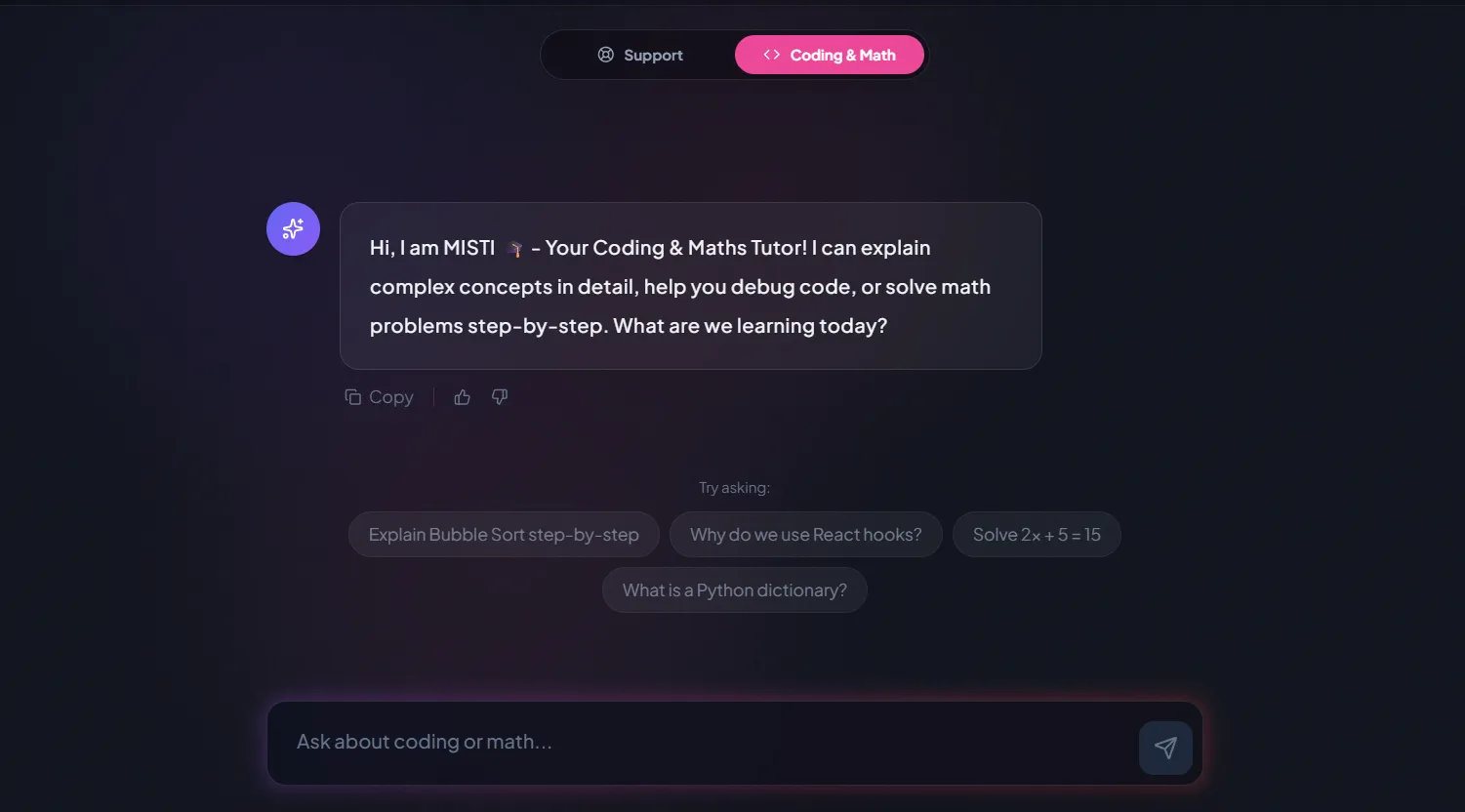
A chatbot that answers mathematics and programming questions, built and deployed by a student.

AI and ML
An assistant that helps a young person recognise unsafe situations online.
Web app
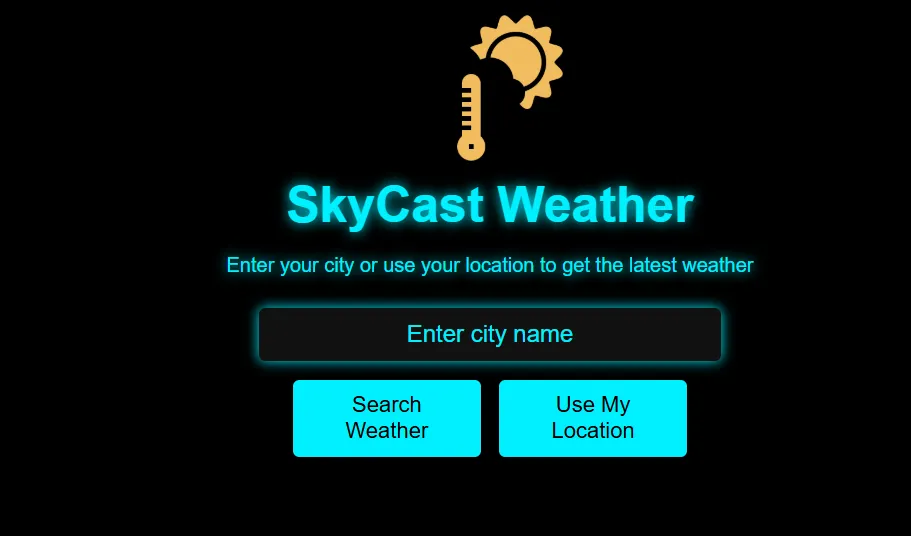
A weather forecasting site with live conditions for any location.
Fees
Charged monthly in US dollars, the same for every country outside India. No registration fee and no contract.
Free first class
USD 0
no card required
Group batch
USD 100
a month, billed in US dollars
One to one
USD 150
a month, billed in US dollars
What families say
Reproduced unchanged from Google reviews written by families and learners.
★★★★★
"The one step solution for my son. Modern Age Coders make learning coding so simple that kids love it. The teachers explain complex concepts clearly with practical exercises and interactive content."
Ria Mukherjee
Parent
★★★★★
"Modern Age Coders has been a game-changer for me. I struggled to grasp IT concepts and coding before joining, but their classes transformed everything. I can now confidently write complex programs with ease."
Samriddha Mondal
Student
★★★★★
"One of the most wonderful education centres out there. Education is not limited to school syllabus but focuses on skill development."
Vansh Agarwal
Student
★★★★★
"My child Dhairya is really enjoying the Modern Age Coders classes. This is his first online class and he eagerly looks forward to it. I can already see his improvement, and the teachers are very cooperative."
Sonam Oswal
Parent of Dhairya
★★★★★
"Modern Age Coders have wonderful teachers who teach in a clear, easy and practical way. The teacher boosts students' confidence and inspires them to learn without hesitation."
Sonu Goyal
Parent
★★★★★
"I highly recommend this computer coding class! The teachers are incredibly knowledgeable and passionate about coding."
Ritu Kedia
Parent
London maths questions
With us the first lesson is free. After that, a place in a group of five to ten costs USD 100 a month and one-to-one tuition costs USD 150 a month, with no joining fee and no fixed term.
For most learners it works as well, provided the lesson is live and the teacher can see the working. Our lessons are live on video with a shared whiteboard, and the teacher watches each step rather than only the final answer.
Stratified sampling splits a population into groups, called strata, and then samples from each group in proportion to its size. It improves accuracy when the groups differ from one another; in our London cycle dock data the rings were too similar for it to help much.
Yes. Our GCSE course takes resit candidates of any age. We start by finding which topics are secure and which are not, then rebuild the weak ones before moving on to exam practice.
Yes. Learners who take Further Maths alongside A level Maths can study the extra pure, statistics and mechanics content with us, one to one or in a group if one at the right level is running.
AQA, Edexcel and OCR, at foundation or higher tier. We also teach IGCSE for learners whose schools enter the international papers.
Short, frequent practice that links facts together works far better than long drills. We teach children to derive a fact they forget from one they know, so 7 × 8 can be rebuilt from 7 × 4 doubled.
Yes. We have separate pages for Barnet, Bexley, Enfield, Kingston, Redbridge and Sutton, each describing that borough's test. This page covers general maths tuition for every age.
No. We describe their public activities so families know about them. We have no link with the NCETM, any Maths Hub, the Royal Institution, TfL or any London school.
No. We teach carefully and report progress honestly, but no tutor can promise an exam grade and we do not.
Further reading
Our national maths pages by stage, our London coding page and the UK index.
Our national GCSE page, by board and tier.
Pure maths, statistics and mechanics.
Years 7 to 9, where GCSE success is really decided.
Our London page for coding and AI.
The same approach, with a Birmingham canal project.
Every nation, city, town and maths page we have.
Start here
Tell us the learner's age or school year, the exam board if there is one, and the topic that worries them most. The first lesson is a real lesson, and afterwards we tell you honestly where things stand.
Want to look around first? Browse the course list or read how we teach.
WhatsApp us · +91 91233 66161 · connect@modernagecoders.com
WhatsApp is the quickest way to reach us. The number has an Indian country code because our team is in India; there is no London office and every lesson is online.
A priority demo is a full class of about 45 to 60 minutes. After the class the mentor sends a written skill report and a personal learning roadmap on WhatsApp. If you enrol, the demo fee is adjusted against your first month's fee. Share your demo Order ID with us on WhatsApp and we take it off.
Book a priority demo