Pick the qualification, then the course that gets you there.
Adults learn differently from fifteen-year-olds: less time, more reasons, and often an old fear of maths. Our tutors teach to the exam you actually need, at a pace that fits a working week.
 Start here
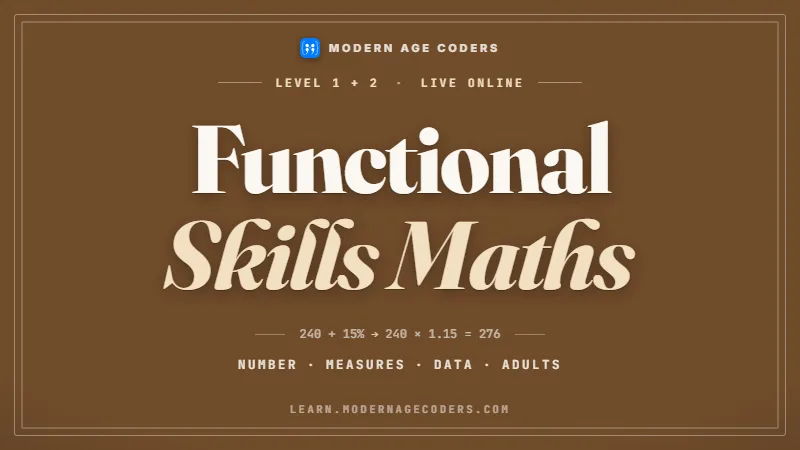
Functional Skills Maths: Level 1 and Level 2
Functional Skills maths at Level 1 and Level 2 for adults, apprentices and post-16 learners, with calculator and non-calculator practice.
$100/mo group · $150/mo one-to-one
View course and enrol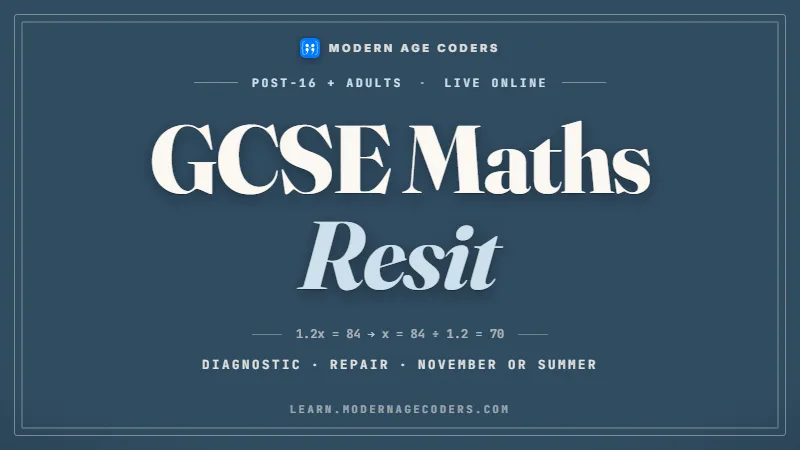
GCSE Maths Resit: Post-16 and Adults
For post-16 learners and adults resitting GCSE maths: a diagnostic, repair of the topics that cost marks, then full papers.
$100/mo group · $150/mo one-to-one
View course and enrol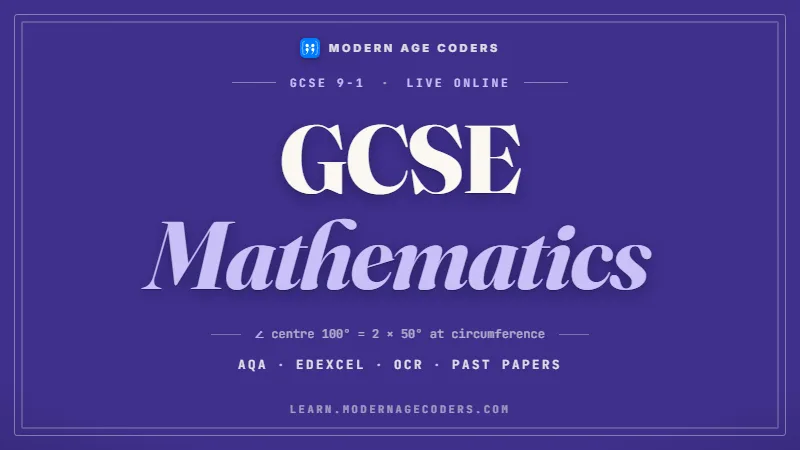
GCSE Maths: Foundation and Higher (9-1)
The full GCSE for AQA, Edexcel and OCR on either tier, for learners who need the broader course.
$100/mo group · $150/mo one-to-one
View course and enrolFind your situation, then follow the row.
| Your situation | What we would suggest | Start with |
|---|---|---|
| An employer or training course asks for Level 2 maths and accepts Functional Skills | Functional Skills Level 2, starting at Level 1 if the basics need rebuilding | Functional Skills Maths |
| A college, university course or employer asks specifically for GCSE maths at grade 4 or above | GCSE maths, planned from a diagnostic paper | GCSE Maths Resit |
| Aged 16 to 18 with a GCSE grade 3 | Full-time students must keep studying towards the GCSE | GCSE Maths Resit |
| Aged 16 to 18 with grade 2 or below | Functional Skills Level 2 or the GCSE; your college helps decide | Functional Skills Maths |
Functional Skills and GCSE maths, line by line.
| What | Functional Skills maths | GCSE maths |
|---|---|---|
| Levels or grades | Entry Levels 1, 2 and 3, Level 1 and Level 2 | Grades 9 to 1, on Foundation or Higher tier |
| Purpose, in the official wording | At Levels 1 and 2, "a qualification for work, study and life" | The national GCSE in mathematics, with content set by the Department for Education |
| Exam time at Levels 1 and 2 | Between 1 hour 45 minutes and 2 hours 30 minutes in total | Three papers of 1 hour 30 minutes, 4 hours 30 minutes in total |
| Without a calculator | 25% of the marks | One of the three papers, a third of the marks |
| What the marks reward | 25% underpinning skills, 75% problem solving | Standard techniques, reasoning and problem solving, weighted by tier |
| Content areas | Numbers and the number system; common measures, shape and space; information and data | Number; algebra; ratio, proportion and rates of change; geometry and measures; probability; statistics |
| Exam format | One assessment with separate calculator and non-calculator sections, or two assessments | Three written papers in the same series |
Functional Skills rules from Ofqual's Functional Skills mathematics conditions and requirements and the Department for Education's subject content. Each awarding organisation sets its own exact paper lengths within Ofqual's limits.
Maths for a purpose, or maths as a subject.
Functional Skills suits you if
- Your employer, apprenticeship or training course asks for Level 2 maths and accepts Functional Skills
- You want maths set in real situations: percentages of pay, measuring, reading charts and budgeting
- You prefer a shorter exam with less algebra
- You want to build up step by step through Entry Levels and Level 1 first
GCSE suits you if
- A college, university course or employer asks for GCSE maths by name
- You may go on to study maths, science or a technical subject
- You want the broader course, including algebra and geometry
- You are 16 to 18 with a grade 3, when the GCSE is required
The question that settles it is not which is easier, but which one the place you are aiming for will accept. Ask them before you start; it is a quick question that can save months of studying for the wrong exam.
What the condition of funding says for 16 to 18 year olds.
In England, students aged 16 to 18 on a study programme who have not yet got a GCSE grade 9 to 4 in maths keep studying maths. The Department for Education calls grade 9 to 4 "a level 2 pass grade".
The rules for 2026 to 2027 say full-time students who have a GCSE grade 3 must study towards the maths GCSE, because they are closest to a pass. Students with a grade 2 or below can study towards a pass in Functional Skills Level 2 or towards a GCSE grade 9 to 4.
For adults who have left school, gov.uk says that if you're over 16 you normally do not have to pay to study maths to GCSE level. Ask a local college or the National Careers Service about free courses near you.
Post-16, at a glance
| GCSE maths grade at 16 | What a full-time student studies |
|---|---|
| 9 to 4 | No further maths requirement |
| 3 | GCSE maths |
| 2 or below | Functional Skills Level 2 or GCSE maths |
From 16 to 19 funding: maths and English condition of funding, 2026 to 2027.
Two questions we wrote on one topic: percentages.
A recipe uses 80 g of sugar. You cut the sugar by 15%. How much do you use now?
15% = 8 + 4 = 12
80 − 12 = 68 g
A real situation, a clear answer, and a method you can check.
After a 15% cut, a recipe uses 68 g of sugar. How much did it use before?
original = 68 ÷ 0.85
= 80 g
A reverse percentage: the same idea, asked backwards and with less help.
The right qualification first, then calm, steady lessons.
In the first lesson the tutor works through a few questions with you, listens to what you need the qualification for, and tells you honestly whether Functional Skills or GCSE fits, and at which level to start.
Lessons then go at your pace: number skills first, the exam rules learned early, and calculator and non-calculator practice in the format of the exam you will sit. Every lesson is live with the same tutor, in the evenings or at weekends in UK time.
We never promise a grade or a score. Results depend on the starting point, the time available and the practice done between lessons, and we say so at the start.
"Modern Age Coder have wonderful teachers who teach in a clear, easy and practical way. The teacher boosts students' confidence, keeps them updated with technology, and inspires them to learn without hesitation."
Sonu Goyal, parent · verified Google review
Functional Skills and GCSE maths: what adults ask.
What is the difference between Functional Skills maths and GCSE maths?
Functional Skills maths tests maths for work and everyday life at Entry Levels 1 to 3, Level 1 and Level 2. GCSE maths is graded 9 to 1, is longer, and covers more algebra and geometry.
Is Functional Skills Level 2 the same as a GCSE?
They are different qualifications. Whether Functional Skills Level 2 is accepted in place of GCSE maths is up to the employer, college or course, so check with them.
How long is the Functional Skills maths exam?
At Levels 1 and 2 the total assessment time is between 1 hour 45 minutes and 2 hours 30 minutes, set by each awarding organisation within Ofqual's limits.
Can you use a calculator in Functional Skills maths?
For most of it. Ofqual's rules put 25% of the marks in a non-calculator test and 75% in a calculator test.
Is Functional Skills maths easier than GCSE?
It is shorter and more practical, with less algebra, but it still asks for real problem solving. The better question is which one your employer or course accepts.
Do I have to resit GCSE maths after 16?
Full-time students aged 16 to 18 with a grade 3 must study towards GCSE maths. With grade 2 or below, they can study Functional Skills Level 2 or the GCSE.
Can adults take GCSE maths for free?
Gov.uk says that if you're over 16 and have left school, you normally do not have to pay to study maths to GCSE level. Ask a local college or the National Careers Service.
What levels does Functional Skills maths have?
Entry Level 1, Entry Level 2, Entry Level 3, Level 1 and Level 2.
How long does it take to prepare for Functional Skills Level 2?
It depends on the starting point. Our Functional Skills course plans about six months for a full level, and less for learners who start part-way.
Can you help me choose and prepare?
Yes. Book a Priority Demo: a full live class of about 45 to 60 minutes with a mentor reserved for you. Afterwards the mentor sends a written skill report and a personal learning roadmap on WhatsApp.
Not sure which maths qualification you need?
In one live class a tutor works through real questions with you, talks through what you need the qualification for, and recommends a level and a plan. If you enrol, the demo fee is adjusted against your first month's fee.
Sources, read in October 2026.
- Ofqual, Functional Skills mathematics conditions and requirements (2024 version).
- Department for Education, Functional Skills subject content: maths (November 2024).
- Department for Education, 16 to 19 funding: maths and English condition of funding, 2026 to 2027.
- Gov.uk, Improve your English, maths and IT skills.
- AQA 8300, Pearson Edexcel 1MA1 and OCR J560 GCSE Mathematics specifications.