ROUTE / PRIM / 01
Scratch Coding for Kids
Blocks first for the youngest, before typed code.
Open the syllabusNetherlands · Groep 6 to vwo 6 · Live online
Parents often ask two questions: when should my child start, and how will I know it is working? This page answers both against the Dutch school system itself. The system has three main routes through secondary school, vmbo, havo and vwo, lasting four, five and six years, and each has moments that shape what comes next: a profile chosen in the upper years, a profielwerkstuk in havo and vwo, final exams in seven or more subjects. A route from first Python to real AI fits around those moments rather than competing with them. Below, stage by stage, is what a learner should be learning, and, just as useful, what a parent should see at home: the programs, projects and questions that show real progress. The route is the same for every learner in our classes, taught live online and in English, and the free first lesson shows where a child actually starts.
Live teaching since 2020 · 10,000+ students · one route, placed by ability
In short
This is the route Modern Age Coders teaches from a child's first typed Python to real AI, set out against the Dutch school years: first programs around groep 6 to 8, the full language and first data in the onderbouw, models and a first public project in the upper years, and agents and a portfolio by the end of havo or vwo. At each stage the page says what a parent should see at home. Classes are live online in English, in groups of five to ten at one level or one to one, and pupils are placed by ability rather than school year. Trying a lesson is free; staying on costs USD 100 a month in a small group or USD 150 a month with a private teacher.
Start here
The first for the end of primary school, the second for the onderbouw, the third for the upper years. Each card opens its own syllabus and timetable.
ROUTE / 01
The first stage: typed Python around groep 6 to 8, with small games and a first program that learns.
Open the syllabus →
ROUTE / 02
The onderbouw stage: the whole language over two years, with files, functions and first data.
Open the syllabus →
ROUTE / 03
The upper-school stage: statistics, models and neural networks, each tested and written up.
Open the syllabus →The school system
The facts below are quoted from the government's own explanations of vmbo, havo and vwo on Rijksoverheid.nl. They set the frame the roadmap fits into.
| Route | Length | Structure | At the end |
|---|---|---|---|
| Vmbo | 4 years | Four learning paths, from the theoretische leerweg to the basisberoepsgerichte leerweg; the basis, kader and gemengde paths share ten profiles, among them Media, vormgeving en ICT | Many pupils go on to mbo; some move on to havo |
| Havo | 5 years | Onderbouw in years 1 to 3, bovenbouw in years 4 and 5, with a choice of 4 profiles in the bovenbouw | A compulsory profielwerkstuk and final exams in 7 subjects |
| Vwo | 6 years | Bovenbouw in years 4, 5 and 6, with a choice of 4 profiles | A compulsory profielwerkstuk and final exams in at least 8 subjects |
The four profiles in havo and vwo are natuur en techniek, natuur en gezondheid, economie en maatschappij and cultuur en maatschappij. The choice is made on entering the bovenbouw, which is why the third year matters so much for a pupil considering a technical future.
In vmbo the picture is different: the ten profiles of the basis, kader and gemengde paths are vocational, and one of them, Media, vormgeving en ICT, sits closest to programming.
Every havo and vwo pupil must write a profielwerkstuk, a substantial project in the upper years. For a pupil on this roadmap it is a natural home for a first serious AI or data project, as long as the school's rules are followed and the work is the pupil's own.
Primary school, the doorstroomtoets and the screen-time guidance for younger children are covered on the kids page.
Sources: Hoe zit het vmbo in elkaar?; Hoe zit de havo in elkaar?; Hoe zit het vwo in elkaar? (all Rijksoverheid.nl). Read 15 September 2026.
The roadmap
The school years below are typical, not rules. A pupil moves on when the current stage is secure, which the teacher judges from the work, not the calendar.
| Stage | What the learner works on | What a parent should see at home |
|---|---|---|
| Groep 6 to 8 | Typed Python: drawings, small games, a first program that learns from examples | A game or drawing the child made and can explain; errors fixed without tears |
| Brugklas and year 2 | The full language: loops, functions, files, first small datasets | Programs that solve a real problem the child chose; a first GitHub repository |
| Year 3 (profile choice in havo and vwo) | Data: cleaning, plotting, first honest averages | Charts made from real data, with a sentence on what the data cannot say |
| Havo 4 to 5, vwo 4 to 6 | Models: training, testing against a simple guess, neural networks | A trained model with its error stated, and a write-up a stranger could follow |
| Profielwerkstuk year | A larger project: a model, an app or an analysis | A finished project, the pupil's own, with its sources and limits recorded |
| After school | Agents, deeper mathematics, a public portfolio | A repository that a university or employer can open and check |
The right-hand column is the one to watch. Progress in programming is visible: a child who is learning makes things, fixes things and can explain them. If months pass without anything a parent can see, something is wrong with the pace or the level, and the teacher should say so.
For a vmbo pupil the same stages apply at a pace that suits the route, and the step to mbo, or to havo, is a good moment for a first larger project. The Media, vormgeving en ICT profile pairs naturally with it.
Parents sometimes worry that starting later means missing out. It does not. A pupil who starts in year 3 simply climbs the first stages faster, because they read and reason better than a nine-year-old. What matters is climbing in order.
The one stage worth protecting is year 3, before the profile choice: a term of real programming there tells a pupil far more about a technical future than any open day.
The roadmap is our teaching plan, set against the school structure quoted above. The school years are typical, not requirements.
Why this order
Each stage supplies what the next depends on. The order is the same whatever age a learner starts.
Python comes first because it is readable and because it is the language of data and AI; the Python page explains why. Data comes before models because a model is only as good as the data it learns from.
Models come before agents because an agent that cannot be evaluated cannot be trusted; machine learning for school students covers that stage in depth.
For each age group the route is described in more detail on coding classes for kids and coding classes for teens. Pupils taking informatica can follow it alongside the subject; see coding alongside informatica.
The national AI and Python Academy sets out the five rungs this roadmap follows.
The five rungs
The roadmap follows five rungs. The right-hand column is how a teacher, and a parent, can tell a learner is ready to move on.
| Rung | Ready to move on when the learner can |
|---|---|
| 1. Python by hand | Write a small program from a blank file and fix their own errors |
| 2. Data | Load, clean and plot a real dataset and say who is missing from it |
| 3. Models | Train a model and show it beats the simplest possible guess |
| 4. Agents | Build a program that plans steps, uses tools and logs what it did |
| 5. Portfolio | Show finished work in public, with its limits written down |
Two twelve-year-olds can be two rungs apart. Placing each by what they can do, not by school year, keeps both learning; the free lesson is where that placement happens.
Beyond school, the general coding roadmap continues where this one stops.
Most pupils take two lessons a week and pause during test weeks. In the exam year, many keep lessons light or stop until the exams are over.
Pupils at international schools follow the same rungs, placed by ability.
The catalogue
Grouped by stage. Each card opens the course page with schedule and fee; the free lesson places the learner.
ROUTE / PRIM / 01
Blocks first for the youngest, before typed code.
Open the syllabusROUTE / PRIM / 02
Typed Python and a first learning program for ages nine to twelve.
Open the syllabusROUTE / ONDER / 01
The full Python language over two years.
Open the syllabusROUTE / ONDER / 02
Real data in Python, cleaned, plotted and questioned.
Open the syllabusROUTE / ONDER / 03
A public repository from the first project.
Open the syllabusROUTE / BOVEN / 01
Models trained, tested and written up.
Open the syllabusROUTE / BOVEN / 02
Machine learning through visual workflows, beside code.
Open the syllabusROUTE / BOVEN / 03
The adult-level route, for pupils ready to go further.
Open the syllabusROUTE / BOVEN / 04
The algorithms university computing courses assume.
Open the syllabusHow the classes run
Our teachers are in India, which keeps the same time all year, so they are three and a half hours ahead of the Netherlands in summer and four and a half in winter. Pupils usually learn in the late afternoon or at the weekend, at a regular time agreed with the family in the free lesson.
After school
Late afternoon, Dutch time, for pupils of every age.
Early evening
By arrangement, for upper-school pupils with afternoon commitments.
Weekend
Saturday or Sunday, for longer project sessions.
The teacher sees what the pupil can already do and says honestly where on the roadmap they start.
Five to ten pupils from several countries at the same stage, whatever their school year.
For a profielwerkstuk, an exam year or a pupil far ahead of their age.
Families hear what their child has built and what comes next, so the right-hand column of the roadmap stays visible.
Lessons are in English; groep, brugklas, havo, vwo and profielwerkstuk keep their Dutch names.
Every stage leaves work in the pupil's own GitHub repository.
Student work
Four live projects by our students. More, from every stage of the roadmap, on the student labs page.
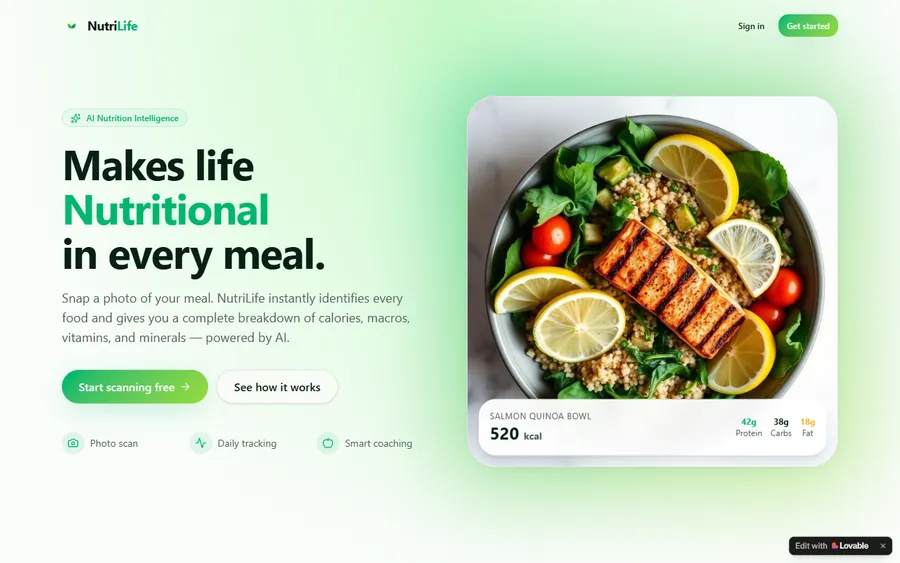
AI and ML
An AI nutrition coach that reads what you eat and works you toward a target.
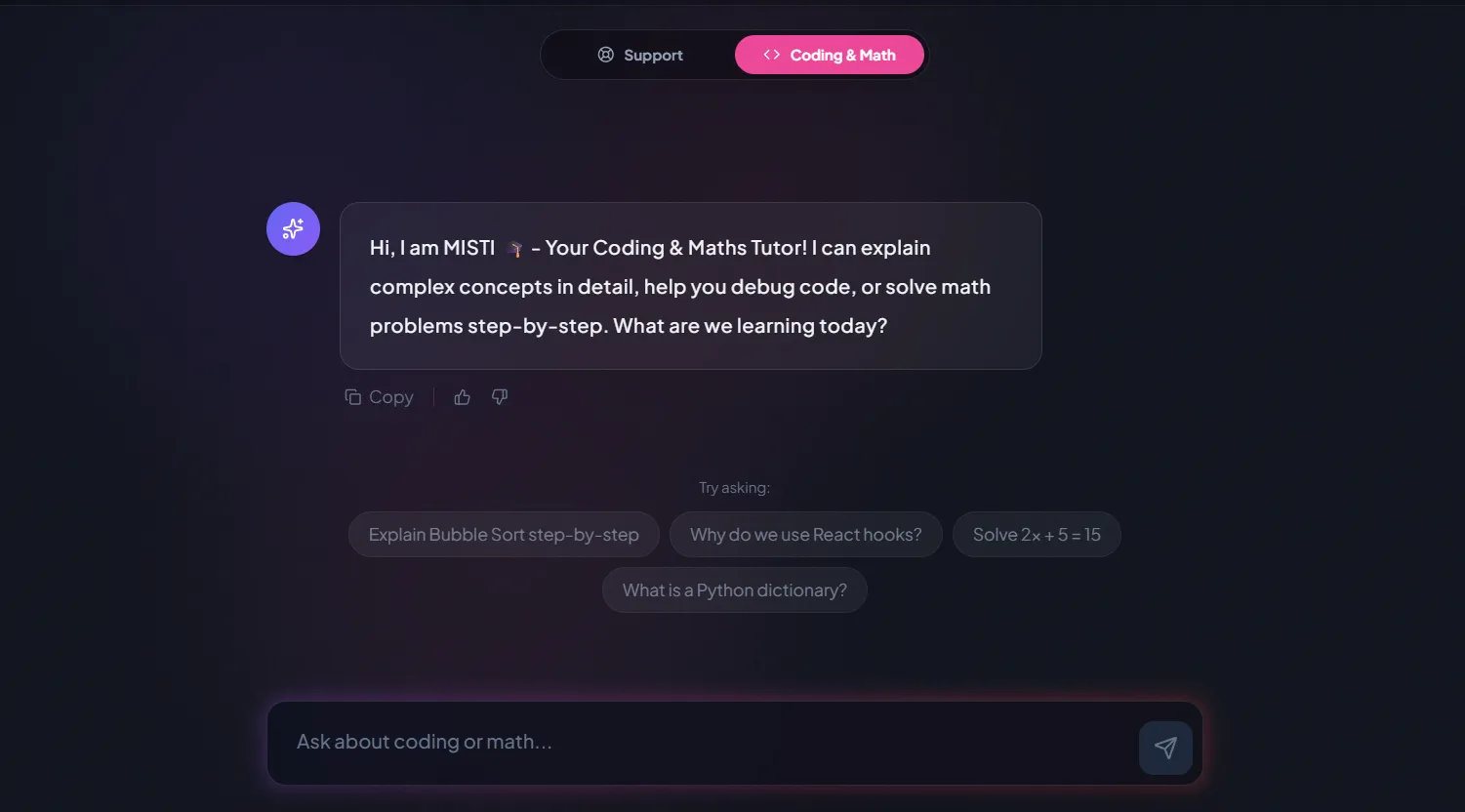
AI and ML
A chatbot that answers mathematics and programming questions, built and deployed by a student.
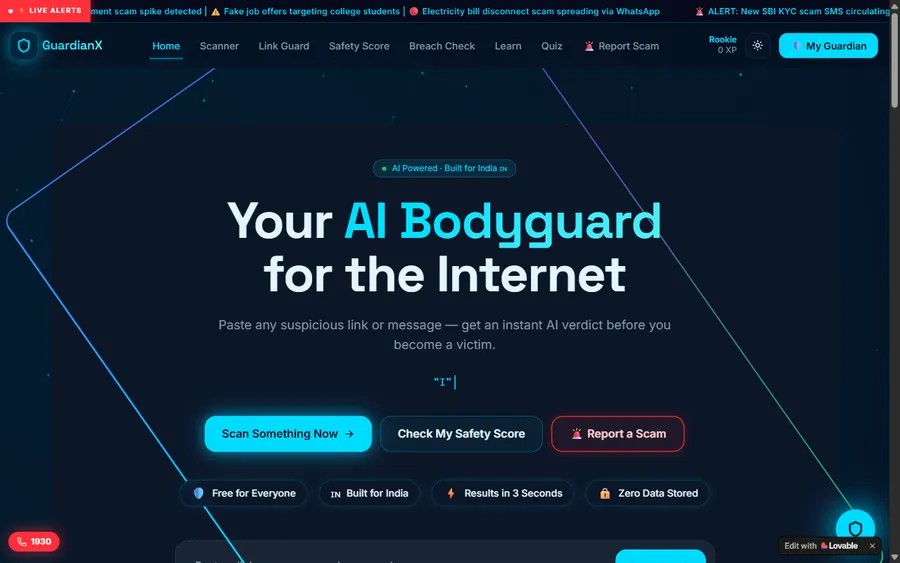
AI and ML
An assistant that helps a young person recognise unsafe situations online.
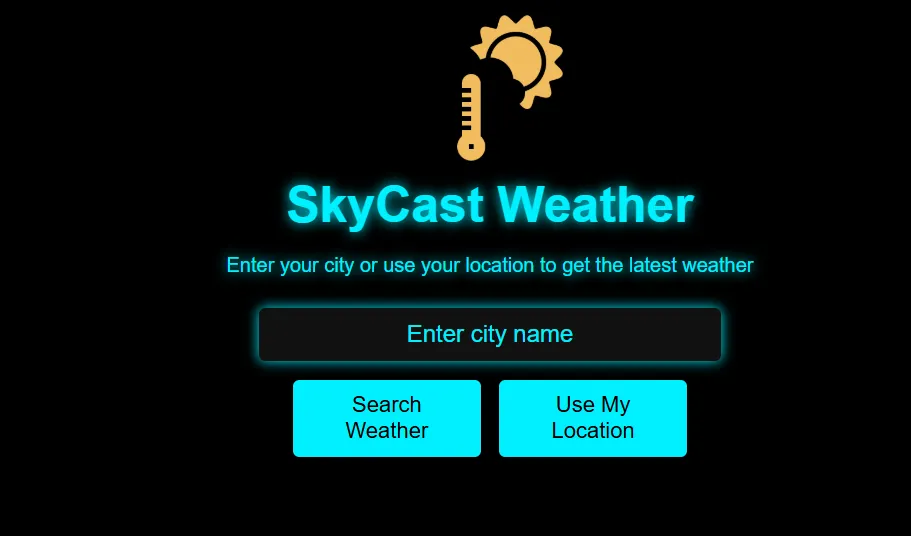
Web app
A weather forecasting site with live conditions for any location.
Fees
Paid monthly in US dollars, at one rate for every country outside India and every stage of the roadmap, with nothing to pay on joining and no yearly tie-in.
Free first class
USD 0
no card required
Group batch
USD 100
a month, billed in US dollars
One to one
USD 150
a month, billed in US dollars
What families say
From Google, as written. We do not write or pay for reviews.
★★★★★
"The one step solution for my son. Modern Age Coders make learning coding so simple that kids love it. The teachers explain complex concepts clearly with practical exercises and interactive content."
Ria Mukherjee
Parent
★★★★★
"Modern Age Coders has been a game-changer for me. I struggled to grasp IT concepts and coding before joining, but their classes transformed everything. I can now confidently write complex programs with ease."
Samriddha Mondal
Student
★★★★★
"One of the most wonderful education centres out there. Education is not limited to school syllabus but focuses on skill development."
Vansh Agarwal
Student
★★★★★
"My child Dhairya is really enjoying the Modern Age Coders classes. This is his first online class and he eagerly looks forward to it. I can already see his improvement, and the teachers are very cooperative."
Sonam Oswal
Parent of Dhairya
★★★★★
"Modern Age Coders have wonderful teachers who teach in a clear, easy and practical way. The teacher boosts students' confidence and inspires them to learn without hesitation."
Sonu Goyal
Parent
★★★★★
"I highly recommend this computer coding class! The teachers are incredibly knowledgeable and passionate about coding."
Ritu Kedia
Parent
Questions from parents
Around groep 6 to 8 for typed Python, or earlier with blocks. Starting later is fine: older pupils climb the first stages faster.
You should see things: games, programs, charts and projects your child made and can explain. The roadmap table lists what to expect at each stage.
Yes. The stages are the same, at a pace that suits the route. The Media, vormgeving en ICT profile pairs well with it, and the step to mbo or havo is a good moment for a larger project.
Havo and vwo pupils choose one of four profiles on entering the bovenbouw. A term of real programming in the third year helps a pupil choose from experience.
Yes. A model, app or analysis makes a strong profielwerkstuk, as long as the work is the pupil's own and the school's rules are followed.
They are placed by ability, not school year, so a quick learner moves on as soon as a stage is secure.
Yes, with Dutch school terms kept. Programming languages are written in English anyway.
The first lesson costs nothing. From then on it is USD 100 a month for a seat in a group of five to ten, or USD 150 a month for private lessons, paid in US dollars, with no sign-up fee and no annual tie-in.
After school or at the weekend, Dutch time. Teachers are three and a half hours ahead in summer and four and a half in winter.
Someone from our team phones a parent back, at a time that suits a Dutch family, to book the free lesson, where the starting stage is agreed. There is no charge unless your child continues.
Elsewhere on this site
Detail for each age group and each subject along the way.
The first stage, with primary-school timing.
The secondary-school stages in detail.
The language the roadmap is built on.
The models stage in depth.
For pupils taking the school subject.
The national ladder behind the roadmap.
Start here
Send a parent's number and we phone back at a convenient Dutch time. In the free lesson a teacher works with your child and tells you honestly where on the roadmap they start.
Would you like to read first? See the general coding roadmap, how we teach and the course list.
WhatsApp us · +91 91233 66161 · contact@modernagecoders.com
WhatsApp from a Dutch phone is free and usually quickest. The number is Indian; we have no office or premises in the Netherlands.