Table of Contents
It is the question every parent and every career-changer is asking in 2026: if an AI can write code in seconds, why should anyone spend months learning to do it by hand? It is a fair question, and the honest answer is not the one the loudest voices on either side will give you.
Coding is still worth learning. In many ways it matters more now than it did five years ago. But what it means to learn coding has changed, and getting that part right is the difference between a skill that lasts and a few weekends wasted on a chatbot.
The short answer, up front
AI has made writing lines of code faster. It has not made understanding code less important. Someone still has to decide what to build, break a vague idea into clear steps, check whether the AI's output is actually correct, and fix it when it quietly breaks. Every one of those jobs needs a person who understands how code works.
The people who get the most out of AI coding tools are, almost without exception, the people who already know how to code. AI is a power tool. A power tool in trained hands builds a house. In untrained hands it is just faster at making mistakes.
What AI actually changed
It helps to be precise about what is genuinely different in 2026, because the hype flattens it into either everything or nothing.
- Speed of typing code went up. Boilerplate, repetitive functions and first drafts arrive in seconds instead of minutes.
- The starting line moved. A beginner can now see a working result faster, which is motivating, and can also hide how little they understand.
- The job shifted from writing every line to directing, reading and correcting what a machine writes. That is a real change, and it rewards a different mix of skills.
- The cost of not understanding went up. When AI writes most of the code, the human's value is entirely in judgment, and judgment cannot be faked.
What AI still cannot do for you
This is the part the marketing skips. Current AI is extraordinary at producing plausible code and genuinely weak at several things that decide whether software actually works.
- Decide what to build. AI answers prompts. It does not know what your users need, what matters, or what to leave out. That judgment is the whole job.
- Know when it is wrong. AI will produce confident, clean, completely incorrect code, and it will not warn you. Only someone who understands the problem can catch it.
- Debug a subtle failure. When a program runs but gives the wrong answer once in a hundred times, you need to reason about how it works. AI is a poor detective on code it half-wrote.
- Hold the whole system in mind. Real projects have moving parts that interact. Understanding how a change here breaks something there is human work.
- Take responsibility. When the code ships and something goes wrong, a person answers for it. You cannot delegate accountability to a tool.
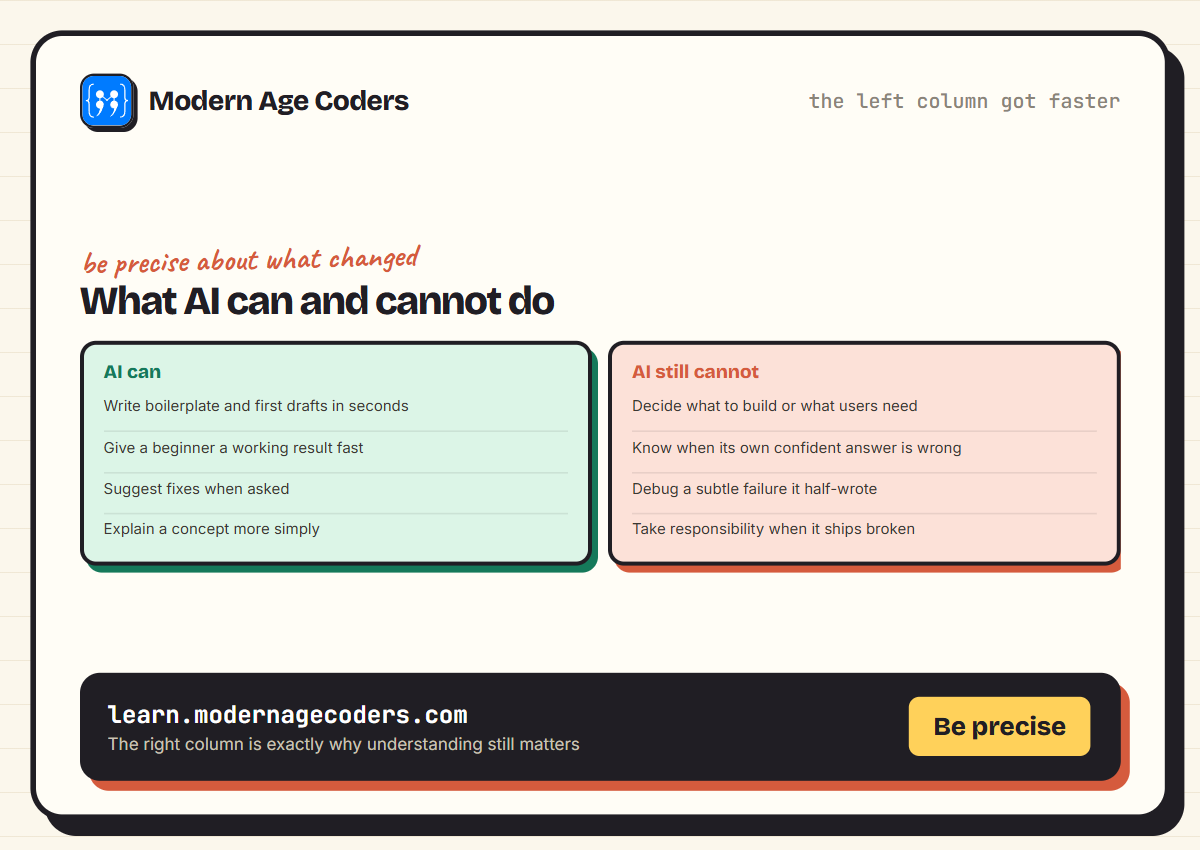
| What AI can do | What AI still cannot do |
|---|---|
| Write boilerplate and first drafts in seconds | Decide what to build or what your users need |
| Give a beginner a working result fast | Know when its own confident answer is wrong |
| Suggest fixes when asked | Debug a subtle failure it half-wrote |
| Speed up someone who already understands code | Hold a whole real system in mind at once |
| Explain a concept in simpler terms | Take responsibility when the code ships broken |
The vibe coding trap
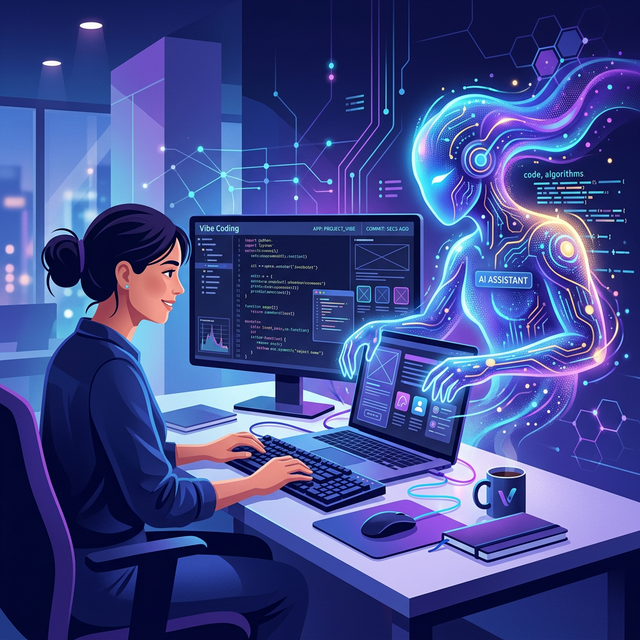
In 2025 the phrase vibe coding took off: describe what you want in plain language, let the AI build it, and ship without reading the code. For quick prototypes it is genuinely useful. As a way to learn, it is a trap.
A student who only vibe codes builds a growing pile of software they cannot read, cannot fix and cannot extend. The moment the AI gets stuck, so do they, because they never built the understanding to take over. It feels productive and teaches almost nothing. The students who thrive with AI tools are the ones who can read every line the machine writes and know why it is there.
What learning to code should mean in 2026
The old debate was which language to learn first. The real question now is how to learn so the skill survives the next tool. Three things matter.
- Fundamentals over syntax. Loops, logic, data, how a program is structured, how to break a problem into steps. These do not change when the tools do, and they are exactly what lets you direct AI well.
- Build real things, not just watch tutorials. Understanding shows up when you make something that runs, hits a bug, and you fix it yourself. That is where the learning actually happens.
- Use AI as a tutor and a tool, not a substitute. Read what it writes, ask it why, and correct it. Used that way, AI makes a learner faster. Used as a crutch, it makes them dependent.
So who should still learn to code?
Children and teenagers, because coding builds the logical thinking and problem solving that helps across school and every future career, whatever they end up doing. Career changers, because the roles that pay are shifting toward people who can direct and check AI, not away from them. Working professionals, because being the person on the team who understands what the AI is producing is quietly becoming one of the most valuable positions in any company.
The one group who should not bother is anyone hoping to learn nothing and let a chatbot do it all. That was never coding, and it does not lead anywhere.
Children do not need another app that teaches them to copy code. They need a mentor who teaches them to think.
, Shivam Khemka, Founder of Modern Age Coders
The bottom line
Coding in 2026 is worth learning precisely because AI is so good at writing it. The scarce, valuable skill is no longer typing code. It is understanding it well enough to decide, direct, check and fix. That is a human skill, it takes real teaching, and it is exactly what a live class with a mentor is for. At Modern Age Coders we teach coding and maths to all ages, 6 to 67, live and in small batches, and we are rated 4.9 across 547 Google reviews. There is a free demo class before you pay, so you can judge the teaching first.
No. AI has changed what programmers do, not removed the need for them. It writes code quickly but cannot decide what to build, verify that the result is correct, or debug subtle failures on its own. Those jobs need people who understand code, and demand for that judgment is rising, not falling.
No. It is arguably a better time than ever, because AI tools let a beginner see results faster and act as an always-available tutor. What matters is learning the fundamentals and building real projects, not just prompting a chatbot. Start with the basics and use AI to speed up your understanding, not to skip it.
Yes. For children, coding is less about a job and more about how it builds logical thinking, problem solving and confidence, skills that help across school and any future career. A child who learns to think in steps and to build real things is well placed to direct AI tools rather than be replaced by them.
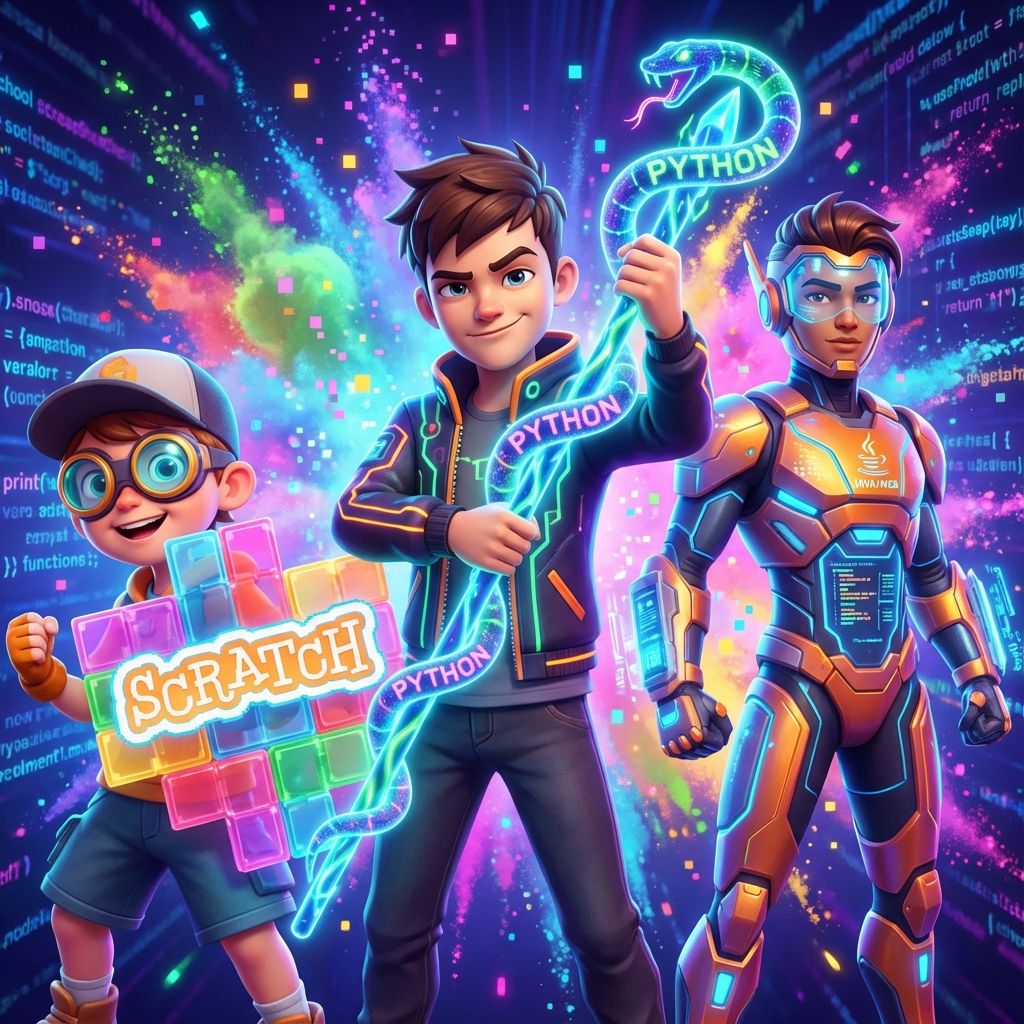
Both, in the right order. Learn the fundamentals first, usually with a language like Python or, for younger children, a visual tool like Scratch, so you understand how code works. Then use AI tools such as coding assistants to work faster. Tools without fundamentals leaves you unable to check or fix what the AI writes.
Vibe coding, letting an AI build software from a plain-language description without reading the code, is useful for quick prototypes but a poor way to learn. Learners who only vibe code end up with software they cannot read or fix. The students who thrive with AI can read every line it writes and know why it is there.
Focus on fundamentals over syntax, build real projects so understanding sticks, and use AI as a tutor you question rather than a substitute you copy. A live class with a mentor who reviews your work and answers why, not just what, is the fastest honest path. Modern Age Coders teaches exactly this way, live and in small batches for ages 6 to 67.