Table of Contents
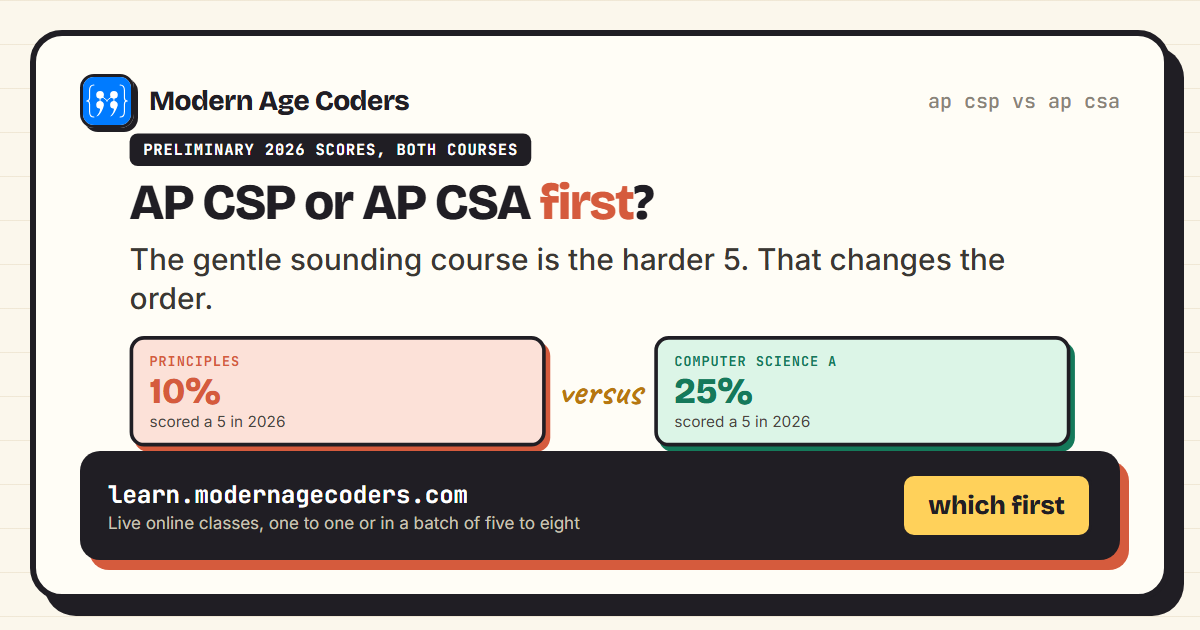
Is AP CSA harder than AP CSP? To learn, yes: Computer Science A means writing Java from memory, with a three-hour exam that is all programming. To score a 5 in, no: in College Board's published 2026 score distributions, 25 per cent of Computer Science A candidates scored a 5 against 10 per cent in Principles. Principles is broader and gentler, a project year with multiple-choice and written responses; Computer Science A is a Java programming year.
AP CSP vs AP CSA at a glance
| AP Computer Science Principles | AP Computer Science A | |
|---|---|---|
| What you learn | Five big ideas: creative development, data, algorithms and programming, computer systems and networks, the impact of computing | Programming in a subset of Java: objects and methods, selection and iteration, class creation, data collections |
| Programming | Your own Create task program; exam questions on algorithms and code | Java throughout, typed in the exam |
| Assessment | Create performance task (9 hours of class time) plus the end-of-course exam | End-of-course exam only |
| Exam | 70 multiple-choice questions in 120 minutes (70%); 60-minute written response on your Create task (30%) | 42 multiple-choice questions in 1 hour 30 minutes (55%); 4 free-response questions in 1 hour 30 minutes (45%) |
| 2027 dates | Create task due Friday 30 April 2027, 11:59 p.m. ET; exam Friday 14 May 2027, Session 1 (typically morning) | Exam Wednesday 12 May 2027, Session 2 (typically afternoon) |
| College equivalent | A first-semester introductory college course in computing | A one-semester introductory college course in computer science |
| Recommended before | High school algebra | High school English and algebra, and familiarity with functions |
All dates and formats above are from College Board's AP Students and AP Central pages, checked on 23 September 2026. Both exams are digital, taken in the Bluebook app; your AP coordinator confirms the exact start times.
The standard advice is so widespread that most families never question it. Take AP Computer Science Principles in Grade 10 as the gentle introduction, then AP Computer Science A in Grade 11 or 12 once the student has some confidence. It sounds obviously right. For a large number of students it is exactly backwards, and the 2026 results make the case better than any argument could.
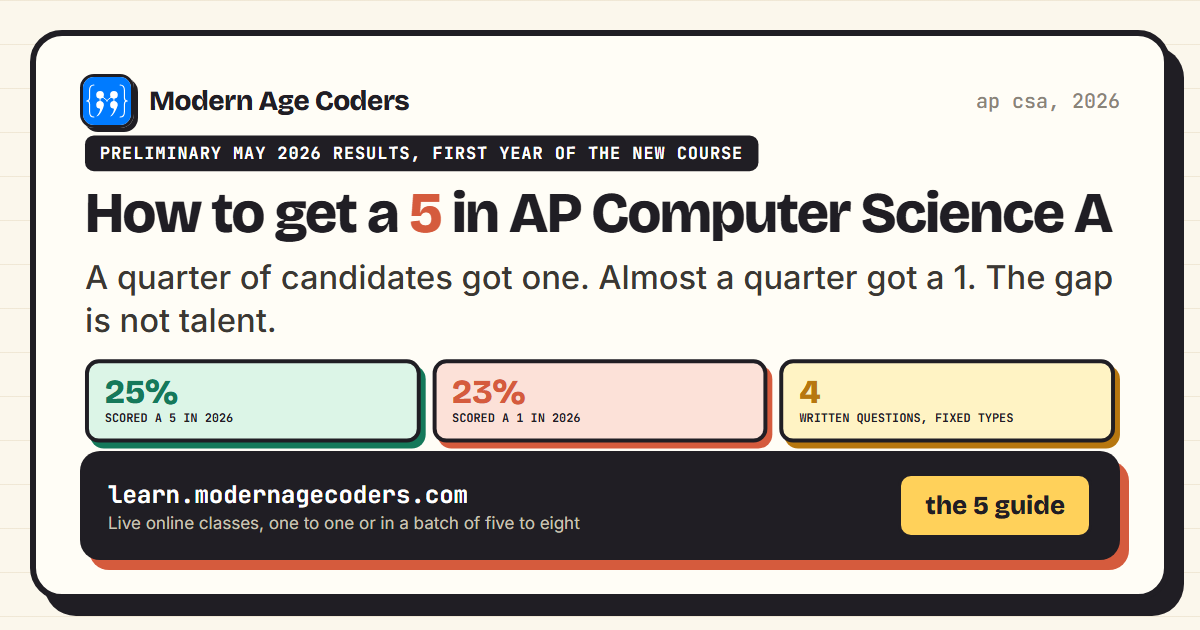
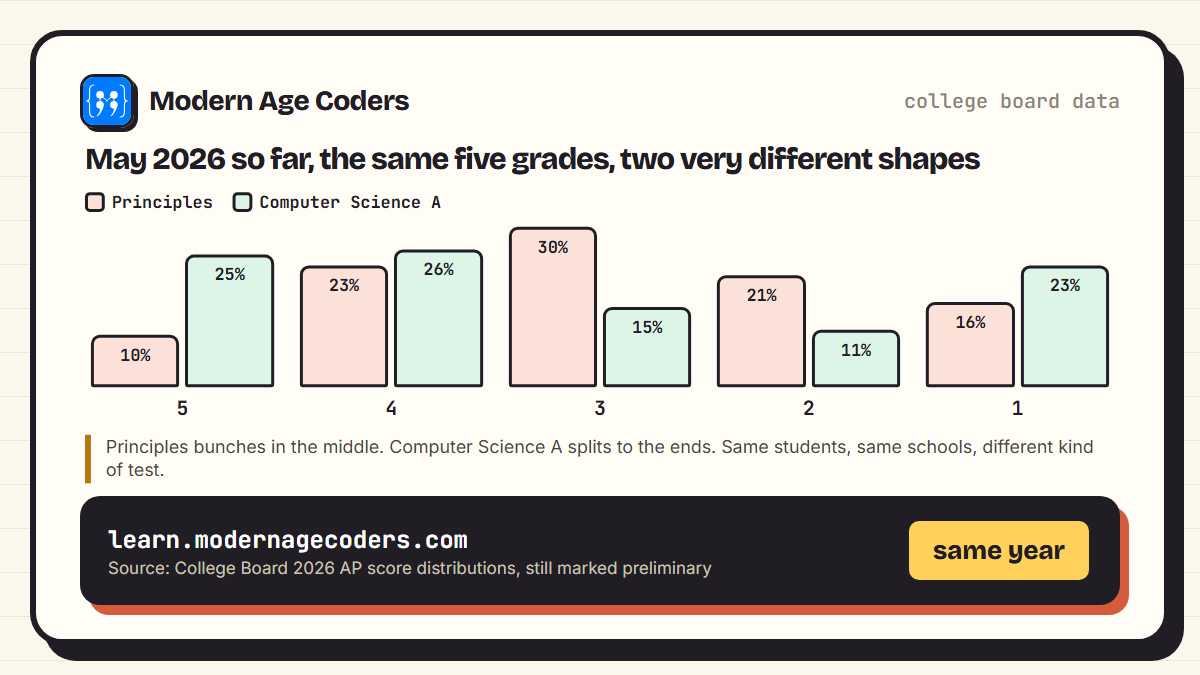
In May 2026, 10 per cent of Principles candidates scored a 5. In the same month, 25 per cent of Computer Science A candidates scored a 5. Both are College Board's preliminary numbers for that year, published ahead of the final counts. The course everyone calls the hard one is two and a half times more likely to produce the top grade.
The two distributions, side by side
| Score | Principles 2026 | Computer Science A 2026 |
|---|---|---|
| 5 | 10% | 25% |
| 4 | 23% | 26% |
| 3 | 30% | 15% |
| 2 | 21% | 11% |
| 1 | 16% | 23% |
| 3 or higher | 63% | 66% |
Read the middle row. Principles sends 30 per cent of its candidates home with a 3, more than any other grade. It is a course that reliably gets students to a pass and rarely past it. Computer Science A is the opposite: the 3 is its rarest outcome after the 2. It sorts, hard, and it sorts on one thing.
Why the shapes differ
Principles asks a broad range of questions about computing, plus written responses about a program you wrote months earlier. Partial credit is available almost everywhere, which lifts weak candidates to a 3 and stops strong ones running away. Computer Science A asks you to write working Java. Code either does the thing or it does not, and a paper made of that produces two clumps of students rather than a curve.
What a year in each course actually looks like
Difficulty is the wrong axis anyway. The useful question is what kind of work the student will be doing for a year, because that is what determines whether they finish it.
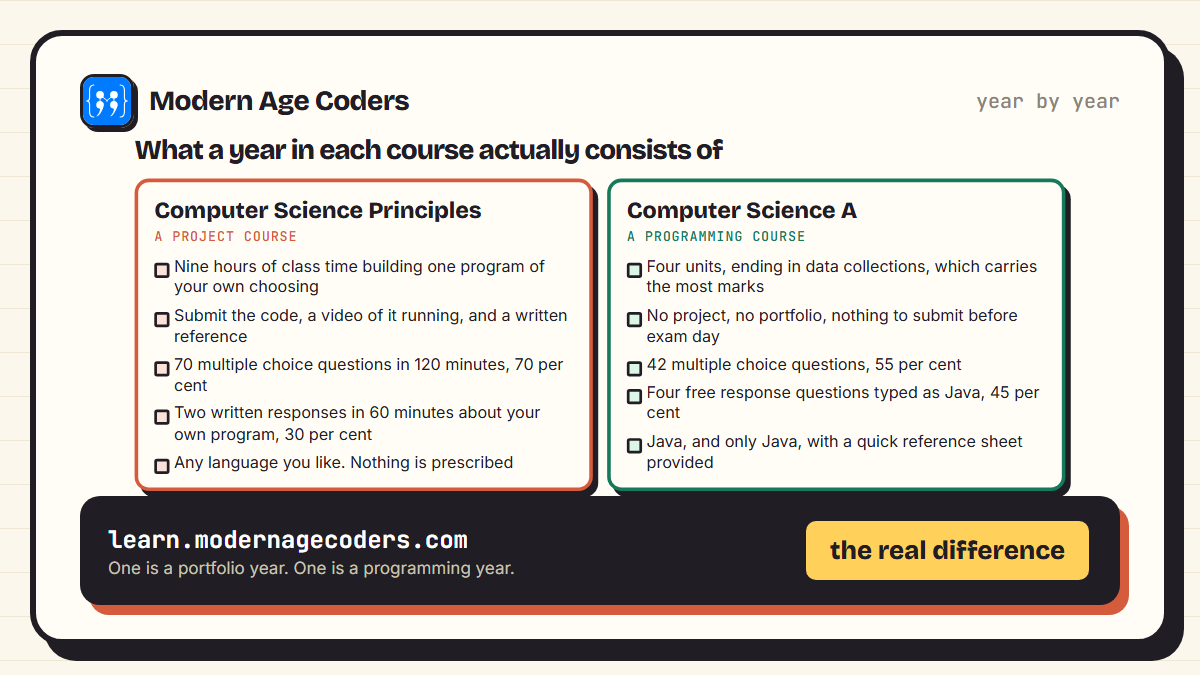
Principles is built around the Create performance task. Students get at least nine hours of class time to build a program of their own choosing, then submit the code, a video of it running, and a Personalized Project Reference through the AP Digital Portfolio by the end of April. The exam itself is 70 multiple choice questions in 120 minutes for 70 per cent of the score, and a 60 minute written response section for the other 30 per cent, in which students answer questions about their own program with the reference document in front of them.
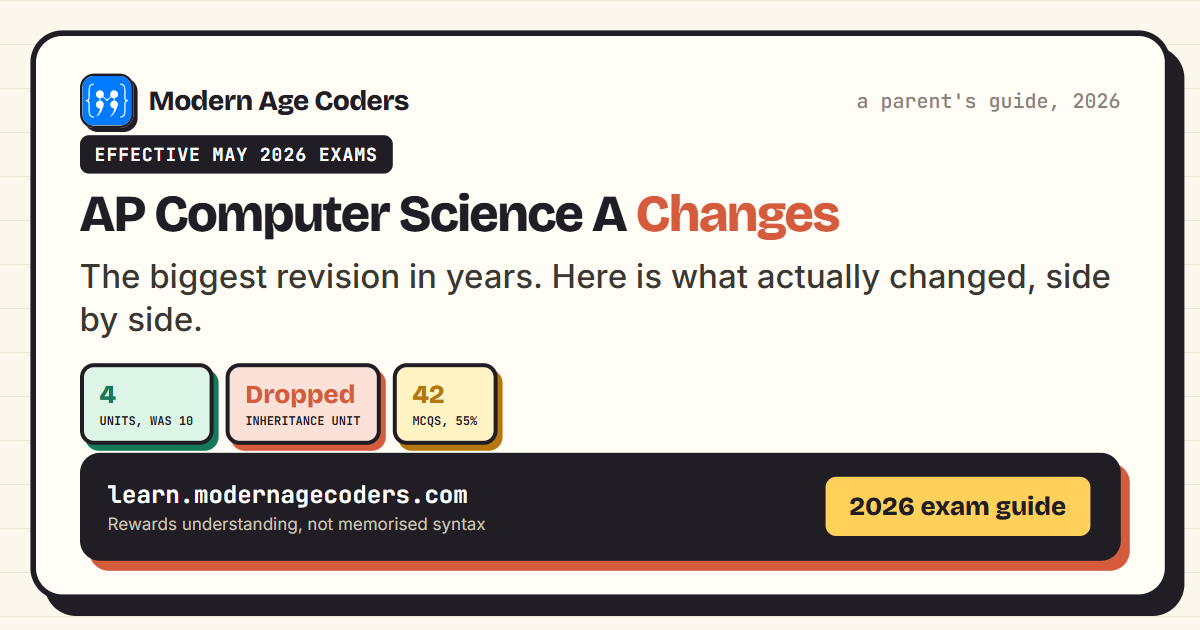
Computer Science A has no project and nothing to submit. Four units, Java throughout, and a three hour exam split into 42 multiple choice questions at 55 per cent and four typed free response questions at 45 per cent. The four written questions are always the same four types: methods and control structures, class design, data analysis with ArrayList, and 2D arrays.
Its four units, with their share of the exam from College Board's course page: Using Objects and Methods (15 to 25 per cent), Selection and Iteration (25 to 35 per cent), Class Creation (10 to 18 per cent) and Data Collections (30 to 40 per cent).
The part of Principles that surprises people
The Create program is not marked as a program. It is developed across the year and submitted, but the thirty percentage points come from what the student writes about it in the exam room, from memory and their reference document. A student who built something impressive with a lot of help cannot answer those questions, which is the single most common way a strong looking Principles candidate lands on a 3.
The same task in both languages
Here is a way to feel the difference rather than read about it. The Create task requires a program containing six specific things: a procedure you wrote that takes a parameter which affects what it does, a call to that procedure, a list, a use of that list, selection, and iteration. This is the whole of it, in Python.
def passing(scores, cutoff):
    kept = []
    for s in scores:
        if s >= cutoff:
            kept.append(s)
    return kept


marks = [72, 45, 91, 58, 30]
print(passing(marks, 50))
print(passing(marks, 90))
[72, 91, 58]
[91]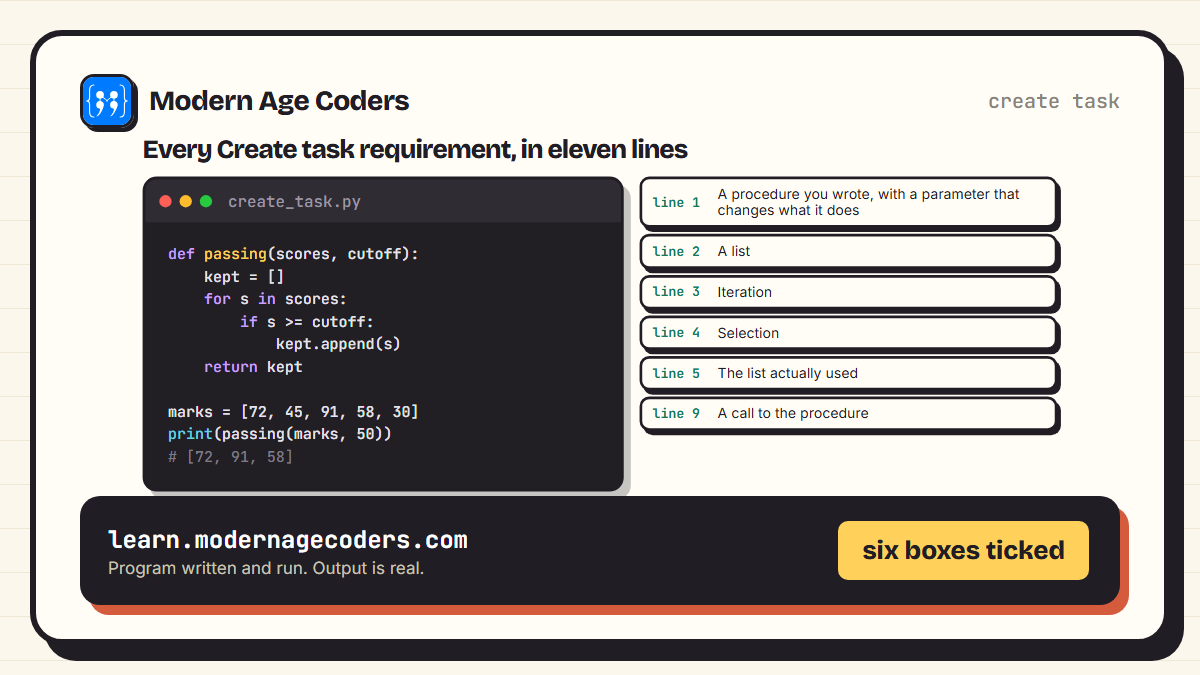
That program, or something no more complicated than it wrapped in a purpose a student can defend, meets the technical bar. What Principles then asks is whether the student can explain in writing why the procedure needs its parameter, what would break without the loop, and how they tested it. The programming is the small part.
Now the same task as Computer Science A would ask for it.
import java.util.ArrayList;
import java.util.List;

public class Passing {
    public static List<Integer> passing(List<Integer> scores, int cutoff) {
        List<Integer> kept = new ArrayList<Integer>();
        for (int s : scores) {
            if (s >= cutoff) {
                kept.add(s);
            }
        }
        return kept;
    }

    public static void main(String[] args) {
        List<Integer> marks = List.of(72, 45, 91, 58, 30);
        System.out.println(passing(marks, 50));
        System.out.println(passing(marks, 90));
    }
}
[72, 91, 58]
[91]Identical output. Roughly three times the syntax, all of it typed from memory in a plain editor with no compiler and nothing underlining a missing semicolon. That is the actual difference between the two courses, and any student can decide which of those two pages they would rather spend a year on.
Which one to take first
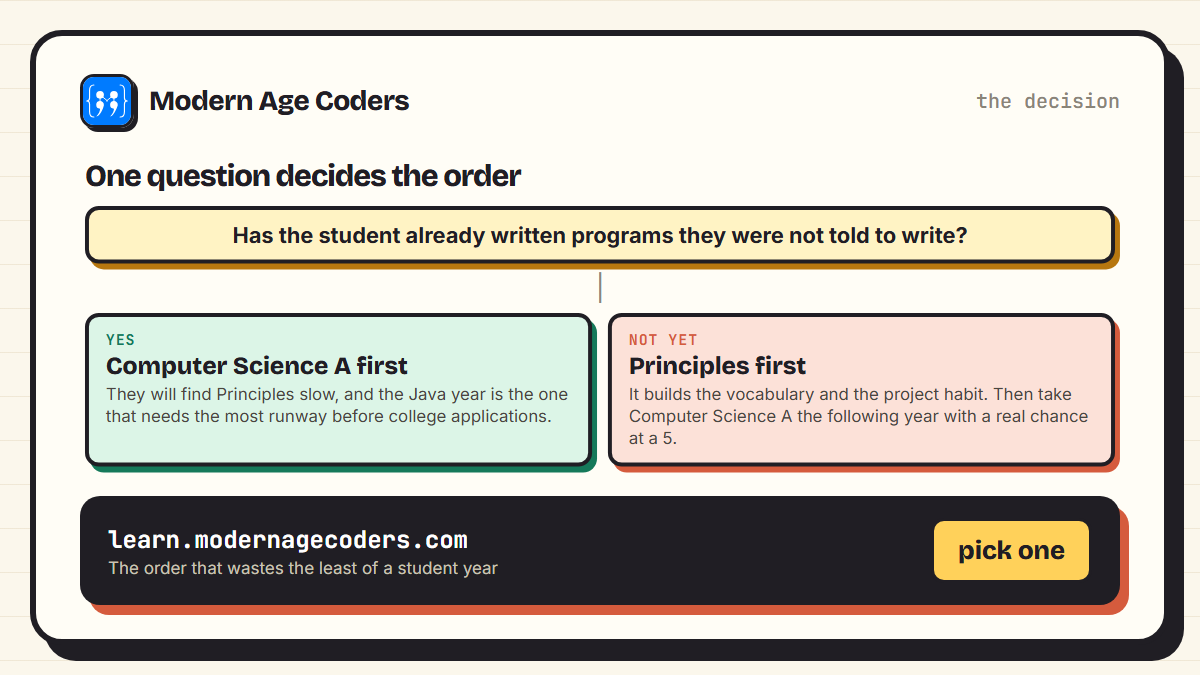
Here is the question we ask on the first free class, and it predicts the right order better than any test score: has this student ever written a program nobody asked them to write? A game, a bot, a script to rename files, anything at all that was their own idea.
- If yes, take Computer Science A first. They will find Principles slow, and slow is the enemy of a fifteen year old's interest. Doing the Java year while the enthusiasm is live gets a 5 on the record early, and Principles afterwards becomes a comfortable second AP rather than a year of waiting.
- If not yet, take Principles first. Not because it is easier, but because it builds two things the Java year assumes: the vocabulary to talk about programs, and the habit of finishing a project. A student who arrives at Computer Science A with those already in place has a far better shot at the 25 per cent than one arriving cold.
- If the school only offers one, take that one. A well taught course with a teacher who knows the student beats the theoretically optimal choice studied alone, every time.
Two things to sanity check before deciding. The exams are in the same window in May, so taking both in one year means preparing a project and a Java paper in the same spring, which is doable but not for a first year of programming. And credit policies differ from college to college, sometimes sharply, so it is worth ten minutes on the AP credit page of two or three colleges the student cares about before treating either course as a credit strategy.
The mistake that costs a grade in each
For Principles, it is leaving the Create task until March. The program has to be finished, filmed and documented before the deadline at the end of April, and a student who starts in March writes something they cannot explain under exam conditions six weeks later. Start it in the autumn, finish it by February, and spend the spring rehearsing the written responses about it.
For Computer Science A, it is treating the four free response questions as four unpredictable problems. They are four fixed types. A student who has written twenty classes to somebody else's written specification does not have to think on exam day, and the minutes that saves usually decide whether question 4 gets finished.
Nobody has ever regretted taking the Java course first because it was too hard. Plenty have drifted out of computing because the introductory course was too slow to hold them.
, What a decade of teaching both has taught us
How we teach both
Our AP Computer Science Principles coaching spends most of its time on the two things that decide the grade, which are the written responses about the student's own program and the reading heavy multiple choice, rather than on building an impressive project. Our AP Computer Science A classes spend most of theirs inside collections, because collections decide close to half of that paper.
Every class is live, one to one, in a mini batch of three or four, or in a group of five to ten students, taught from India to students worldwide. The first class is free, no card is asked for, and the single most useful thing to bring to it is the honest answer to the question above about programs nobody asked for.
Frequently asked questions
Harder to learn, yes: Computer Science A is a year of Java and an exam made entirely of programming questions. Harder to get a 5 in, no: in College Board's published 2026 score distributions, 25 per cent of Computer Science A candidates scored a 5 against 10 per cent in Principles.
Principles is a broad introduction to computing across five big ideas, with a through-year Create project and an exam of multiple-choice and written responses. Computer Science A is a programming course in Java, assessed only by an exam of 42 multiple-choice and 4 free-response questions.
AP Computer Science A is on Wednesday 12 May 2027 in Session 2 (typically the afternoon). AP Computer Science Principles is on Friday 14 May 2027 in Session 1 (typically the morning), and its Create performance task must be submitted by Friday 30 April 2027 at 11:59 p.m. ET. Your AP coordinator confirms local times.
Yes, and many do. Principles is not a prerequisite for anything. Computer Science A starts from Java syntax and assumes no prior programming, only the ability to reason through a problem in ordered steps.
Neither is universally preferred and anyone who tells you otherwise is guessing. What admissions readers respond to is evidence of sustained interest, so two years of computing beats one year of the theoretically better course. Credit policies are a separate question and vary by institution, so check the AP credit page of the specific colleges that matter to you.
For most students, yes, and remember the 2026 figures are still preliminary. A 3 or a 4 in Principles is still a pass and still shows a year of computing, and the Create task is genuine experience of finishing something. Just do not take it expecting it to be the easy 5, because the data is clear that it is not.
Whichever one the student can debug without help. Python works well because the code stays short enough to explain in a written response, which is what actually earns the marks. The task is language agnostic and no language earns bonus credit.
Principles takes less week to week and then spikes hard around the Create task. Computer Science A is steadier, three to five hours a week including class, and the load does not drop until the exam. A student with a heavy spring of other commitments will find the Principles spike harder to survive than the Computer Science A grind.
It is allowed and we would rarely advise it in a student's first year of programming. Both exams fall in the same May window, so the Create task deadline and the Java revision land on top of each other. For a student already programming confidently it is a reasonable double.
The submitted program, video and reference are checked and used, but the thirty percentage points are earned by the written responses the student produces in the exam room about that program. This is why building something the student fully understands beats building something impressive.