LCET / KIDS / 01
Block coding for kids
Blocks labelled in English, read aloud as the child builds.
Open the syllabusPeru · Two languages, one class · Ages 6 to adult
Programming is the one subject a Spanish speaker cannot fully take in Spanish. Some of it can be translated, and volunteers are doing exactly that. A large part never will be. This page draws that line from Python's own sources, then shows how a live class taught in English turns the part that stays English into daily language practice, at any age.
Live classes since 2020 · 10,000+ students worldwide · every lesson spoken, read and written in English
The short answer
Yes, you can learn coding and English together. Modern Age Coders teaches programming live and online, in English, to learners in Peru from age 6 to adult, so every lesson uses English for listening, speaking, reading and writing about code. Mentors based in India speak clearly and follow your pace and accent. It is not an English academy: you learn to program, and your technical and spoken English grow because the class happens in English. Lessons run for groups of fifteen to twenty or one to one, whenever suits you.
Start here
Web courses are a natural place to begin, because HTML tags are short English words a beginner meets in the first hour: head, body, title, link.
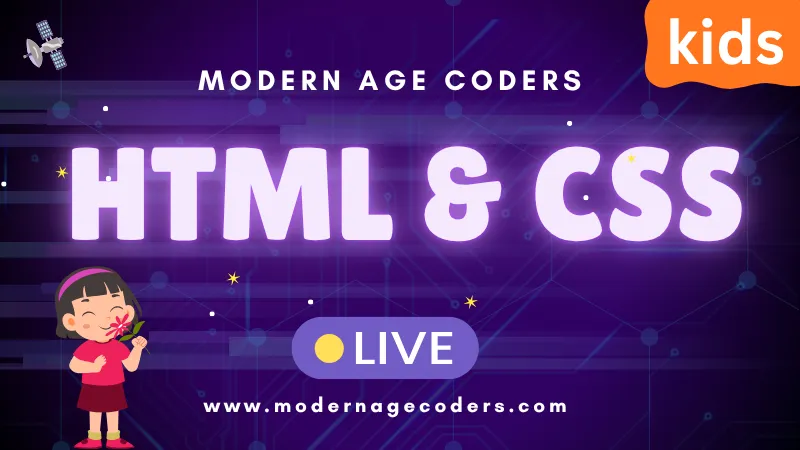
LCET / 01
Ages 8 to 12. A first website, where every tag a child types is an English word they can say aloud.
Open the syllabus →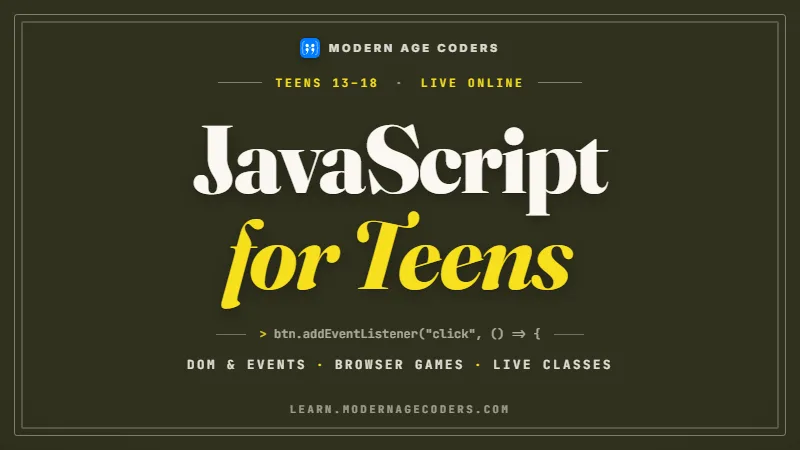
LCET / 02
Ages 13 to 17. Interactive pages and small games, reading documentation in English from the first month.
Open the syllabus →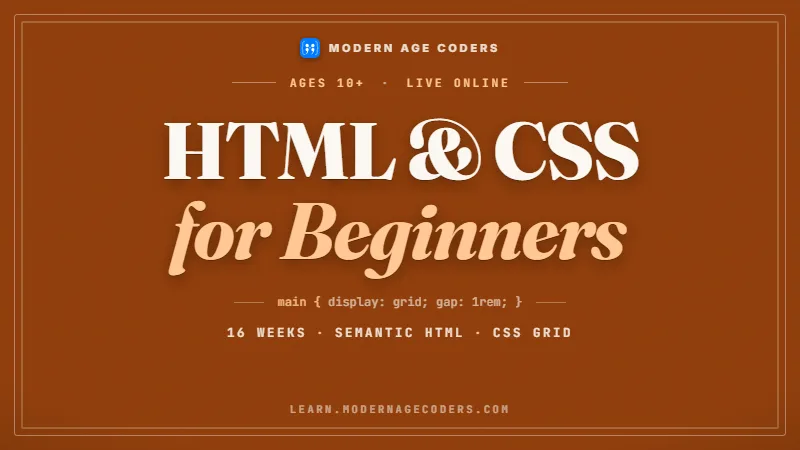
LCET / 03
Adults. Real websites from scratch, with English used for every instruction and every explanation.
Open the syllabus →Where the line falls
Partly in Spanish, never entirely. Explanations, tutorials and even part of the official documentation exist in Spanish. The language itself, its error messages and its standard library are English and will stay so. Here is the line, from Python's own sources and our own test runs.
| Part of the work | In Spanish? | Evidence |
|---|---|---|
| The official documentation | Partly | Spanish translation at 45.83% overall and 12.82% of the core pages (Python Docs Translation Dashboard, 9 November 2026) |
| Your own variable and function names | Yes, accents allowed | PEP 3131 (Python 3.0) allows non-ASCII letters in names; our run accepts año and niños |
| Keywords such as if, while, class | No | Fixed by the language; si and mientras are ordinary names, not keywords (our run) |
| Error messages | No | Still English on a computer set to Peruvian Spanish (our run, Python 3.14.8) |
| Standard library names | No, by policy | PEP 3131: standard library identifiers "MUST use ASCII-only identifiers, and SHOULD use English words wherever feasible" |
Sources: translations.python.org, Python Docs Translation Dashboard, last updated on 9 November 2026; Python Developer's Guide, "Translating"; PEP 3131, "Supporting Non-ASCII Identifiers"; our own runs of Python 3.14.8 on 9 November 2026, shown in the lesson below. The dashboard's percentages change as volunteers work; read the live page for today's figure.
Python's developer guide says several documentation translations are already in production and reachable from the language switcher, each run by a volunteer team; Spanish has one. On 9 November 2026 the dashboard showed Spanish at 45.83% overall but only 12.82% of the core pages, while Japanese stood at 95.98% overall and Brazilian Portuguese at 56.25%.
So a Spanish speaker can read a good part of the documentation in Spanish, with gaps, and the gaps are often in the most used pages. Anyone who wants the full picture ends up reading English.
PEP 3131 opened Python 3 to names in other alphabets, explaining that "Python code is written by many people in the world who are not familiar with the English language". It kept the standard library in ASCII and asked for English words wherever feasible, so code written anywhere still shares one vocabulary.
The result is a deal every Spanish-speaking programmer accepts: name your own things however you like, but read, search and talk about the shared parts in English.
That is the case for learning both at once. A learner taught in Spanish meets the English parts anyway, as unexplained symbols. A learner taught in English meets them as words, said aloud, in sentences. For a Spanish-language view of the same choice, see our page on un curso de Python en inglés.
Four skills in one lesson
By making you use all four language skills for a real purpose, every few minutes, with a patient listener. Peru's national curriculum names those same skills for English at school; a coding class gives them a job to do.
The mentor explains, you answer questions and, above all, you explain your own code aloud. "This loop runs once for each name" is a full English sentence with a precise meaning, said many times a lesson.
Error messages, documentation, instructions and the code itself. A traceback is short, structured English that rewards careful reading: the last line names the problem and the line above shows where.
Comments, names for variables and functions, a short description of each project and, for older learners, questions written to a forum or a teammate. Each is small, frequent and checked.
The CNEB sets three English competencies: to communicate orally in English as a foreign language, to read different types of written texts in English, and to write different types of texts in English. In secundaria the timetable gives English 3 hours a week under the regular school day and 5 under the Jornada Escolar Completa.
A coding class does not replace that. It adds hours where those competencies are used on something the learner has chosen to do.
EF's English Proficiency Index 2025 gives Peru 540 for reading, 499 for listening, 514 for writing and 480 for speaking, its lowest skill. EF tests adults, but the pattern is familiar to many families: English read well, spoken less.
A live class tilts the balance towards speaking and listening, because the main thing you do in it is talk about what you are building with someone who is listening closely.
Families in Lima whose children already study in English at school will find a page written for them: coding for Lima's English-medium pupils.
A real lesson
This lesson is ours. We use it with teenagers and adults in their first weeks of Python, and with confident 11 and 12 year olds. It answers a question Spanish speakers often ask: can I just write my code in Spanish? The answer, found by running code rather than by taking our word for it, is "partly".
año = 2026
niños = ['Ana', 'Luis']
print(año, len(niños))

for name in ['año', 'niños', 'mi_variable', 'mi-variable', '2026año', 'class', 'clase']:
    print(f'{name:<12} {name.isidentifier()}')
isidentifier() asks Python whether a piece of text could be used as a name. The documentation says it returns True if the string is a valid identifier according to the language definition.
2026 2
año          True
niños        True
mi_variable  True
mi-variable  False
2026año      False
class        True
clase        True
Exact output from our run with Python 3.14.8. año and niños work, accents and all. A hyphen is not allowed, and a name cannot start with a digit. And class says True, which turns out to be misleading.
The mentor asks, in English: "If class is a valid identifier, can I write class = 5?" Learners try it and get a syntax error. The word is the right shape for a name, but Python has reserved it. That calls for a second check.
import keyword

for name in ['class', 'clase', 'if', 'si', 'while', 'mientras', 'print', 'imprimir']:
    usable = name.isidentifier() and not keyword.iskeyword(name)
    print(f'{name:<10} keyword: {keyword.iskeyword(name)!s:<6} usable as a name: {usable}')
keyword.iskeyword tells you whether a word is reserved by the language. A name is only usable if it passes both checks.
class      keyword: True   usable as a name: False
clase      keyword: False  usable as a name: True
if         keyword: True   usable as a name: False
si         keyword: False  usable as a name: True
while      keyword: True   usable as a name: False
mientras   keyword: False  usable as a name: True
print      keyword: False  usable as a name: True
imprimir   keyword: False  usable as a name: True
Exact output from our run. Every English keyword is taken, and every Spanish translation is free. The last two lines hide a trap: print is not a keyword, so Python will let you use it as a name.
print is a built-in function, not a keyword. Python allows print = "hola", and the damage only appears on the next line. Step 3 shows it.# run on a computer whose language is set to Spanish (Peru)
imprimir("hola")We ran this with the computer's language set to Spanish (Peru), to see whether Python answers in Spanish.
Traceback (most recent call last):
  File "<string>", line 1, in <module>
    imprimir("hola")
    ^^^^^^^^
NameError: name 'imprimir' is not defined
Exact output from our run. The computer is in Spanish; the error is in English. imprimir is a perfectly legal name, but nothing has that name, so Python reports a NameError.
print = "hola"
print("hola")
The first line is allowed. The second line tries to call the text "hola" as if it were a function.
Traceback (most recent call last):
  File "<string>", line 2, in <module>
    print("hola")
    ~~~~~^^^^^^^^
TypeError: 'str' object is not callable
Exact output from our run. "Object is not callable" is precise technical English: the thing named print is now a string, and you cannot call a string.
By the end of the lesson the learner has met five English words that the language owns, a rule they can state aloud, two error messages they can read word by word, and a practical decision: use Spanish names if you like, but never reuse an English built-in. They have also discovered for themselves why most teams write their names in English anyway. Python's own standard library does exactly that, by policy.
Who it suits
Most learners who already have some school English and want to use it. It suits some people less, and it is better to know that before starting than after.
Children absorb the words of a game or a web page quickly, especially when they built the thing being described. Classes use pictures and short phrases, and parents see both skills grow in the weekly note.
Teenagers get a reason to speak English outside the classroom and a head start on the technical English used at university and online. Their school English hours stay as they are; this adds practice.
For adults, English and coding together are often a work goal. INEI found that 97.3% of Peruvians aged 19 to 24 used the internet in the second quarter of 2026, much of the technical part of it in English.
A learner who cannot yet follow simple spoken instructions in English will struggle to learn programming at the same time. For them, a few months of general English first is kinder.
The free first class answers this honestly. We would rather say "not yet" than see someone discouraged in both subjects at once.
We are not an English academy and we do not teach grammar lessons, give English certificates or prepare for English exams. You learn to program, in English, with mentors who are patient about language.
If English is your main goal, combine our classes with an English course. If programming is your goal and English is a welcome side effect, this is the right place.
Adults in Peru weighing courses alongside a job can read our Spanish page for cursos de programación para adultos. For families planning a summer start, vacaciones útiles virtuales en inglés covers the January to March break.
Teaching language
No. Each class is live and online, and English is the only language of teaching. Mentors in India keep their speech clear, check understanding often and follow the pace and accent of each learner, from a 6-year-old beginner to a fluent adult.
You ask, in English, and the mentor says it another way, shows it on the screen or writes the key word in the chat. "Could you say that more slowly?" is the first useful sentence of the course.
Mentors never switch to Spanish to explain. That can feel hard in the first weeks and is exactly what makes the English grow.
Parents and learners can write to us in Spanish on WhatsApp about schedules, payments or anything else. Only the lessons are in English.
Mentors send a short note after classes for children, saying what was practised in code and which English words were new.
Peru time
Pick any hour. Mentors teach from India, and since Peru and India both ignore daylight saving, the difference between the two clocks never moves.
| Peru time | India time | Day in India |
|---|---|---|
| 6:00 a.m. | 4:30 p.m. | Same day |
| 9:30 a.m. | 8:00 p.m. | Same day |
| 11:00 a.m. | 9:30 p.m. | Same day |
| 2:00 p.m. | 12:30 a.m. | Next day |
| 5:30 p.m. | 4:00 a.m. | Next day |
| 9:30 p.m. | 8:00 a.m. | Next day |
Time zones: Peru, UTC minus 5 all year, no daylight saving (tz database, America/Lima); India, UTC plus 5:30 all year. The difference is always 10 hours 30 minutes, with India ahead.
Adults often take a class before work or late in the evening; children and teenagers usually pick an hour after school. Book in Peru time and we handle the conversion.
Progress
Five stages we use, with a coding side and a language side for each. They are ours and are not linked to any official English scale.
| Stage | In code | In English |
|---|---|---|
| 1. Recognise | Runs and changes small examples | Recognises keywords and common instructions by ear |
| 2. Name | Chooses clear names for variables and functions | Names things precisely: "total", "count", "is_ready" |
| 3. Read | Reads an error message and finds the line | Reads a traceback and says what it means |
| 4. Explain | Explains a whole program step by step | Speaks for a minute about code without switching language |
| 5. Ask and teach | Looks up new functions in documentation | Writes a clear question to a forum or explains a fix to someone else |
Listen for longer English sentences about code over the weeks. That is the most reliable sign that both skills are growing.
A child at stage 3 can tell you what an error message says in Spanish; that translation is itself a good exercise.
Explain every program aloud to someone, even yourself. If you get stuck on a word, write it down and ask the mentor.
Read the last line of an error message first. It is usually the shortest and most useful English sentence on the screen.
More courses
All live, with one mentor through the course, and all using English for every part of the lesson.
LCET / KIDS / 01
Blocks labelled in English, read aloud as the child builds.
Open the syllabusLCET / KIDS / 02
A first typed language, explained one English word at a time.
Open the syllabusLCET / KIDS / 03
Commands and loops in a world children love to describe.
Open the syllabusLCET / TEEN / 01
From first program to files and classes, with documentation in English.
Open the syllabusLCET / TEEN / 02
Interfaces built from English-named tags and properties.
Open the syllabusLCET / TEEN / 03
Charts and findings explained in short English reports.
Open the syllabusLCET / ADULT / 01
The whole language, for adults starting fresh.
Open the syllabusLCET / ADULT / 02
Working with data at work, explained in plain English.
Open the syllabusLCET / ADULT / 03
Front end to database, with English technical writing throughout.
Open the syllabusHow it works
Any day, any time, flexible: choose a batch, or for a very personalised plan choose 1-on-1 at the hour that suits your family.
Before work
Early hours in Peru time for adults.
After school
Afternoons and evenings for children and teenagers.
When you choose
One-to-one lessons on your own timetable.
The whole lesson, with patience for every level.
Learners explain their code aloud every class.
New technical words written in the chat and reviewed.
Tracebacks read together, word by word.
The same person, who learns how you speak and think.
A class of fifteen to twenty at your level, or private lessons.
Student work
Projects our older students built and then presented in English. More can be found on the student labs page.

AI and ML
An AI nutrition coach that reads what you eat and works you toward a target.

AI and ML
A chatbot that answers mathematics and programming questions, built and deployed by a student.

AI and ML
An assistant that helps a young person recognise unsafe situations online.

Web app
A weather forecasting site with live conditions for any location.
Fees
Fees are monthly and shown below in US dollars. You pay with a card, and the bank that issued it converts the amount into soles using its own rate, so your statement may show a slightly different figure each month.
Free first class
Free
no card required
Group batch
$100 USD
a month, eight live classes
One to one
$150 USD
a month, eight live classes
What families say
Reviews from Google, in the words families and learners used.
★★★★★
"The one step solution for my son. Modern Age Coders make learning coding so simple that kids love it. The teachers explain complex concepts clearly with practical exercises and interactive content."
Ria Mukherjee
Parent
★★★★★
"Modern Age Coders has been a game-changer for me. I struggled to grasp IT concepts and coding before joining, but their classes transformed everything. I can now confidently write complex programs with ease."
Samriddha Mondal
Student
★★★★★
"One of the most wonderful education centres out there. Education is not limited to school syllabus but focuses on skill development."
Vansh Agarwal
Student
★★★★★
"My child Dhairya is really enjoying the Modern Age Coders classes. This is his first online class and he eagerly looks forward to it. I can already see his improvement, and the teachers are very cooperative."
Sonam Oswal
Parent of Dhairya
★★★★★
"Modern Age Coders have wonderful teachers who teach in a clear, easy and practical way. The teacher boosts students' confidence and inspires them to learn without hesitation."
Sonu Goyal
Parent
★★★★★
"I highly recommend this computer coding class! The teachers are incredibly knowledgeable and passionate about coding."
Ritu Kedia
Parent
Learners in Peru ask
No. Lessons are live and online, and they are given in English only. Mentors in India speak clearly and adjust to your pace and accent, and you can message us in Spanish on WhatsApp about anything outside the lesson.
Only partly. Tutorials and part of the official Python documentation exist in Spanish, but keywords, error messages and standard library names are English and stay that way. Learning in English means meeting them as words rather than symbols.
Your technical English and your spoken English usually do, because you listen, read and explain code in English every lesson. It is not a grammar course, and we do not give English certificates.
Enough to follow simple spoken instructions. Children start with pictures and short phrases; adults with basic school English can begin. The free first class checks this and tells you honestly if you should wait.
Yes. Python 3 accepts names such as año and niños. We still recommend English names for anything you share, and never reusing a built-in such as print, as the lesson on this page shows.
Both. We teach from age 6 to adults of any age, with separate groups and courses by age. Adults often take one-to-one classes around work.
Any day, any time, flexible: choose a batch, or for a very personalised plan choose 1-on-1 at the hour that suits your family. The two clocks differ by 10 hours 30 minutes on every day of the year, India ahead: 9:30 a.m. in Lima is 8:00 p.m. there.
At the end of a course you receive our own certificate of completion for the programming course. It is not an English certificate, a Peruvian qualification or a university credit.
No. Modern Age Coders has no tie to MINEDU, to any school or to any university. The classes sit beside your studies or your job.
You pay monthly by card, in US dollars, and your card issuer turns that into soles. The trial class costs nothing and asks for no card details.
Elsewhere on this site
Related pages, all in English.
Why practice and explanation beat watching videos.
Reading error messages as clues.
One live class, start to finish.
Understanding before tools, at every age.
Projects our students built and presented.
The full list of what we teach in Peru.
Part of the guide: Every Peru page
More guides: Coding and AI classes in Peru · En español: clases de programación en inglés · Start here: English-medium coding in Lima · By age and stage: AI and coding for professionals · Subjects and courses: AI agents course · Exams, olympiads and school holidays: IB computer science tutor · Regions of Peru: Amazonas region · Cities: Arequipa: coding for every age · Lima and Callao districts: Programación para niños en Ancón
Start here
The free class is short and practical. You build something small with a mentor, explain it in whatever English you have, and the mentor gauges both your coding and your comfort with spoken English before suggesting a course, a format and an hour.
Would you rather read first? How we teach describes a lesson, and the course catalogue lists every syllabus.
WhatsApp us · +91 91233 66161 · connect@modernagecoders.com
All lessons are live and online, taught in English by mentors in India. Message us on WhatsApp in Spanish or English.
A priority demo is a full class of about 45 to 60 minutes. After the class the mentor sends a written skill report and a personal learning roadmap on WhatsApp. If you enrol, the demo fee is adjusted against your first month's fee. Share your demo Order ID with us on WhatsApp and we take it off.
Book a priority demo