HAK / A / 01
Full stack web development
A screen and a database, built in slices.
Open the syllabusUnited Kingdom · Mostly 16 and over · Weekend events
A hackathon is the only competition on this site where nobody tells you what to build. You arrive on a Friday evening, usually with people you have not met, and by Sunday afternoon there has to be a working thing to show. Everything else, the pizza, the sleeping bags, the lanyards, is decoration around that one constraint. Which makes the useful questions narrower than parents expect: who is actually allowed in at sixteen, what a weekend really contains, and why four capable people so often arrive at Sunday with four half-finished pieces that do not fit together.
Quoted from each organisation with the date we read it · No age rule asserted without a source · Our own merge run
In short
Most student hackathons in the UK are run by university tech societies, supported by Hackathons UK, "a growing, community-led non-profit focused on supporting hackathon organisers and student tech societies in the United Kingdom", a registered charity in England, number 1195243, which reports 5,000 or more hackers reached, 1,000 or more projects judged and 60 or more events supported over five years. For school-age students, HackUK says it hosts "free hackathons and tech events for sixth form students across the United Kingdom" for "young people aged 16-18 across Britain", with events described as workshops and build sessions with mentors; its Counterspell Wolverhampton was "a weekend-long game-making hackathon" where participants "had two days to ship a playable game", and Hack4Health is listed for 19 December 2026 in Central London. Internationally, Major League Hacking describes itself as "the world's largest developer community" with "1000+ annual events" across "100 countries". We teach the building. A first class is free; a group place is USD 100 a month and one-to-one teaching USD 150.
Where to start
The skill a hackathon rewards is finishing something with other people, which is narrower and harder than it sounds.
HAK / 01
The most useful hackathon skill set: a working interface with something real behind it, built in slices.
Open the syllabus →
HAK / 02
For students who want to build the logic rather than the screens, and to debug it at speed.
Open the syllabus →
HAK / 03
For younger students, ages 8 to 12: the same habits, at a pace that suits a child who is years away from a real event.
Open the syllabus →Who runs them
Facts read at each organisation's own site on 20 September 2026, attributed in the row.
| Organisation | What it says about itself | What it means for a student |
|---|---|---|
| Hackathons UK | "A growing, community-led non-profit focused on supporting hackathon organisers and student tech societies in the United Kingdom" | The support layer behind many university events |
| Its status | A registered charity in England, number 1195243, and a company limited by guarantee, number 12530692 | A real organisation, not a brand |
| Its scale | 5,000 or more hackers reached, 1,000 or more projects judged, 60 or more events supported, over five years | A busy calendar, mostly at universities |
| HackUK | "We Host Free Hackathons & Tech Events for Sixth Form Students Across the United Kingdom", for "young people aged 16-18 across Britain" | The clearest route in for a school-age student |
| A HackUK event | "Workshops and build sessions where you'll learn from mentors, work on your own ideas, and actually finish something you can show people" | Taught and supported, not thrown in at the deep end |
| An example | Counterspell Wolverhampton, "a weekend-long game-making hackathon", where participants "had two days to ship a playable game" | Two days, one finished thing |
| Listed next | Hack4Health, 19 December 2026, Central London | A concrete date to plan around |
| Major League Hacking | "The World's Largest Developer Community", with "5 million software creators" and "1000+ Annual Events" across "100 Countries" | The international network many university events belong to |
One thing this page will not do is tell you the minimum age for a hackathon in general, because there is no such thing. Each event sets its own rules, and Major League Hacking's published code of conduct, which we read, does not state an age policy. Anyone who tells you that hackathons are open from thirteen, or closed below eighteen, is generalising from one event they went to.
What we can say is what we found. HackUK publishes an age range of 16 to 18. University society events are, in practice, for students at that university or visiting from another. And we could find no national listing of hackathons open to under-16s at all.
That gap is worth naming rather than papering over. A thirteen-year-old who wants the hackathon experience in Britain has no obvious front door, which is part of why we run our own event alongside a preparation course for ages 8 to 12.
For a sixteen-year-old the picture is much better, and it is free. HackUK charges nothing, and university events typically charge nothing either, which makes travel the only real cost.
Sources: Hackathons UK, HackUK and Major League Hacking, all read 20 September 2026. Modern Age Coders is not connected with any of them.
The method
Teams do not usually fail because the idea was bad. They fail at the point where four people's work has to become one program, and here is that moment, reproduced.
We made a repository with a two-line program, then had two people each add one line near the top: Ana added a variable for lives, Ben added one for the level. Both changes are correct. Both work. Then Ben merged Ana's work into his.
| Step | What happened |
|---|---|
| Ana's branch | She adds a line for lives, and her copy runs |
| Ben's branch | He adds a line for level, and his copy runs |
| Ben merges Ana's work | "CONFLICT (content): Merge conflict in game.py" |
| The file afterwards | Rewritten to hold both versions, separated by conflict markers, and it no longer runs |
Two correct changes to nearby lines is all it takes. The tool cannot know which one should come first, so it stops and asks, in a format that terrifies anyone meeting it for the first time at 3am.
Teams work separately all Saturday and integrate on Sunday morning, so every conflict in the weekend arrives at once, in the hours when nobody is thinking clearly.
Merge early and often. A team that joins its work together every two hours meets conflicts one at a time, awake, with time to fix them.
This is the single most valuable thing a student can learn before their first hackathon, and almost nobody teaches it, because school projects are written by one person. The first time most young programmers see conflict markers is in an event, under a deadline, with three teammates watching.
Ten minutes of practice removes the fear entirely. Make a repository, create the conflict on purpose, resolve it, and it stops being an emergency and becomes a chore.
The second habit is to divide the work by file rather than by feature where possible. Two people editing different files almost never collide; two people editing the same function collide constantly, however carefully they talk.
And agree before Friday night who merges. A team with one person responsible for integration finishes; a team where everyone merges into everyone spends Sunday morning untangling.
The repository, both branches, the conflict and the resulting file are ours, produced on 20 September 2026. The error text is exactly what the tool printed.
The weekend
The advertised number and the usable number are not the same, and knowing the difference is most of a good plan.
| Goes on | Roughly | Note |
|---|---|---|
| Opening, briefing and team forming | 2 hours | Longer than anyone expects, and it matters |
| Sleep, across two nights | 12 hours | Teams that skip this demo badly on Sunday |
| Eating, breaks and moving about | 5 hours | Including the walk to find food at midnight |
| Workshops and mentor sessions | 3 hours | Optional, and usually worth it for a first-timer |
| Judging, demos and the closing | 3 hours | Nothing gets built in this time |
| What is left to build in | About 23 hours | Per person, minus every minute spent integrating |
Twenty-three hours is a useful number to hold in your head on Friday evening, because it is roughly three school days of work, not a fortnight. Teams that plan a product plan badly; teams that plan one feature that works, with a screen somebody can press, finish.
The other consequence is that the demo is the deliverable. Judges see what can be shown in a few minutes, so anything clever that is invisible on screen may as well not exist. Build the visible thing first and the clever thing after, not the other way round.
For a first-timer the most useful advice we can give is to go without a team and without an idea. Events are built to match people up and most of them run sessions for exactly that, and arriving with a fixed plan makes it harder to join anyone.
And go for the weekend rather than for the prize. Almost everything a student takes away from a hackathon, including the version control they will use for the rest of their life, has nothing to do with who won.
Getting ready
Each rung is something to have done once before Friday, not something to learn during it.
| Stage | Rung | The sign it is secure |
|---|---|---|
| Before 14 | 1. Finishing something | Has built a small thing end to end and shown it to somebody |
| 14 to 16 | 2. Version control | Can make a repository, branch, merge and resolve a conflict without panic |
| 16 to 18 | 3. Building in slices | Gets something on screen in the first hours, then improves it |
| 16 and up | 4. Working with strangers | Can divide work, agree an integrator, and demo in three minutes |
Create a merge conflict on purpose and resolve it. Ten minutes now saves the worst hour of the weekend.
Decide who merges before anyone writes any code, and divide the work by file rather than by feature.
We could find no national listing of UK hackathons open to under-16s, which is why we run our own event alongside a preparation course for ages 8 to 12.
The competitions calendar has plenty that is open at any age, including showcases with no ranking.
The full list
Grouped by what a student will actually be doing at the table.
HAK / A / 01
A screen and a database, built in slices.
Open the syllabusHAK / A / 02
Something on a phone that a judge can press.
Open the syllabusHAK / A / 03
The logic, and debugging it at speed.
Open the syllabusHAK / B / 01
Choosing a method that will finish tonight.
Open the syllabusHAK / B / 02
Writing correct code when the clock is unkind.
Open the syllabusHAK / B / 03
The same habits for ages 8 to 12.
Open the syllabusHAK / C / 01
A model that does something visible.
Open the syllabusHAK / C / 02
Real data, shown convincingly.
Open the syllabusHAK / C / 03
For a game-making weekend, at a younger age.
Open the syllabusHAK / D / 01
A first typed language, taught patiently.
Open the syllabusHAK / D / 02
Finishing something, which is the real skill.
Open the syllabusHAK / D / 03
The qualification running alongside.
Open the syllabusHow lessons run
Lessons are live on video from India, five and a half hours ahead of the UK in winter and four and a half in summer, at a time agreed and kept in UK time.
Weekday evening
The usual slot for teenagers.
Weekend morning
For a long build session, start to finish.
Holiday weeks
For a project run like a small hackathon.
Branches, merges and conflicts practised deliberately, before anyone meets one under pressure.
We teach building in slices, so there is always a demonstrable thing.
Enough that work has to be divided, few enough that everyone is heard.
We run an event for younger students alongside a twelve-week preparation course for ages 8 to 12.
For a student preparing for a specific event.
We have no relationship with Hackathons UK, HackUK or Major League Hacking.
Student work
Four finished, published projects from students here, built in their own time. There are more on the student labs page.
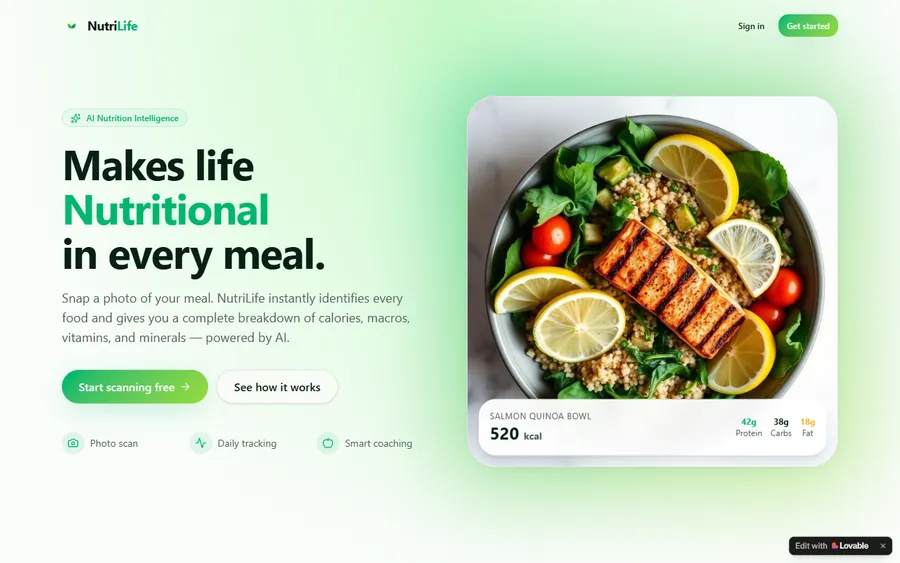
AI and ML
An AI nutrition coach that reads what you eat and works you toward a target.
AI and ML
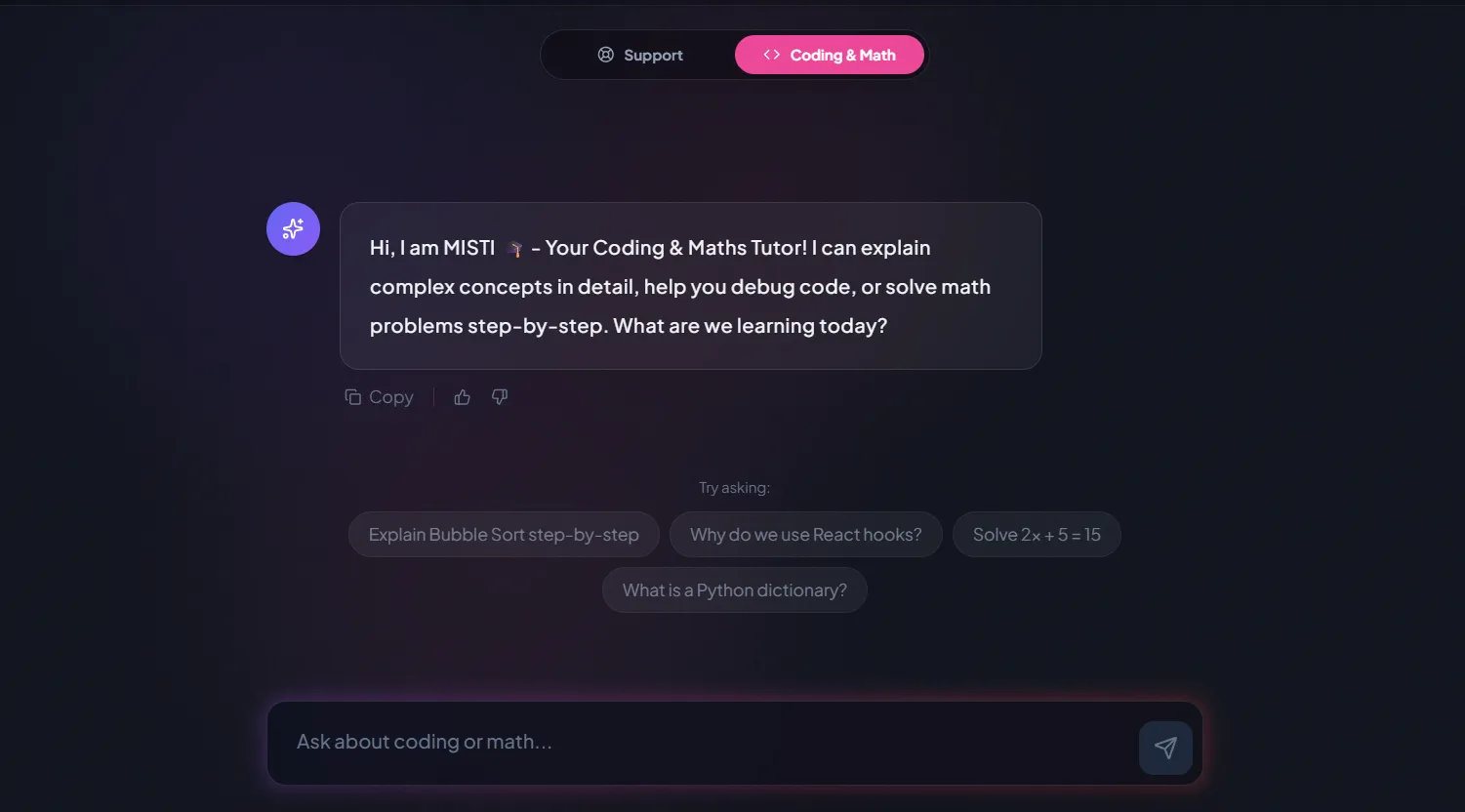
A chatbot that answers mathematics and programming questions, built and deployed by a student.
AI and ML
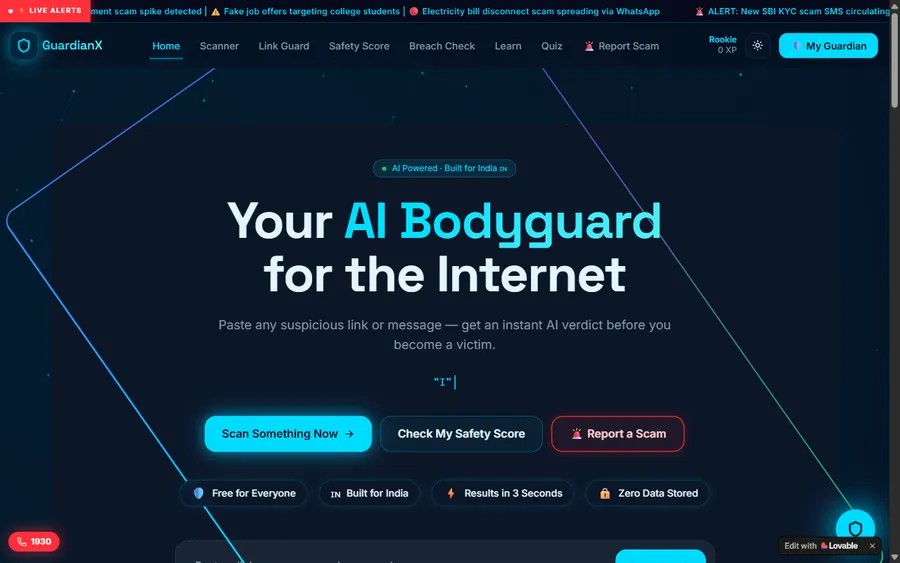
An assistant that helps a young person recognise unsafe situations online.
Web app
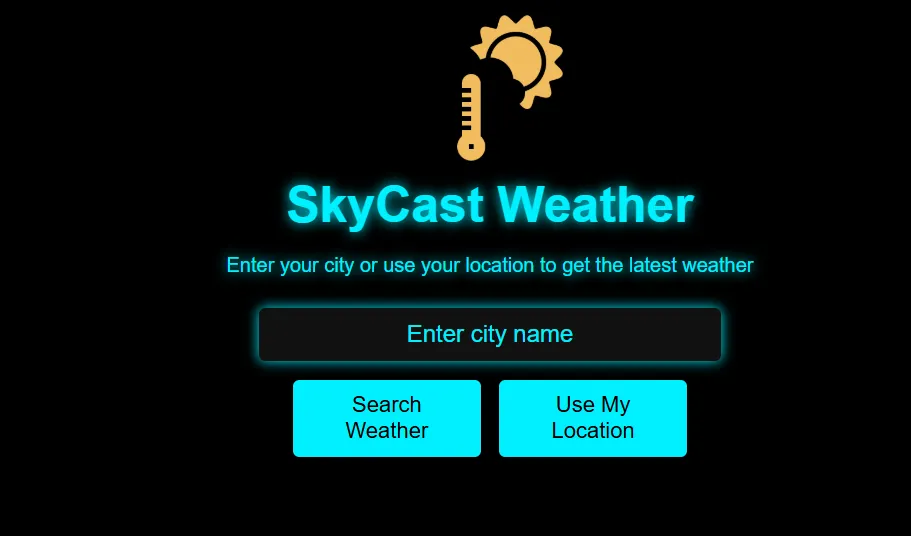
A weather forecasting site with live conditions for any location.
Fees
One monthly price in US dollars for families outside India, nothing to pay to register, and no term you are locked into.
Free first class
USD 0
no card required
Group batch
USD 100
a month, billed in US dollars
One to one
USD 150
a month, billed in US dollars
What families say
Reviews left by families on Google, printed with nothing changed.
★★★★★
"The one step solution for my son. Modern Age Coders make learning coding so simple that kids love it. The teachers explain complex concepts clearly with practical exercises and interactive content."
Ria Mukherjee
Parent
★★★★★
"Modern Age Coders has been a game-changer for me. I struggled to grasp IT concepts and coding before joining, but their classes transformed everything. I can now confidently write complex programs with ease."
Samriddha Mondal
Student
★★★★★
"One of the most wonderful education centres out there. Education is not limited to school syllabus but focuses on skill development."
Vansh Agarwal
Student
★★★★★
"My child Dhairya is really enjoying the Modern Age Coders classes. This is his first online class and he eagerly looks forward to it. I can already see his improvement, and the teachers are very cooperative."
Sonam Oswal
Parent of Dhairya
★★★★★
"Modern Age Coders have wonderful teachers who teach in a clear, easy and practical way. The teacher boosts students' confidence and inspires them to learn without hesitation."
Sonu Goyal
Parent
★★★★★
"I highly recommend this computer coding class! The teachers are incredibly knowledgeable and passionate about coding."
Ritu Kedia
Parent
Student hackathon questions
A weekend event where students build something working and demonstrate it at the end. Nobody tells you what to build, and the deadline is the only fixed thing.
It depends on the event, and there is no general rule. HackUK publishes an age range of 16 to 18 for its free events. University society events are in practice for students at a university. Major League Hacking's published code of conduct, which we read, does not state an age policy.
We could find no national listing of them. That gap is real, and it is why we run our own event for younger students alongside a preparation course for ages 8 to 12.
Hackathons UK, which describes itself as a community-led non-profit supporting hackathon organisers and student tech societies, and is a registered charity in England, number 1195243. It reports supporting more than 60 events over five years.
HackUK says its hackathons and tech events are free, and university events are typically free to attend, so travel is usually the only cost.
Less building than the advertised hours suggest. Once opening, sleep, food, workshops and judging are accounted for, our own allowance leaves about 23 hours to build in, which is roughly three school days.
Usually at integration. Two people making correct changes near the same lines produce a merge conflict, and teams that work separately all Saturday meet every conflict at once on Sunday morning.
Merge early and often, divide work by file rather than by feature, and agree before anyone writes code who is responsible for integrating. Practising a conflict on purpose beforehand takes ten minutes.
Not necessarily. Events are built to match people up and run sessions for it, and arriving with a fixed plan can make joining a team harder.
Almost everything a student takes away, including the version control they will use for the rest of their life, has nothing to do with who won.
Related pages
Showcases, project competitions and the whole competition year.
Any age, no ranking, every checked entry shown.
Project entries from teams of any size.
Autonomous robots and an innovation project.
The season in one table, with each organiser named.
The four school systems, and every UK page.
Projects our own students have finished and published.
Start here
Tell us the age and what your child wants to build. The free lesson makes a start on it, and we say afterwards what a weekend would realistically hold.
Rather read first? Syllabuses are on the course pages, the method on how we teach, and the topic order on the roadmap.
WhatsApp us · +91 91233 66161 · contact@modernagecoders.com
WhatsApp is free from a UK mobile and usually the fastest way to us. Our number is an Indian one, which we always state, and there is no office in Britain.