Table of Contents
Division is the operation children usually find hardest to picture. Adding is putting together, subtracting is taking away, and multiplying is groups of things. Division is often introduced as "the opposite of multiplying", which is true but means nothing to a seven-year-old. Children who are taught it only as a times table fact backwards tend to get stuck the moment a question is worded differently or leaves something over.
This guide gives you a way to explain division that a child can see and hold. It covers the two different meanings of division, which most adults have never noticed, how arrays connect division to times tables, what to do with remainders, why you cannot divide by zero, and the order to teach it in. The small Python programs along the way are optional extras for children who enjoy computers, and every output shown is real.
The two meanings of division
Here is the idea that makes division click for most children, and for many parents too. The sum 12 ÷ 3 can mean two quite different things:
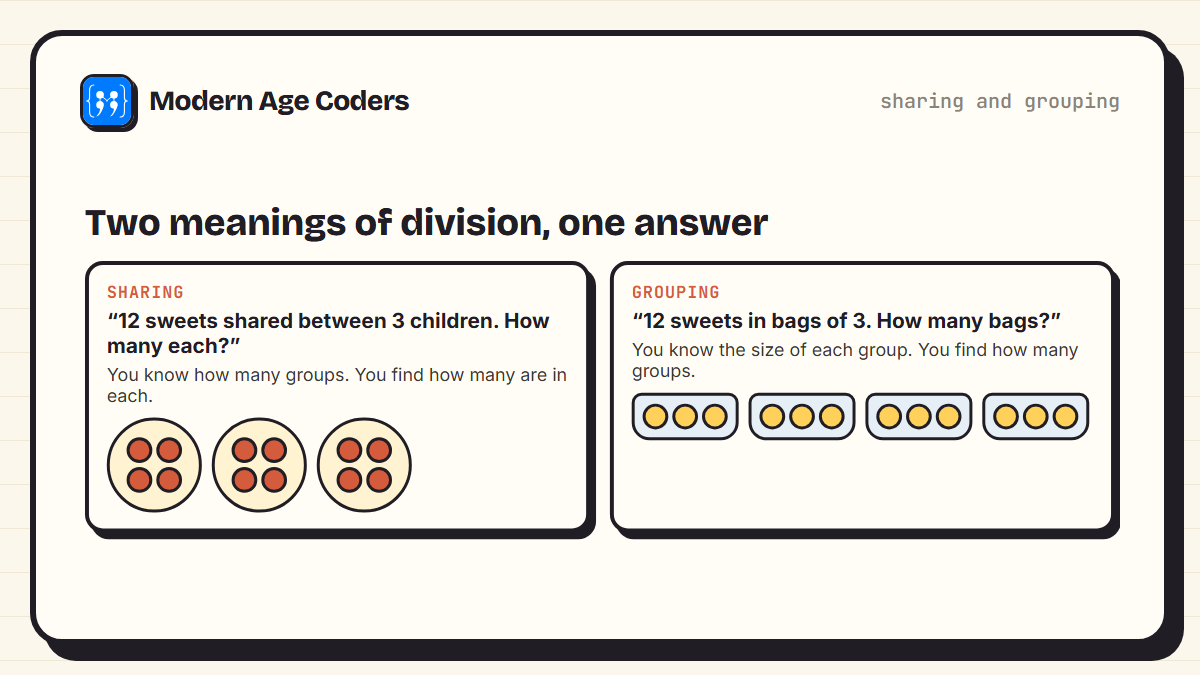
- Sharing (also called partitioning). 12 sweets are shared between 3 children. How many does each child get? You know the number of groups and you are finding the size of each group.
- Grouping (also called measuring or quotition). 12 sweets are put into bags of 3. How many bags do you need? You know the size of each group and you are finding how many groups.
Both give 4, and both are 12 ÷ 3, but they feel completely different to act out. Sharing is dealing out cards one at a time. Grouping is filling bags until you run out. Children who only ever meet one meaning get confused by word problems that use the other, which is one reason division word problems cause so much trouble.
sweets = 12

# SHARING: 3 children, deal the sweets out one at a time
plates = [0, 0, 0]
for i in range(sweets):
    plates[i % 3] += 1
print("sharing between 3 children:", plates, "-> each gets", plates[0])

# GROUPING: bags that hold 3 sweets each, fill bags until the sweets run out
bags, left = 0, sweets
while left >= 3:
    left -= 3
    bags += 1
print("grouping into bags of 3:   ", bags, "bags")

print("both are 12 / 3 =", sweets // 3)sharing between 3 children: [4, 4, 4] -> each gets 4
grouping into bags of 3: 4 bags
both are 12 / 3 = 4Act it out before writing anything
Give your child 12 small objects and two different instructions: "share these fairly between these 3 cups" and then "put them into piles of 3". Ask what is the same and what is different. That one conversation does more than a page of division facts.
Arrays and fact families: division and multiplication together
Once sharing and grouping make sense, show that division and multiplication are the same relationship seen from different sides. The best tool is an array: objects arranged in neat rows and columns.
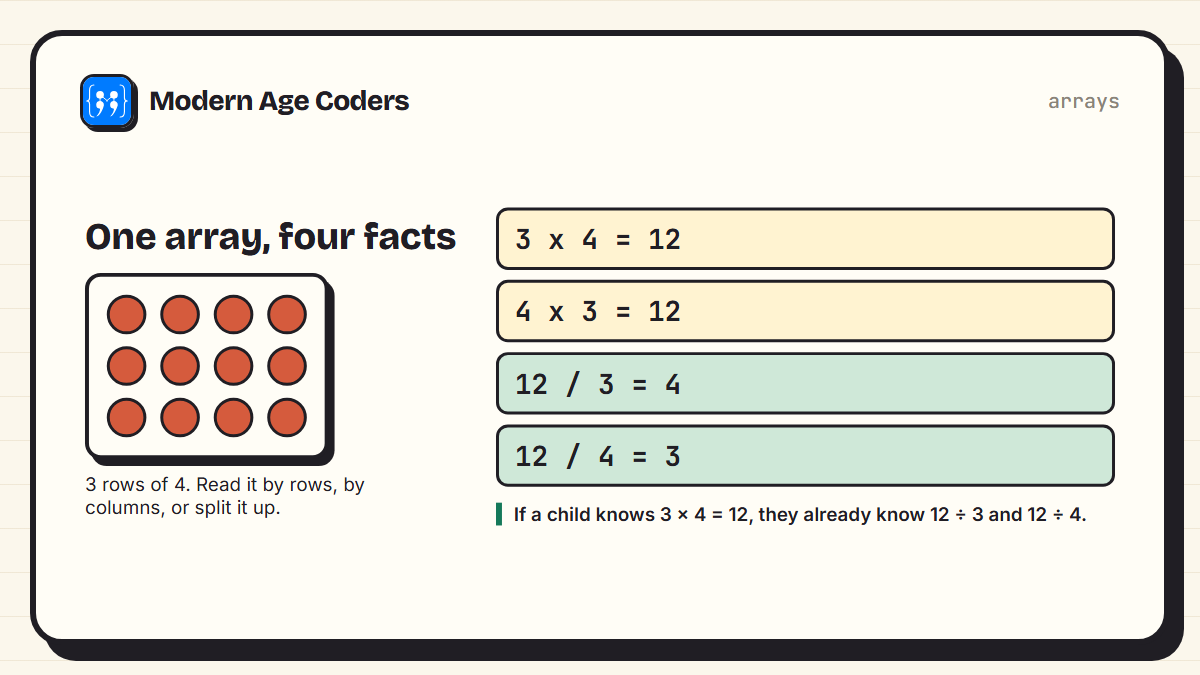
3 rows of 4 dots is 12. Read it another way and it is 4 columns of 3. Cover it with your hand and split it into 3 equal rows, and each has 4. So one picture gives four facts, called a fact family:
def fact_family(a, b):
    c = a * b
    return [f"{a} x {b} = {c}", f"{b} x {a} = {c}", f"{c} / {a} = {b}", f"{c} / {b} = {a}"]

for line in fact_family(3, 4):
print(line)3 x 4 = 12
4 x 3 = 12
12 / 3 = 4
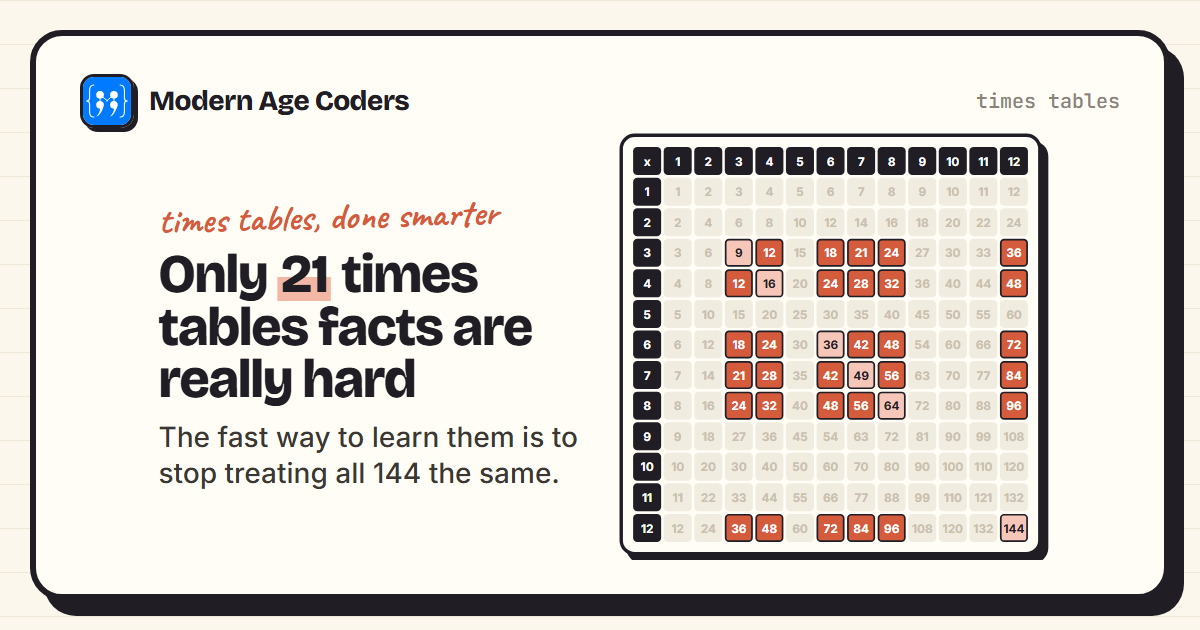
12 / 4 = 3This is why secure times tables make division so much easier. A child who knows 7 x 8 = 56 does not need to learn 56 ÷ 7 separately. If times tables are still shaky, our guide to learning times tables fast shows why only 21 facts need real memory work.
Remainders: what to do with what is left over
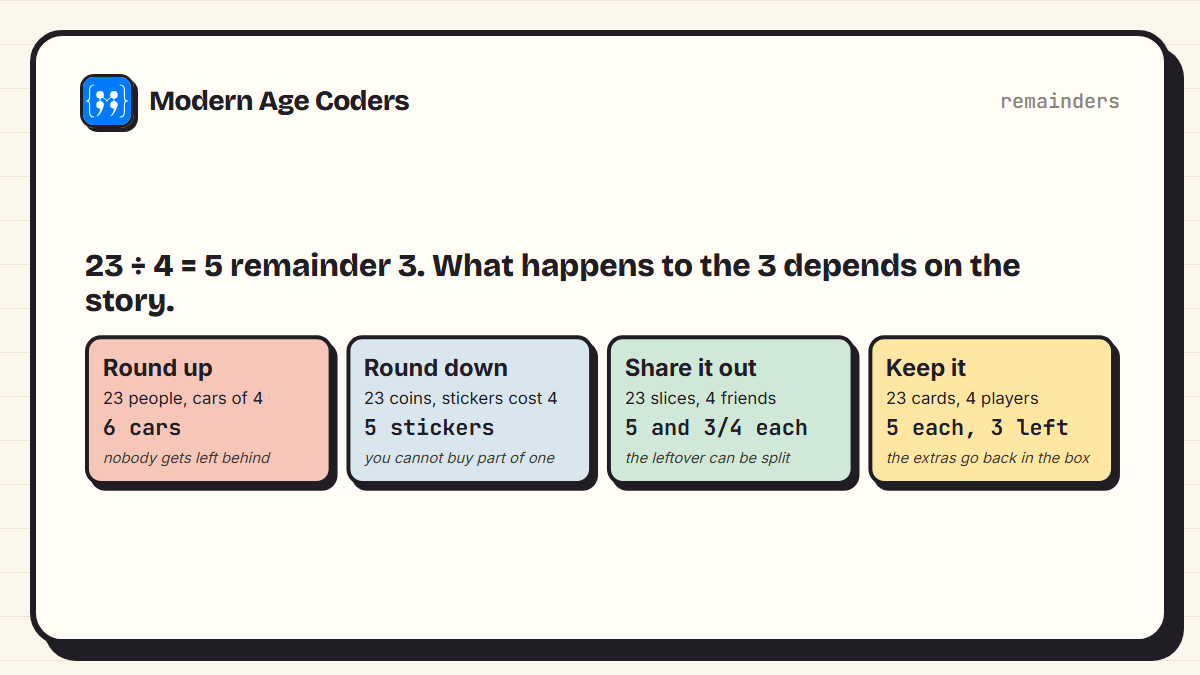
Real division rarely comes out exactly. 23 ÷ 4 is 5 with 3 left over, and the most important thing to teach about remainders is that what you do with them depends on the situation. That is a reasoning skill, not a calculation, and it is exactly what exam word problems test.
import math

people, seats_per_car = 23, 4
cars_full, left_over = divmod(people, seats_per_car)
print(f"{people} people, cars of {seats_per_car}: {cars_full} full cars and {left_over} people left over")
print("cars needed:", math.ceil(people / seats_per_car), "   (round UP: nobody gets left behind)")

money, price = 23, 4
print("stickers you can afford:", money // price, "   (round DOWN: you cannot buy part of one)")

pizza, friends = 23, 4
print("pizza slices each:", pizza / friends, " (share the remainder: 5 and 3 quarters)")23 people, cars of 4: 5 full cars and 3 people left over
cars needed: 6 (round UP: nobody gets left behind)
stickers you can afford: 5 (round DOWN: you cannot buy part of one)
pizza slices each: 5.75 (share the remainder: 5 and 3 quarters)- Round up when everyone or everything must be included: cars, buses, boxes, tables.
- Round down when you can only use whole groups: things you can afford, complete teams, full bags.
- Share the remainder when the leftover can be cut: pizza, cake, lengths of ribbon. This is where fractions and decimals come from.
- Keep it as a remainder when the leftovers simply stay: cards left in the pack.
Why you cannot divide by zero
Children eventually ask this, and it is a brilliant question. Use the two meanings. Grouping: how many groups of 0 sweets do you need to make 12 sweets? No number of empty groups ever reaches 12, so there is no answer. Sharing: share 12 sweets between 0 children. There is nobody to give them to, so "how many each" has no meaning. Mathematicians say division by zero is undefined.
Computers agree. Here is what Python does when you ask it:
print(12 / 3)
print(12 / 1)
print(12 / 0)4.0
12.0
Traceback (most recent call last):
File "divide.py", line 3, in <module>
print(12 / 0)
~~~^~~
ZeroDivisionError: division by zeroDividing by 1 is the opposite case and easy to show: share 12 sweets with 1 child and that child gets all 12. And 0 ÷ 12 is fine too: sharing no sweets between 12 children gives each of them 0.
The order to teach division in
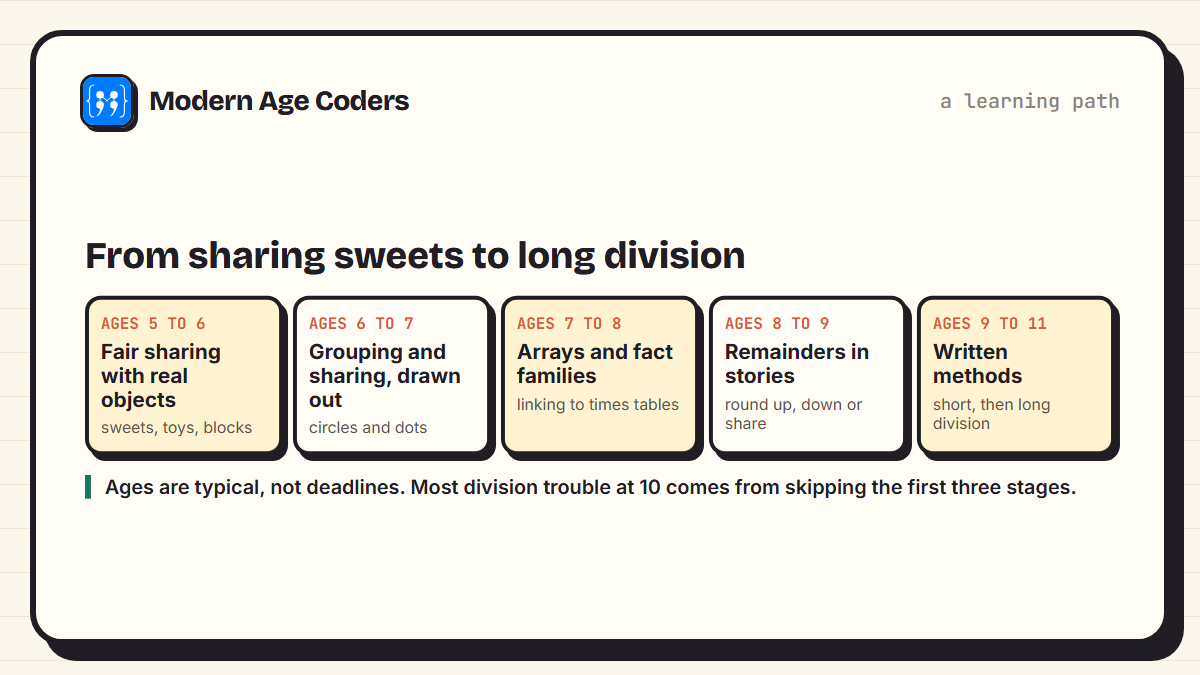
- Fair sharing with real objects, around ages 5 and 6. Sweets, blocks, toys. "Is that fair?" is the key question.
- Sharing and grouping drawn out, around 6 and 7. Circles for groups, dots for objects, and both meanings side by side.
- Arrays and fact families, around 7 and 8, linked directly to the times tables being learned.
- Remainders in stories, around 8 and 9, always asking what should happen to the leftover.
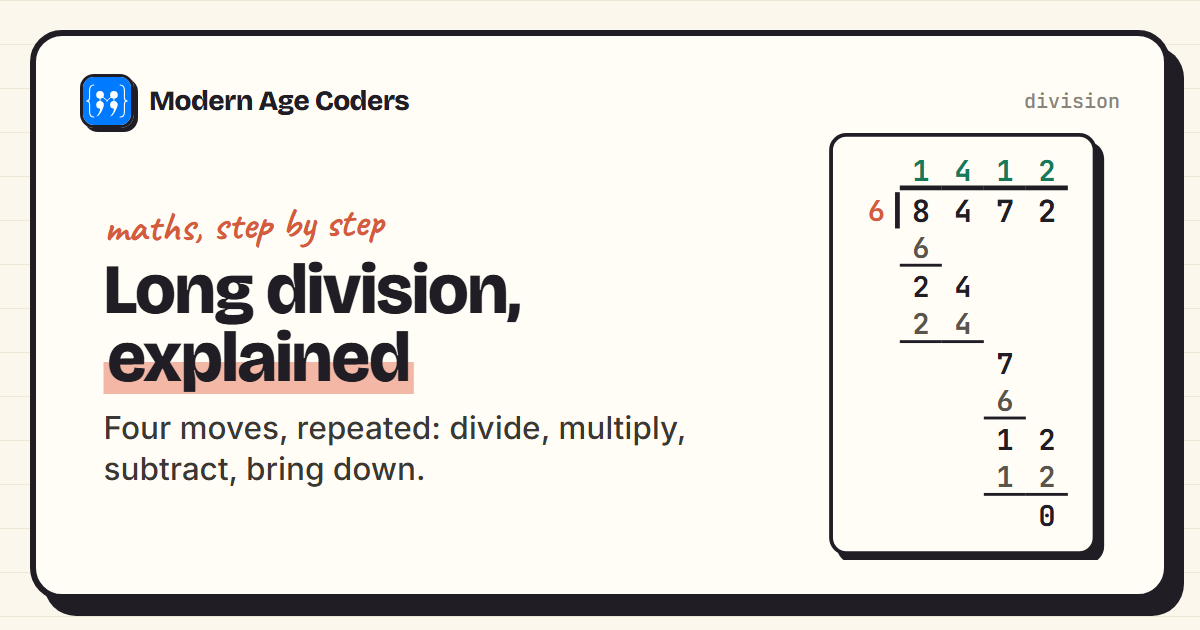
- Written methods, around 9 to 11: short division first, then long division for bigger numbers. Our long division step by step guide covers that stage.
If an older child is struggling with written division, it is almost always worth going back to stage one or two with objects for a session or two. It can feel like a step backwards, but it usually gets things moving again quickly. Our article on why children struggle with maths explains how to find the missing stage.
Games and everyday moments that teach division
- Dealing cards. Deal a pack between different numbers of players and predict how many each will get, and how many will be left.
- Snack sharing. "We have 20 grapes and 3 people. How should we share them fairly?" Let them decide what to do with the leftovers.
- Egg boxes and muffin trays. Natural arrays. How many boxes of 6 do you need for 30 eggs?
- Division bingo. Call out division facts from the fact families your child knows, and cover the answers.
For more ideas, see how to make maths fun for kids, and if homework time is tense, how to help with maths homework without solving it.
Ask a child to share sweets fairly and they will do division perfectly. Write 12 ÷ 3 on a worksheet and many of them freeze. Start with the sweets.
How we teach it
In our live online maths classes for younger learners, we aim for a child to understand what division means before practising a method, and to stay on one idea until it genuinely clicks, as described on our how we teach page. Classes are one to one or in small groups of 5 to 10.
Frequently asked questions
Show that division is fair sharing or making equal groups. With 12 sweets, ask them to share the sweets fairly between 3 children, then ask them to put the sweets into bags of 3. Both give 4, and both are 12 divided by 3.
In sharing, you know how many groups there are and find how many go in each, such as sharing 12 sweets between 3 children. In grouping, you know how big each group is and find how many groups, such as putting 12 sweets into bags of 3.
They are inverse operations: one undoes the other. An array of 3 rows of 4 shows 3 x 4 = 12, and also 12 divided by 3 = 4 and 12 divided by 4 = 3. These four related facts are called a fact family.
Children usually start with fair sharing using objects at around 5 or 6, connect division to times tables at around 7 or 8, and learn written methods such as short and long division between 9 and 11. Hands-on understanding should come before written methods.
Use a story. Share 23 sweets between 4 children: each gets 5 and 3 are left over. Then ask what should happen to the leftovers in different situations, since sometimes you round up, sometimes down, and sometimes you share the remainder.
Because the question has no answer. No number of empty groups can ever make 12, and you cannot share 12 things between nobody. Mathematicians call division by zero undefined, and calculators and computers show an error.
Often because they learned division only as a rule, not as sharing and grouping. Word problems then confuse them because they cannot tell which meaning is intended. Going back to objects and drawings for a few sessions usually helps quickly.