UK / GTC / 01
Reasoning for young thinkers
Pattern, space and number play.
Open the syllabusMore able pupils · Ages 6 to 16 · Maths reasoning and code
Many UK parents search for a gifted and talented maths programme and find there is no national one. Ofsted noted in 2015 that there was no national definition of "most able", and schools usually decide for themselves which pupils count, mostly by attainment. What the national curriculum does say is clear: a quick learner should get richer problems before faster content. Modern Age Coders teaches that kind of stretch live online, in maths reasoning and in coding, for ages 6 to 16, through our olympiad course and our reasoning course for young children, as a group or 1-on-1. We do not test, label or certify children.
From Ofsted, the national curriculum and Potential Plus UK, read 31 October 2026 · We award no gifted label
Is there a gifted and talented programme for maths in UK schools?
There is no single national gifted and talented maths programme in the UK, and no national label. Ofsted's 2015 report on the most able said: "There is currently no national definition for most able." Potential Plus UK notes that most UK children are identified as most able or more able on academic achievement alone. The national curriculum for England is specific about stretch: "Pupils who grasp concepts rapidly should be challenged through being offered rich and sophisticated problems before any acceleration through new content." Modern Age Coders teaches that depth-first stretch live online in maths and coding for ages 6 to 16, on our olympiad and reasoning courses, in groups of 15 to 20 or 1-on-1, with no label attached.
Where to begin
One for each age band. Every card opens a syllabus built on depth rather than next year's content.
GTC / 01
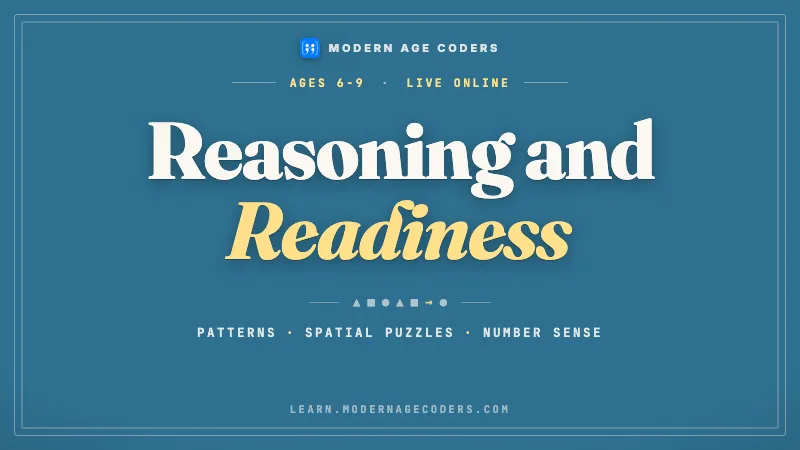
Patterns, spatial puzzles and number sense for ages 6 to 9, never test drilling.
Open the syllabus →
GTC / 02
Number theory, counting and proof for ages 11 to 16, one rich problem at a time.
Open the syllabus →
GTC / 03
A real textual language from age 13, so a strong maths mind gets a second discipline.
Open the syllabus →Is there a label?
Less than many parents expect. There is no national test and no national list, and the words schools use vary. Here is what the sources we read actually say.
| Source | What it says | What it means for parents |
|---|---|---|
| Ofsted, The most able students (March 2015) | "There is currently no national definition for most able." | Schools set their own criteria; there is nothing national to qualify for |
| Ofsted, same report | Inspectors visited 40 non-selective secondary schools and 10 primary schools, plus questions in 130 routine inspections | The findings come from a broad sample, though they are now over a decade old |
| Potential Plus UK | Most UK children are identified as most able or more able "solely based on high academic achievement, rather than cognitive ability" | A child who is quick but not yet top of the class may be missed |
| Potential Plus UK | Prefers "high learning potential" to "gifted", "talented", "bright" or "clever", and has used it since 2013 | The vocabulary itself is not settled |
| National curriculum, mathematics | Rich and sophisticated problems before acceleration | The official advice is depth, not speed |
In over half of the schools visited, Ofsted reported that the most able students it spoke to said "work in Key Stage 3 is too easy". Students described lessons that "covered what they had already learnt in Key Stage 2".
The contrast was the more effective schools, where students said "there is always a question we can't answer or a really interesting challenge." That sentence is a good test of any stretch, at school or outside it.
Ofsted's report cites two organisations: the National Association for Able Children in Education (NACE), which works with schools, and Potential Plus UK, which works with families. Potential Plus has announced it is joining the children's charity Coram and continues as Coram Potential Plus.
Both are better placed than a tutoring school to advise on identification. We do not assess, and we would not ask a family to pay for a label.
Sources: Ofsted, The most able students: an update on progress since June 2013 (March 2015); Potential Plus UK, High learning potential. Read 31 October 2026. We found no newer national definition in what we read; if your school uses one, it will be in the school's own policy.
Depth first
By going deeper before going faster. The national curriculum for England says so twice, once for primary and once for Key Stage 3.
For Key Stages 1 and 2: "Pupils who grasp concepts rapidly should be challenged through being offered rich and sophisticated problems before any acceleration through new content."
For Key Stage 3 the same sentence ends "in preparation for key stage 4". Both sit beside the rule that decisions about progress should rest on "the security of pupils' understanding and their readiness to progress".
A child who races into next year's methods is soon bored again, a year later, and has learned to expect maths to be easy. A child given a problem that resists for twenty minutes learns persistence, which no textbook supplies.
Depth also keeps a child with classmates in school, so stretch outside school adds to their week rather than making the classroom pointless.
| Acceleration | Depth | Breadth | |
|---|---|---|---|
| What it is | Next year's content now | Harder problems on today's content | A new field, such as coding or logic |
| Example | Algebra at age 8 | Why 5 must sit at the centre of a magic square | Writing a program to search for patterns |
| Risk | Gaps, and boredom returns | Frustration if pitched too high | Spread too thin |
| Curriculum view | After depth | First | Computing is its own subject |
Coding is the natural breadth for a mathematical child, and the computing curriculum asks for it: at Key Stage 3 pupils should "use 2 or more programming languages, at least one of which is textual, to solve a variety of computational problems". A child who already thinks in patterns usually finds a textual language such as Python a joy, because it lets them test a hunch on thousands of cases. Our KS3 computing page covers the school side.
Sources: National curriculum in England: mathematics; National curriculum in England: computing. The comparison table and the view are ours.
Problems by age
Three problems we wrote, each with a first answer a quick child finds fast and a second question that makes them slow down. That second question is where stretch lives.
Using 12 square tiles, how many different rectangles can you build? Three: 1 by 12, 2 by 6 and 3 by 4. The depth question: which number of tiles makes only one rectangle? 7, 11, 13: the primes. The child has found prime numbers without the word.
Put 1 to 9 in a 3 by 3 grid so every row, column and diagonal adds to 15. Many children find one by trial. The depth question: why must 5 be in the middle? Four lines pass through the centre; their total is 60, which is all nine numbers (45) plus the centre counted three extra times. So the centre is 5.
A perfect number equals the sum of its proper factors: 6 is 1 plus 2 plus 3. Write a program to find all below 10,000. It prints 6, 28, 496 and 8128. The depth question: why are they all even? Nobody knows whether an odd one exists. A real open question, met at fourteen.
def proper_factor_sum(n):
    total = 1
    d = 2
    while d * d <= n:
        if n % d == 0:
            total += d
            if d != n // d:
                total += n // d
        d += 1
    return total

print([n for n in range(2, 10000) if proper_factor_sum(n) == n])
Output: [6, 28, 496, 8128]. Checking factors only up to the square root, and adding each pair at once, is itself a small piece of mathematical thinking.
None of these needs content beyond the child's age. The rectangles use multiplication facts, the magic square uses addition, and the program uses division with remainders. What changes is the question asked once the answer is found. In our lessons that second question takes up most of the time, and the child explains their reasoning aloud or in writing before moving on.
All three problems, the program, its output and the explanations are written by Modern Age Coders. They are not items from any ability test, and we do not prepare children for gifted tests.
Talking to school
Calmly, specifically and with the school's own words. These steps are our suggestion, built around what the curriculum already asks of schools.
Asking for your child to be "put on the gifted register" can stall a conversation, because many schools have no such register and there is no national one. Asking what the next harder problem is usually moves things on.
Comparing your child with classmates rarely helps either.
A weekly lesson outside school can supply the depth problems a busy class teacher has little time for, and a peer group of children who enjoy the same thing.
For enrichment that comes through school, see our pages on maths masterclasses and the UKMT olympiad ladder.
Readiness, not labels
Watch what they do with problems rather than how fast they finish worksheets. These are our own observations from teaching, not a diagnostic list.
| What you might notice | What it suggests | A next step (ours) |
|---|---|---|
| Finishes homework quickly and asks for "a hard one" | Appetite outruns the set work | One open problem a week, discussed at dinner |
| Asks why a method works, not just how | Ready for reasoning and proof | Ask them to explain a method to you |
| Invents their own rules or games | Thinks in systems | A first coding project in Scratch or Python |
| Gets upset when stuck | Rarely stuck so far | Problems that take more than one sitting |
| Spots patterns in numbers around them | Strong number sense | Puzzles with a pattern to generalise |
Potential Plus UK publishes a list of 25 characteristics for families who want a fuller picture, and offers assessments of its own. We neither assess nor recommend for or against assessment; that is a family's decision. For children aged 6 to 9 our US page on gifted testing explains why honest preparation for any ability test is broad reasoning rather than drilling, which applies in the UK too.
The table is ours. Potential Plus characteristics: Characteristics of Children with High Learning Potential, read 31 October 2026. We are not connected with Potential Plus, Coram or NACE.
Stages
Our stages, placed by readiness rather than birthday, as the curriculum itself advises.
| Stage | Ages | Focus |
|---|---|---|
| 1. Play | 6 to 8 | Patterns, shapes and number games, explained aloud |
| 2. Reason | 8 to 11 | Why a rule works; first written explanations |
| 3. Prove and code | 11 to 14 | Short proofs; a textual language for testing ideas |
| 4. Specialise | 14 to 16 | Olympiad problems, larger coding projects, or both |
A child can be at stage 3 in number and stage 2 in geometry. We teach the stage, not the year group.
We tell parents what is secure, not what label might apply.
Competition maths through the Junior Mathematical Olympiad.
Or computing contests such as the British Informatics Olympiad.
All related courses
Grouped by age. Each opens a syllabus so you can judge the depth yourself.
UK / GTC / 01
Pattern, space and number play.
Open the syllabusUK / GTC / 02
Number sense, not tricks.
Open the syllabusUK / GTC / 03
Logic through Scratch projects.
Open the syllabusUK / GTC / 04
Python as a maths laboratory.
Open the syllabusUK / GTC / 05
Problems that resist for a while.
Open the syllabusUK / GTC / 06
A first textual language.
Open the syllabusUK / GTC / 07
Olympiad-style depth.
Open the syllabusUK / GTC / 08
From basics to real programs.
Open the syllabusUK / GTC / 09
Logic and data structures.
Open the syllabusHow lessons run
Weekdays or weekends, flexible: choose your batch, or for a very personalised plan choose 1-on-1 at your convenience, weekend mornings or weekdays. Lesson times are agreed in UK time, and our teachers in India keep to that clock.
After school
Group lessons by stage, ages 8 to 16.
Early evening
Shorter sessions for ages 6 to 8.
Weekend morning
Groups and 1-on-1 lessons.
Every problem gets a follow-up that slows a quick child down.
Reasoning is said aloud first, then written in a sentence or two.
From about age 9, programs test what the maths suggests.
A group of 15 to 20 at the same stage, or 1-on-1.
We report what is secure and what is next, never a category.
Depth rather than next year's content, so school still makes sense.
Student work
Projects our students built in maths and code. More in student labs.

AI and ML
An AI nutrition coach that reads what you eat and works you toward a target.

AI and ML
A chatbot that answers mathematics and programming questions, built and deployed by a student.

AI and ML
An assistant that helps a young person recognise unsafe situations online.

Web app
A weather forecasting site with live conditions for any location.
Fees
A flat monthly fee for UK families, with no term commitment and no assessment fee, because we do not assess. The first lesson is free.
Free first class
USD 0
no card required
Group batch
USD 100
a month, billed in US dollars
One to one
USD 150
a month, billed in US dollars
What families say
What parents said on our Google profile, unedited.
★★★★★
"The one step solution for my son. Modern Age Coders make learning coding so simple that kids love it. The teachers explain complex concepts clearly with practical exercises and interactive content."
Ria Mukherjee
Parent
★★★★★
"Modern Age Coders has been a game-changer for me. I struggled to grasp IT concepts and coding before joining, but their classes transformed everything. I can now confidently write complex programs with ease."
Samriddha Mondal
Student
★★★★★
"One of the most wonderful education centres out there. Education is not limited to school syllabus but focuses on skill development."
Vansh Agarwal
Student
★★★★★
"My child Dhairya is really enjoying the Modern Age Coders classes. This is his first online class and he eagerly looks forward to it. I can already see his improvement, and the teachers are very cooperative."
Sonam Oswal
Parent of Dhairya
★★★★★
"Modern Age Coders have wonderful teachers who teach in a clear, easy and practical way. The teacher boosts students' confidence and inspires them to learn without hesitation."
Sonu Goyal
Parent
★★★★★
"I highly recommend this computer coding class! The teachers are incredibly knowledgeable and passionate about coding."
Ritu Kedia
Parent
More able questions
Not a national one. Ofsted's 2015 report said there was no national definition for most able, and schools decide their own approach. Ask your child's school whether it has a more able policy or a named lead.
Usually by attainment at school. Potential Plus UK says most UK children are identified as most able or more able solely on high academic achievement rather than cognitive ability, so a quick child who is not yet top of the class can be missed.
The national curriculum for England says pupils who grasp concepts rapidly should be offered rich and sophisticated problems before any acceleration through new content. In practice that means harder problems on current topics rather than next year's textbook.
The curriculum advises depth first, with progress based on the security of understanding. Speeding ahead often brings the same boredom back a year later; richer problems usually serve a quick learner better, though every child is different.
The phrase Potential Plus UK has used since 2013 instead of gifted, talented, bright or clever. It describes children who understand quickly and learn faster than most, and the charity says this can be developed alongside traits such as motivation and persistence.
Often, because it adds breadth rather than speed. The Key Stage 3 computing curriculum already asks for two or more programming languages, at least one textual, and a mathematical child can use code to test patterns on thousands of cases.
No. We do not assess, label or certify children. In a free first lesson we see what your child can do with a rich problem and tell you which stage we would teach them at.
No. We teach reasoning, number sense, spatial thinking and code for their own sake. That kind of broad thinking is the only honest preparation for any ability test, and we never use imitation test items.
No. We quote their published words so parents can follow them up, and we have no link with any of them.
Weekdays or weekends, flexible: choose your batch, or for a very personalised plan choose 1-on-1 at your convenience, weekend mornings or weekdays. All lessons are in UK time.
Related pages
Enrichment through school, competitions and coding.
Royal Institution series and nomination.
Long problems with a steady group.
The UKMT week and summer at home.
Coding for ages 7 to 11.
The Year 7 to 9 curriculum.
The UK hub.
Part of the guide: UK maths enrichment, competitions and able pupils
More guides: UK maths exam boards and specification codes · UK maths year by year, Reception to Year 11 · UK selective school maths tests: 7+, 11+, 13+ and 16+ · UK university admissions: maths tests and computing applications
Start here
Send us your child's age and something in maths or coding they loved. We teach one lesson around a rich problem, then suggest a stage.
Looking first? Each course page carries its syllabus, and how we teach describes our lessons.
WhatsApp us · +91 91233 66161 · connect@modernagecoders.com
WhatsApp gets the fastest reply. We write back from India on a +91 number.
A priority demo is a full class of about 45 to 60 minutes. After the class the mentor sends a written skill report and a personal learning roadmap on WhatsApp. If you enrol, the demo fee is adjusted against your first month's fee. Share your demo Order ID with us on WhatsApp and we take it off.
Book a priority demo