UK / N5M1 / 01
IGCSE mathematics
Surds, vectors and quadratics at the right depth.
Open the syllabusScotland · National 5 · S4
National 5 Mathematics has no coursework, no assignment and no project. The whole award rests on two question papers sat in the exam diet, and the first of them, 40 of the 90 marks, is taken without a calculator. That is where the 2025 course report put its sharpest warning: "In question paper 1, many candidates miss out on valuable marks because they do not demonstrate the necessary basic number skills." Not advanced topics. Fractions, percentages, simplifying, the arithmetic a calculator normally hides. This page sets out how the course is assessed, where the 2025 candidates dropped marks, the exact wording markers look for, and why working only from recent past papers leaves gaps.
Live teaching since 2020 · 10,000+ students · From the course specification and 2025 course report
In short
National 5 Mathematics is assessed entirely by two question papers: paper 1, without a calculator, worth 40 marks in one hour, and paper 2, with a calculator, worth 50 marks in an hour and a half. There is no coursework. The course also certifies Numeracy at SCQF level 5. In 2025, 34,846 candidates received a result. The course report said many candidates lost marks on paper 1 through weak basic number skills, and that algebra, the nature of roots, comparing data sets and vectors caused recurring problems. It also warned against preparing only from recent past papers. Modern Age Coders teaches National 5 Maths live, with daily-style non-calculator number work, the exact wording the marking instructions expect, and coverage of the whole specification rather than the last few papers. The first lesson is free, then USD 100 a month in a group or USD 150 one to one.
Start here
Our maths courses serve several curricula; we teach the National 5 specification inside them. Each card opens a syllabus.
N5M / 01
Surds, indices, quadratics, vectors and trigonometry, most of which National 5 shares.
Open the syllabus →
N5M / 02
Number and algebra fluency at the level paper 1 demands, taught without a calculator first.
Open the syllabus →
N5M / 03
A broad secondary course for students who need gaps filled from earlier years.
Open the syllabus →Two papers
From the National 5 Mathematics Course Specification, version 3.0, valid from session 2023 to 24.
| Component | Marks | Time | Calculator |
|---|---|---|---|
| Question paper 1 | 40 | 1 hour | Not allowed |
| Question paper 2 | 50 | 1 hour 30 minutes | Allowed |
| Coursework | None | Not applicable | Not applicable |
Both papers can test anything in the course: numerical, algebraic, geometric, trigonometric and statistical skills, plus reasoning. The specification suggests about 160 hours of learning, recommends that candidates arrive having achieved the fourth curriculum level or National 4 Mathematics, and awards the Core Skill of Numeracy at SCQF level 5 automatically with the course.
| Measure | Published figure |
|---|---|
| Resulted entries | 34,846 (36,689 in 2024) |
| Grade A | 39.6 per cent, minimum mark 64 of 90 |
| Grade C minimum mark | 47 of 90 |
| No award | 18.5 per cent |
Grade boundaries move each year. In 2025 the report says "The question papers were slightly less demanding than expected. We adjusted the grade boundaries to account for this." A boundary from one year is no target for the next, which is why we quote these figures only to describe 2025.
Source: the National 5 Mathematics Course Specification, version 3.0, and the National 5 Mathematics course report 2025, both from sqa.org.uk. Qualifications Scotland replaced SQA on 1 February 2026 and confirms the SQA-era documents remain current; the National 5 Computing page quotes its notice in full.
No calculator
Paper 1 is where arithmetic, not advanced mathematics, decides the result.
The specification says paper 1 lets candidates "apply numerical, algebraic, geometric, trigonometric, statistical and reasoning skills, without the aid of a calculator". In practice that means exact fractions, reverse percentages done by hand, surds, indices and algebra, with every step visible. The 2025 report is direct about what went wrong: "In question paper 1, many candidates miss out on valuable marks because they do not demonstrate the necessary basic number skills."
| Question topic | What the report saw |
|---|---|
| Reverse percentage | Most did well, but a few could not divide 720 by 8 or by 80 correctly by hand |
| Area of a triangle | Some substituted the sine of the wrong expression into the formula |
| Straight line | Coordinates swapped in the gradient formula or the line equation |
| Trigonometric graph | Many gained no marks, often giving the x-coordinate for the y-coordinate |
| Indices | The rule for a power of a power misapplied, or the final simplification left out |
| Resultant vector | Many found it in component form; few drew it correctly |
| Algebraic fractions | A sign error expanding the numerator bracket |
| Quadratic from a context | Many gained no marks constructing or solving it, some solving it as if linear |
The report's first recommendation is to "maintain and practise number skills" for paper 1. Short, frequent practice with fractions, percentages and division by hand beats a late cram.
Rearranging, factorising and simplifying cost marks in both papers. The skills are basic; the errors come from rushing and from signs.
One 2025 question needed the area of a rectangle, from years earlier. The report asks candidates to keep previously learned skills in practice.
Wording
Several 2025 marks were lost not on the mathematics but on how the answer was stated or where it was written.
| Discriminant | Expected response |
|---|---|
| Greater than zero | "two real and distinct roots" |
| Equal to zero | "one repeated real root" or "two equal real roots" |
| Less than zero | "no real roots" |
In 2025 many candidates calculated the discriminant correctly and then wrote something close but wrong, most commonly phrases like no distinct real roots, and lost the mark. The report now lists the expected responses, and practising them word for word is the simplest fix on the paper.
A question comparing the weights of two rugby squads with a mean and a standard deviation caught many out. The report lists comments that earned nothing, among them "The French rugby players were more consistent." and statements that one squad's results or scores were lower, with no reference to what the measures show.
A valid comment names the measure, says what it shows, and refers to the context: on average the weights were lower, and the weights were more varied, for this group.
For angles in a diagram, write each angle on the diagram. The report warns: "Markers are unlikely to award marks to calculations candidates do elsewhere on the page."
Avoid "inappropriate premature rounding that leads to incorrect answers", and give units where they belong, which most candidates did well.
None of this is a trick. It is the marking instructions, which are published, applied consistently. Reading them alongside past papers is part of how we teach.
Paper 2 has its own habits. A calculator removes the arithmetic but not the method: a percentage increase over two years still has to be applied twice, not doubled, and a volume still has to be rounded to the significant figures asked for. In 2025 a few candidates increased by 4 per cent for one year only, or by 8 per cent for two, on a simple appreciation question, and some rounded to the wrong number of figures on a sphere. Setting the working out clearly on the calculator paper protects method marks when a keying slip spoils the final number.
Past papers
The 2025 report named a question that had not appeared in recent years, and said so.
Question 13 on the 2025 paper 1 asked candidates to add or subtract two-dimensional vectors using directed line segments, which the report notes "has not featured in recent past papers". Most candidates managed the component form and few drew the vector. The report's advice is plain: prepare for all the skills in the course specification "and not purely concentrate on recent past paper questions".
We work from the specification's list of skills, topic by topic, and use past papers to practise exam technique, not as the syllabus.
Paper 1 skills are practised without a calculator from the first lesson, so the calculator becomes a tool for paper 2 rather than a crutch.
We do not run a course written only for National 5. Our maths courses serve several curricula, and we teach the National 5 content within them, checked against the specification.
We do not promise a grade. Boundaries move, and the report shows how much depends on steady number and algebra practice.
For the next step, the Higher Maths page covers what changes at Higher, and the Scotland page sets out the whole system. Students who enjoy problem solving may like the Scottish Mathematical Challenge.
Progression
Placement follows what a student can do without a calculator, which is the fastest honest test.
| Rung | When | What should be true |
|---|---|---|
| 1. Number by hand | Start of S4 | Fractions, percentages, reverse percentages and division done confidently without a calculator |
| 2. Algebra | Autumn | Expanding, factorising, rearranging and simplifying, including algebraic fractions and indices |
| 3. The course topics | Winter | Quadratics and the discriminant, trigonometry and its graphs, vectors, statistics, geometry |
| 4. Exam habits | Spring | Expected wording, working on diagrams, no premature rounding, and every skill in the specification practised |
The 2025 report pointed at basic number skills first. Ten minutes a day on them is worth more than an extra past paper.
The wider order of topics is set out on the coding roadmap for students who also code.
The expected phrases and habits take a few weeks, then protect marks on every paper.
Lessons ease off during the diet and resume for Higher afterwards.
The catalogue
Grouped by purpose. The free lesson decides the starting point.
UK / N5M1 / 01
Surds, vectors and quadratics at the right depth.
Open the syllabusUK / N5M1 / 02
Non-calculator fluency and algebra, built steadily.
Open the syllabusUK / N5M1 / 03
For students filling gaps from earlier years.
Open the syllabusUK / N5M2 / 01
Fractions, ratio and early algebra, rebuilt properly.
Open the syllabusUK / N5M2 / 02
For younger siblings, or anyone whose number facts wobble.
Open the syllabusUK / N5M2 / 03
Mean, spread and interpretation, pitched older but clear.
Open the syllabusUK / N5M3 / 01
Calculus and more, much of which Higher shares.
Open the syllabusUK / N5M3 / 02
For students who enjoy hard problems.
Open the syllabusUK / N5M3 / 03
Mathematical ideas explored by writing programs.
Open the syllabusHow lessons work
Our teachers work from India, which keeps one clock all year, so Scotland is four and a half hours behind in summer and five and a half in winter. Lessons are timed in UK hours.
After school
Most S4 students choose this.
Evening
Around sport, clubs or part-time work.
Weekend
Room for a full paper under timed conditions.
Every lesson opens with number work by hand, because paper 1 depends on it.
Signs and brackets checked as they are written, where the 2025 errors came from.
The phrases from the marking instructions practised until they are automatic.
Every skill in the course covered, not only what recent papers asked.
Past papers under exam timing in the spring, marked against the published instructions.
Five to ten S4 students at one rung, checking each other's working.
Student work
Four projects from classes, none of them assessed. More in student labs.

AI and ML
An AI nutrition coach that reads what you eat and works you toward a target.
AI and ML
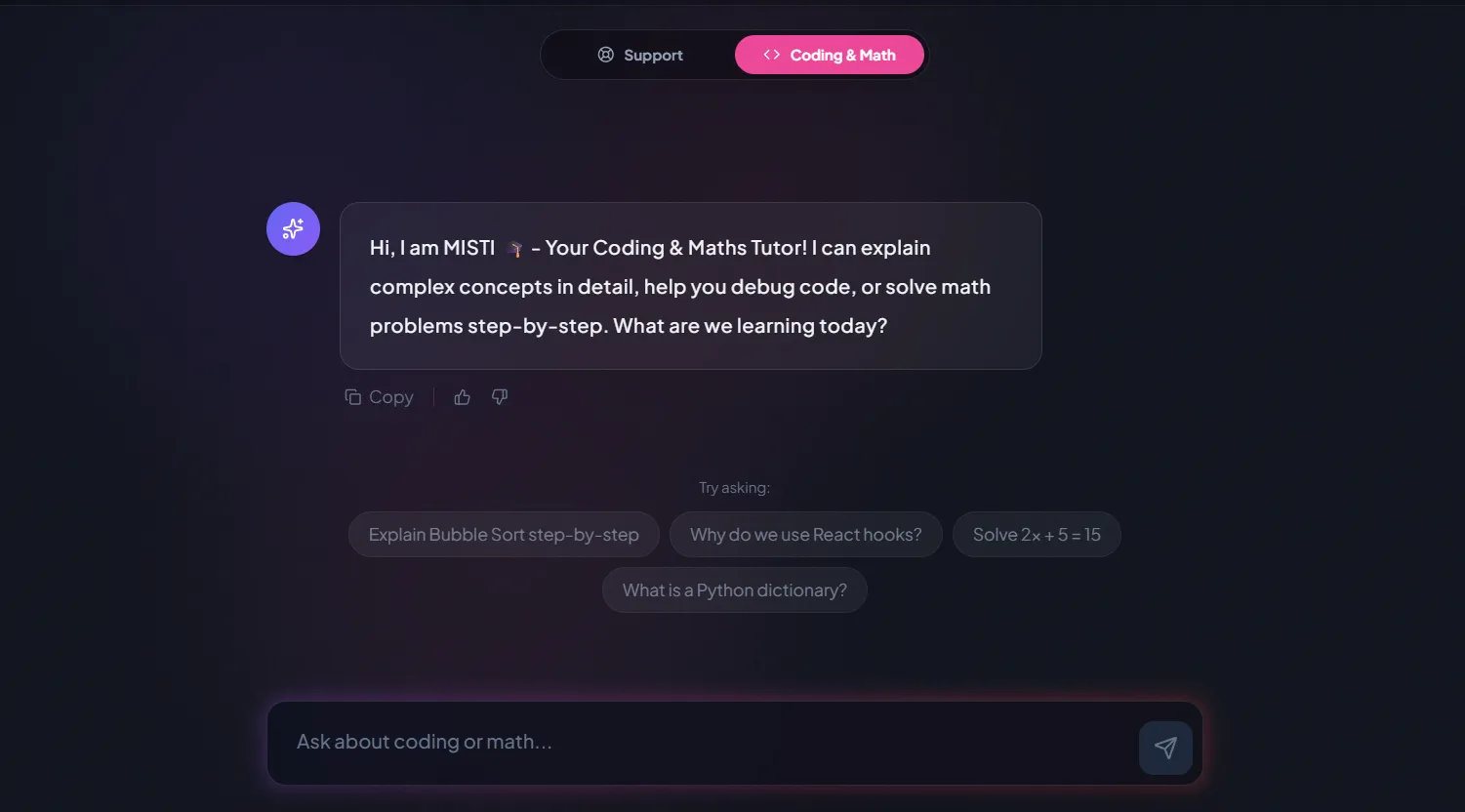
A chatbot that answers mathematics and programming questions, built and deployed by a student.

AI and ML
An assistant that helps a young person recognise unsafe situations online.

Web app
A weather forecasting site with live conditions for any location.
Fees
Lessons are billed monthly in US dollars, and families everywhere outside India pay the same. Your first lesson costs nothing; we only invoice once a course and a regular weekly slot are in place.
Free first class
USD 0
no card required
Group batch
USD 100
a month, billed in US dollars
One to one
USD 150
a month, billed in US dollars
What families say
Google reviews from parents, reproduced exactly.
★★★★★
"The one step solution for my son. Modern Age Coders make learning coding so simple that kids love it. The teachers explain complex concepts clearly with practical exercises and interactive content."
Ria Mukherjee
Parent
★★★★★
"Modern Age Coders has been a game-changer for me. I struggled to grasp IT concepts and coding before joining, but their classes transformed everything. I can now confidently write complex programs with ease."
Samriddha Mondal
Student
★★★★★
"One of the most wonderful education centres out there. Education is not limited to school syllabus but focuses on skill development."
Vansh Agarwal
Student
★★★★★
"My child Dhairya is really enjoying the Modern Age Coders classes. This is his first online class and he eagerly looks forward to it. I can already see his improvement, and the teachers are very cooperative."
Sonam Oswal
Parent of Dhairya
★★★★★
"Modern Age Coders have wonderful teachers who teach in a clear, easy and practical way. The teacher boosts students' confidence and inspires them to learn without hesitation."
Sonu Goyal
Parent
★★★★★
"I highly recommend this computer coding class! The teachers are incredibly knowledgeable and passionate about coding."
Ritu Kedia
Parent
Questions about National 5 Maths
By two question papers only. Paper 1, without a calculator, is worth 40 marks in one hour; paper 2, with a calculator, is worth 50 marks in an hour and a half. There is no coursework.
It carries 40 of the 90 marks, and the 2025 course report said many candidates lost marks there through weak basic number skills rather than through the harder topics.
Interpreting a trigonometric graph, constructing and solving a quadratic from a context, drawing a resultant vector, stating the nature of roots correctly, and comparing data sets using the mean and standard deviation.
Two real and distinct roots when the discriminant is positive; one repeated real root, or two equal real roots, when it is zero; and no real roots when it is negative.
No. The 2025 report noted a vectors question that had not featured in recent papers and advised preparing for every skill in the specification rather than only recent questions.
Boundaries change every year. In 2025 an A needed 64 of 90 and a C needed 47, after the papers proved slightly less demanding than expected; those figures describe 2025 only.
Yes. Achieving National 5 Mathematics automatically certifies the Core Skill of Numeracy at SCQF level 5.
It is awarded by Qualifications Scotland, which replaced SQA on 1 February 2026. The SQA-era course documents remain current.
No. Our maths courses serve several curricula, and we teach the National 5 specification within them. We would rather say that than label a course as something it is not.
Nothing for the first lesson. Regular lessons are then a single monthly charge in US dollars, cheaper in a group than one to one; both prices appear in the fees section, and we never take payment in advance.
Elsewhere on this site
The next level, the computing equivalent, and the wider system.
What changes when the working itself earns the marks.
The other National 5 many maths students take.
Problem solving for pupils who enjoy maths.
Primary to S6, and how the system fits together.
The competition ladder for strong mathematicians.
Our UK hub, with links to every page.
Start here
Leave a number and we will call at a UK time that suits. The lesson includes some non-calculator work and ends with a clear list of gaps.
Not ready to talk yet? Each course listing shows its full syllabus, our teaching approach explains who it works for and who it does not, and student labs has real student work.
WhatsApp us · +91 91233 66161 · contact@modernagecoders.com
A WhatsApp message is the fastest way in and costs nothing from a UK mobile. Our office is in India, which is why the number begins +91.