Pick the course. Start this week.
Every mentor teaches from a structured programme, adapted live to your child. Open a course to see the full syllabus and enroll in minutes, or start with a Priority Demo and let the diagnostic pick the level for you.
 Best fit
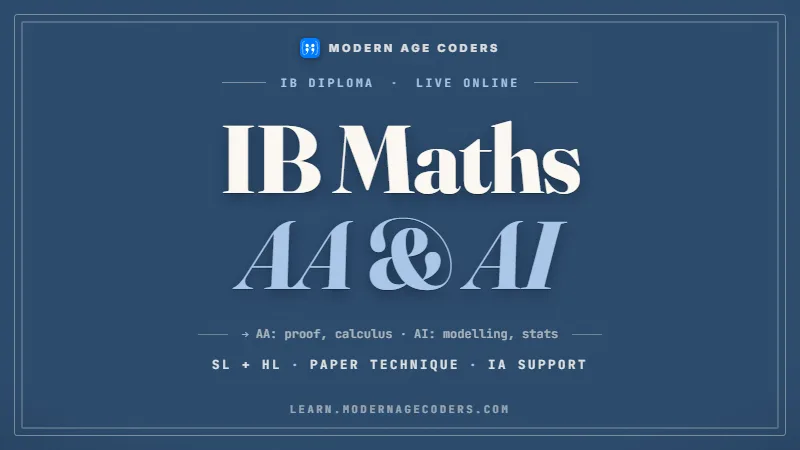
IB Mathematics AA & AI Masterclass
Your exact IB course taught to a 7: paper-specific technique, GDC fluency and honest IA coaching.
$100/mo group · $150/mo 1-on-1
View course & enroll
College Mathematics Masterclass
Calculus, linear algebra and the mathematics behind engineering, computer science and data careers.
$100/mo group · $150/mo 1-on-1
View course & enroll
Olympiad & Competition Mathematics
Contest-level problem solving for the student who wants more than the syllabus.
$100/mo group · $150/mo 1-on-1
View course & enrollIB Mathematics AA and AI: which curriculum your child is on, and until when
The current Analysis and Approaches and Applications and Interpretation courses run to a final assessment in November 2028. A new mathematics curriculum is taught from 2027 for first assessment in 2029, so a student starting DP1 in August or September 2027 is on the new one.
| What | When | Where we read it |
|---|---|---|
| Current AA and AI curriculum | Final assessment November 2028 | ibo.org curriculum pages (read 22 Sep 2026) |
| New AA and AI curriculum | Taught from 2027; first assessment 2029 | ibo.org curriculum pages (read 22 Sep 2026) |
| Who is affected | DP1 cohorts beginning in 2027 study the new content; students already in DP1 or DP2 finish on the current one | ibo.org curriculum pages (read 22 Sep 2026) |
| Our teaching | Both AA and AI, SL and HL, on the curriculum your child is actually sitting; ask us which one on the call | This page |
What changes in the new mathematics curriculum is in the IB's subject briefs, which were not summarised here; we will update this table when we have read them in full.
Good IB maths tuition is course-specific: Analysis & Approaches and Applications & Interpretation are genuinely different subjects, each split into SL and HL, with different papers, calculator rules and emphasis. A tutor must teach your course, coach the Internal Assessment honestly (it is a fifth of the grade), and train paper technique on real past questions. That is what we do: live one-hour classes in small groups (8 a month) or private 1-on-1, priced for your country and shown in your local currency, Priority Demo first.
A two-year marathon with a fork at the start and coursework in the middle.
Since the IB redesigned Diploma mathematics, every student faces a fork before day one: Analysis & Approaches (algebraic, proof-flavoured, calculus-heavy) or Applications & Interpretation (modelling, statistics, technology-first), each at Standard or Higher Level. Choose against your strengths or your degree plans, and the next two years get harder than they needed to be.
Then the structure does things no other school course does. AA students sit a non-calculator paper that punishes technology dependence; AI students need genuine fluency with a graphing calculator, because their papers assume it. HL students of both flavours face an extended problem-solving paper. And in the middle of it all sits the Mathematical Exploration, the IA: a personal investigation worth 20% of the final grade, where students routinely drift for months without direction.
Add the quieter pressures: predicted grades that decide university offers get set before the real exams; MYP maths gaps surface exactly when the DP pace stops forgiving them; and the two-year syllabus means a wobble in the first term compounds quietly for twenty months.
Generic tutoring, even good generic tutoring, misses most of this. A tutor who does not know which paper allows a calculator, what IA criteria reward, or how AA HL differs from AI HL is prepping your teen for a different exam. Our mentors teach the IB course in front of them: right course, right level, right papers, right session, with the depth-first, genuinely interactive teaching we bring to everything. One hour, twice a week, that students actually look forward to.
AA or AI, SL or HL: the honest decoder.
| Dimension | Analysis & Approaches (AA) | Applications & Interpretation (AI) |
|---|---|---|
| Flavour | Algebra, proof and calculus for their own sake: the classic mathematician's course | Modelling, statistics and interpretation: maths as a tool aimed at real contexts |
| Calculator rules | Paper 1 is strictly non-calculator; Paper 2 allows the GDC | All papers assume the graphing calculator; GDC fluency is a scored skill |
| HL extras | Deeper calculus, complex numbers, proof by induction, and Paper 3's extended problems | Matrices, graph theory, further statistics, and its own Paper 3 |
| Typically suits | Students aiming at engineering, mathematics, physics, computer science and other maths-heavy degrees, where competitive courses often expect AA, frequently at HL | Students headed for business, economics, social sciences, design and biology-side degrees, where statistical literacy outworks symbolic manipulation |
| Common trap | Taking AA HL for prestige without the algebra base, then drowning in term two | Assuming AI is "easy maths"; its modelling and statistics run genuinely deep, especially at HL |
Both courses share five topic areas, number & algebra, functions, geometry & trigonometry, statistics & probability, and calculus, weighted very differently. Course structures and assessment details evolve; we verify against current IBO documentation and your school's IB coordinator for your exam session.
Still choosing, or suspecting the wrong choice was made? The Priority Demo doubles as an honest course-fit consultation, including when the honest answer is "stay where you are and repair the base".
Eight signs an IB maths student needs help now, not after mocks.
Paper 1 panic (AA)
Fine with a calculator, lost without one. Non-calculator technique is trainable, and it is a third to half the exam.
The GDC gathers dust (AI)
Solving by hand what the course expects technology to do burns time the papers do not give back.
The IA is drifting
Three months in, still "thinking about a topic". The Exploration is 20% of the grade and rewards early, structured starts.
MYP gaps are surfacing
Weak algebra from the MYP years turns every DP topic into two topics: the new idea, plus the old one it stands on.
Keeping up, not owning
Notes copied, homework survived, nothing explainable a week later. The two-year syllabus makes this debt compound.
Predicted grades are at risk
University offers ride on predictions set well before finals. The window to move them is now, not exam season.
HL Paper 3 shock
Long, unfamiliar, multi-part problems reward a kind of stamina and strategy that regular homework never builds.
Wrong-course suspicion
Every week feels like swimming upstream. Sometimes the fix is teaching; sometimes it is an honest conversation about the course.
An AA Paper 1 problem, no calculator, no panic.
The stuck student sees exponents and reaches for the missing calculator, or tries taking logs of everything and creates a mess.
The structure-trained student our mentors build asks the Paper 1 question: what is this really? Since 22x = (2x)2, this is a quadratic wearing a costume. Let y = 2x:
(y - 1)(y - 4) = 0 → y = 1 or y = 4
2x = 1 → x = 0 · 2x = 4 → x = 2
Ninety seconds, no calculator, full marks. Nearly every AA Paper 1 question is a familiar structure in costume, and recognizing structures is a teachable skill, not a talent. That is what "depth-first" means in practice: we teach the idea underneath, and whole families of exam questions fall together.
Papers and the IA, mapped.
| Component | What it is | What we train for it |
|---|---|---|
| Paper 1 | AA: non-calculator, short and extended questions. AI: calculator allowed, short-response focus | For AA, exact-value fluency and structure recognition; for AI, fast correct GDC workflows |
| Paper 2 | Calculator paper for both courses, longer structured problems | Knowing when the GDC helps and when it wastes time; full-method presentation for method marks |
| Paper 3 (HL only) | Extended, unfamiliar problem-solving investigations | Stamina, part-to-part momentum, and mining earlier parts for the later ones, the P3 meta-skill |
| The IA (Exploration) | A personal mathematical investigation, internally assessed, worth 20% of the final grade | Topic selection that fits the criteria, structure, mathematical depth checks and honest feedback, your teen's own work throughout, guided within IB academic integrity rules |
Marks in IB maths are engineered: method marks, follow-through, criteria rubrics. Students who know how marks are awarded stop donating them. Every mentor teaches to the mark scheme's logic, using real past-paper questions from your exact course and level.
An AI-style modelling question, where interpretation is the mark.
T(t) = 20 + 60e-0.1t (t in minutes)
(a) State the initial temperature. (b) Explain the meaning of the 20. (c) Find when the coffee reaches 40°C.
(a) At t = 0: T = 20 + 60 = 80°C. (b) The 20 is the room temperature, the value T approaches as t grows, the model's horizontal asymptote. This "explain" mark is where AI students trained only to compute lose points: the course grades interpretation.
e-0.1t = 20/60 = 1/3
-0.1t = ln(1/3) → t = 10 ln 3 ≈ 11.0 minutes
(or solved graphically on the GDC, which AI papers fully accept)
Every parameter earns its meaning before any algebra moves: that is how we teach AI, because that is what AI examines. Students stop treating models as formula soup and start reading them, which, not coincidentally, is also the skill their future business and science degrees actually want.
From diagnostic to exam session, mapped.
Class 1 · The Priority Demo diagnostic
A real lesson plus an audit: course fit, level fit, MYP-era gaps, GDC habits, and where the IA stands if it has started.
Term 1-2 · Foundations at DP pace
The syllabus taught for ownership, algebra debt repaired inline, and paper technique introduced early so it never becomes a cram.
IA season · The Exploration, shepherded
Topic chosen against the criteria, milestones set, mathematics deepened, drafts critiqued honestly, your teen's own work, guided properly.
Year 2 · Close the syllabus, open the papers
Remaining topics finished with margin, then past papers by course and level, mark-scheme literacy and, for HL, Paper 3 stamina work.
Exam session · Peak, not panic
Timed full papers, error-pattern review, and a calm, rehearsed walk into the real thing, with predicted grades already moved along the way.
What one full hour of IB teaching looks like.
Every class is a full 60 minutes, live and interactive, no 25-minute check-ins, no recorded lectures pretending to be tuition:
0-10 min · Retrieval and repair
Last topic re-derived from memory, plus one Paper 1-style warm-up (AA) or GDC drill (AI). Two-year courses live on retrieval.
10-35 min · The syllabus, taught deep
Today's topic built from the idea underneath, your teen deriving and explaining aloud, not transcribing.
35-50 min · Past-paper reps
Real questions from your course and level, on the clock, then reviewed against the actual mark scheme's logic.
50-60 min · Explain-back and the week's plan
Your teen teaches the idea back, IA milestones get checked in season, and the week's work is set with a purpose they can state.
IB students tell us these classes are the hour their week organizes around. Watch one before believing us: the demo is free. See exactly how we teach →
Who this genuinely fits, and who it does not.
A strong fit if…
• Your teen is in the Diploma Programme (or MYP heading there) and the maths grade, or the predicted grade, is not where their effort deserves.
• The IA is drifting, Paper 1 technique is shaky, or AA versus AI was chosen badly and someone needs to say so honestly.
• DP maths has become a nightly grind and you want a calm IB-fluent expert to take over the teaching.
• You want one mentor who knows your teen and their exam session, not a rotating cast or an app with streaks.
Honestly not the fit if…
• Your teen cannot yet engage with a screen and a teacher for a full hour. Every DP student can, provided the hour is genuinely interactive, and ours are.
• You want homework done for the teen. We teach the teen to do it, which is slower on night one and far faster by week four.
• You want the IA written for your teen. We coach it hard, structure, criteria, honest critique, but the work stays theirs; IB academic integrity rules exist and we take them seriously.
The courses behind the tutoring.
Every mentor teaches from a structured curriculum, adapted live to your teen. If you prefer to see the full syllabus before you start, these are the programmes IB maths students join.
Serious teaching. One honest price.
You are paying for a real teacher, live, for a full hour, twice a week, the same format IB-specialist tutors bill $60 to $120 an hour for. Our cost base is global, so the price is not.
1:1 Private Mentorship
$150 / month
- 8 live one-hour classes a month, 2 per week4 live one-hour classes a month, 1 per week
- A dedicated mentor who knows your teen by name
- Diagnostic-led plan for your exact course, level and session
- Class recordings for revision · cancel any time
Small-Group Class
$100 / month
- 8 live one-hour classes a month, 2 per week
- A handful of children at the same level
- Same teaching method, gentle peer energy
- Recordings included · cancel any time
That is $18.75 per dedicated hour of 1-on-1 teaching, or $12.50 in a small group. No registration fee, no contract, and you can see a full class first with a Priority Demo. Read our zero-risk promise or compare with what maths tutoring costs in 2026.
Mentors who teach the why, in classes kids wait for.
Our mentors are trained in one method: understanding before procedure, concrete before abstract, the child talking more than the teacher. They teach both maths and coding, which matters more than it sounds, because a mentor who can turn "4 groups of 6" into a model your teen wants to build has engagement tools a worksheet never will.
And because the same mentor stays with your teen month after month, teaching compounds. They know that your daughter rushes when unsure, that your son shuts down after two wrong answers, and exactly which idea to revisit before it becomes a gap.
"My child Dhairya is really enjoying the classes. This is his first online class, and he eagerly looks forward to it. I can see his improvement."
Sonam Oswal, mother of Dhairya · verified Google review
"My son struggled with math for years. Integrating it into coding projects has transformed his understanding and confidence. Highly recommended!"
Shewta Singh, mother of Ishan · verified Google review
Your real options for an IB maths student.
| Option | Typical cost | What it really is | Best for |
|---|---|---|---|
| Modern Age Coders | $100–$150 / month | 8 live one-hour classes with a dedicated mentor teaching your exact course, level and papers, IA coached honestly | Sustained two-year support that moves grades and predicted grades |
| IB-specialist agencies | $60-$120+ / hour | Genuine IB expertise at premium rates; twice weekly runs $480-$960+ a month | Families for whom price is no object |
| Generic online tutoring platforms | $25-$60 / hour | Marketplace tutors of varying quality, often unfamiliar with AA/AI structure, papers or IA criteria | Occasional homework help on universal topics |
| School extra-help sessions | Free | Well-meaning group revision, rarely individual, never IA-deep | Always take these too; they complement real tuition |
| Revision sites and question banks | $0-$30 / month | Excellent practice material with nobody watching how your teen thinks | Self-driven students who already own the ideas |
Competitor figures are typical published prices as of July 2026. See our full comparisons: what maths tutoring costs · best online math tutoring 2026.
Everything families ask about IB maths tuition.
Should my teen take AA or AI, and at which level?
Follow the degree, then the strengths. Maths-heavy degrees (engineering, mathematics, physics, computer science) often expect AA, frequently at HL, check target universities' actual requirements. Business, economics, social sciences and design lean AI. Then be honest about strengths: AA HL without a solid algebra base is the most common self-inflicted wound in DP maths. The Priority Demo doubles as a course-fit consult, and we will say "stay at SL" when that is the truth.
Can my teen switch courses or drop from HL to SL after starting?
Schools generally allow changes early in the programme, and dropping HL to SL is common and often wise; policies and deadlines are your IB coordinator's territory. What we add is the evidence: a few weeks of teaching reveals whether the problem is the course or repairable gaps, so the decision gets made on data instead of despair.
Do you help with the IA? How far is too far?
We coach it properly: topic selection against the actual criteria, structure, pushing the mathematics deep enough to score, and honest critique of drafts. We do not write it, suggest results to fake, or polish prose into someone else's voice, IB academic integrity rules are real, schools check, and a mentor who breaks them is risking your teen's diploma. Done right, the IA is the most coachable 20% of the grade.
My AA student falls apart on the non-calculator paper. Fixable?
Very. Paper 1 skill is mostly exact-value fluency plus structure recognition, seeing the quadratic inside the exponential equation, the identity inside the trig expression. Both are trained, not innate. Every AA class includes non-calculator work so Paper 1 becomes routine long before the exam.
Do you teach GDC skills for AI?
Yes, as a first-class skill, because AI examines it. Efficient graphing workflows, solving and regression on the calculator, knowing what the papers accept as "using technology": AI students who underuse the GDC are leaving marks and minutes on the table, and we fix that deliberately.
How do you prepare HL students for Paper 3?
With the specific skills P3 rewards: reading long unfamiliar problems calmly, harvesting earlier parts for later ones, and keeping momentum when a part fails. We build up with olympiad-flavoured problem work and timed past P3s. It is stamina training as much as mathematics.
Can you rescue a grade before predicted grades are set?
Often, yes, and this is the highest-leverage timing in the IB. Predicted grades ride on school assessments, so a focused arc aimed at the next internal exams moves the number universities actually see. Start earlier than feels necessary; predictions harden sooner than most families expect.
What does it cost?
Pricing is set for each country and shown on this page in your own currency. Group plans include 8 live one-hour classes a month and 1-on-1 plans run private weekly sessions, all billed month to month. To see a class first, book a Priority Demo. No registration fee, no contract. IB-specialist agencies bill $60 to $120 an hour for the same format.
Do you cover MYP maths too?
Yes. MYP students get depth-first teaching aimed at arriving in the DP with the algebra and functions base that AA and AI both silently assume, which is the cheapest IB maths insurance there is.
My teen's school teaches in a different time zone rhythm. Can you match our schedule?
Yes, IB families are our most international cohort, and mentors teach across every time zone. Classes are scheduled around your school calendar, including adjusting intensity around mocks, IA deadlines and the exam session itself.
Who teaches IB maths?
Mentors who teach both mathematics and programming, which IB students get real value from: AI's models come alive in a spreadsheet or a few lines of Python, AA's calculus becomes visual, and Paper 3-style investigation is basically what programmers do all day. Meet the team on our team page.
Can we try a class before enrolling?
Yes. Book a Priority Demo: a full live class of about 45 to 60 minutes, today or tomorrow, with a mentor reserved for your child. After the class the mentor sends a written skill report and a personal learning roadmap on WhatsApp. If you enrol, the demo fee is adjusted against your first month's fee.
More maths help from Modern Age Coders.
Watch one full hour of real teaching. Free.
Book the demo class. Your teen gets a real lesson with a real mentor, you get a diagnostic and an honest course-fit read, one full hour of real IB maths teaching, free. If your teen does not leave the hour lighter about maths, walk away with our thanks.
Real student projects
What our students actually build
Every one is a real, live project shipped by a Modern Age Coders student. Explore more in Student Labs.
 ToolImage Slider WebsiteA visually appealing site with a smooth image carousel, auto or manual navigation, responsive layout and beautiful transition effects.by SomrajOpen the live project ↗
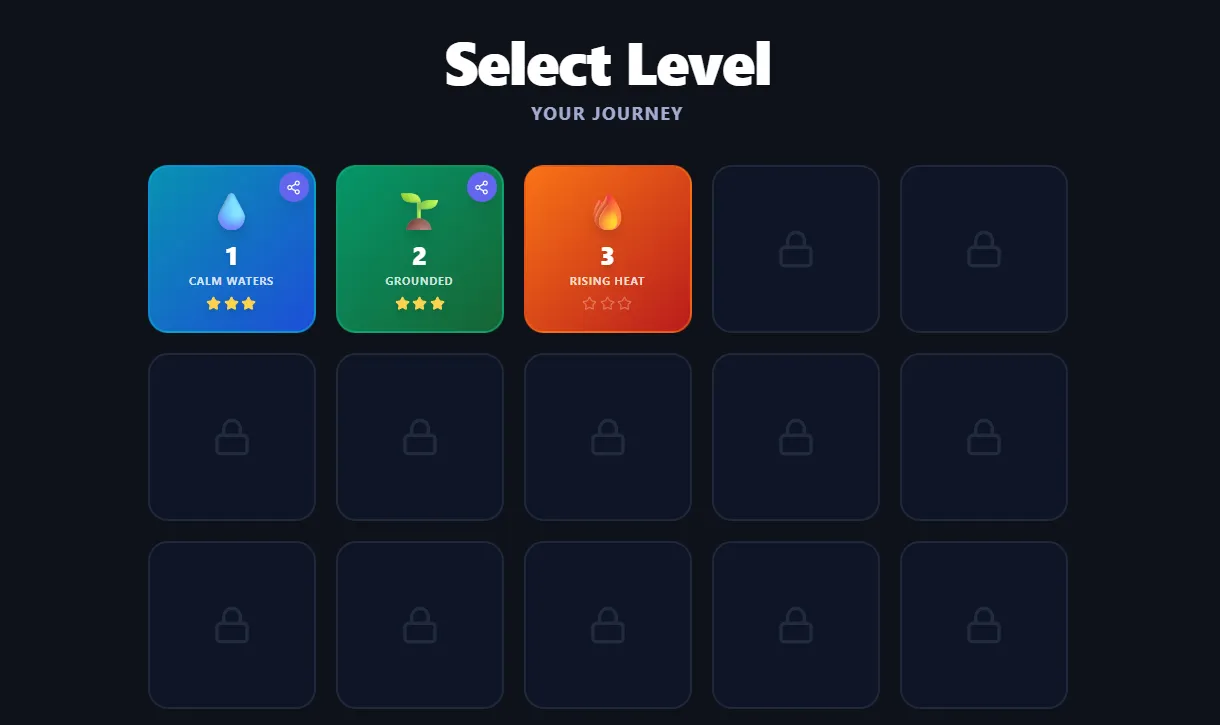 GameThe Beautiful MindA scientifically designed focus and brain-strength game with 15 progressive levels, testing attention, control and mental endurance with real-time progress tracking and leaderboards.by Modern Age CodersOpen the live project ↗
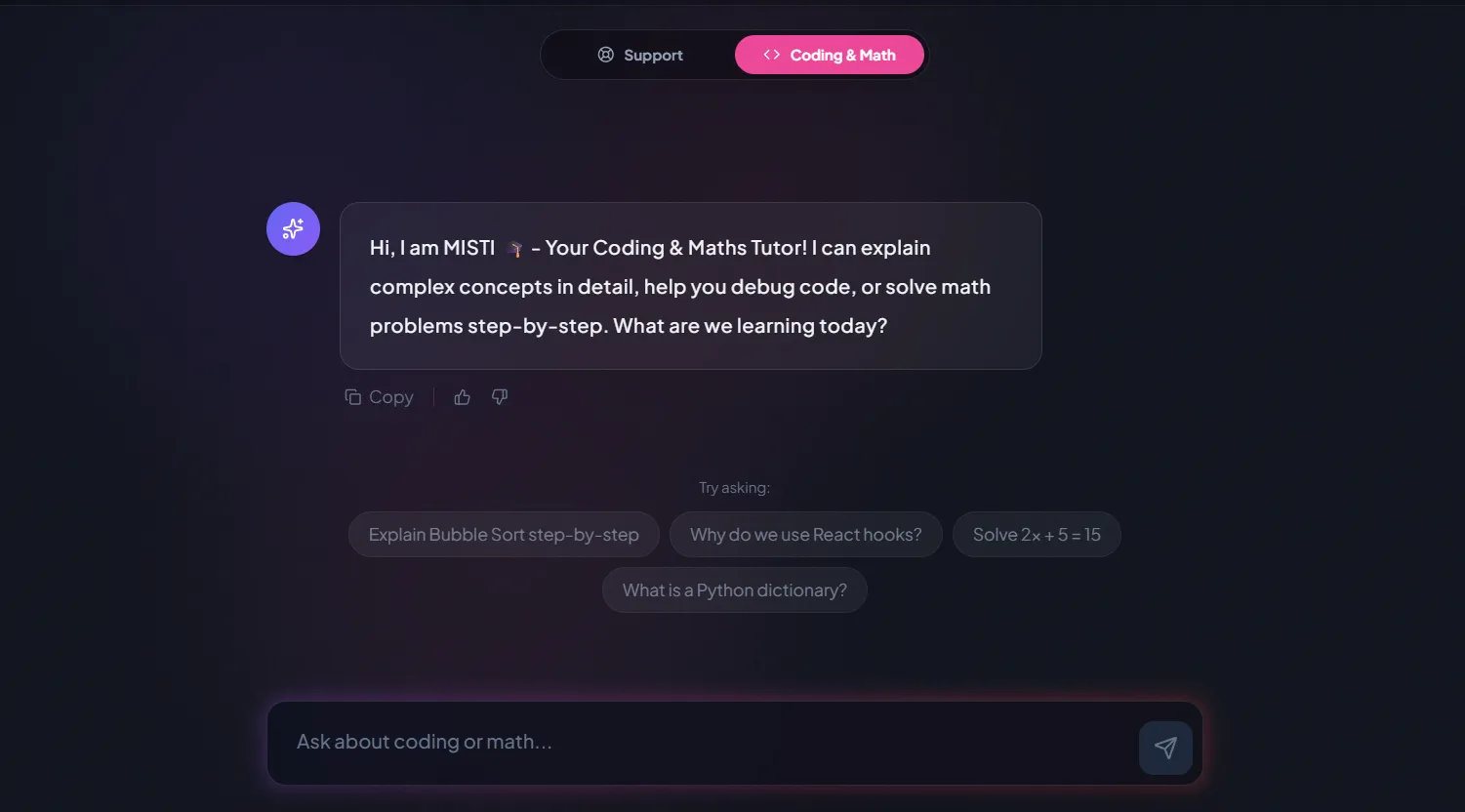 AI & MLMisti: AI Chatbot for Maths & CodingAn intelligent AI-powered chatbot that helps students solve maths and coding questions with deep, step-by-step explanations using advanced Python AI frameworks and LLM APIs.by HarshitOpen the live project ↗