Not the whole GCSE again: the marks you are missing.
A resit is a different job from a first attempt. Most of the content has been met before, so our tutors start with a diagnostic paper, repair the topics that cost the most marks, then practise full papers until the exam feels familiar.
 Start here
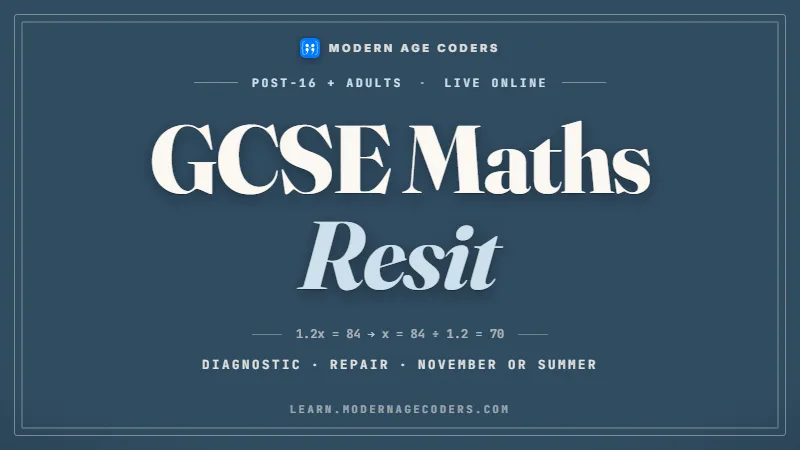
GCSE Maths Resit: Post-16 and Adults
For post-16 learners and adults resitting GCSE maths with AQA, Edexcel or OCR: diagnostic, targeted repair, then full papers for November or summer.
$100/mo group · $150/mo one-to-one
View course and enrol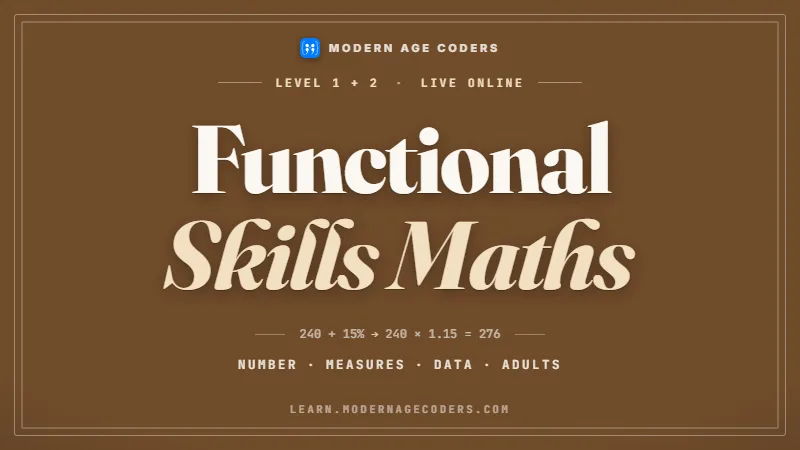
Functional Skills Maths: Level 1 and Level 2
For learners with grade 2 or below, or adults whose employer accepts it: Functional Skills maths at Level 1 and Level 2.
$100/mo group · $150/mo one-to-one
View course and enrol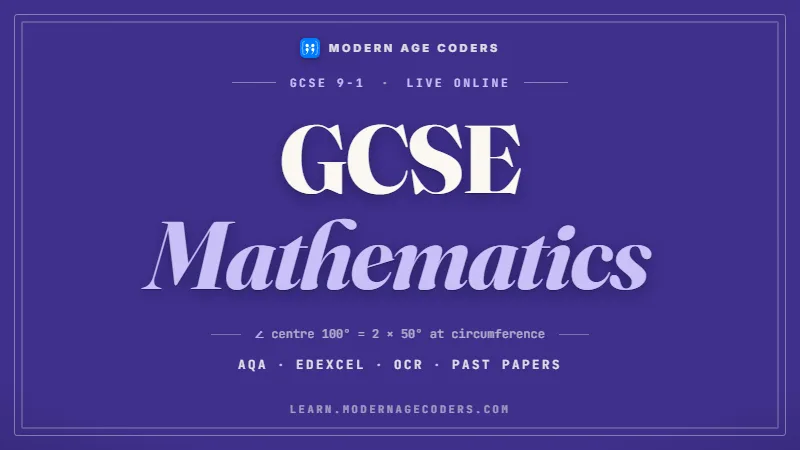
GCSE Maths: Foundation and Higher (9-1)
The full GCSE course on either tier, for a learner who needs to rebuild most of the content from the start.
$100/mo group · $150/mo one-to-one
View course and enrolFind your situation, then follow the row.
| Your situation | What we would suggest | Start with |
|---|---|---|
| Grade 3, close to a pass | A diagnostic to find the marks just out of reach, then full papers in your board's format | GCSE Maths Resit |
| Grade 1 or 2 | Number skills rebuilt first; GCSE or Functional Skills Level 2 depending on your goal | GCSE Maths Resit or Functional Skills Maths |
| Adult who left school years ago | A calm diagnostic, then a plan around work and family | GCSE Maths Resit |
| Employer accepts Functional Skills Level 2 | Functional Skills may be the quicker route | Functional Skills Maths, see Functional Skills vs GCSE |
The post-16 rule, from the Department for Education.
The rule is called the maths and English condition of funding. It applies to students aged 16 to 18 (up to 25 with an education, health and care plan) on a study programme of 150 hours or more who do not hold "a GCSE grade 9 to 4 (a level 2 pass grade)" in maths by the end of Year 11.
For 2026 to 2027, full-time students with a grade 3 must study towards the maths GCSE, because they are "closest to achieving level 2". Students with grade 2 or below can study towards Functional Skills Level 2 or the GCSE. Part-time students can study any approved qualification on their way to a grade 9 to 4.
Colleges must plan at least 100 hours of maths teaching a year for full-time students, and are encouraged to add an extra 35 hours of maths in 2026 to 2027.
The rule at a glance
| GCSE maths grade at 16 | Full-time student, aged 16 to 18 |
|---|---|
| 9 to 4 | No maths requirement |
| 3 | Must study towards the GCSE |
| 2 or below | Functional Skills Level 2 or the GCSE |
From 16 to 19 funding: maths and English condition of funding, 2026 to 2027 academic year.
A second chance each year, with an age rule.
| Board | November GCSE maths | Who can enter |
|---|---|---|
| AQA 8300 | Yes | Students who were at least 16 on the previous 31 August |
| Edexcel 1MA1 | Yes | Students at least 16 years of age on the preceding 31 August |
| OCR J560 | Yes | Learners who reached at least 16 on or before 31 August of that year |
November is quicker, but it is not always wiser. The Department for Education asks colleges to "carefully consider" whether students with a low grade 3 or below should sit in November, looking at attendance, engagement and progress first. A summer entry gives more teaching time.
Whichever series you choose, a resit means sitting all three papers again, at one tier, in that one series. OCR's specification says learners "retake all components of the qualification", and AQA and OCR both allow as many retakes as a learner wishes.
Resitting GCSE maths as an adult.
Cost of the course
Gov.uk says that if you're over 16 and have left school, you normally do not have to pay to study maths to GCSE level. Colleges and adult education centres run these courses; the National Careers Service can help you find one.
Sitting the exam
The exams are sat at an exam centre. If you study with a tutor rather than at college, ask local schools, colleges and exam centres whether they accept private candidates for your board.
GCSE or Functional Skills
If your employer or course accepts Functional Skills Level 2, it can be a shorter route. Our comparison sets out the differences.
Diagnose, repair, then rehearse.
One full paper, marked properly
Every lost mark is sorted into a gap in knowledge, a method slip or timing. That map decides the plan.
Repair the big leaks first
Number and ratio carry about half of the Foundation marks on every board, so they usually come first.
Practise the non-calculator paper weekly
It is a third of the GCSE, and arithmetic slips there are often quick marks to win back.
Full papers in your board's format
Timed, marked with the mark scheme, so method marks are banked and nothing on the day is a surprise.
Increase 240 by 15%.
15% = 36
240 + 36 = 276 or 240 × 1.15 = 276
Percentages appear in many forms on Foundation papers. Two methods, one answer, and each checks the other.
A resit built from your own lost marks.
In the first lesson the tutor works through a GCSE paper with you and sorts every lost mark. You leave knowing the handful of topics and habits that stand between you and a grade 4, and which exam series makes sense.
Lessons then repair those topics in order and move on to full papers in your board's format. Everything is live, with the same tutor, in the evenings or at weekends in UK time, so it fits around college, work or family.
We never promise a grade or a score. Results depend on the starting point, the time available and the practice done between lessons, and we say so at the start.
"Modern Age Coder have wonderful teachers who teach in a clear, easy and practical way. The teacher boosts students' confidence, keeps them updated with technology, and inspires them to learn without hesitation."
Sonu Goyal, parent · verified Google review
GCSE maths resits: what students and adults ask.
Do you have to resit GCSE maths if you get a 3?
If you are aged 16 to 18 on a full-time study programme, yes: students with a grade 3 must study towards the maths GCSE.
What if I got a grade 2 or below?
Students aged 16 to 18 with grade 2 or below can study towards Functional Skills Level 2 or towards the GCSE.
When can I resit GCSE maths?
Every May and June, and in the November series if you were at least 16 on the previous 31 August.
Can a 15 year old sit the November GCSE maths exam?
No. All three boards restrict November entry to students who were at least 16 on the relevant 31 August.
Do I have to retake all three papers?
Yes. GCSE maths is linear, so a resit means sitting all three papers again at one tier in one series.
How many times can you resit GCSE maths?
As many times as you wish. AQA and OCR both state this in their specifications.
Can adults resit GCSE maths for free?
Gov.uk says that if you're over 16 and have left school, you normally do not have to pay to study maths to GCSE level.
Can I resit on Higher tier?
Yes, if your working level supports it. Our Foundation vs Higher guide explains the trade-off.
Is Functional Skills easier than a GCSE resit?
It is shorter and more practical. Whether it counts for you depends on what your employer or course accepts.
Can you help me pass my GCSE maths resit?
We can help you prepare, though we never promise a grade. Book a Priority Demo: a full live class of about 45 to 60 minutes with a mentor reserved for you, followed by a written skill report and a personal learning roadmap on WhatsApp.
Resitting? Start with what the paper shows.
Bring a recent paper or your old results. In one live class we show where the marks go, which series fits and what the next weeks should look like. If you enrol, the demo fee is adjusted against your first month's fee.
Sources, read in October 2026.
- Department for Education, 16 to 19 funding: maths and English condition of funding, 2026 to 2027 academic year (July 2026).
- AQA, GCSE Mathematics (8300) specification, scheme of assessment and re-sits.
- Pearson Edexcel, GCSE (9-1) Mathematics (1MA1) specification, Issue 2, November resits.
- OCR, GCSE (9-1) Mathematics (J560) specification, version 2.1, sections 3e and 3f.
- Gov.uk, Improve your English, maths and IT skills.