UK / NI1 / 01
Python for teens
Constructs, arrays, functions and files, the Unit 5 toolkit in Python.
Open the syllabusNorthern Ireland · CCEA GCSE · Years 11 and 12
On the programming route of CCEA's GCSE Digital Technology, the biggest single unit is a paper candidates answer with a pen. Unit 4, Digital Development Concepts, is worth 40 per cent, and in summer 2025 it carried 120 marks in 90 minutes: algorithms completed and written by hand, arrays processed in loops, trace tables filled in, binary added, and one extended answer marked for the quality of its writing. CCEA's own report on that paper is unusually direct about where the marks went. Candidates were strong at predicting output and spotting logic errors. They lost marks by skipping a bullet-pointed requirement, ignoring a variable name the question gave them, or leaving it unclear where a loop ended. "These requirements align closely to the mark scheme", the examiners wrote. This page is built on that report.
Live teaching since 2020 · 10,000+ students · Read from CCEA's specification and its 2025 examiners' report
In short
CCEA's GCSE Digital Technology (Programming) is three units: the compulsory core, Unit 1, a one-hour written exam worth 30 per cent; Unit 4, Digital Development Concepts, a written exam of 1 hour 30 minutes worth 40 per cent; and Unit 5, Digital Development Practice, a controlled assessment worth 30 per cent and 60 marks, completed in up to 36 hours in Python, Java or C# on a scenario CCEA publishes each June. In 2025 the Unit 4 paper carried 120 marks. CCEA's report on it says candidates predicted output well but lost marks on arrays inside loops, while loops, running totals and, above all, on not following the bullet-pointed requirements and given variable names, which it says align closely to the mark scheme. Modern Age Coders teaches handwritten algorithm practice against exactly those habits, the Unit 1 core, and the design, testing and evaluation skills Unit 5 grades, on our own briefs. We never work on a live controlled assessment task. The first lesson is free, then USD 100 a month in a group or USD 150 one to one.
Start here
Two of the three languages CCEA allows in Unit 5, and the algorithms Unit 4 asks for by hand. Every card opens its syllabus.
NI / 01
Variables to file handling in the language most Northern Irish schools use for Unit 5.
Open the syllabus →
NI / 02
For schools on Java, and for the object-oriented ideas the Unit 4 extended answer asks candidates to describe.
Open the syllabus →
NI / 03
Bubble and insertion sort, linear and binary search, arrays and trace tables, practised on paper as well as on screen.
Open the syllabus →The Unit 4 paper
From CCEA's Chief Examiner's report on Unit 4, Digital Development Concepts, summer 2025.
| Feature | In 2025 |
|---|---|
| Marks and time | 120 marks in 90 minutes, ten compulsory questions |
| Question types | Multiple choice, fill in the blanks, closed response, tick box, matching terms and open response |
| Marks per part | From 1 to 9 |
| Extended writing | One question of 6 marks, marked in levels for the quality of written communication |
| Share of the GCSE | 40 per cent |
Predicting the output of algorithms, identifying the cause of logic errors and writing accurate solutions, which the report says has improved year on year.
Binary arithmetic, validation, test plans, and the difference between black box and white box testing, where many took full marks.
Arrays inside loops: using the index variable correctly, as in sales[j], and keeping a running total. Unbounded iteration, where many candidates reach for a for loop when a while loop is needed.
Short explanations that describe instead of answering: what a constant is rather than why it helps, one point about a dry run instead of two, one difference between Unicode and ASCII restated backwards.
| Topic | The slip | Practise |
|---|---|---|
| Arrays | Not using the array name given, setting all elements with one assignment instead of a loop | Initialising and totalling arrays in loops, by hand, weekly |
| While loops | Wrong condition, no counter moving through the array, output statements left inside the loop | Writing while versions of every for loop, and marking where each loop ends |
| Constants | Defining a constant instead of giving an advantage | Answering "why" questions with a benefit, such as readability or easier maintenance |
| Characters | Confusing the number of bits with the number of characters in ASCII and Unicode | Two genuinely different contrasts, stated both ways |
| Sorting | Mixing up insertion and bubble sort | Tracing both sorts on the same short list until the difference is obvious |
| Robustness | Naming a type of testing instead of the data used | Two of valid, null, invalid and exceptional data, at high volume |
Source: CCEA GCSE Chief Examiner's and Principal Moderator's Report, Digital Technology, Summer Series 2025, and the CCEA GCSE Digital Technology specification, both from the CCEA GCSE Digital Technology pages. The 120-mark total is the 2025 paper's; papers can vary.
The bullet-point rule
The single most repeated piece of advice in the 2025 report, and the easiest to practise.
Long Unit 4 questions set out a scenario and then list what the algorithm must do, usually as bullet points: read this, calculate that, output these two values, use one condition per if-statement. The report says of one such question: "These requirements align closely to the mark scheme." Candidates lost marks for not outputting a value a bullet asked for, for using two conditions where one was specified, and for entering numbers where the question gave variable names such as HireCost and NumberOfNights.
The report is plain: "where variable names are provided candidates must make use of them". A correct algorithm with invented names loses marks it did not need to lose.
Outputs placed inside a while loop earned nothing when they belonged after it. Indent clearly or end the loop explicitly, so the logic is visible on paper.
Where a question asks for a set number of ticks, "only the first n, where n=the required number, will be accepted". Extra answers in a single-answer space score nothing.
The extended answer has its own trap. The report warns that "Candidates making use of generic terms will be unable to score in the top band", and elsewhere singles out words like faster and quicker. In 2025 the question asked candidates to describe procedural and object-oriented programming. Most described objects, classes and inheritance well and procedural programming thinly, sometimes as no more than step-by-step instructions.
| Step | What to do |
|---|---|
| 1. Number the bullets | Write a small number beside each requirement before writing any code |
| 2. Copy the names | Underline every variable and array name the question supplies, and use them exactly |
| 3. Write the algorithm | One requirement at a time, in the order given, with loops clearly opened and closed |
| 4. Tick them off | Check each numbered bullet against a line of the answer before moving on |
| 5. Dry run it | Trace one set of values through by hand, which also catches outputs in the wrong place |
Writing code by hand is its own skill. Students who only ever type into an editor that indents and completes for them find a blank page slow and untidy, and CCEA marks what it can read. We set handwritten algorithm work in every group from the start, alongside the on-screen programming Unit 5 needs.
Unit 5
Digital Development Practice: a new scenario each June, 60 marks, up to 36 hours, marked in school and moderated by CCEA.
| Task | What moderators saw |
|---|---|
| 1. Design | Strong flowcharts and pseudo-code; user requirements sometimes copied from the task without being developed; user feedback to refine the design sometimes missing |
| 2. Build | High standard of programs; every solution must be annotated; the strongest considered robustness |
| 3. Test | Well-structured test tables, but extreme test data often missing; screenshots needed only to show corrective action, which some skipped |
| 4. Evaluate | Too often descriptive; the advice is to judge each user requirement as fully met, partially met or not met, and to treat performance, robustness and refinements in depth |
Two rules from the report shape how anyone outside the school should behave. "The use of templates is prohibited", and moderators encourage candidates to develop their own program style. CCEA also expects schools to practise on legacy tasks and practice tasks rather than rehearsing on the live scenario, and says "Extreme testing of data was lacking in a number of centres", a gap that practice fixes cheaply.
Teach design with flowcharts and pseudo-code, validation and error trapping, annotated code, test tables with valid, invalid and extreme data, and evaluation against user requirements, on practice scenarios we write.
Use Python or Java, whichever the school teaches. We have no general C# course; C# appears only in our Unity game course, so a family at a C# school should tell us in the first lesson.
Look at, discuss or help with the live controlled assessment task, or any work produced for it. The teacher signs that the work is the candidate's own and may not correct it in detail for a fair copy.
Supply templates or model solutions of any kind, which CCEA prohibits in any case.
Unit 1
Shared by both routes, worth 30 per cent, and broader than most students expect.
Unit 1, Digital Technology, covers data storage and representation, networks, databases, spreadsheets, security, legislation and the wider effects of digital technology. The 2025 report found it answered well overall, with a few recurring gaps worth planning around.
| Topic | What went wrong |
|---|---|
| Start-up | Many could not identify the boot-up sequence when a computer is switched on |
| Databases | Validation questions separated candidates; many lacked the knowledge |
| Spreadsheets | Some could not describe VLOOKUP, and some wrote formulae with the wrong symbols |
| Connected devices | Many could not expand the letters IoT |
| Legislation | Titles not known precisely enough to earn the mark |
| Health | Answers not tied to the situation described in the question |
Because at least 40 per cent of the assessment must be taken at the end of the course, schools plan when each unit is sat. For the step after the GCSE, the CCEA Software Systems Development page covers the A level, and the Northern Ireland page sets out the two routes and the whole system from primary school up.
Progression
Placement follows what a student can already write without help, on screen and on paper.
| Rung | When | What should be true |
|---|---|---|
| 1. Constructs | Year 10 or early Year 11 | Variables, constants, selection, for and while loops, written unaided in Python or Java |
| 2. Arrays and algorithms | Year 11 | One-dimensional arrays in loops with running totals, bubble and insertion sort, linear and binary search, by hand and on screen |
| 3. Data and testing | Year 11 | Binary, hexadecimal and overflow, ASCII and Unicode, validation checks, test plans with valid, invalid and extreme data |
| 4. Exam habits | Year 12 | Long questions answered against numbered bullets, given names used exactly, extended answers in precise terms |
Arrays inside while loops were the weakest area in the report. Weekly handwritten practice closes the gap faster than anything else.
The full order of topics runs down the coding roadmap.
The bullet-point routine takes a few weeks of practice and then pays on every long question.
Lessons lighten during controlled assessment weeks and before the exams.
The catalogue
Arranged by unit. The free lesson decides the first one.
UK / NI1 / 01
Constructs, arrays, functions and files, the Unit 5 toolkit in Python.
Open the syllabusUK / NI1 / 02
The same ground in Java, with the object-oriented ideas Unit 4 asks about.
Open the syllabusUK / NI1 / 03
Our only C# course, through Unity; useful for a C# school, though games are not the Unit 5 brief.
Open the syllabusUK / NI2 / 01
Sorts, searches, arrays and trace tables, by hand first.
Open the syllabusUK / NI2 / 02
Binary, hexadecimal, character sets and testing theory shared with Unit 4.
Open the syllabusUK / NI2 / 03
Database design, data types and validation, which Unit 1 examines.
Open the syllabusUK / NI3 / 01
Cybercrime, threats and protection for the Unit 1 security questions.
Open the syllabusUK / NI3 / 02
Spreadsheet formulae and lookups; pitched older, but it covers VLOOKUP properly.
Open the syllabusUK / NI3 / 03
For students heading to A level Software Systems Development.
Open the syllabusHow lessons work
Our teachers work from India on a clock that never changes, so Northern Ireland is four and a half hours behind in summer and five and a half in winter. Slots are fixed in UK time.
After school
Most Year 11 and 12 students choose this.
Evening
Around sport, music or part-time work.
Saturday
Long enough for a timed Unit 4 section and its marking.
Every week at least one algorithm written on paper against numbered bullet points, then marked the way the report describes.
Arrays processed with while loops as well as for loops, with counters and running totals checked by dry run.
Extended answers rewritten until generic words like faster are replaced with the correct terms.
Every practice test table includes extreme data, the gap the moderators flagged.
Unit 5 skills practised on briefs we write, never on the live task.
Students at one rung, swapping and marking each other's handwritten answers.
Student work
Four projects from classes, none of them assessed work. More in student labs.
AI and ML
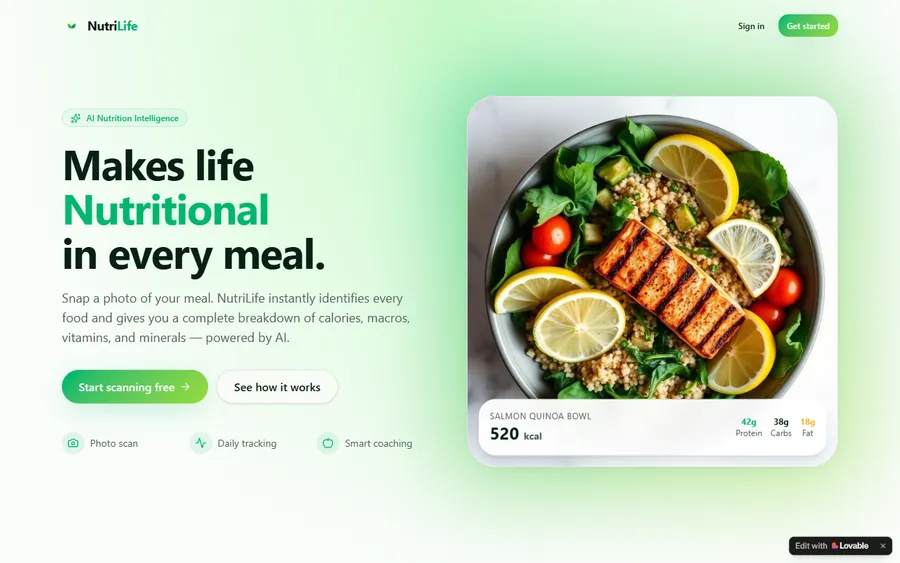
An AI nutrition coach that reads what you eat and works you toward a target.
AI and ML
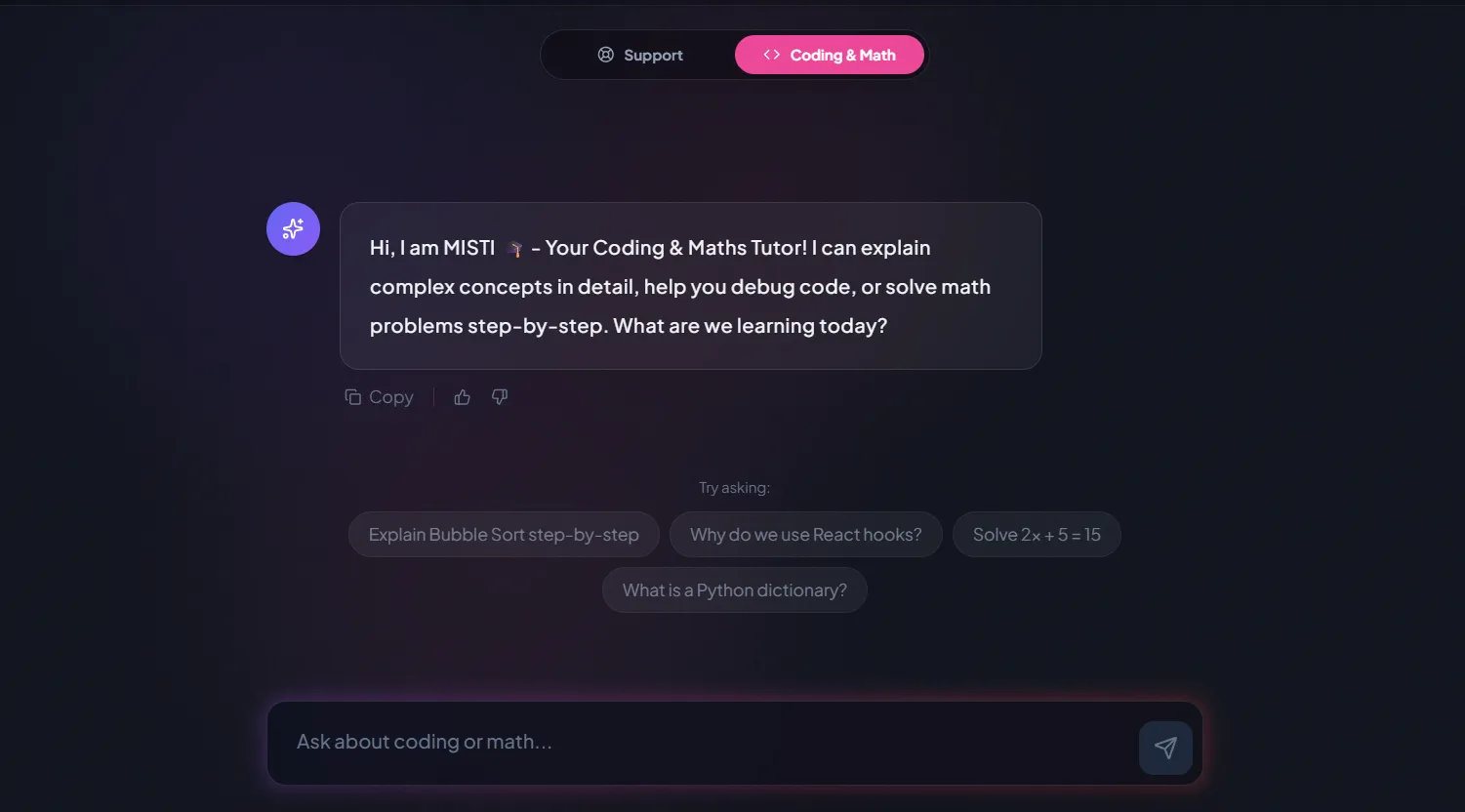
A chatbot that answers mathematics and programming questions, built and deployed by a student.

AI and ML
An assistant that helps a young person recognise unsafe situations online.
Web app
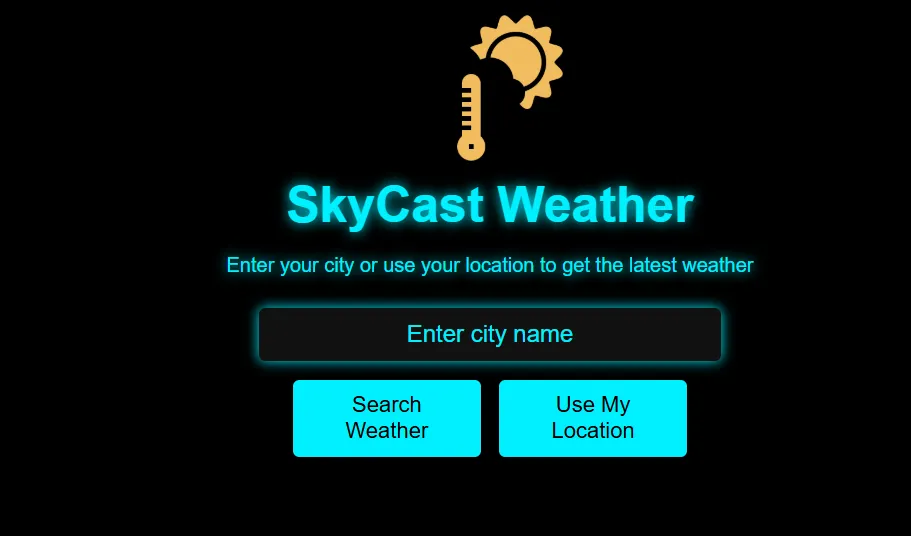
A weather forecasting site with live conditions for any location.
Fees
One monthly charge in US dollars, applied to every family outside India. The first lesson costs nothing, and nothing is billed until a course and a weekly slot are fixed.
Free first class
USD 0
no card required
Group batch
USD 100
a month, billed in US dollars
One to one
USD 150
a month, billed in US dollars
What families say
Google reviews from parents, reproduced as written.
★★★★★
"The one step solution for my son. Modern Age Coders make learning coding so simple that kids love it. The teachers explain complex concepts clearly with practical exercises and interactive content."
Ria Mukherjee
Parent
★★★★★
"Modern Age Coders has been a game-changer for me. I struggled to grasp IT concepts and coding before joining, but their classes transformed everything. I can now confidently write complex programs with ease."
Samriddha Mondal
Student
★★★★★
"One of the most wonderful education centres out there. Education is not limited to school syllabus but focuses on skill development."
Vansh Agarwal
Student
★★★★★
"My child Dhairya is really enjoying the Modern Age Coders classes. This is his first online class and he eagerly looks forward to it. I can already see his improvement, and the teachers are very cooperative."
Sonam Oswal
Parent of Dhairya
★★★★★
"Modern Age Coders have wonderful teachers who teach in a clear, easy and practical way. The teacher boosts students' confidence and inspires them to learn without hesitation."
Sonu Goyal
Parent
★★★★★
"I highly recommend this computer coding class! The teachers are incredibly knowledgeable and passionate about coding."
Ritu Kedia
Parent
Questions about CCEA GCSE Digital Technology
Unit 1 is a one-hour written exam worth 30 per cent. Unit 4 is a written exam of 1 hour 30 minutes worth 40 per cent. Unit 5 is a controlled assessment worth 30 per cent and 60 marks, done in up to 36 hours.
No. It is an external written examination, so algorithms are written by hand. In 2025 it carried 120 marks across ten compulsory questions.
According to CCEA's 2025 report: arrays processed inside loops, while loops, running totals, and not following the bullet-pointed requirements or the variable names a question supplies.
Python, Java or C#, chosen by the school. The solution must be written in one of the three.
Every year. CCEA publishes a new scenario-based task in June, worth 60 marks and taking up to 36 hours.
Structured test tables with valid, invalid and extreme data, both black box and white box tests, and screenshots only where they show a correction. Extreme data was often missing in 2025.
Not with the task itself. The teacher certifies the work as the candidate's own and may not correct it in detail. We teach the skills beforehand on our own scenarios and never see the live task.
Data representation and storage, networks, databases, spreadsheets, security, legislation and the effects of digital technology. It is shared with the multimedia route.
CCEA offers A level Software Systems Development and A level Digital Technology. Our Software Systems Development page covers the first.
The first lesson is free. Then a single monthly fee in US dollars, lower for a group place than for one-to-one teaching, as listed in the fees section, with nothing paid ahead.
Elsewhere on this site
The system around the GCSE, the A level after it, and choosing at 14.
The two routes, the permitted languages, and the whole system.
The programming A level that follows this route.
What the evidence says about picking a computing GCSE.
Northern Ireland's science and technology showcase for young people.
AI tools and assessed work.
The hub for every UK page we publish.
Start here
Leave a number and we will phone at a UK time of your choosing. The lesson uses CCEA-style questions, one of them on paper, and ends with a rung to begin on.
Rather read first? Each course page carries its syllabus, how we teach is candid about who the method suits, and the coding roadmap sets out the order.
WhatsApp us · +91 91233 66161 · contact@modernagecoders.com
WhatsApp is quickest and free from a UK phone. It rings our office in India, so the number starts +91.