SYI / A / 01
Python from start to finish
Fluency, so nothing has to be looked up.
Open the syllabusNorthern Ireland · Under 19 · Final 26 November 2026
Northern Ireland runs its own STEM competition and almost nobody outside it knows. Sentinus Young Innovators picks a Young Scientist, a Young Engineer, a Young Mathematician and a Young Coder of the Year, and unlike almost every project competition in Britain, the coding and mathematics titles are not decided by something submitted from home. Finalists come to Ulster University in Belfast on a Thursday in November and are given ninety minutes, live, in front of a panel. You cannot polish that, and you cannot outsource it, which makes preparing for it a completely different job.
Quoted from Sentinus with the date we read it · Our own arithmetic on the age rule · No prize money printed
In short
Sentinus Young Innovators 2026 chooses Northern Ireland's Young Scientist, Young Engineer, Young Mathematician and Young Coder of the Year, with an overall Sentinus Young Innovator above them. "Applications must be aged under 19 on July 1st 2027." Scientists submit a poster by 29 September 2026 and engineers by 30 September 2026, while the mathematics and coding categories run "an assessment in late September 2026, to select the finalists"; the first two allow individuals or "teams of up to 3 people" and the second two are individual. The final is "Thursday 26th November 2026" at Ulster University, Belfast, where mathematics finalists face "a 90 minutes live maths challenge" and coders "a 90 minute coding challenge", judged by a panel of industry experts. The overall winner receives a funded trip to the International Science and Engineering Fair 2027 in the USA. We teach the coding and the mathematics. A first class is free; a group place is USD 100 a month and one-to-one teaching USD 150.
Where to start
A live challenge rewards what a student can produce unaided, which is a narrower thing than what they know.
SYI / 01
For the coding final: writing and debugging without looking things up, which is the whole skill on the day.
Open the syllabus →
SYI / 02
For the mathematics final: unfamiliar problems worked to an answer under a clock.
Open the syllabus →
SYI / 03
For choosing a method quickly and knowing it will finish inside the time.
Open the syllabus →The competition
Facts read at the organiser's own pages on 20 September 2026.
| Part | Scientist and Engineer | Mathematician and Coder |
|---|---|---|
| How you get in | An online poster submission | "An assessment in late September 2026, to select the finalists" |
| Deadline | 29 September 2026 for scientists, 30 September for engineers | The assessment, in late September |
| Who can enter | "Individuals" or "teams of up to 3 people" | Individual entries |
| At the final | The project is judged | A live 90-minute challenge |
| Judged by | A panel of industry experts | A panel of industry experts |
| The date | Thursday 26 November 2026 | Thursday 26 November 2026 |
| The venue | Ulster University, Belfast | Ulster University, Belfast |
| Eligibility | "Aged under 19 on July 1st 2027" | "Aged under 19 on July 1st 2027" |
The split between the two columns is the thing to understand first. A scientist or engineer prepares work at home and brings it; a mathematician or coder sits an assessment to qualify and then performs on the day. They are different competitions wearing one name, and a student should know which one they are entering before September.
Above the four titles sits the overall Sentinus Young Innovator, whose prize is a funded trip to the International Science and Engineering Fair in the USA in 2027. The other category winners receive a cash prize, which the organiser publishes in pounds and we do not print.
For a school in Northern Ireland this is the nearest thing to a home fixture on our whole competitions calendar. Almost everything else on it is run from England and sat at a desk; this one ends with a day at Ulster University and a panel who work in the field.
It also runs early. The assessment is in late September and the final in November, so a student thinking about it in October has already missed the first stage. That is worth knowing in the summer term, not the autumn.
Source: Sentinus Young Innovators, read 20 September 2026. Modern Age Coders is not connected with Sentinus or Ulster University.
The method
Sentinus sets eligibility by birthday rather than by year group. In Northern Ireland, and only there, those two things come to almost exactly the same thing.
The rule is "aged under 19 on July 1st 2027". Turn that into a birth date and something interesting appears.
| Step | Result |
|---|---|
| "Under 19 on 1 July 2027" means born after | 1 July 2008 |
| Northern Ireland's compulsory school age cut-off | 2 July |
| So a Northern Ireland school year runs from | 2 July to 1 July |
| A pupil born 30 June 2008 is | Too old, and a school year above |
| A pupil born 2 July 2008 is | Eligible, and in the year below |
An age rule normally cuts across a year group, so a class contains some eligible pupils and some not. Here the rule falls on the school-year boundary itself, so whole year groups are in or out together.
England uses 1 September. The same "under 19 on 1 July" rule applied to an English school would split a year group roughly in half, which is exactly the confusion this avoids in Belfast.
Check one pupil's birthday and you know about the whole class. That is worth thirty separate checks in a busy September.
None of this is an accident of luck; it is what happens when a Northern Ireland organisation writes a rule for Northern Ireland schools. It is also the kind of detail that gets lost when a UK-wide site copies an eligibility line without asking which school system it was written for.
It matters practically because sixth form in Northern Ireland runs to Year 14 rather than Year 13, and students assume an under-19 rule excludes them. Often it does not.
The wider lesson, for anyone who writes rules, is that a date is never just a date: it belongs to a system. Our UK page works through the four different school-start rules in Britain and what one birthday does under each of them.
The Northern Ireland cut-off we use here was read at the Department of Education for that page on 19 September 2026, and our own first draft of the rule was a year out, which is recorded there too.
The arithmetic is ours, computed on 20 September 2026 from the organiser's published eligibility rule and the Northern Ireland compulsory school age cut-off.
The final
A live final is not a harder version of a take-home task. It tests a different thing, and it can be practised.
| Rewarded | Why | Not rewarded |
|---|---|---|
| Writing code from memory | There is no time to look up how a thing is spelled | Knowing where to find an answer |
| Choosing a method quickly | Ninety minutes is enough for one good plan and not two | Exploring three approaches |
| Starting with something that runs | A partial working program beats an unfinished elegant one | Designing before typing anything |
| Reading the whole task first | Late requirements change early decisions | Starting at the first sentence |
| Calm under observation | A panel is watching, and that is a skill of its own | Anything practised only alone and untimed |
The single most useful practice is the least fashionable: sit down with a clock, no internet, and a problem you have not seen, for ninety minutes, once a week. Everything else follows from finding out what you actually reach for when nothing can be looked up.
The second is to get something running in the first fifteen minutes, even if it only handles the simplest case. A student with a working partial answer at minute eighty is in a far better position than one with an ambitious half-finished design.
For the mathematics final the shape is the same: ninety live minutes, unfamiliar problems, no reference. The olympiad pages on this site are about exactly that kind of work.
And whether or not a student reaches Belfast, practising under a clock without a search engine is the rarest and most useful habit we teach. Most young programmers have never once worked without one.
Getting ready
Each rung is something a student can do without help, which is the only thing a live challenge can see.
| Stage | Rung | The sign it is secure |
|---|---|---|
| Years 8 to 10 | 1. Fluent basics | Writes input, loops and conditions without looking anything up |
| Years 10 to 11 | 2. Unaided debugging | Finds and fixes an error without asking or searching |
| Years 11 to 13 | 3. Under a clock | Produces a working partial answer inside the first quarter of the time |
| Years 12 to 14 | 4. Under observation | Does all of the above with somebody watching |
The assessment that selects finalists is in late September, so an entry has to be decided in the summer term rather than the autumn.
Practise one ninety-minute sitting a week with no internet. Nothing else prepares for a live final.
Working without a search engine is a skill almost no young programmer has, and it is the one employers notice first.
The rest of the season is on the competitions calendar, including several open across all four nations.
The full list
Grouped by which final a student is heading for, with the syllabus behind each card.
SYI / A / 01
Fluency, so nothing has to be looked up.
Open the syllabusSYI / A / 02
Correct code against a clock.
Open the syllabusSYI / A / 03
Picking a method that will finish in time.
Open the syllabusSYI / B / 01
Unfamiliar problems, worked to an answer.
Open the syllabusSYI / B / 02
Technique that should never slow the thinking.
Open the syllabusSYI / B / 03
Careful counting under time pressure.
Open the syllabusSYI / C / 01
Evidence a poster can actually carry.
Open the syllabusSYI / C / 02
A trained model, honestly reported.
Open the syllabusSYI / C / 03
Building something people can try.
Open the syllabusSYI / D / 01
The first typed language, taught patiently.
Open the syllabusSYI / D / 02
Logic first, typing later.
Open the syllabusSYI / D / 03
Programs that show why a method works.
Open the syllabusHow lessons run
Lessons are live on video from India, five and a half hours ahead of the UK in winter and four and a half in summer, at a time agreed and kept in UK time.
Weekday evening
The usual slot for Years 11 to 14.
Weekend morning
Long enough for a full ninety-minute sitting.
September weeks
For the run-up to the selection assessment.
We run ninety-minute practices with nothing to look up, because that is the round.
A student finds their own error while a teacher watches and says nothing, which is uncomfortable and works.
Enough for two approaches to meet, small enough for every program to be read.
Year 12 and Year 14 mean what they mean in Belfast, not what they mean in Birmingham.
For a finalist in the weeks before November.
We do not enter students, and we have no relationship with Sentinus.
Student work
Four pieces of finished, published work by students here, made for their own reasons. More of them sit on the student labs page.
AI and ML
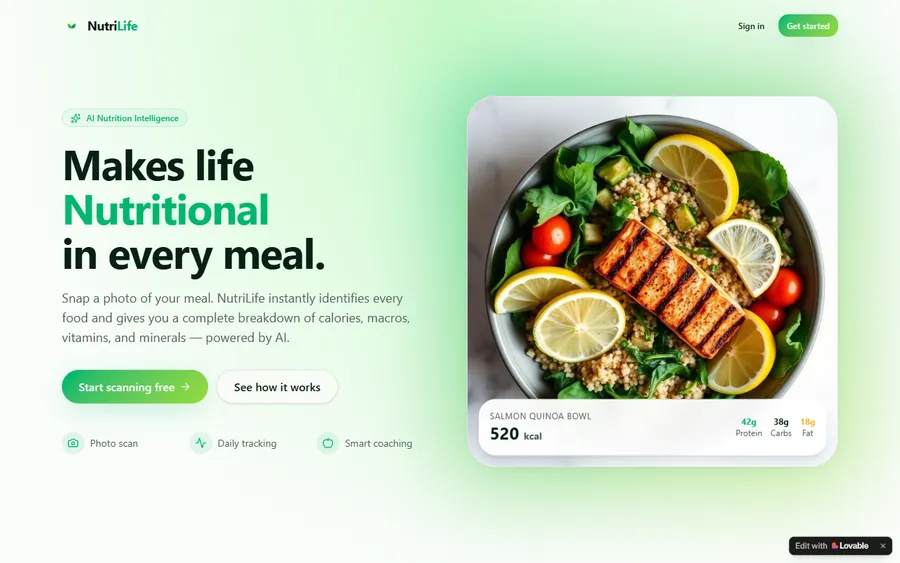
An AI nutrition coach that reads what you eat and works you toward a target.
AI and ML
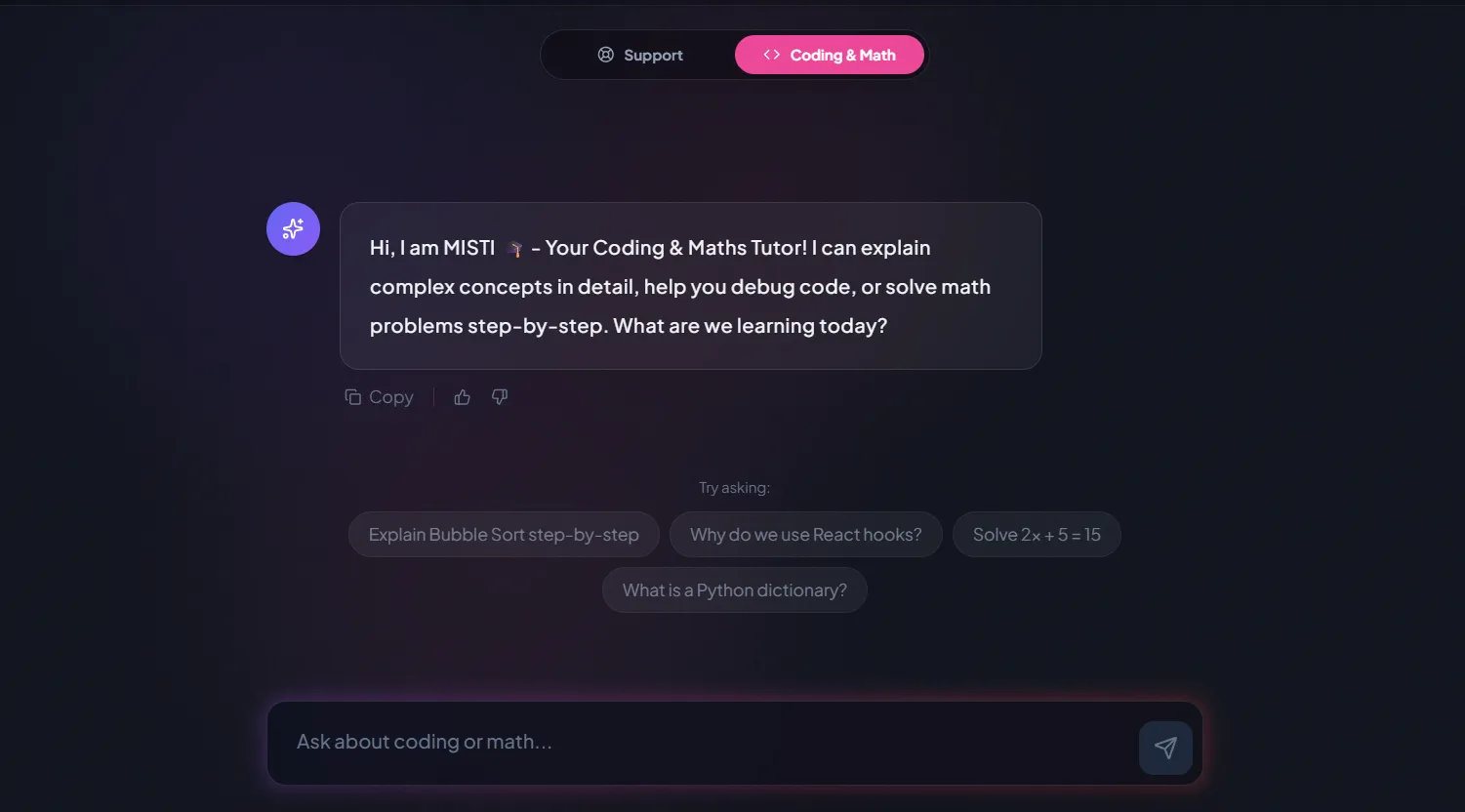
A chatbot that answers mathematics and programming questions, built and deployed by a student.
AI and ML
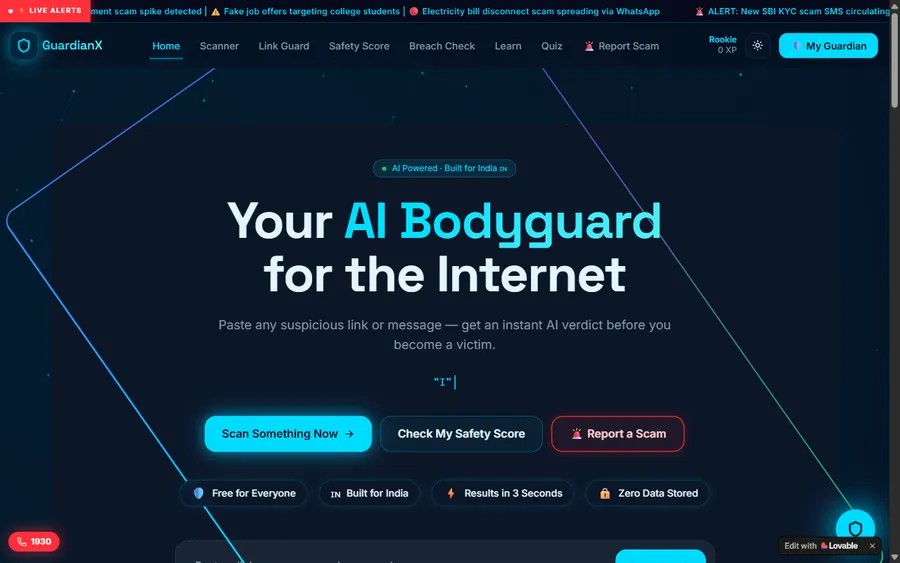
An assistant that helps a young person recognise unsafe situations online.
Web app
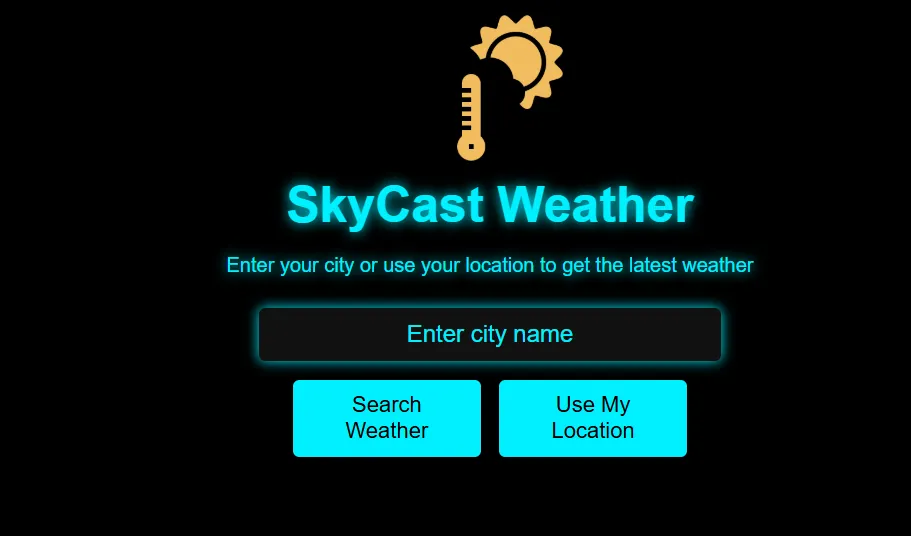
A weather forecasting site with live conditions for any location.
Fees
A single monthly rate in US dollars outside India, no registration charge, and you can stop whenever a month ends.
Free first class
USD 0
no card required
Group batch
USD 100
a month, billed in US dollars
One to one
USD 150
a month, billed in US dollars
What families say
What families have written about us on Google, unedited.
★★★★★
"The one step solution for my son. Modern Age Coders make learning coding so simple that kids love it. The teachers explain complex concepts clearly with practical exercises and interactive content."
Ria Mukherjee
Parent
★★★★★
"Modern Age Coders has been a game-changer for me. I struggled to grasp IT concepts and coding before joining, but their classes transformed everything. I can now confidently write complex programs with ease."
Samriddha Mondal
Student
★★★★★
"One of the most wonderful education centres out there. Education is not limited to school syllabus but focuses on skill development."
Vansh Agarwal
Student
★★★★★
"My child Dhairya is really enjoying the Modern Age Coders classes. This is his first online class and he eagerly looks forward to it. I can already see his improvement, and the teachers are very cooperative."
Sonam Oswal
Parent of Dhairya
★★★★★
"Modern Age Coders have wonderful teachers who teach in a clear, easy and practical way. The teacher boosts students' confidence and inspires them to learn without hesitation."
Sonu Goyal
Parent
★★★★★
"I highly recommend this computer coding class! The teachers are incredibly knowledgeable and passionate about coding."
Ritu Kedia
Parent
Sentinus Young Innovators questions
Northern Ireland's STEM competition, choosing a Young Scientist, Young Engineer, Young Mathematician and Young Coder of the Year, with an overall Sentinus Young Innovator above them.
The organiser says applications must be aged under 19 on 1 July 2027. That works out as born after 1 July 2008.
In Northern Ireland, almost exactly. The compulsory school age cut-off there is 2 July, so an NI school year runs 2 July to 1 July and the eligibility window falls on the boundary. A pupil born 30 June 2008 is too old and one born 2 July 2008 is eligible, and they are a school year apart.
Through an assessment in late September 2026 that selects the finalists. Scientists and engineers instead submit a poster, by 29 and 30 September 2026 respectively.
In the scientist and engineer categories, yes: individuals or teams of up to three people. The mathematics and coding categories are individual.
It is on Thursday 26 November 2026 at Ulster University, Belfast. Mathematics finalists face a 90-minute live maths challenge and coders a 90-minute coding challenge, judged by a panel of industry experts.
The overall Sentinus Young Innovator receives a funded trip to the International Science and Engineering Fair 2027 in the USA. Category winners receive a cash prize, which the organiser publishes in pounds and we do not print.
By sitting ninety minutes a week with a clock and no internet, and by aiming to have something running in the first fifteen minutes. A working partial answer beats an unfinished elegant one.
Sentinus is a Northern Ireland organisation and the competition and its final are run there. Check the organiser for anything outside that.
We teach coding and mathematics in live online classes, including timed practice. We do not enter anyone and have no relationship with Sentinus.
Related pages
The UK-wide contests open to the same students, and where the whole year is set out.
Four school systems, and what one birthday does under each.
Sat in school in December and January.
The season in one table, with each organiser named.
Three and a half hours, and marked by hand.
Project entries from teams of any size.
How to tell a serious provider from a well-designed one.
Start here
Tell us the year group and which title your child is aiming at. The free lesson is real work, and afterwards we say honestly what we saw.
Rather read first? Syllabuses are on the course pages, the method on how we teach, and the topic order on the roadmap.
WhatsApp us · +91 91233 66161 · contact@modernagecoders.com
A WhatsApp message reaches us quickest and is free from a UK mobile. Our number is Indian, which we say on every page, and no British office exists.