UK / MN1 / 01
GCSE mathematics
Both tiers, all strands.
Open the syllabusWales · WJEC GCSE · Years 10 and 11
Until September 2025, many pupils in Wales took two maths GCSEs: Mathematics and Mathematics-Numeracy. From September 2025 they take one, a double award called GCSE Mathematics and Numeracy, which is graded as two GCSEs on a scale from A*A* down to GG. Qualifications Wales describes it simply: "we are replacing the existing mathematics and mathematics-numeracy GCSEs with one GCSE Mathematics and Numeracy qualification". The most striking change is inside it. One of the three units is devoted to money: payslips, income tax and National Insurance, mortgages, interest rates, bills, exchange rates. The first units were available in summer 2026, and the first full results arrive in November 2026. This page explains the structure, the finance paper, the new tiering rules, and how to prepare.
Live teaching since 2020 · 10,000+ students · From WJEC's specification and FAQs, and Qualifications Wales
In short
WJEC's GCSE Mathematics and Numeracy (Double Award), first taught in September 2025, replaces the separate Mathematics and Mathematics-Numeracy GCSEs in Wales. It is graded as a double award, from A*A* to GG, and assessed entirely by three written exams: Unit 1, Financial Mathematics and Other Applications of Numeracy, calculator allowed, 30 per cent; Unit 2, non-calculator, 30 per cent; and Unit 3, calculator allowed, 40 per cent. Each unit has a Higher tier (A* to D) and a Foundation tier (C to G), and pupils can sit different tiers for different units. Units 1 and 2 were first available in summer 2026; Unit 3 is first available in November 2026, when the first full awards are made. Modern Age Coders teaches the whole course live, with particular care on the finance content, payslips, tax, AER and APR, mortgages and bills, which is unfamiliar territory for many pupils. Lessons are in English. The first lesson is free, then USD 100 a month in a group or USD 150 one to one.
Start here
GCSE content, the finance unit, and broader practice. We teach the WJEC specification through courses written for more than one curriculum.
MN / 01
Number, algebra, geometry and statistics at both tiers, the core of Units 2 and 3.
Open the syllabus →
MN / 02
Pitched at older learners, but covers interest, loans, mortgages, VAT and budgeting, much of Unit 1.
Open the syllabus →
MN / 03
Extra depth in surds, algebra and trigonometry for Higher-tier pupils.
Open the syllabus →One GCSE, two grades
From the WJEC specification, version 5, September 2025, and Qualifications Wales.
| Unit | Calculator | Higher tier | Foundation tier | Weight |
|---|---|---|---|---|
| 1. Financial Mathematics and Other Applications of Numeracy | Allowed | 1 hour 45 minutes, 80 marks | 1 hour 30 minutes, 65 marks | 30 per cent |
| 2. Non-calculator | Not allowed | 1 hour 45 minutes, 80 marks | 1 hour 30 minutes, 65 marks | 30 per cent |
| 3. Calculator-allowed | Allowed | 2 hours, 90 marks | 1 hour 45 minutes, 75 marks | 40 per cent |
Because it replaces two GCSEs, it is graded as a double award, on an eight-grade scale from A*A* down to GG, with results below that reported as U. There is no single-award option: WJEC's FAQs state plainly, "There is no Single Award GCSE for Mathematics." And there is no coursework either. Qualifications Wales notes that, "unlike most other GCSEs, it does not include non-examination assessment", which is one reason the exams are split into units that can be sat before the end of Year 11.
One qualification instead of two, and less assessment overall than taking both old GCSEs, according to Qualifications Wales.
Content that mostly mirrors the old GCSEs, with some modern additions such as infographics alongside the usual charts and graphs.
Tiering: pupils still sit Higher or Foundation papers, now with only those two tiers and no intermediate tier.
Written exams only, sat in the familiar summer series, now with a November series as well.
Source: WJEC GCSE Mathematics and Numeracy (Double Award) specification and FAQs, and the Qualifications Wales blog of 21 February 2025 explaining the new double award.
The finance paper
Unit 1 is set in personal and real-world contexts, and much of it is personal finance.
The specification says Unit 1 questions "will be set in personal and other real-world contexts", with a calculator allowed. Its section on personal and household finance and enterprise lists what pupils should be able to work with, and it reads like a first year of adult life.
| Area | Includes |
|---|---|
| Earning | Wages and salaries, including payslips; income tax and National Insurance |
| Saving and borrowing | Savings and investments, loans and repayments, mortgages, finance schemes including buying by instalments |
| Interest | Simple and compound interest with multipliers, calculations with multiple rates, AER and APR to compare products |
| Running a home | Budgeting, bank statements, utility bills, mobile phone and other bills |
| Shopping and selling | VAT, value-for-money comparisons, price comparison, discounts and price increases, buying and selling, profit and loss |
| Value over time | Appreciation and depreciation |
| Travel | Foreign currencies, exchange rates and commission |
WJEC's FAQs say pupils should be able to "compare mortgage products or determine the required deposit amount", and that harder information, such as monthly payments, will be provided in the question.
Tax questions may use pounds alongside other currencies, and the FAQs warn that "tax rates may not match current UK rates". Pupils must apply the rates given, not the ones they remember.
AER, APR, National Insurance, commission: most fifteen-year-olds have never needed these words. WJEC promises glossaries, and unfamiliar terms in questions will be explained.
This is where many able mathematicians are caught out. The mathematics in Unit 1 is rarely hard; percentages, multipliers and proportion. What is new is reading a payslip, a bank statement or a tariff table quickly and knowing which numbers matter. That is a skill built by working with real-looking documents, not by more algebra.
Tiers and timing
Two changes that give schools more flexibility, and give families more decisions to understand.
| Unit | First available | Then |
|---|---|---|
| Unit 1 | Summer 2026 | Every November and summer series |
| Unit 2 | Summer 2026 | Every November and summer series |
| Unit 3 | November 2026 | Every November and summer series |
| Full qualification | First awarded November 2026 | Awarded in November and summer |
Pupils can sit different tiers for different units: Higher for the finance paper and Foundation for the non-calculator paper, for example. Raw marks are converted to a uniform mark scale for each unit, and those are added together to give the overall grade.
Qualifications Wales explains that the new Foundation tier also fixes an old frustration: "learners should be able to obtain a Grade C on the Foundation tier (which is not currently the case)".
Pupils still finishing the old Mathematics or Mathematics-Numeracy GCSEs have resit opportunities in the transition. WJEC has moved the legacy Mathematics-Numeracy November 2026 series to January 2027.
A family unsure which qualification a child is on should check with the school before booking any resit preparation.
Because the first full awards are made in November 2026, there is not yet an examiners' report on the new units. We will revise this page when WJEC publishes one. Until then, the specification, the sample assessment materials and the FAQs are the only primary guidance, and they are what we teach from.
Preparing
Each unit asks for something different, so preparation should differ too.
| Unit | What it rewards | How to practise |
|---|---|---|
| 1. Finance | Reading real-world documents and applying percentages and rates accurately | Payslips, bills, statements and tariff tables, worked with a calculator |
| 2. Non-calculator | Number, algebra, geometry and probability without a calculator, including context-free questions | Short daily non-calculator practice, fractions, surds and algebra by hand |
| 3. Calculator | Number, geometry, measures and algebra that need a calculator, plus statistics, in mixed contexts | Mixed questions across the whole specification, with efficient calculator use |
The specification asks pupils to be aware that "premature rounding in problems involving multiple steps may affect the accuracy of the final answer", which matters most in the finance paper, where interest and tax calculations run over several steps. Keeping full calculator values until the end is a habit worth building from the first lesson.
Teach the full content at the tier each unit needs, with finance lessons built around realistic payslips, bills and product comparisons.
Keep non-calculator skills in daily practice for Unit 2, and cover Unit 3's statistics and calculator geometry thoroughly.
Knowledge of how the first papers will be marked. The first examiners' report has not been published, and we will not guess at it.
A course written only for this qualification, or a grade. We teach the WJEC specification through broader courses, in English.
For computing in Wales, see the WJEC Computer Science page and the Digital Technology page; the Wales page sets out the wider system.
Progression
Placement follows what a pupil can do without help, unit by unit, since tiers can differ.
| Rung | When | What should be true |
|---|---|---|
| 1. Number fluency | Early Year 10 | Fractions, percentages, ratio and multipliers by hand and on a calculator |
| 2. Money | Year 10 | Payslips, tax, bills, interest, AER and APR read and calculated accurately |
| 3. Algebra and geometry | Year 10 into Year 11 | Equations, graphs, trigonometry, probability and geometry at the right tier |
| 4. Paper by paper | Before each series | Each unit practised in its own style, with no premature rounding |
Few pupils have handled a payslip or compared APRs. A few weeks of realistic documents transforms Unit 1.
The wider order of topics is on the coding roadmap for pupils who code too.
With November and summer series, a pupil may sit units at different times. We plan back from each date.
Lessons lighten before each series and pick up after it.
The catalogue
Sorted by unit and purpose. The free lesson chooses the starting point.
UK / MN1 / 01
Both tiers, all strands.
Open the syllabusUK / MN1 / 02
Extra stretch for Higher-tier pupils.
Open the syllabusUK / MN1 / 03
Foundations rebuilt for pupils who are behind.
Open the syllabusUK / MN2 / 01
Interest, loans, mortgages and budgeting.
Open the syllabusUK / MN2 / 02
Charts, averages and probability explained clearly.
Open the syllabusUK / MN2 / 03
Reading infographics and real data with confidence.
Open the syllabusUK / MN3 / 01
For pupils heading to AS and A level mathematics.
Open the syllabusUK / MN3 / 02
Problem solving for those who enjoy a challenge.
Open the syllabusUK / MN3 / 03
Mathematics explored by writing programs.
Open the syllabusHow lessons work
Our teachers are in India, which keeps the same clock all year, so Wales is four and a half hours behind in summer and five and a half in winter. Lessons are booked in UK time.
After school
The usual time for Years 10 and 11.
Evening
Around clubs, sport or a part-time job.
Weekend
Space for a full paper and its review.
Payslips, bills and bank statements used in finance lessons, so Unit 1 contexts feel familiar.
Tax and interest worked from the rates in the question, never from memory.
Non-calculator number and algebra practised every week.
Statistics, geometry and measures covered in full, not left to the end.
Each unit taught at the tier the school has chosen for it.
Five to ten pupils at one rung, comparing methods.
Student work
Four projects from lessons, none of them assessed. More in student labs.

AI and ML
An AI nutrition coach that reads what you eat and works you toward a target.
AI and ML
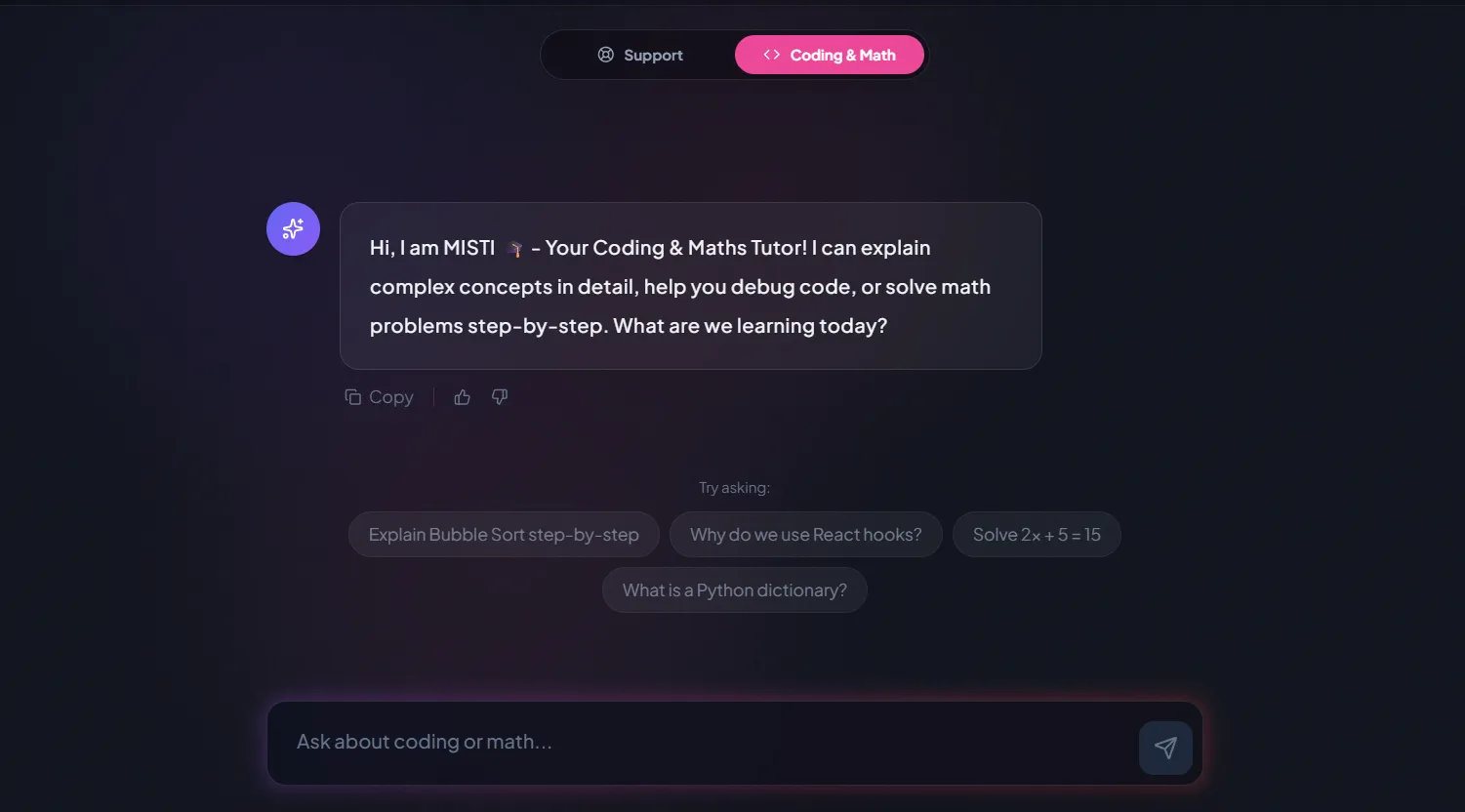
A chatbot that answers mathematics and programming questions, built and deployed by a student.

AI and ML
An assistant that helps a young person recognise unsafe situations online.
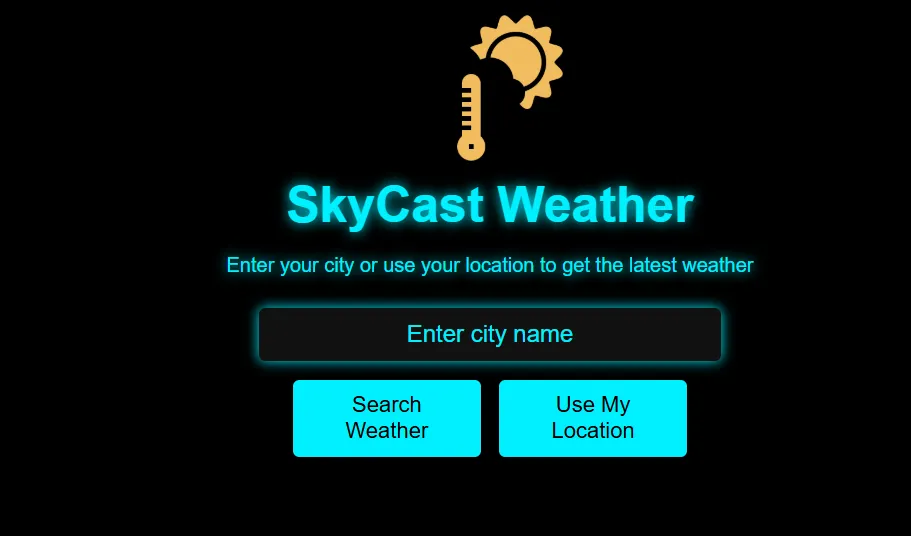
Web app
A weather forecasting site with live conditions for any location.
Fees
Charged monthly in US dollars, at the single rate every family outside India pays. A first lesson costs nothing, and billing only starts once you have picked a course and a weekly slot.
Free first class
USD 0
no card required
Group batch
USD 100
a month, billed in US dollars
One to one
USD 150
a month, billed in US dollars
What families say
Google reviews from parents, as they were written.
★★★★★
"The one step solution for my son. Modern Age Coders make learning coding so simple that kids love it. The teachers explain complex concepts clearly with practical exercises and interactive content."
Ria Mukherjee
Parent
★★★★★
"Modern Age Coders has been a game-changer for me. I struggled to grasp IT concepts and coding before joining, but their classes transformed everything. I can now confidently write complex programs with ease."
Samriddha Mondal
Student
★★★★★
"One of the most wonderful education centres out there. Education is not limited to school syllabus but focuses on skill development."
Vansh Agarwal
Student
★★★★★
"My child Dhairya is really enjoying the Modern Age Coders classes. This is his first online class and he eagerly looks forward to it. I can already see his improvement, and the teachers are very cooperative."
Sonam Oswal
Parent of Dhairya
★★★★★
"Modern Age Coders have wonderful teachers who teach in a clear, easy and practical way. The teacher boosts students' confidence and inspires them to learn without hesitation."
Sonu Goyal
Parent
★★★★★
"I highly recommend this computer coding class! The teachers are incredibly knowledgeable and passionate about coding."
Ritu Kedia
Parent
Questions about GCSE Mathematics and Numeracy
A WJEC double award GCSE, first taught in September 2025, that replaces the separate Mathematics and Mathematics-Numeracy GCSEs in Wales. It is assessed by three written exams.
As a double award, on an eight-grade scale from A*A* down to GG. Results below the minimum are reported as U.
Unit 1 covers personal and household finance: payslips, income tax and National Insurance, savings, loans and mortgages, interest including AER and APR, bills, VAT, value-for-money comparisons, exchange rates and more, with a calculator.
Yes. Each unit has a Higher tier, A* to D, and a Foundation tier, C to G, and pupils can be entered at different tiers across the three units.
Yes. Qualifications Wales changed the tiering so that a Grade C is available on the Foundation tier, which was not the case before.
Units 1 and 2 were first available in summer 2026 and Unit 3 in November 2026. After that, all three are available every November and summer, and the first full awards are made in November 2026.
No. WJEC states that there is no Single Award GCSE for Mathematics. Pupils not ready for the double award may follow an Entry Level route instead.
No. It is assessed entirely by written exams, unlike most other GCSEs, which is one reason it is split into units.
No. Our lessons are in English. WJEC publishes its papers in both languages, and Welsh-medium pupils are welcome, but will learn the terms in English.
Your first lesson is free. Regular lessons are then one monthly fee in US dollars, lower for a group place than for one to one, shown in the fees section, and we never charge in advance.
Elsewhere on this site
Computing in Wales, the wider system, and maths beyond the GCSE.
The Unit 2 exam that hands pupils a program they did not write.
The computing GCSE that is mostly made in school.
The Welsh system from primary school up.
For pupils who want harder problems.
Competition practice open to pupils across the UK.
The UK hub, linking every page.
Start here
Leave a number and we will phone at a UK time that suits you. The lesson includes a short finance task and ends with a view on tiers.
Prefer to read first? Every course page sets out its content, how we teach says who our method suits, and student labs shows real student work.
WhatsApp us · +91 91233 66161 · contact@modernagecoders.com
WhatsApp is quickest and free from a UK mobile. It reaches our office in India, so look for a number starting +91.