UK / AHM1 / 01
University mathematics
Matrices, series, induction and differential equations.
Open the syllabusScotland · Advanced Higher · S6
Advanced Higher Mathematics is where Scottish school maths starts asking students to prove things, not just calculate them. The course lists proof by contradiction, by contrapositive, direct proof and proof by induction among its skills, and the 2025 course report gave a warning that surprises students used to method marks: in an induction proof, "omitting certain words or phrases can invalidate the proof". A proof is an argument, and an argument with a missing step is not a proof, however good the algebra around it. The rest of the paper rewards something just as exacting: established routines, such as the integrating factor, done without a sign slip, and notation that leaves a marker no doubt. This page sets out the course, what the 2025 candidates did well and badly, and how we teach it.
Live teaching since 2020 · 10,000+ students · Drawn from the course specification and the 2025 report
In short
Advanced Higher Mathematics is examined by a non-calculator paper worth 35 marks in one hour and a calculator paper worth 80 marks in two and a half hours, with no coursework. Its content falls into three areas: algebra, proof and number theory; calculus; and matrices, vectors and complex numbers. Candidates normally arrive with Higher Mathematics. In 2025, 4,469 received a result. The course report praised excellent answers to the hardest questions, but warned that omitting certain words can invalidate a proof by induction, and flagged sign errors with integrating factors, Maclaurin series, matrix inverses, cyclic integration by parts, missing constants, brackets and unclear handwriting. Modern Age Coders teaches Advanced Higher Maths live, with proofs written in full and checked for every necessary step, routines drilled until exact, and notation treated as part of the mark. The first lesson is free, then USD 100 a month in a group or USD 150 one to one.
Start here
University-level content, the calculus bridge, and proof. We teach the Advanced Higher specification through courses built for more than one curriculum.
AHM / 01
Matrices, proof by induction, Maclaurin series and differential equations, much of the Advanced Higher list.
Open the syllabus →
AHM / 02
Calculus, the binomial theorem and vectors, to secure the foundations Advanced Higher builds on.
Open the syllabus →
AHM / 03
Proof, induction and complex numbers, for students who want to write arguments, not only answers.
Open the syllabus →The course
From the Advanced Higher Mathematics Course Specification, version 2.0, valid from session 2019 to 20.
| Part | Marks | Length | Calculator |
|---|---|---|---|
| Question paper 1 | 35 | 1 hour | No |
| Question paper 2 | 80 | 2 hours 30 minutes | Yes |
| Area | Includes |
|---|---|
| Algebra, proof and number theory | Partial fractions, the binomial theorem, sequences and series, proof by contradiction, contrapositive, direct proof and induction, Euclid's algorithm |
| Calculus | Differentiation of exponential, logarithmic and inverse functions, integration by substitution and by parts, first-order differential equations, Maclaurin expansions |
| Matrices, vectors and complex numbers | Gaussian elimination for three equations, matrix algebra and inverses, lines and planes in three dimensions, de Moivre's theorem and roots of complex numbers |
| Item | Figure as published |
|---|---|
| Resulted entries | 4,469 (4,390 in 2024) |
| Grade A | 41.3 per cent, minimum 83 of 115 |
| Grade C minimum | 60 of 115 |
| No award | 16.9 per cent |
Both 2025 papers proved less demanding than expected, and the boundaries were adjusted upward to reflect that, so those minimum marks describe 2025 and are not targets. Advanced Higher Mathematics is one of three Advanced Higher maths courses; Mathematics of Mechanics and Statistics are separate qualifications.
Source: the Advanced Higher Mathematics Course Specification, version 2.0, and the Advanced Higher Mathematics course report 2025, both from sqa.org.uk. Qualifications Scotland has awarded the course since replacing SQA on 1 February 2026, and the SQA-era documents remain in force.
Proof
The report's advice on proof by induction, and why it matters more than students expect.
Question 15 on the 2025 paper 2 was a proof by induction. The report advises that candidates "should practise proof by induction", citing that question, "so that they are familiar with the vocabulary necessary to demonstrate their understanding of the process", and warns: "They should be aware that omitting certain words or phrases can invalidate the proof. They should ensure that they clearly show details such as substitution and algebraic manipulation."
| Part | What it has to establish |
|---|---|
| Base case | The statement is true for the first value, shown by substitution, not asserted |
| Assumption | The statement is assumed true for n = k, stated explicitly |
| Inductive step | Using that assumption, the statement is shown true for n = k + 1, with every piece of algebra visible |
| Conclusion | A sentence tying the three together: because it holds for the first value, and truth for k implies truth for k + 1, it holds for all the required values |
The conclusion is where the missing words usually are. A student who has done the algebra perfectly and then stops has not finished the proof, because the logical link that makes induction work has never been stated. The same is true of an assumption used but never written down. These are not formalities; they are the argument.
Assume the opposite of what is to be proved and show it leads to something impossible. The assumption has to be stated clearly at the start.
Prove that if not Q then not P, which is logically the same as if P then Q. Students often confuse it with the converse, which is not equivalent.
A chain of reasoning from known facts to the result. In straightforward examples, each step must be justified, not just asserted.
Routines
The report's first recommendation is to revise standard techniques thoroughly. Here is where they slipped in 2025.
| Topic | What went wrong |
|---|---|
| Binomial expansion | A few gave the general term instead of the full expansion |
| Complex division | Some did not multiply numerator and denominator by the conjugate of the denominator |
| Matrices | A few gave an incorrect transpose; most did not take a suitable first step to find an inverse from a given relation |
| Rational functions | The non-vertical asymptote not stated after the function was rewritten |
| Maclaurin series | Some could not expand a simple trigonometric function; many did not square the result in the next part and restarted from first principles |
| Differential equations | Some omitted the negative sign when finding the integrating factor |
| Integration by parts | In a cyclic case, some said the reappearing integral meant no solution or infinitely many |
| Volume of revolution | Most set up the integral; fewer reached the value, and a few gave an approximation where an exact answer was required |
Two patterns run through that list. The first is a routine known but not finished: the expansion left at the general term, the asymptote not stated, the exact value replaced with a decimal. The second is a routine misread: in cyclic integration by parts, the original integral reappearing is the whole point of the method, a signal to rearrange and solve, not a sign that something has failed.
Most used Gaussian elimination successfully to find where three planes meet, and many handled logarithmic differentiation and rearranged to the required result.
Some produced excellent, insightful answers to the hardest questions, including related rates of change with a combined increase and decrease.
One question gave two expressions that already shared two common factors. Many candidates multiplied both out, making the factorisation much harder, and only a few completed it.
The report's advice: "expressions can often be simplified by looking for common factors", rather than expanding first.
Writing it down
At Advanced Higher, how an answer is written can decide whether it is marked at all.
| Point | The report's advice |
|---|---|
| Brackets | Marks were lost for omitted brackets in several questions on both papers |
| Integrals | Write integrals accurately, especially where the variable is not obvious, as in substitution or volume of revolution |
| Constants | Include the constant of integration, and take care if it is later manipulated |
| Handwriting | "Candidates should not write over their original answer if they make a mistake." Score it through and rewrite legibly in a blank space |
| Units and variables | Give units in rates of change, and do not introduce undefined variables |
| Stamina | Look for accessible marks in the harder parts and persevere to the end of each paper |
The handwriting point is sharper than it sounds. The report notes that markers can find candidates' writing difficult to interpret, especially when an answer has been corrected by writing over it. A mark cannot be given for an answer the marker cannot read with confidence. Layout, the report says, should leave the marker in no doubt about what to mark and what to ignore.
Proofs written in full every week, then read back for any missing step or unstated assumption, the way a marker would.
Standard routines drilled to exactness, and the finishing step of each, the asymptote, the exact value, the constant, treated as part of the routine.
That we run a course made only for Advanced Higher. Our university-level and A level courses cover the content, and we teach it against the specification.
That any grade is guaranteed. The report shows how much rests on care in writing as well as on understanding.
For the level below, the Higher Maths page covers consistent working, and students who also take computing will find the Advanced Higher Computing Science page useful. Strong mathematicians may want British Mathematical Olympiad preparation.
Progression
Placement depends on how securely a student can write an argument, not only on how much calculus they know.
| Rung | When | What should be true |
|---|---|---|
| 1. Higher, secure | Start of S6 | Differentiation, integration, logarithms and trigonometry from Higher, done fluently and consistently |
| 2. New techniques | Autumn | Partial fractions, integration by parts and substitution, the binomial theorem, matrices and complex numbers |
| 3. Proof | Winter | Induction, contradiction and contrapositive written in full, with every assumption and conclusion stated |
| 4. The whole paper | Spring | Two-and-a-half-hour papers worked to the end, with accessible marks found in the hardest questions |
Few students have written a formal proof before S6. It improves quickly with weekly writing and careful feedback.
Students who code may enjoy the coding roadmap, where the same logical care applies.
Paper 2 is long. Persevering to the end, as the report asks, is a habit built with full timed papers.
Lessons pause for the diet and are there afterwards for university preparation.
The catalogue
Grouped by purpose. The first lesson settles the order.
UK / AHM1 / 01
Matrices, series, induction and differential equations.
Open the syllabusUK / AHM1 / 02
Calculus and algebra foundations made secure.
Open the syllabusUK / AHM1 / 03
Proof and problem solving at depth.
Open the syllabusUK / AHM2 / 01
For students also considering Advanced Higher Statistics.
Open the syllabusUK / AHM2 / 02
A rigorous parallel curriculum with strong proof content.
Open the syllabusUK / AHM2 / 03
Where university mathematics meets data.
Open the syllabusUK / AHM3 / 01
Proof and induction at work in computer science.
Open the syllabusUK / AHM3 / 02
Numerical methods and experiments with series.
Open the syllabusUK / AHM3 / 03
Mathematical ideas explored by writing programs.
Open the syllabusHow lessons work
Our teachers are based in India, which never moves its clocks, so Scotland is four and a half hours behind in summer and five and a half in winter. Every slot is fixed in UK time.
After school
The usual slot for S6 students.
Evening
Around free periods, jobs and applications.
Weekend
Time for a full paper 2 and its review.
Induction and other proofs written in full, then checked for any missing word or step.
Each standard technique practised through to its final step, exact values and all.
Expressions examined for shared factors before anything is expanded.
Corrections scored through and rewritten, never written over.
Two-and-a-half-hour papers in spring, worked to the end.
Five to ten S6 students, reading each other's proofs critically.
Student work
Four projects from classes, none of them assessed. More in student labs.

AI and ML
An AI nutrition coach that reads what you eat and works you toward a target.
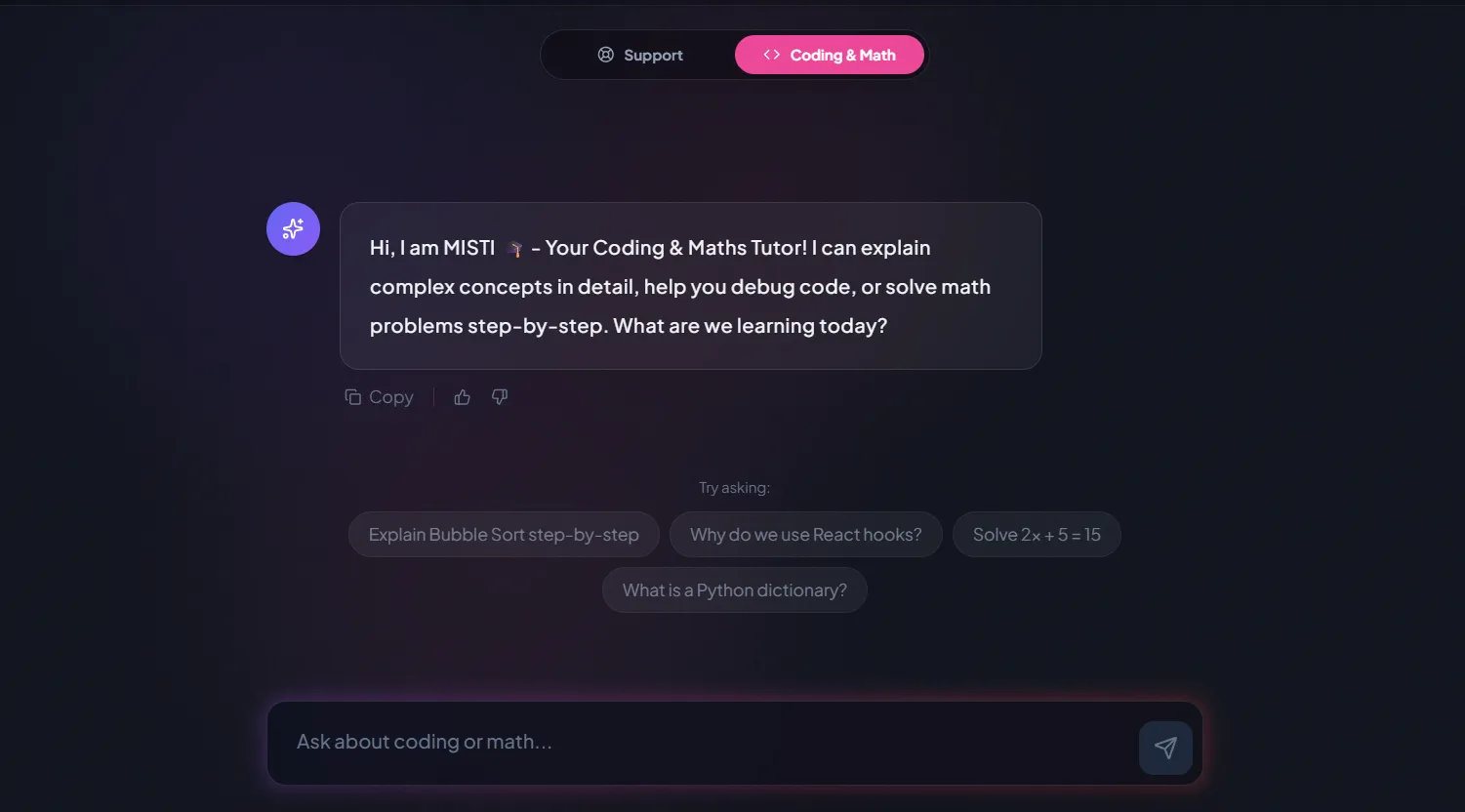
AI and ML
A chatbot that answers mathematics and programming questions, built and deployed by a student.

AI and ML
An assistant that helps a young person recognise unsafe situations online.

Web app
A weather forecasting site with live conditions for any location.
Fees
A monthly charge in US dollars, the same for all families outside India. First lessons are free, and we invoice only after a course and a weekly time have been chosen.
Free first class
USD 0
no card required
Group batch
USD 100
a month, billed in US dollars
One to one
USD 150
a month, billed in US dollars
What families say
Parents' Google reviews, word for word.
★★★★★
"The one step solution for my son. Modern Age Coders make learning coding so simple that kids love it. The teachers explain complex concepts clearly with practical exercises and interactive content."
Ria Mukherjee
Parent
★★★★★
"Modern Age Coders has been a game-changer for me. I struggled to grasp IT concepts and coding before joining, but their classes transformed everything. I can now confidently write complex programs with ease."
Samriddha Mondal
Student
★★★★★
"One of the most wonderful education centres out there. Education is not limited to school syllabus but focuses on skill development."
Vansh Agarwal
Student
★★★★★
"My child Dhairya is really enjoying the Modern Age Coders classes. This is his first online class and he eagerly looks forward to it. I can already see his improvement, and the teachers are very cooperative."
Sonam Oswal
Parent of Dhairya
★★★★★
"Modern Age Coders have wonderful teachers who teach in a clear, easy and practical way. The teacher boosts students' confidence and inspires them to learn without hesitation."
Sonu Goyal
Parent
★★★★★
"I highly recommend this computer coding class! The teachers are incredibly knowledgeable and passionate about coding."
Ritu Kedia
Parent
Questions about Advanced Higher Maths
By two question papers: a non-calculator paper worth 35 marks in one hour and a calculator paper worth 80 marks in two hours and 30 minutes. There is no coursework.
Three areas: algebra, proof and number theory; calculus, including differential equations and Maclaurin series; and matrices, vectors and complex numbers, including de Moivre's theorem.
The 2025 report warns that omitting certain words or phrases can invalidate the proof. The base case, the assumption, the inductive step and the conclusion all have to be written out.
Finding an inverse matrix from a given relation, completing a factorisation that needed common factors, Maclaurin series, the sign of an integrating factor, and cyclic integration by parts.
Yes. The report says markers can find handwriting hard to interpret, especially over-written corrections, and asks candidates to score through mistakes and rewrite clearly instead.
It varies. In 2025 the minimum was 83 of 115 for an A and 60 for a C, after both papers proved less demanding than expected; the next diet will be different.
Entry is at the school's discretion, but the specification expects candidates to have achieved Higher Mathematics or equivalent.
Yes. Mathematics of Mechanics and Statistics are separate Advanced Higher qualifications. This page covers Advanced Higher Mathematics.
Qualifications Scotland, which replaced SQA on 1 February 2026. The course documents from the SQA period remain current.
The first lesson is free. Ongoing lessons are a monthly fee in US dollars, lower for a group place than one to one, as set out in the fees section, and nothing is payable in advance.
Elsewhere on this site
The Scottish ladder, the olympiad route, and computing at the same level.
The level below, where consistent working is the lesson.
Where the ladder starts, without a calculator.
The computing course at the same level.
Proof-based competition for the strongest students.
The full UK competition ladder.
Where every UK page is linked.
Start here
Leave a number and we will call at a UK time of your choice. The lesson includes a short proof written in full and ends with a plan for the session.
Would you like to read first? Each course page gives its syllabus, how we teach is candid about who our method suits, and student labs shows what students make.
WhatsApp us · +91 91233 66161 · contact@modernagecoders.com
WhatsApp is the fastest route, free from a UK phone. Messages go to our India office, so the number opens with +91.