UK / HM1 / 01
A level maths
Pure mathematics at Higher depth and beyond.
Open the syllabusScotland · Higher · S5 and S6
In the 2025 Higher Maths paper, a number of candidates factorised a polynomial and reached the right answer, and still did not get full marks. The course report explains why: the lines of working that led there contradicted each other along the way. "The inconsistencies meant that these examples did not gain full marks". That is the character of Higher. National 5 rewards getting the method and the number right; Higher also marks whether each step genuinely follows from the one before, whether the notation is exact, and whether the conclusion says precisely what was shown. This page sets out the two papers, where the 2025 candidates lost marks on the route rather than the destination, and how we teach working that holds up.
Live teaching since 2020 · 10,000+ students · Taken from the Higher specification and the 2025 course report
In short
Two exam papers make up the whole of Higher Mathematics. The first, 55 marks in 1 hour 15 minutes, allows no calculator; the second, 65 marks in 1 hour 30 minutes, does. Nothing is assessed in class, and most candidates arrive from National 5 Mathematics. The 2025 diet produced 19,767 results, and the course report that followed said many lost marks to numerical inaccuracy, and that working which did not follow logically from line to line could not gain full marks even when the final answer was right. It also flagged notation such as dx and the constant of integration, nature tables, the wave function, vector pathways and conclusions about collinearity. Modern Age Coders teaches Higher Maths live, with working checked line by line, notation treated as part of the answer, and practice on novel questions under exam timing. The first lesson is free, then USD 100 a month in a group or USD 150 one to one.
Start here
These courses serve several curricula, and we teach the Higher specification through them. Each card opens a syllabus.
HM / 01
Differentiation, integration, logarithms, radians and vectors, the core of Higher at a similar depth.
Open the syllabus →
HM / 02
For students strengthening algebra and functions before the calculus arrives.
Open the syllabus →
HM / 03
Rigorous working and notation, useful for students aiming at Advanced Higher next.
Open the syllabus →The papers
From the Higher Mathematics Course Specification, valid from session 2023 to 24.
| Paper | Marks | Length | Calculator |
|---|---|---|---|
| Paper 1 | 55 | 1 hour 15 minutes | No |
| Paper 2 | 65 | 1 hour 30 minutes | Yes |
The specification suggests about 160 hours and expects candidates to have achieved National 5 Mathematics or equivalent. Without a calculator, the harder mathematics has to be done by hand: in 2025, paper 1 included a tangent, an indefinite integral, logarithms, the double-angle formula, a differential equation and a cubic with its stationary points.
| Figure | As published for 2025 |
|---|---|
| Resulted entries | 19,767 (18,517 in 2024) |
| Grade A | 41.2 per cent, minimum mark 86 of 120 |
| Grade C minimum mark | 60 of 120 |
| No award | 15.7 per cent |
The report notes that two questions were less demanding than expected and that this was taken into account in setting the boundaries. Boundaries move each year, so the figures above describe 2025 and nothing more.
Figures and rules come from two sqa.org.uk documents: the Higher Mathematics Course Specification and the 2025 Higher Mathematics course report. Since 1 February 2026 the award has belonged to Qualifications Scotland, which keeps those documents in force.
Line by line
The report's most distinctive message about Higher, and the one students find hardest to believe until they see it marked.
In the 2025 non-calculator paper, question 7 was a polynomial, and part (b) involved factorising it. The report prints examples of working it describes as common: chains in which one line did not equal the next, a bracket appearing and disappearing, a sign changing without reason. Those examples reached the correct factorised form, and the verdict was: "The inconsistencies meant that these examples did not gain full marks". Its advice for teaching is equally direct: "Each line of working should follow logically from the line above."
| Question topic | What went wrong |
|---|---|
| Factorising a polynomial | Lines that did not equal each other, even when the final factors were right |
| Completing the square | Numeric terms handled loosely, producing inconsistent lines |
| Simultaneous equations | Terms scored out mid-working, leaving lines that no longer matched |
| Inverse function | Several different expressions each labelled y =, which could not all be true |
| Exponential equation | Many inconsistent lines converting between exponential and logarithmic form |
Each line should be equal to the last, or clearly linked to it. If a step is skipped, the next line must still be true on its own.
The report is explicit that statements inconsistent from line to line do not gain full marks, whatever the final line says. The route is marked.
Working that is not part of the answer should be scored out, including in the additional space at the back, so the marker reads only the chain you intend.
This is also where handwriting matters. The report records candidates losing marks to transcription errors between 3 and 5, 4 and y, and 1 and 7, copying their own working wrongly from one line to the next. Clear, unhurried writing is part of consistent working, not a separate nicety.
Notation
Several 2025 marks were lost on symbols, labels and brackets rather than on the mathematics.
| Area | The slip |
|---|---|
| Derivatives | Lines labelled y = when they were derivatives, dy/dx = |
| Integrals | No dx in a definite integral; no constant of integration where it belonged, which invalidated working in a differential equation |
| Brackets | Missing brackets when substituting into the discriminant or when evaluating a definite integral |
| Inequalities | Two separate regions written as one inequality |
| Angles | Degrees used throughout a radian question, or degrees and radians mixed in one line |
| Collinearity | Conclusions implying the points were parallel or the lines collinear, instead of the points |
| Nature tables | Tables that did not meet the minimum requirements, or were labelled incorrectly |
Collinearity is a good example of how precise Higher is. Few candidates in 2025 communicated their conclusion unambiguously. A correct conclusion states that the vectors are parallel and share a point, so the points are collinear; saying the points are parallel, or the lines collinear, confuses objects the mark scheme keeps apart.
The report asks teachers to encourage full nature tables when determining stationary points and confirming a maximum or minimum. In 2025 some solutions fell short of the minimum requirements, with numerical errors evaluating the derivative near the point or wrong labels.
We teach one standard layout and use it every time, so it never has to be improvised in the exam.
Some candidates did not use the double-angle and addition formulae provided, and a few invented identities that are false, such as treating the sine of a difference as a difference of sines.
Knowing what is on the formulae list, and trusting it, saves marks and time.
Exam habits
Beyond the working itself, the 2025 report listed practical habits that separate strong scripts.
| Habit | Why it matters |
|---|---|
| Numerical care | "Maintain and practise basic numerical skills regularly, particularly fractions and negative numbers." Many marks in paper 1 went to numerical inaccuracy |
| Common factors first | Candidates who did not take out a common factor made factorisation harder, and dividing by cos x lost solutions in a trigonometric equation |
| Efficient calculator use | In paper 2, many wrote extra lines of working instead of letting the calculator do the arithmetic |
| Vector pathways | Many gained no marks determining a pathway in three dimensions, one of the weakest areas in the report |
| Novel questions | "Provide opportunities for candidates to attempt more challenging and novel questions under exam conditions." |
The final circle question in 2025 was designed to be demanding, and the few who solved it used a remarkable range of approaches: geometry, algebra, similarity, stepping out, gradients, ratios and vectors. Higher rewards flexible thinking on unfamiliar problems, and that only grows from practising problems that are genuinely new rather than repeating familiar ones.
Every piece of written working is read line by line, and any line that does not follow from the last is marked as it would be in the exam.
Notation, nature tables and conclusions are practised in fixed forms until they are automatic, then tested on novel questions under exam timing.
That our courses were written for Higher alone. They were built for more than one curriculum, and Higher is taught through them against its own specification.
That any grade is assured. Boundaries move, and the report shows how many marks depend on care rather than knowledge.
Coming from National 5, the National 5 Maths page covers the non-calculator foundations. Going further, the Advanced Higher Maths page covers proof and the rest of the S6 course. Strong problem solvers may enjoy olympiad training.
Progression
Placement depends on how securely a student writes working, not only on what they know.
| Rung | When | What should be true |
|---|---|---|
| 1. Algebra and functions | Start of S5 | Factorising, completing the square, composite and inverse functions, logarithms, with every line consistent |
| 2. Calculus | Autumn | Differentiation with the chain rule, integration with the constant, areas, stationary points with full nature tables |
| 3. Geometry and trigonometry | Winter | Circles, vectors in three dimensions and pathways, radians, exact values, the wave function |
| 4. Exam habits | Spring | Precise conclusions, efficient calculator use, novel questions under timing |
Consistent algebra is learned early or not at all. Every later topic depends on it.
Students who also code may like the coding roadmap, where the same habit of exactness applies.
Vector pathways and the wave function were among the hardest areas in 2025.
We slow down while the diet runs and pick up again for Advanced Higher once it ends.
The catalogue
Arranged by where they help. The first lesson decides the order.
UK / HM1 / 01
Pure mathematics at Higher depth and beyond.
Open the syllabusUK / HM1 / 02
Algebra and functions made solid.
Open the syllabusUK / HM1 / 03
Careful notation and rigorous working.
Open the syllabusUK / HM2 / 01
Matrices, series and differential equations ahead of time.
Open the syllabusUK / HM2 / 02
Novel problems and proof, for flexible thinkers.
Open the syllabusUK / HM2 / 03
For students heading to Advanced Higher Statistics.
Open the syllabusUK / HM3 / 01
Mathematical ideas tested by writing programs.
Open the syllabusUK / HM3 / 02
Where Higher maths meets real data.
Open the syllabusUK / HM3 / 03
For students who want to compute as well as calculate.
Open the syllabusHow lessons work
Teachers work from India on a clock that never shifts, putting Scotland four and a half hours behind in summer and five and a half in winter. Times are agreed in UK hours.
After school
The common choice in S5 and S6.
Evening
For students with free periods or jobs.
Weekend
Long enough for a full paper and its marking.
Written working checked for consistency at every step, as the marking instructions do.
One layout for nature tables, one for collinearity conclusions, used every time.
dx, the constant, brackets and radians, until leaving them out feels wrong.
Unfamiliar problems under exam timing, as the report recommends.
In paper 2 practice, the calculator used for what it does well, with working still recorded.
S5 and S6 students at one rung, reviewing each other's chains of working.
Student work
Four projects from lessons, none of them assessed. More in student labs.

AI and ML
An AI nutrition coach that reads what you eat and works you toward a target.
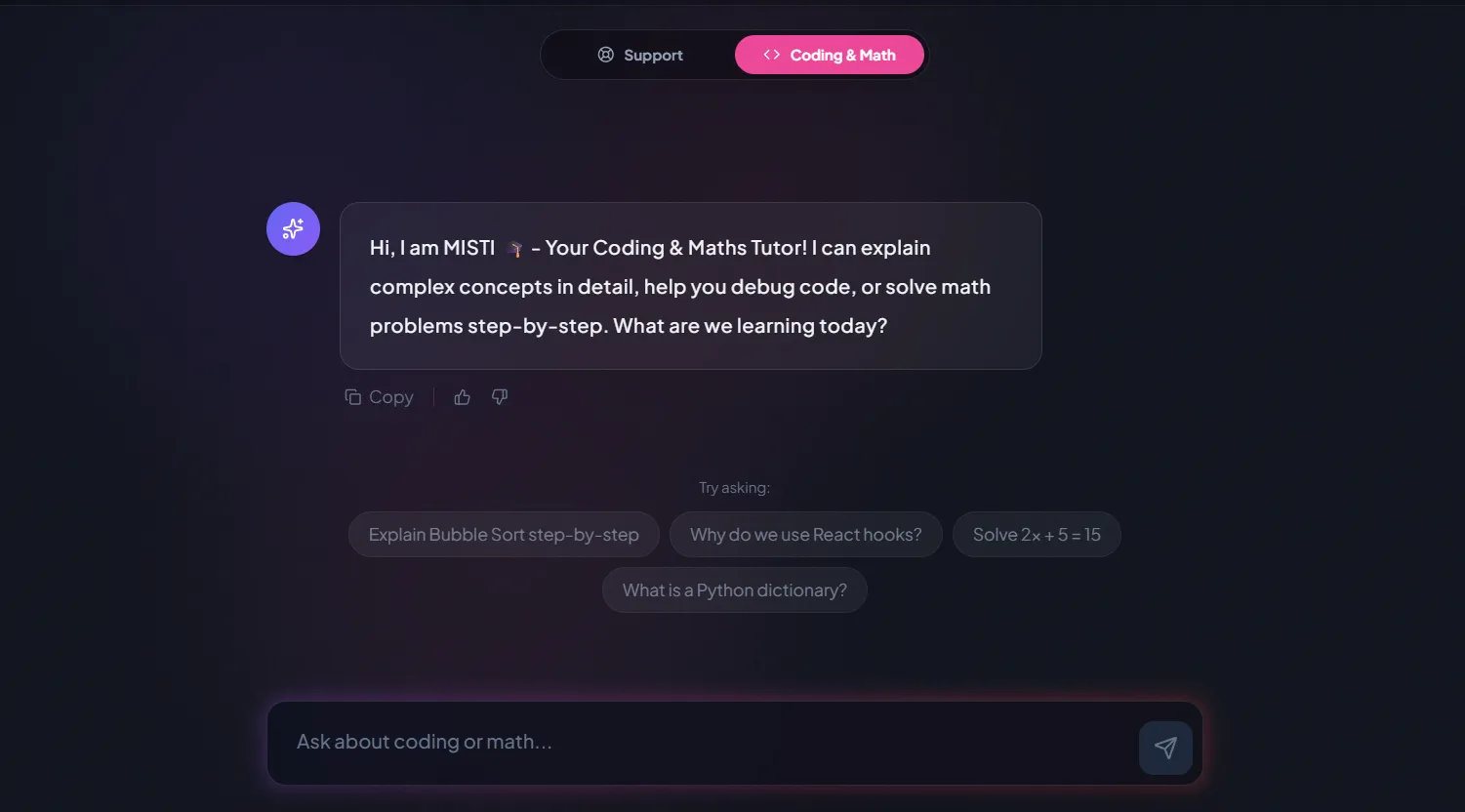
AI and ML
A chatbot that answers mathematics and programming questions, built and deployed by a student.

AI and ML
An assistant that helps a young person recognise unsafe situations online.
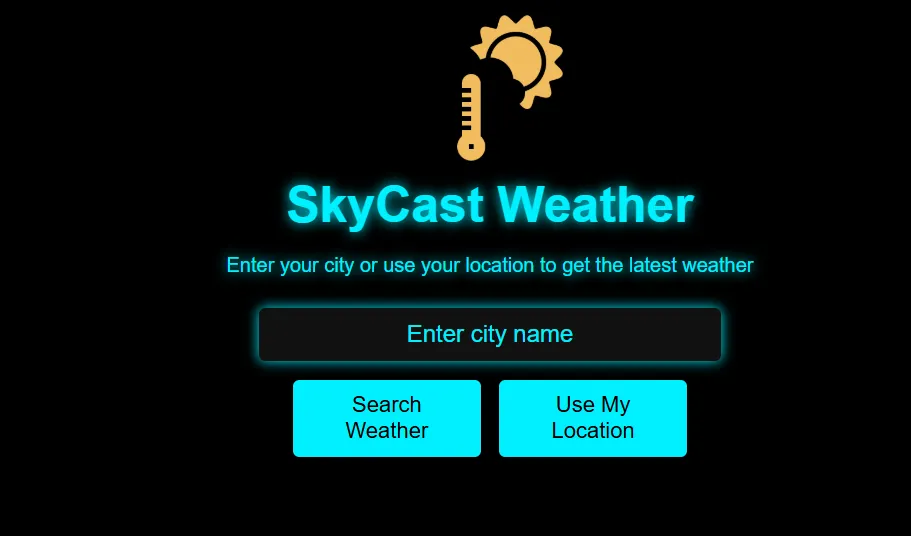
Web app
A weather forecasting site with live conditions for any location.
Fees
We charge a monthly fee in US dollars, identical for every family outside India. There is no charge for a first lesson, and no invoice until a course and a weekly slot have been agreed.
Free first class
USD 0
no card required
Group batch
USD 100
a month, billed in US dollars
One to one
USD 150
a month, billed in US dollars
What families say
Parents' reviews from Google, unaltered.
★★★★★
"The one step solution for my son. Modern Age Coders make learning coding so simple that kids love it. The teachers explain complex concepts clearly with practical exercises and interactive content."
Ria Mukherjee
Parent
★★★★★
"Modern Age Coders has been a game-changer for me. I struggled to grasp IT concepts and coding before joining, but their classes transformed everything. I can now confidently write complex programs with ease."
Samriddha Mondal
Student
★★★★★
"One of the most wonderful education centres out there. Education is not limited to school syllabus but focuses on skill development."
Vansh Agarwal
Student
★★★★★
"My child Dhairya is really enjoying the Modern Age Coders classes. This is his first online class and he eagerly looks forward to it. I can already see his improvement, and the teachers are very cooperative."
Sonam Oswal
Parent of Dhairya
★★★★★
"Modern Age Coders have wonderful teachers who teach in a clear, easy and practical way. The teacher boosts students' confidence and inspires them to learn without hesitation."
Sonu Goyal
Parent
★★★★★
"I highly recommend this computer coding class! The teachers are incredibly knowledgeable and passionate about coding."
Ritu Kedia
Parent
Questions about Higher Maths
By two question papers only: paper 1, without a calculator, worth 55 marks in 1 hour 15 minutes, and paper 2, with a calculator, worth 65 marks in 1 hour 30 minutes.
Yes. The 2025 report describes correct factorised answers that did not gain full marks because the lines of working before them were inconsistent. Each line should follow logically from the one above.
Vector pathways in three dimensions, the wave function and its phase change, sketching a cubic from given conditions, the chain rule with a constant, and stating collinearity conclusions precisely.
They are the accepted way to justify the nature of a stationary point. In 2025 some solutions fell short of the minimum requirements or contained labelling and numerical errors.
Yes, where it helps. The report notes candidates who did not use the double-angle and addition formulae provided, and some who invented incorrect identities instead.
There is no fixed figure. The 2025 minimum for an A was 86 of 120 and for a C 60, set after two questions proved easier than intended; the next diet will differ.
In 2025, 19,767 candidates received a result, up from 18,517 in 2024.
Qualifications Scotland, since it took over from SQA on 1 February 2026. The course documents written under SQA stay in force.
No. The courses we use cover more than one curriculum, and the Higher specification is taught through them topic by topic.
The first lesson is free. After that, lessons are one monthly charge in US dollars, less for a group place than for one to one, both listed in the fees section, and nothing is ever taken up front.
Elsewhere on this site
The levels either side, and where strong mathematicians go next.
The level below, and its non-calculator foundations.
The S6 course, where proof enters properly.
A natural partner subject for mathematicians.
Competition puzzles set for Scottish pupils.
The UK competition ladder.
The UK hub for all our pages.
Start here
Leave a number and we will call at a UK time that suits you. The lesson looks at a real Higher question and how the working is set out, and ends with a plan.
Want to look around first? Every course page lists what it covers, how we teach sets out who our method suits, and the coding roadmap is there for students who code too.
WhatsApp us · +91 91233 66161 · contact@modernagecoders.com
WhatsApp is the quickest option and free from a UK mobile. Messages land at our office in India, so expect a number starting +91.