OXM / A1
GCSE maths
Foundation and Higher, matched to the board.
Open the syllabusOxford · Maths for every age from 6 to 67 · Live online teaching
The Met Office publishes monthly weather figures for Oxford going back to 1853. Add up each year's rainfall and you have 173 complete years. Now a question a GCSE student can answer and a professional statistician still enjoys: how many of those years should have been the wettest so far? If every year is equally likely to be the wettest, the chance that year n breaks the record is 1 in n. Add those chances up and the answer is about 5.73. Oxford had 7. This page shows how we teach maths to Oxford learners, from times tables to A level, and uses those records as our running example.
This page is about maths only · Primary, secondary, sixth form, adult · We are independent of the university and every Oxford school
Maths tuition in Oxford, summarised
Oxford learners aged 6 to 67 can study maths with Modern Age Coders in live online lessons. Primary children work towards the Year 6 SATs with secure tables; Years 7 to 9 cover KS3; GCSE students are taught at their tier (Foundation or Higher) and board (AQA, Edexcel or OCR), or for IGCSE; sixth formers take A level Maths and can add Further Maths topics; adults resit GCSE or refresh their statistics. A learner can be taught alone or in a class of five to ten at a matching level. Our Oxford project counts record-breaking years in the Met Office series from 1853: of 173 complete years, 7 were the wettest so far, against about 5.73 expected if every year were equally likely to set a record. The first lesson is free; continuing costs USD 100 a month in a class or USD 150 a month one to one.
Most requested by Oxford families
Most first enquiries from Oxford are about one of these three courses. The full list of our maths courses comes later on the page.
OXF / 1
Probability, statistics and every other strand of the specification, matched to the school's exam board.
Open the syllabus →
OXF / 2
Sequences, series, logarithms and simulation, the tools behind the record-year project below.
Open the syllabus →
OXF / 3
Fractions, ratio, algebra and first probability, taught so they hold up under GCSE pressure.
Open the syllabus →Primary to adult
Oxford schools teach the national curriculum for England. The table shows the stages and the thing our lessons care most about at each one.
| Stage | Ages | Our main concern |
|---|---|---|
| KS1 | 5 to 7 | Counting reliably, place value and the first ideas of more, less and equal. |
| KS2 | 7 to 11 | Fluent tables by Year 4, fractions and decimals, and reasoning for the end-of-primary SATs. |
| KS3 | 11 to 14 | Algebra, ratio, and probability as a number between 0 and 1. |
| GCSE | 14 to 16 | Foundation or Higher with AQA, Edexcel or OCR; IGCSE where needed. |
| A level | 16 to 18 | Series, logarithms, statistical models and mechanics; Further Maths topics on request. |
| Adults | 18 to 67 | GCSE maths resits, statistics for work, and maths for its own sake. |
In primary school we keep returning to number until it is fluent and understood. Tables are learned as linked facts: 8 × 7 is double 4 × 7, and a child who sees that can rebuild what they forget.
Probability first appears informally, as words like likely and impossible. We like to turn those words into fractions early, because that makes the step to KS3 much smoother.
From Year 7 the work becomes algebraic, and probability becomes a number. At GCSE we teach to the board and tier the school uses; at A level, statistics and pure maths meet in topics like series and simulation, which is exactly where the record-year project lives.
Our national pages give more detail for each stage: KS2, KS3, GCSE, A level and Further Maths.
Ages shown are those usual in England. This page gives no advice on university admissions.
The Oxford project
A long, honest data set and a probability result that fits on one line.
The Met Office makes historic station data for Oxford freely available: monthly rainfall, temperatures, frost and sunshine from January 1853. We added the twelve monthly rainfall totals for each year from 1853 to 2025, giving 173 complete years. Those yearly totals are our sums, not figures the Met Office publishes, and a few months in 1996, 1997, 2011 and 2012 are marked by the Met Office as estimated.
Then we walked through the years in order, asking each time: is this the wettest year so far? The first year, 1853, counts automatically. After that a new record came in 1857, 1860, 1875, 1903, 1960 and 2012. That is 7 record-wet years in all, ending with 984.4 millimetres in 2012.
Here is the probability idea. Suppose the years were shuffled, with no year more likely than any other to be the wettest. Then among the first n years, each one is equally likely to be the wettest so far, so the chance that year n sets a record is 1/n.
The expected number of records is the sum 1 + 1/2 + 1/3 + ... + 1/173, a harmonic number, which comes to 5.73. Mathematicians know it grows like the natural logarithm of n plus 0.577, and ln 173 + 0.577 is also 5.73. Oxford's 7 is a little above that, but well within what chance allows, as the shuffles below show.
| Record type | How many | Years | Expected if years were shuffled |
|---|---|---|---|
| Wettest so far (yearly rain) | 7 | 1853, 1857, 1860, 1875, 1903, 1960, 2012 | 5.73 |
| Driest so far (yearly rain) | 4 | 1853, 1854, 1902, 1921 | 5.73 |
| Warmest so far (yearly average of monthly maximum) | 10 | 1853, 1854, 1857, 1865, 1868, 1921, 2003, 2011, 2020, 2022 | 5.73 |
| Coolest so far (same measure) | 4 | 1853, 1855, 1860, 1879 | 5.73 |
The driest year in the series is 1921, with 379.3 millimetres, and no year since has beaten it. Is a 104-year wait surprising? Under the shuffle idea, the driest of 173 years is equally likely to be any of them, so the chance it lies among the first 69 years, as 1921 does, is 69/173, about 0.40.
So a record standing for more than a century is not strange at all. Probability often says the opposite of what instinct expects.
Temperature behaves differently. Using the average of the twelve monthly maximum temperatures, there are 10 warm records, four of them since 2003, against the 5.73 the shuffle idea predicts. That pattern is what you would expect if the numbers were drifting upwards rather than shuffled.
We stop at the mathematics: the 1/n rule assumes years are interchangeable, and a learner can test that assumption with data. We make no claim here about causes, which belong to a different subject.
Data: Met Office historic station data, Oxford, read on 1 October 2026; the file gives the station at latitude 51.761, longitude -1.262, 63 metres above sea level. Yearly totals, averages and record counts are Modern Age Coders calculations; 2026 is left out because it is incomplete and provisional.
Testing the idea by simulation
A formula is convincing. A simulation that agrees with it is more convincing, and it is something a GCSE student can run.
We took the 173 yearly rainfall totals, shuffled them into a random order, counted the record-wet years, and repeated that 10,000 times. The average number of records across all the shuffles was 5.74, almost exactly the 5.73 the harmonic number predicts.
The DfE content for GCSE asks learners to "understand that empirical unbiased samples tend towards theoretical probability distributions, with increasing sample size". Here you can watch it happen: after 10 shuffles the average wanders, after 10,000 it settles beside the theory.
The shuffles also say how unusual Oxford's 7 is. In 33.3 per cent of them there were 7 or more records. One time in three is ordinary, so the rainfall series gives no sign that wet records are becoming more frequent.
The most common counts were 5 and 6, each turning up in about one shuffle in five. Counts as low as 1, which needs the first year to be the wettest of all, happened 54 times in 10,000.
| Records | Shuffles | Share |
|---|---|---|
| 1 or 2 | 385 | 3.9% |
| 3 or 4 | 2,386 | 23.9% |
| 5 or 6 | 3,902 | 39.0% |
| 7 or 8 | 2,436 | 24.4% |
| 9 or more | 891 | 8.9% |
| Stage | Question | Skill |
|---|---|---|
| KS2 | Which was the wettest year in the list? | Ordering and comparing decimals |
| KS3 | What is the chance the 10th year is a record? | Probability as a fraction, here 1/10 |
| GCSE | Do 10,000 shuffles agree with the formula? | Relative frequency and sample size |
| A level | Why does the sum of 1/n grow like ln n? | Series, logarithms and estimation |
Simulation: 10,000 random shuffles of our 173 yearly totals, run by Modern Age Coders with a fixed seed so the result can be repeated. GCSE wording from DfE, GCSE mathematics subject content.
Maths in Oxford
Oxford has plenty of maths going on outside school. These are public programmes; we are part of none of them.
The University of Oxford Mathematical Institute is in the Andrew Wiles Building on Woodstock Road. Its Oxford Mathematics Public Lectures are, in its own words, "aimed at the General Public, schools and anyone who just wants to come along and hear a bit more about what maths is really about."
The Institute describes the Oxford Mathematics Alphabet as an outreach project showcasing research at the Mathematical Institute, a gentle way into university-level ideas for a curious teenager or adult.
The NCETM lists Oxfordshire among the areas of the Bucks, Berks and Oxon Maths Hub. Maths Hubs support teachers and schools rather than individual families.
The UKMT maths challenge papers, which Oxford secondary schools commonly enter, suit a learner who liked the record-year puzzle: short questions, deep thinking. Our maths challenges page and British Olympiad page explain how we prepare.
Our competitions calendar lists national events by age.
All of our teaching is live online, so a learner in Headington, Cowley, Summertown or Botley joins from home. Classes are formed by level, so a classmate could be in Cambridge or Belfast.
This page deliberately says nothing about university applications or admissions tests; we teach maths, and the maths is the same wherever a learner hopes to go next.
Sources: Mathematical Institute, public lectures; Mathematical Institute, outreach; NCETM, Bucks, Berks and Oxon Maths Hub. All read on 1 October 2026. We have no connection with the University of Oxford, the NCETM, the Maths Hubs or the UKMT.
Adult learners
Many of our Oxford learners are adults: some need a GCSE pass, some need statistics for work, and some simply want to understand maths they were rushed through at school.
We teach the GCSE course again from the topics that feel weakest. You enter the exam through a college or exam centre; we get you ready for it.
Averages, spread, probability and reading a graph critically, the same reasoning as the record-year project. See also our Functional Skills page.
Some adults come because they enjoyed a public lecture and want to understand the next one. We welcome that warmly.
The record-year idea is a favourite with adults, because it explains something everyone notices: records keep getting broken, yet fewer and fewer of them as time goes on. Our adult maths page has more.
The path through probability
Any learner can begin at any step; the free lesson shows us which.
| Typical years | Step | Ready for the next when they |
|---|---|---|
| Years 3 to 5 | 1. Chance words | Put impossible, unlikely, even, likely and certain in order |
| Years 6 to 8 | 2. Probability as a fraction | Write the chance of an event as a fraction between 0 and 1 |
| Years 9 to 11 | 3. Experiments | Compare relative frequency with theory and explain the gap |
| Years 12 and 13 | 4. Series and simulation | Sum a series, estimate it with a logarithm and test it by simulation |
A learner joining in Year 11 can still do well. We look first at fractions, because a weak grasp of fractions breaks almost every probability question.
If more needs repairing than the time allows, we will tell you frankly at the free lesson.
Learners who liked the simulation often move to maths through coding, where 10,000 shuffles take a fraction of a second, or to our statistics and probability course.
Those who enjoy proof usually try Further Maths topics next.
Every maths course
Ordered by how often UK families look for them, so GCSE, A level, 11 plus and IGCSE lead. A card opens its syllabus.
OXM / A1
Foundation and Higher, matched to the board.
Open the syllabusOXM / A2
Pure, statistics and mechanics in balance.
Open the syllabusOXM / A3
Selective-test practice for families who need it.
Open the syllabusOXM / A4
International GCSE specifications.
Open the syllabusOXM / B1
From Year 1 to the Year 6 SATs.
Open the syllabusOXM / B2
Number and pattern for young children.
Open the syllabusOXM / B3
Sums in the head, without guessing.
Open the syllabusOXM / B4
A visual route into mental arithmetic.
Open the syllabusOXM / C1
Algebra, ratio, geometry and probability.
Open the syllabusOXM / C2
Data, chance and simulation.
Open the syllabusOXM / C3
Problem solving for UKMT and beyond.
Open the syllabusOXM / C4
Solid algebra from the ground up.
Open the syllabusOXM / D1
Calculus, linear algebra and proof.
Open the syllabusOXM / D2
Statistics for analysts.
Open the syllabusOXM / D3
Growth, interest and risk.
Open the syllabusOXM / D4
Quick calculation patterns.
Open the syllabusTimes of lessons
The clocks in India never change, so our team is 5.5 hours ahead of Oxford from late October to late March and 4.5 hours ahead the rest of the year. Every slot we offer is stated in UK time.
After school on weekdays
Younger learners and KS3.
Weekday evenings
Exam years and adults.
Saturday and Sunday mornings
Anyone.
One teacher follows the learner through the course.
A few lines after lessons on progress and next steps.
Five to ten learners at a similar point, never a mixed bag.
Weather records and census tables used alongside past papers.
For an approaching exam or a specific weakness.
We explain why a method works before drilling it.
Student work
Learners who began with questions like this one went on to build the projects shown. The student labs show many more.
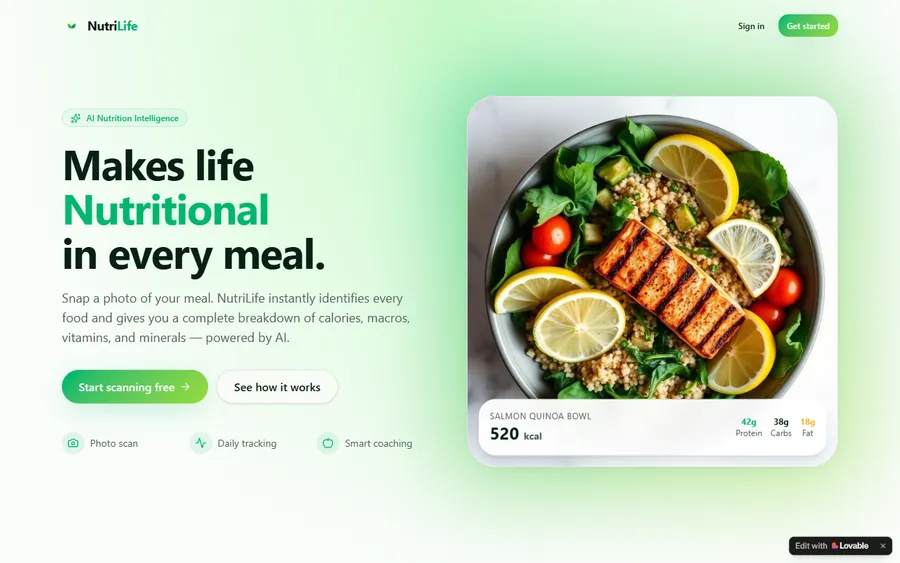
AI and ML
An AI nutrition coach that reads what you eat and works you toward a target.
AI and ML
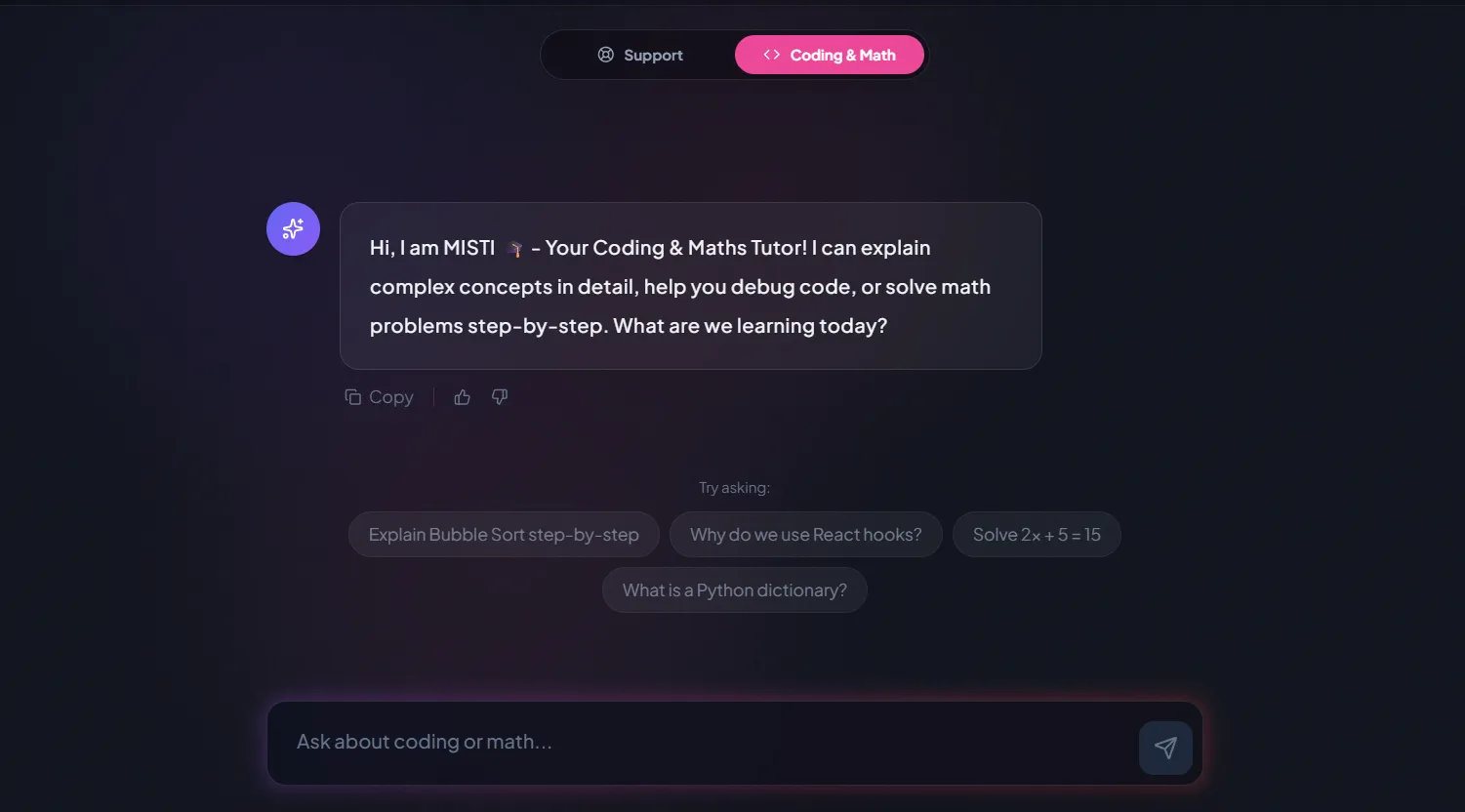
A chatbot that answers mathematics and programming questions, built and deployed by a student.
AI and ML
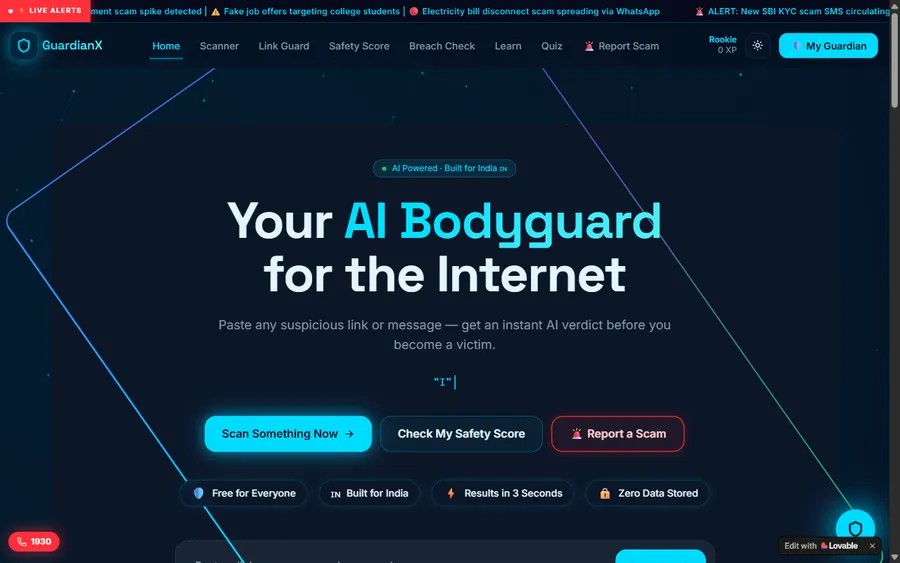
An assistant that helps a young person recognise unsafe situations online.
Web app
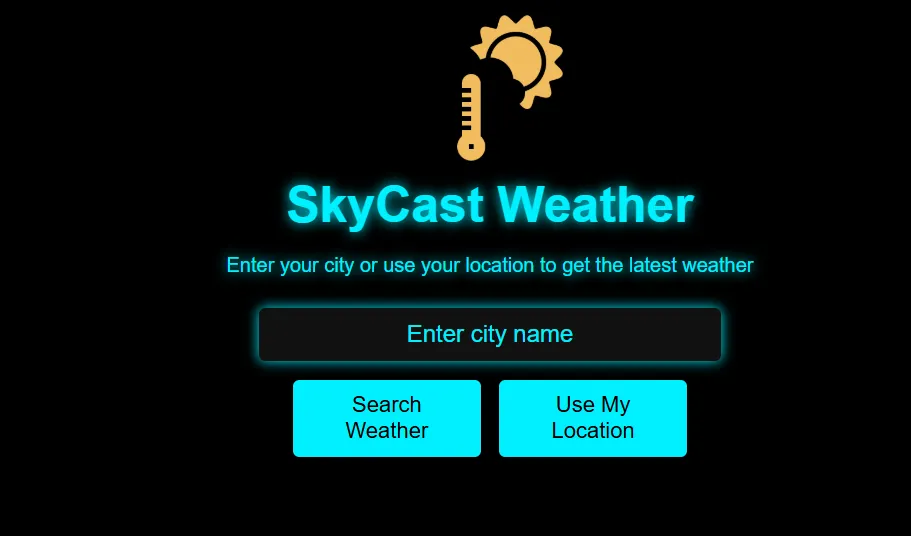
A weather forecasting site with live conditions for any location.
Fees
Monthly fees in US dollars, the same everywhere outside India, with no registration charge and no contract.
Free first class
USD 0
no card required
Group batch
USD 100
a month, billed in US dollars
One to one
USD 150
a month, billed in US dollars
What families say
Reviews left on our Google profile, reproduced exactly as they were written.
★★★★★
"The one step solution for my son. Modern Age Coders make learning coding so simple that kids love it. The teachers explain complex concepts clearly with practical exercises and interactive content."
Ria Mukherjee
Parent
★★★★★
"Modern Age Coders has been a game-changer for me. I struggled to grasp IT concepts and coding before joining, but their classes transformed everything. I can now confidently write complex programs with ease."
Samriddha Mondal
Student
★★★★★
"One of the most wonderful education centres out there. Education is not limited to school syllabus but focuses on skill development."
Vansh Agarwal
Student
★★★★★
"My child Dhairya is really enjoying the Modern Age Coders classes. This is his first online class and he eagerly looks forward to it. I can already see his improvement, and the teachers are very cooperative."
Sonam Oswal
Parent of Dhairya
★★★★★
"Modern Age Coders have wonderful teachers who teach in a clear, easy and practical way. The teacher boosts students' confidence and inspires them to learn without hesitation."
Sonu Goyal
Parent
★★★★★
"I highly recommend this computer coding class! The teachers are incredibly knowledgeable and passionate about coding."
Ritu Kedia
Parent
Oxford maths questions
A harmonic number is the sum 1 + 1/2 + 1/3 and so on up to 1/n. It grows slowly, roughly like the natural logarithm of n plus 0.577. For n = 173 it is about 5.73.
The first lesson is free. Ongoing lessons cost USD 100 a month in a class of five to ten, or USD 150 a month one to one. There is no joining fee.
AQA, Edexcel and OCR at both tiers, and the IGCSE papers too. We follow the specification the school has chosen.
Yes. We teach the course again, starting from your weakest topic, and prepare you for an exam you enter through a college or exam centre.
Yes, from times tables and the Year 4 check through to the arithmetic and reasoning papers sat in Year 6.
We teach Further Maths topics as an extension of our A level course for students ready to go further. Tell us the board when you book.
No. We teach the school and A level curriculum and problem solving in general. We do not offer admissions test preparation or application advice.
Run experiments and compare them with theory. Rolling a dice 600 times and counting sixes teaches more than a page of rules.
There is not. We teach only over live video, which means a learner in Jericho, Marston or Littlemore studies from their own desk.
No. We teach carefully and report honestly, but no tutor can promise a grade.
Related
National maths pages, our coding page for Oxford and nearby maths pages.
Pure, statistics and mechanics.
For sixth formers who want more.
Every tier, every board.
Our coding page for the city.
Another university city, a percentages project.
Our full list of UK pages.
Start here
Which year is the learner in, and which topic has stalled? Tell us that and we will plan a real trial lesson, then report back candidly on what we saw.
Want to browse first? Look at our courses or read about how we teach.
WhatsApp us · +91 91233 66161 · connect@modernagecoders.com
Messages sent on WhatsApp are answered soonest. You will notice an Indian dialling code, since the teaching team works from India; we keep no premises in Oxford and teach entirely online.
A priority demo is a full class of about 45 to 60 minutes. After the class the mentor sends a written skill report and a personal learning roadmap on WhatsApp. If you enrol, the demo fee is adjusted against your first month's fee. Share your demo Order ID with us on WhatsApp and we take it off.
Book a priority demo