MTN / A1
Early number
Counting, patterns and shape for young children.
Open the syllabusNottingham · Maths for every learner from 6 to 67 · Live online, small groups or one to one
Does a sunny month run warmer? It sounds too obvious to test, so we tested it on forty-one years of Met Office records from Sutton Bonington, in Rushcliffe. Across 481 months the answer looks like a firm yes: the correlation between sunshine hours and average maximum temperature is 0.834. Then split the months up. In July the link stays strong. In November it vanishes, and the correlation even turns slightly negative. The strong overall pattern was mostly the seasons talking. Knowing when a correlation means something is a GCSE skill and an A level one, and it is the thread running through this page about how we teach maths to Nottingham learners of every age.
Maths only on this page · Primary, secondary, sixth form and adult learners · Not linked to any Nottingham school or university
In short
We are an online maths tutor for Nottingham learners from 6 to 67: KS2 maths and the Year 6 SATs papers, KS3, GCSE at Foundation or Higher tier on AQA, Edexcel or OCR including resits, A level Maths and Further Maths, and adult maths such as Functional Skills and refreshers. Groups of five to ten learners share one level, and private lessons are also available. Our local example uses Met Office records from Sutton Bonington: over 481 months from 1959 to 1999, sunshine and maximum temperature correlate at 0.834, but within November alone the correlation is -0.098, because the season, not the sunshine, drives most of the pattern. The opening lesson costs nothing; then it is USD 100 a month for a group place or USD 150 a month for one to one.
Where Nottingham learners tend to start
Start from the stage. Every other course, from early number to university maths, is listed lower down.
NOT / 1
Arithmetic that holds up under a 30 minute paper, and reasoning that can be written down, ready for Year 6.
Open the syllabus →
NOT / 2
AQA, Edexcel or OCR at either tier, including learners resitting after Year 11.
Open the syllabus →
NOT / 3
Regression, correlation and calculus practised on genuine data, such as the weather records further down.
Open the syllabus →Stage by stage
Nottingham schools teach the national curriculum for England, so a learner here passes through the same key stages and exams as one in Leeds or Bristol. Adults pick up wherever they stopped.
| Stage | Typical ages | Where we put the weight |
|---|---|---|
| Key Stage 1 | 5 to 7 | Number bonds, counting in steps, halves and quarters, telling the time. |
| Key Stage 2 | 7 to 11 | Fluent arithmetic for Paper 1, then multi-step reasoning for Papers 2 and 3 of the Year 6 tests. |
| Key Stage 3 | 11 to 14 | Algebraic notation, proportion, area and volume, and drawing and reading charts. |
| GCSE | 14 to 16 | Foundation or Higher on AQA, Edexcel or OCR; scatter graphs, probability, algebra and geometry. |
| A level | 16 to 18 | Pure, statistics and mechanics, plus Further Maths for learners who want more. |
| Adults | 18 to 67 | Functional Skills, a GCSE resit, or simply getting comfortable with numbers again. |
The Standards and Testing Agency's framework for the Key Stage 2 maths test sets out three papers. Paper 1 is arithmetic: 40 marks in 30 minutes. Papers 2 and 3 are reasoning, 35 marks each, with 40 minutes per paper. In the framework's words, "the total testing time is 110 minutes".
The two kinds of paper need different preparation. Arithmetic rewards accuracy and speed with written methods. Reasoning rewards reading a problem slowly and showing working, and the same framework expects pupils to read information from a line graph and to "calculate and interpret the mean as an average".
GCSE lessons follow the board and tier the school has chosen, with proper time given to statistics, where marks are often lost cheaply. At A level we keep correlation and regression tied to genuine data sets so a coefficient always means something.
For more detail by stage, see our national pages on KS2 maths, KS3 maths, GCSE maths, A level maths and Further Maths.
Source: Standards and Testing Agency, Key stage 2 mathematics test framework, read on 1 October 2026. The ages shown are typical, not rules.
The Nottingham project
A scatter graph of sunshine against temperature looks convincing. The interesting maths starts when you ask what is really causing the pattern.
The Met Office publishes long monthly records for a set of historic weather stations. One of them is Sutton Bonington, in Rushcliffe, which the file says stands 48 metres above sea level. It lists, month by month, the average daily maximum temperature and the total hours of sunshine.
Sunshine figures in the file run from 1959 to 1999, so we used those forty-one years. We dropped the 11 months that the Met Office marks as estimated, which leaves 481 months, each giving one point on a scatter graph: sunshine hours across, maximum temperature up.
The points rise steeply from left to right. The correlation coefficient is 0.834, and the fitted line says each extra hour of sunshine goes with about 0.078 °C more warmth. A student who stops here concludes that sunshine warms a month, and says so with confidence.
The trouble is that both quantities follow the calendar. Summer months are long and bright; winter months are short and dull. Put every month on one graph and you mostly measure the difference between July and January, not the effect of a sunny spell.
| Months included | Points | Correlation r | What it suggests |
|---|---|---|---|
| All months together | 481 | 0.834 | A strong pattern, mostly made by the seasons |
| Julys only | 40 | 0.872 | In summer, a sunnier July really is a warmer July |
| Mays only | 41 | 0.644 | Still clearly positive in late spring |
| Octobers only | 40 | 0.242 | Weak by autumn |
| Januarys only | 39 | 0.106 | Almost nothing in midwinter |
| Novembers only | 41 | -0.098 | Slightly negative: a sunny November is no warmer |
Data: Met Office historic station data, Sutton Bonington, read on 1 October 2026; sunshine in these years came from a Campbell Stokes recorder. Months marked as estimated were left out. Correlations, lines and residuals are Modern Age Coders' calculations. Number of years differs slightly by month because of those exclusions.
A GCSE skill with a trap in it
The DfE content for GCSE maths asks students to "interpolate and extrapolate apparent trends whilst knowing the dangers of so doing". These records show both dangers clearly.
A residual is the gap between a real point and the fitted line. Take the line drawn through all 481 months and look at which months sit above it. July months sit on average 2.59 °C above the line, October months 1.93 °C above, and April months 2.46 °C below.
So two months with identical sunshine can differ by several degrees, depending on whether they come in spring or autumn. A likely reason, which is our reading rather than something these numbers prove, is that ground and sea are still cool in April and still warm in October. A single straight line through every month cannot see that.
Now fit a line through the forty Julys alone: temperature ≈ 13.46 + 0.0419 × sunshine. Within the Julys we actually have, 106.4 to 252.4 hours of sun, it predicts sensibly. That is interpolation, and it is fairly safe.
Push it to 400 hours and it promises 30.2 °C. No July on the record came anywhere close to that much sun, so the line is guessing. Push it down to zero hours and it gives 13.5 °C, a July with no sun at all, which has never happened either. The arithmetic is perfect and the answers mean nothing.
The DfE wording also asks students to "draw estimated lines of best fit" and to know that correlation "does not indicate causation". This data set teaches both in one sitting, and it carries on into A level, where students compute the coefficient themselves, test whether it differs from zero, and write a sentence about what it does not prove.
Wording: DfE, GCSE mathematics subject content and assessment objectives. All fitted values and residuals are our calculations from the Met Office file above.
Maths around the city
Families ask what else is on offer locally. These are things we confirmed on public web pages; we run none of them.
The NCETM page names George Spencer Academy, Nottinghamshire, as lead school for the hub, and lists Nottingham among the council areas it serves, with Derby, Derbyshire, Ashfield and Broxtowe. Hubs support teachers and schools, not families.
The School of Mathematical Sciences runs a Sixth Form Conference, described as "A one-day conference for KS5 students and their maths teachers", and states that "There is no charge for the Sixth Form Conference."
Its online taster lecture on statistics says "In particular we look at extrapolation and its limitations". The school also joins Wonder, the university's free community day, and Family Discovery Days for primary children.
Places at university events usually go through schools, so a maths teacher is the person to ask. For competitions, the UKMT maths challenges are the national ones most schools enter; they are dated on our competitions calendar, and the olympiad page covers the later rounds.
It is a happy coincidence that the university's statistics taster dwells on extrapolation, the same idea as our weather project. It is the kind of idea that separates a learner who can run a calculation from one who can judge it.
Beeston, Arnold or Sneinton, it makes no difference: a learner joins each live lesson from home. Groups are formed by level, so a classmate could just as easily be in Derby or Glasgow.
Adults usually come to us for one of two routes, Functional Skills maths or a GCSE resit. Our Functional Skills page explains the levels.
Sources: NCETM, East Midlands West Maths Hub; University of Nottingham, School of Mathematical Sciences, schools and community outreach. Read on 1 October 2026. None of these bodies is connected with Modern Age Coders.
Adult learners
Adults make up a good share of the people who contact us, and they rarely want the same thing.
Practical maths for work and further training, taught step by step, with plenty of everyday problems: percentages on a payslip, scale on a plan, averages in a report.
For adults and older students who need the grade for a course or a job. The GCSE course we use explicitly includes resit candidates, at Foundation or Higher tier.
Some adults just want to understand what they once memorised. Our adult maths page describes how those groups run.
The weather data suits adults well. Most of us have seen a chart in the news showing two things rising together, and the November result above is a quick, memorable way to learn the question worth asking every time: what else changed at the same moment?
How the steps fit
The steps build on one another. Learners start at whichever one fits, and the free first lesson finds it.
| Usually | Step | A sign it is secure |
|---|---|---|
| Years 3 to 6 | 1. Arithmetic | Completes long multiplication and division accurately without a calculator |
| Years 6 to 8 | 2. Reading data | Reads values and differences off a line graph and works out a mean |
| Years 8 to 11 | 3. Relationships | Plots a scatter graph and describes the correlation in a sentence |
| Years 11 to 13 | 4. Judgement | Explains when a fitted line can be trusted and when it cannot |
A Year 11 or Year 6 learner who joins late can still gain a great deal, provided we fix the arithmetic first. Most lost marks trace back to it.
If there is more to fix than there is time, we will tell you plainly after the trial lesson.
Some learners continue with statistics and probability, where the sunshine records become a full regression study, or with maths through coding, where a short program draws the scatter graph.
Others find they enjoy problem solving for its own sake and move on to competition maths.
All courses
Arranged by stage; open any card for the complete syllabus.
MTN / A1
Counting, patterns and shape for young children.
Open the syllabusMTN / A2
The whole primary curriculum, reasons included.
Open the syllabusMTN / A3
Fast, reliable calculation in the head.
Open the syllabusMTN / A4
A physical frame that becomes a mental one.
Open the syllabusMTN / B1
Years 7 to 9: algebra, proportion, geometry, data.
Open the syllabusMTN / B2
Rebuilding algebra from the ground up.
Open the syllabusMTN / B3
AQA, Edexcel or OCR, either tier, resits included.
Open the syllabusMTN / B4
Cambridge and Edexcel International entries.
Open the syllabusMTN / C1
Pure, mechanics and statistics.
Open the syllabusMTN / C2
Correlation, regression and hypothesis tests.
Open the syllabusMTN / C3
First-year calculus and linear algebra.
Open the syllabusMTN / C4
Problems that need ideas, not procedures.
Open the syllabusMTN / D1
Interest, depreciation and investment.
Open the syllabusMTN / D2
Statistics and matrices behind data work.
Open the syllabusMTN / D3
Exploring number and data in Python.
Open the syllabusMTN / D4
Speedy calculation tricks for confident learners.
Open the syllabusTimetable
Our teachers are in India, where the clocks never change. From late October to late March India is five and a half hours ahead of Nottingham, and four and a half hours ahead in British Summer Time. Slots are always fixed and shown in UK time.
Weekdays after school
Primary and secondary pupils.
Weekday evenings
Sixth formers and adults after work.
Weekend mornings
For learners who prefer an early start.
One teacher follows a group week after week and remembers each learner's habits.
A few lines home on what is secure and what needs another look.
Five to ten learners, all working at the same level.
Weather records, census tables and maps alongside exam questions.
One to one for a single topic, a looming exam or personal preference.
Learners explain a method before they practise it.
Student work
Learners who started with graphs and data went on to make the four projects below. Plenty more are in the student labs.
AI and ML
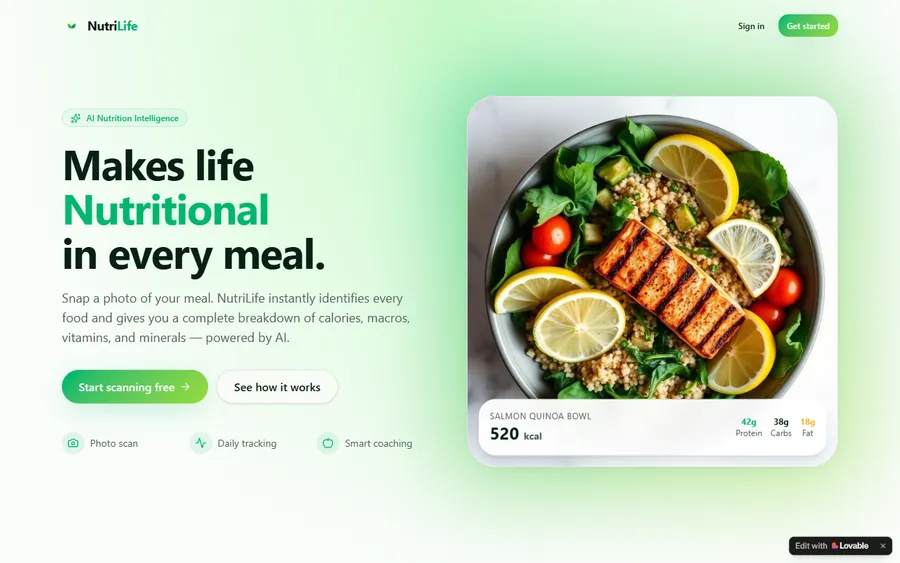
An AI nutrition coach that reads what you eat and works you toward a target.
AI and ML
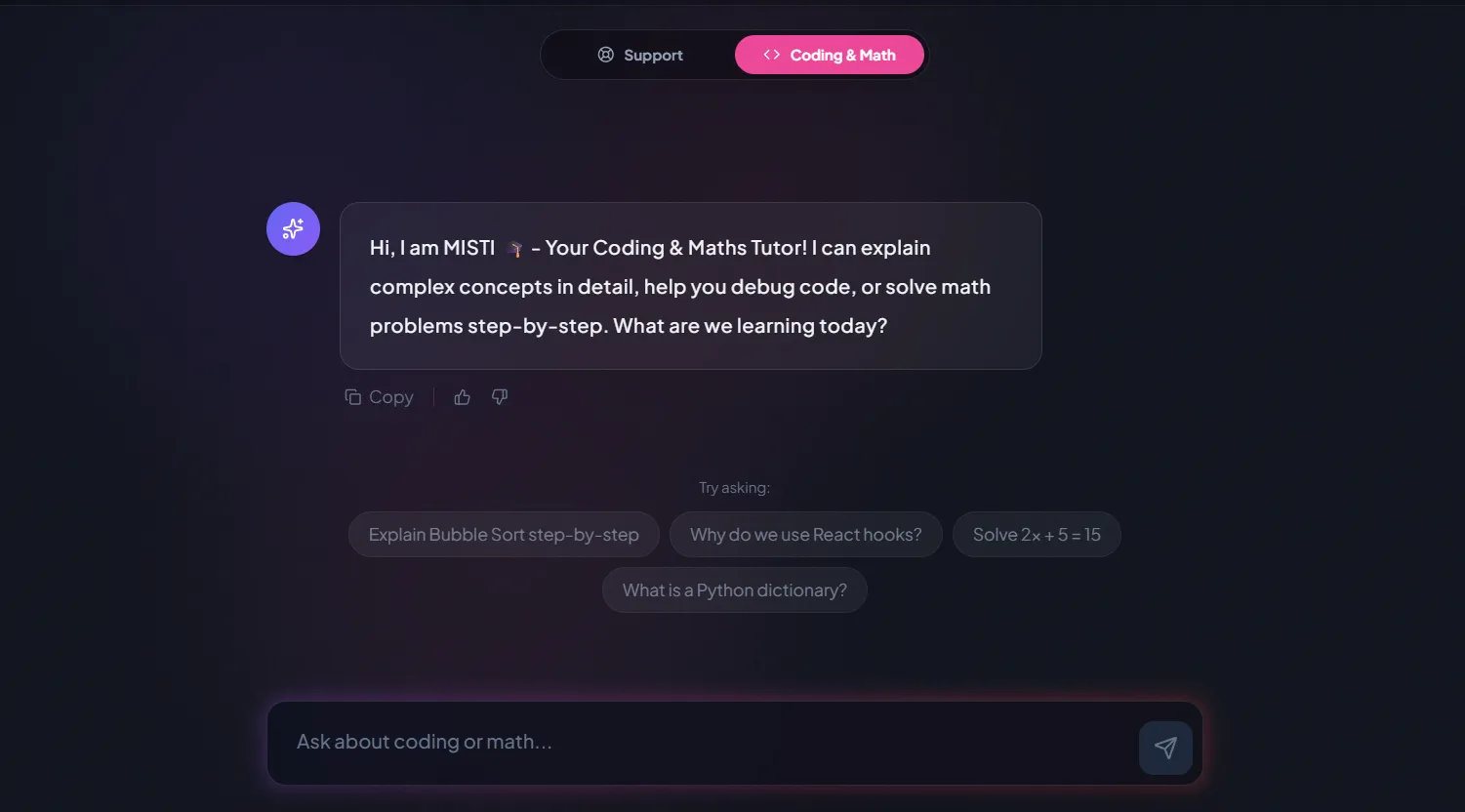
A chatbot that answers mathematics and programming questions, built and deployed by a student.

AI and ML
An assistant that helps a young person recognise unsafe situations online.
Web app
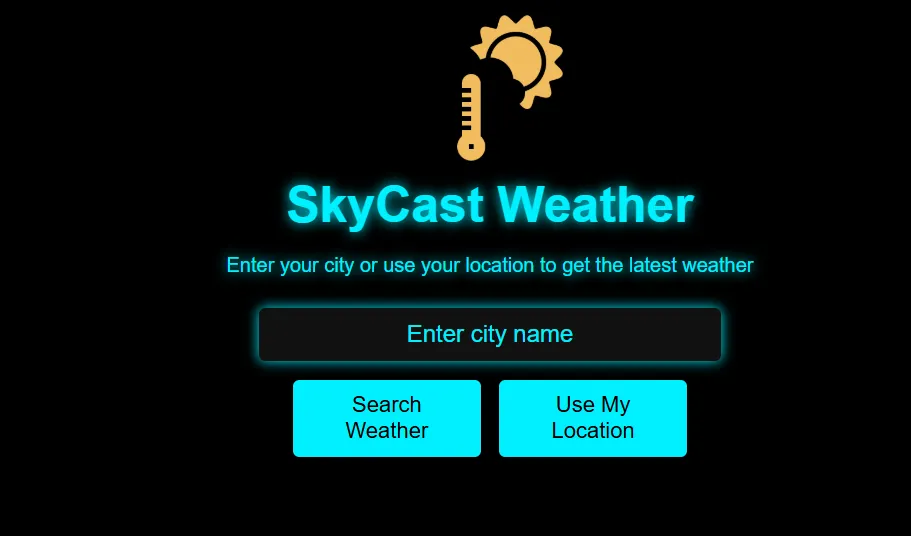
A weather forecasting site with live conditions for any location.
Fees
Billed each month in US dollars, at one rate for all countries outside India, with no sign-up fee and no contract.
Free first class
USD 0
no card required
Group batch
USD 100
a month, billed in US dollars
One to one
USD 150
a month, billed in US dollars
What families say
Reproduced without editing from Google reviews left by our families and learners.
★★★★★
"The one step solution for my son. Modern Age Coders make learning coding so simple that kids love it. The teachers explain complex concepts clearly with practical exercises and interactive content."
Ria Mukherjee
Parent
★★★★★
"Modern Age Coders has been a game-changer for me. I struggled to grasp IT concepts and coding before joining, but their classes transformed everything. I can now confidently write complex programs with ease."
Samriddha Mondal
Student
★★★★★
"One of the most wonderful education centres out there. Education is not limited to school syllabus but focuses on skill development."
Vansh Agarwal
Student
★★★★★
"My child Dhairya is really enjoying the Modern Age Coders classes. This is his first online class and he eagerly looks forward to it. I can already see his improvement, and the teachers are very cooperative."
Sonam Oswal
Parent of Dhairya
★★★★★
"Modern Age Coders have wonderful teachers who teach in a clear, easy and practical way. The teacher boosts students' confidence and inspires them to learn without hesitation."
Sonu Goyal
Parent
★★★★★
"I highly recommend this computer coding class! The teachers are incredibly knowledgeable and passionate about coding."
Ritu Kedia
Parent
Nottingham maths questions
Correlation measures how closely two quantities move together, from -1 to 1. A value near 1 means they rise together; near 0 means little straight-line link. It never proves that one causes the other, which is why our sunshine data matters.
The first lesson is free. After that it is USD 100 a month for a place in a small group, or USD 150 a month for one to one lessons. There is no joining fee.
Yes. We work on fast, accurate arithmetic for Paper 1 and on reading and reasoning for Papers 2 and 3, using the structure set out in the official test framework.
Yes, for older students and adults, at Foundation or Higher tier, on AQA, Edexcel or OCR. The course we use is designed to include resit candidates.
For most learners it is. Our teachers teach live, see the learner's working as it is written, and correct it on the spot. There are no recorded lessons, and each group keeps the same teacher.
Yes. We teach Functional Skills maths to adults at their own pace, in adult groups or privately, with practical problems from everyday life and work.
Yes. A level Maths covers pure, statistics and mechanics; Further Maths adds more proof, complex numbers, matrices and deeper applied topics.
No. All lessons are live online, so learners anywhere in the city or the county join from home.
No. Nobody can honestly guarantee a grade. We teach carefully, set and mark work, and tell you each month how things are going.
No. We mention their public events so families know about them, but we have no connection with the university, the NCETM, any Maths Hub or any school.
Related
Stage-by-stage maths pages, the county page and our coding page for the city.
Years 3 to 6 and the Year 6 tests.
Every board and both tiers.
Practical maths qualifications for adults.
Our page on coding for the city.
Our county page.
A tide data project on the Mersey.
Start here
Let us know the learner's age or year group and the topic that worries them most. The trial is a genuine lesson, and you get a clear account of the learner's level afterwards.
Rather browse first? See our course list or read about how we teach.
WhatsApp us · +91 91233 66161 · connect@modernagecoders.com
A WhatsApp message is the fastest route to a reply. Our number carries India's dialling code because the team is based there; we have no Nottingham office, and teaching is entirely online.
A priority demo is a full class of about 45 to 60 minutes. After the class the mentor sends a written skill report and a personal learning roadmap on WhatsApp. If you enrol, the demo fee is adjusted against your first month's fee. Share your demo Order ID with us on WhatsApp and we take it off.
Book a priority demo