MSL / A1
11 plus maths
Fluency and problem solving for selective tests.
Open the syllabusSlough · Maths lessons for ages 6 to 67 · Taught live by video
Here is a ratio a Year 9 pupil can work out from public data in ten minutes. In the 2021 census Slough had 105,895 residents aged 15 to 64, 37,285 under 15 and 15,320 aged 65 or over. For every 100 people of working age, then, there were 35.2 children and 14.5 older people. Across England the same two figures were 27.1 and 28.7. Slough has far more children for its size and far fewer pensioners, and the ratio says so in one line. This page explains how we teach maths to Slough learners, from times tables and the 11 plus to A level, and why ratio and proportion sit at the heart of so much of it.
Maths is the only subject on this page · Primary, 11 plus, GCSE, A level, adults · Unconnected to any Slough school
Maths tuition in Slough at a glance
Modern Age Coders gives live online maths lessons to Slough learners between 6 and 67. Children start with number, times tables and the Year 6 SATs; some go on to 11 plus maths; older pupils move through KS3 into GCSE at Foundation or Higher tier for AQA, Edexcel or OCR, or IGCSE; sixth formers take A level Maths and, if they want, Further Maths topics; and adults come for GCSE maths resits and everyday confidence. Teaching is private or in classes of five to ten at one level. Our Slough project builds ratios from the census: 35.2 children and 14.5 people aged 65 or over for every 100 aged 15 to 64. Lesson one is free. From then on a class seat costs USD 100 per month and a private teacher USD 150 per month.
Where Slough learners usually begin
Slough families most often ask about these three. The complete list of our maths courses is lower down the page.
SLO / 1
Number fluency and multi-step problems for Year 5 children working towards a selective test in the autumn of Year 6.
Open the syllabus →
SLO / 2
Ratio, proportion and every other topic on the specification, at whichever tier and board the school uses.
Open the syllabus →
SLO / 3
The three strands of the course, with statistics practised on census tables like the ones on this page.
Open the syllabus →Six to sixty-seven
Slough schools follow the national curriculum for England, and the 11 plus sits alongside it for families who choose it. Here is how our lessons change across the stages.
| Stage | Years or ages | Heart of our lessons |
|---|---|---|
| KS1 | Years 1 and 2 | Counting, place value, adding and taking away, halves and quarters. |
| KS2 | Years 3 to 6 | All the times tables, the Year 4 multiplication tables check, fractions and the Year 6 SATs papers. |
| 11 plus | Years 5 and 6 | Speed with accuracy, and problems that need two or three steps. |
| KS3 | Years 7 to 9 | Ratio and proportion, algebra, area and volume, simple probability. |
| GCSE and IGCSE | Years 10 and 11 | Foundation or Higher tier with AQA, Edexcel or OCR, or the international papers. |
| A level and adults | 16 onwards | A level Maths, Further Maths topics, GCSE resits and adult refreshers. |
Primary maths is mostly about number, and number is mostly about knowing facts well enough to use them. We teach tables as connected facts, so a child who forgets 7 × 9 can get there from 7 × 10 minus 7.
Families preparing for the Slough grammar school tests will find the schools, test format and timings on our 11 plus maths in Slough page. Here we only say that strong primary number work is the base for both the SATs and the 11 plus.
Ratio and proportion run through secondary maths like a thread: recipes and maps in Year 7, similar shapes and value-for-money problems at GCSE, rates of change at A level. We give it more time than most courses do.
Our national pages add detail stage by stage: KS2 maths, KS3 maths, GCSE maths, A level maths and Further Maths.
Years and ages are the usual ones in England. Details of the Slough selective tests are kept on our separate Slough 11 plus page.
The Slough project
Three numbers from the census, two ratios, and a comparison with England that a learner can explain in a sentence.
The Office for National Statistics publishes the 2021 census through Nomis, including a table of age in five-year bands for every local authority. For Slough it gives a total of 158,500 residents. We grouped the bands three ways: under 15, 15 to 64, and 65 and over. That gave 37,285 children, 105,895 people of working age and 15,320 older people.
Statisticians often divide the young and the old by the working-age group and scale to 100, a figure known as a dependency ratio. It is not a judgement about anyone; it is simply a way to compare places of very different sizes.
For Slough: 37,285 ÷ 105,895 × 100 = 35.2 children per 100 working-age residents, and 15,320 ÷ 105,895 × 100 = 14.5 older people. Together that is 49.7.
For England, the same table gives 9,838,977 under 15, 36,249,768 aged 15 to 64 and 10,401,303 aged 65 and over, which makes 27.1 and 28.7 per 100, or 55.8 together. Slough has fewer dependants per worker than England overall, even though it has far more children. The ratio shows two things a single percentage would hide.
| Under 15 | Aged 15 to 64 | 65 and over | Children per 100 | Older per 100 | |
|---|---|---|---|---|---|
| Slough | 37,285 | 105,895 | 15,320 | 35.2 | 14.5 |
| England | 9,838,977 | 36,249,768 | 10,401,303 | 27.1 | 28.7 |
The DfE content for GCSE asks learners to "use ratio notation, including reduction to simplest form". Children to older people in Slough is 37,285 : 15,320. The highest common factor is only 5, so the simplest form is 7,457 : 3,064, which helps nobody.
Divide instead: 37,285 ÷ 15,320 is about 2.43, so the ratio is roughly 2.43 : 1, or close to 12 : 5. In England it is about 0.95 : 1. Knowing when an exact simplest form is useless and a rounded unit ratio is clearer is a real mathematical judgement.
Proportion questions become easy once you scale to one, or to a round number. Per 1,000 Slough residents there are 235 children under 15 and 97 people aged 65 or over. Per 1,000 people in England there are 174 and 184.
Now a "what if" question. If Slough had England's rate of 55.8 dependants per 100 working-age people, its 105,895 working-age residents would come with about 59,127 children and older people. Our sum of the census bands gives 52,605. That gap of about 6,500 is the difference the ratio describes.
Data: Nomis, Census 2021 table TS007A (age by five-year age bands), Slough and England, read on 1 October 2026; Office for National Statistics, Open Government Licence. The grouping into three age groups and every ratio are Modern Age Coders calculations. GCSE wording: DfE, GCSE mathematics subject content.
When the parts do not add up
A careful learner checks a total. Here the check fails, and the reason is one of the more interesting facts in official statistics.
The five-year table gives Slough 158,500 residents. A second census table, age by single year from under 1 to 100 and over, gives a total of 158,498. Same census, same town, two published totals that differ by two people.
The ONS explains that, to protect privacy, it used a "cell key method" on its tables, and that "a typical dataset would have around 14% of cell counts perturbed by a small amount, and small counts were more likely to have been perturbed than large counts." Our reading is that this is why the two totals differ; we do not try to say which is right.
The lesson for a learner is not that statistics are wrong. It is that a published figure is a measurement with a method behind it, and two methods can give slightly different answers. We never force them to agree, and we never add up the parts of one table and call it the total of another.
For the ratios above, a difference of two people out of 158,500 changes nothing at one decimal place. That is a second lesson: always ask whether a discrepancy is big enough to matter for the question you are answering.
| Stage | Question we ask | Skill practised |
|---|---|---|
| KS2 | Are there more children or more older people in Slough? | Comparing and ordering large numbers |
| KS3 | How many children per 100 working-age people? | Ratio, division, rounding to one decimal place |
| GCSE | What would the dependants be at the England rate? | Proportion as equality of ratios |
| A level | Why might two official totals differ? | Data quality, error and judgement |
Source on perturbation: ONS, Protecting personal data in Census 2021 results, read on 1 October 2026. The comparison of the two totals is our own; the ONS does not comment on these two Slough figures.
Maths beyond lessons
A few things a Slough family might want to know about. We have no link with any of them.
The NCETM lists Slough among the council areas of the Bucks, Berks and Oxon Maths Hub, led by Wycombe High School in High Wycombe. Maths Hubs work with schools and teachers, not directly with families.
Slough secondary schools can enter pupils for the UK Mathematics Trust challenges. We prepare learners for that style of problem; see our maths challenges page.
Selective school places in Slough are decided by a test in Year 6. Everything about it, schools and format included, is on our Slough 11 plus page.
Children who enjoy puzzles often like the census work above, because it rewards spotting the right question before reaching for a calculator.
Our UK competitions calendar lists challenges by age, and the Junior Olympiad page covers the next round up.
Every lesson is online, so a learner in Langley, Cippenham, Chalvey or Britwell logs in from home. Our classes are grouped by level, not by town, so a classmate might be in Reading or Leicester.
Adults often say this is the first time a ratio has felt useful rather than abstract, because the numbers describe the town they live in.
Source: NCETM, Bucks, Berks and Oxon Maths Hub, read on 1 October 2026. We are independent of the NCETM, the Maths Hubs, the UKMT and every Slough school and test body.
For adults
Not every learner on this page is a child. Adults join us to resit GCSE maths, to sharpen their numbers for work, or to keep pace with a child at school.
We go back through the course from the shakiest topic, at a pace that suits working adults. Exam entry is arranged through a college or exam centre.
Fractions, percentages, ratios, measures and money in practical settings. Our Functional Skills maths page explains more.
Parents learn today's school methods, so help at home matches what the teacher says in class.
Ratio is where many adults first lost confidence at school, and it is often where they regain it fastest once the idea of scaling to one clicks. There is more on our adult maths page.
How the topic builds
Anyone can come in at any rung. The free first lesson shows us which.
| When it usually happens | Rung | Check before climbing |
|---|---|---|
| Years 2 to 4 | 1. Sharing | Shares a quantity fairly and explains any remainder |
| Years 5 to 7 | 2. Ratio | Writes a ratio, simplifies it and says what each part means |
| Years 8 to 10 | 3. Unitary method | Scales to one, or to 100 or 1,000, to compare two places |
| Years 11 to 13 | 4. Proportion | Treats proportion as equal ratios and spots when data quality matters |
Late starters are welcome. We look at fractions and division first, since almost every ratio question that goes wrong goes wrong there.
If more needs fixing than there is time before the exam, we tell you at the first lesson.
Learners who enjoy census data often continue with statistics and probability, or use maths through coding to calculate ratios for every town at once.
Puzzle lovers usually head for competition maths.
Our full list
We list first what UK families most often search for: the 11 plus, GCSE, A level and IGCSE. Each card leads to a full syllabus.
MSL / A1
Fluency and problem solving for selective tests.
Open the syllabusMSL / A2
Either tier, any of the main boards.
Open the syllabusMSL / A3
Pure, mechanics and statistics together.
Open the syllabusMSL / A4
For international specifications.
Open the syllabusMSL / B1
Years 1 to 6 up to the SATs.
Open the syllabusMSL / B2
Confident sums without pen and paper.
Open the syllabusMSL / B3
Bead-frame calculation for young children.
Open the syllabusMSL / B4
For children just starting school.
Open the syllabusMSL / C1
Ratio, algebra and geometry for Years 7 to 9.
Open the syllabusMSL / C2
Handling data and chance.
Open the syllabusMSL / C3
For learners who need a second run.
Open the syllabusMSL / C4
UKMT-type questions for keen pupils.
Open the syllabusMSL / D1
Ratios, percentages and interest in practice.
Open the syllabusMSL / D2
For adults going back to study.
Open the syllabusMSL / D3
The numbers under data analysis.
Open the syllabusMSL / D4
Shortcut methods for quick sums.
Open the syllabusLesson times
Teachers work from India, five and a half hours ahead of Slough in winter and four and a half in summer. Every time we give you is in UK time.
Late afternoon, weekdays
Primary, 11 plus and KS3 pupils.
Evening, weekdays
GCSE, sixth form and adults.
Saturday and Sunday mornings
Learners of any age.
Your teacher stays the same, so nothing has to be explained twice.
A brief note after lessons on what went well and what comes next.
Five to ten learners, all at a similar point.
Census tables and other real data, not only textbook exercises.
One to one for a near exam or a stubborn topic.
We show why a method works before practising it.
Student work
Students who began with numbers like these went on to build the projects shown here. Browse the student labs for more.
AI and ML
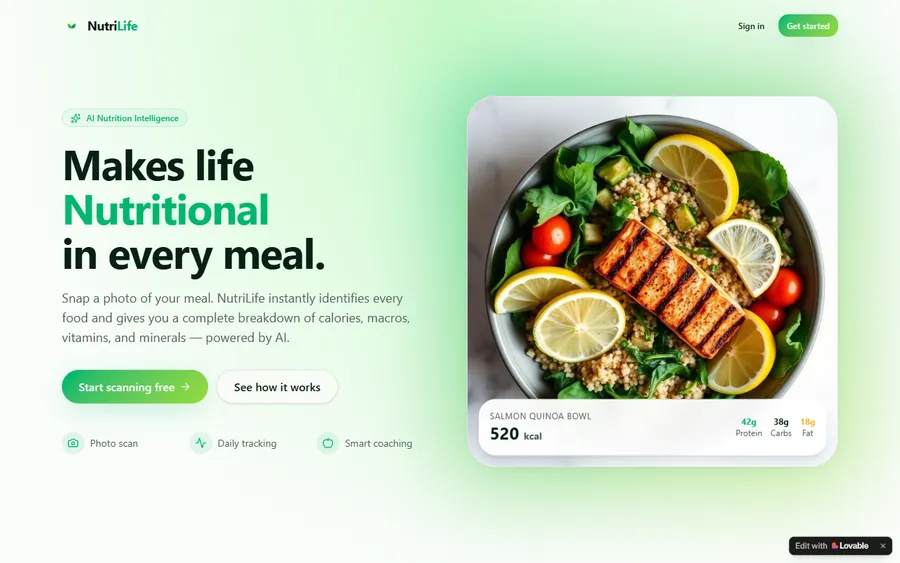
An AI nutrition coach that reads what you eat and works you toward a target.
AI and ML
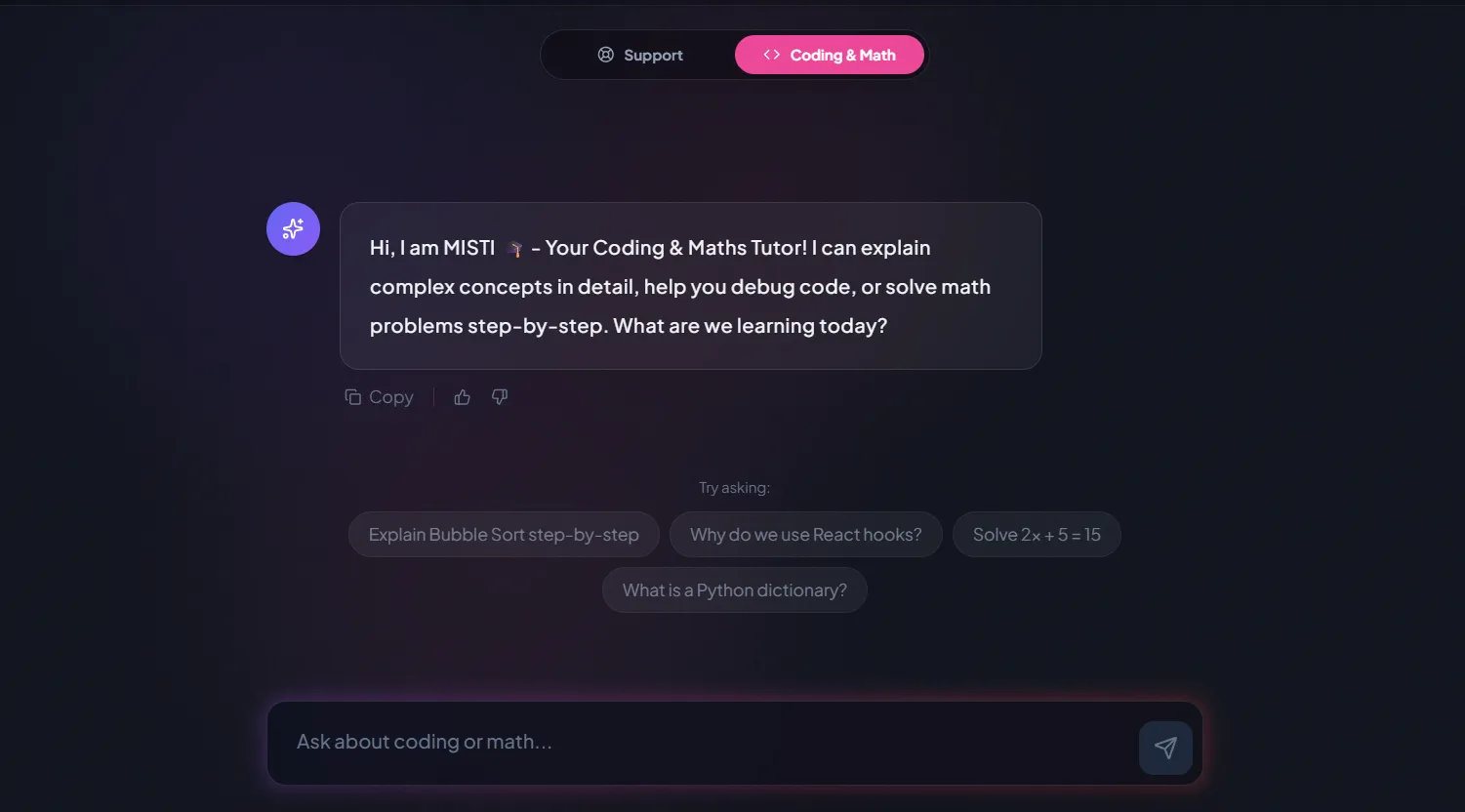
A chatbot that answers mathematics and programming questions, built and deployed by a student.

AI and ML
An assistant that helps a young person recognise unsafe situations online.
Web app
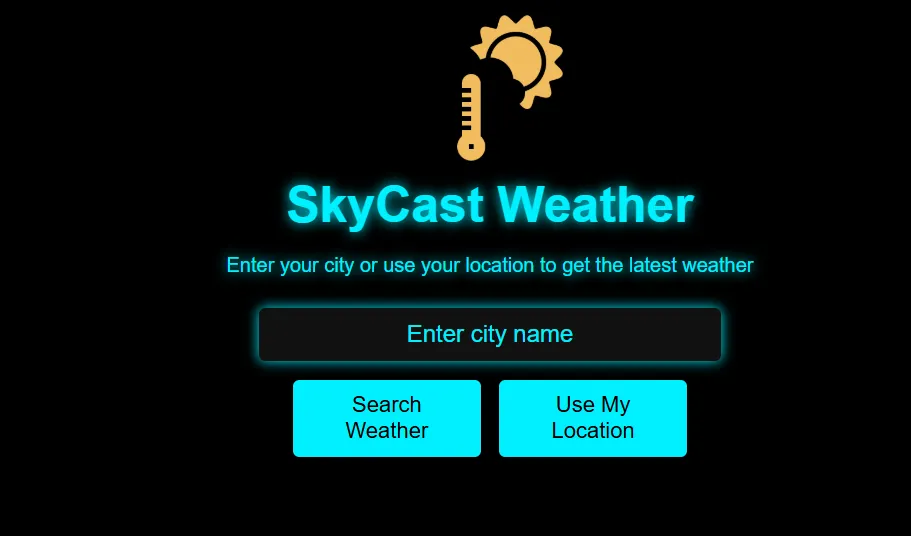
A weather forecasting site with live conditions for any location.
Fees
We bill monthly in US dollars, one price for all countries except India. No sign-up fee, no fixed term.
Free first class
USD 0
no card required
Group batch
USD 100
a month, billed in US dollars
One to one
USD 150
a month, billed in US dollars
What families say
Reviews from our Google profile, quoted exactly as families and learners wrote them.
★★★★★
"The one step solution for my son. Modern Age Coders make learning coding so simple that kids love it. The teachers explain complex concepts clearly with practical exercises and interactive content."
Ria Mukherjee
Parent
★★★★★
"Modern Age Coders has been a game-changer for me. I struggled to grasp IT concepts and coding before joining, but their classes transformed everything. I can now confidently write complex programs with ease."
Samriddha Mondal
Student
★★★★★
"One of the most wonderful education centres out there. Education is not limited to school syllabus but focuses on skill development."
Vansh Agarwal
Student
★★★★★
"My child Dhairya is really enjoying the Modern Age Coders classes. This is his first online class and he eagerly looks forward to it. I can already see his improvement, and the teachers are very cooperative."
Sonam Oswal
Parent of Dhairya
★★★★★
"Modern Age Coders have wonderful teachers who teach in a clear, easy and practical way. The teacher boosts students' confidence and inspires them to learn without hesitation."
Sonu Goyal
Parent
★★★★★
"I highly recommend this computer coding class! The teachers are incredibly knowledgeable and passionate about coding."
Ritu Kedia
Parent
Slough maths questions
A ratio compares two or more quantities by how many times bigger one is than another. If a class has 12 girls and 8 boys, the ratio of girls to boys is 12:8, which simplifies to 3:2.
Our first lesson is free. After that, a place in a small class costs USD 100 a month and one to one lessons USD 150 a month. There is no joining fee.
Yes, through our 11 plus maths course. The details of the local tests and schools are on our Slough 11 plus page.
AQA, Edexcel and OCR at Foundation and Higher tier, plus IGCSE. We follow whichever specification the school uses.
Yes. We reteach the course from the topics you find hardest. You enter for the exam through a college or exam centre, and we prepare you for it.
Yes. We cover the whole KS2 curriculum, the times tables for the Year 4 check, and the arithmetic and reasoning papers of the Year 6 SATs.
Yes. Our competition maths course works on the kind of problems the UK Mathematics Trust sets. Schools handle the entries.
Turn every ratio into a fraction or a rate per one, then check the answer makes sense. Most ratio mistakes come from dividing the wrong way round.
No, all teaching is live online, so learners join from home anywhere in Slough.
No. Nobody honest can. We teach carefully and keep you informed about progress.
See also
The Slough 11 plus page, national maths pages and our coding page for the town.
The Slough selective tests in full.
Years 3 to 6, up to the SATs.
Every tier and board.
Our coding page for the town.
A neighbouring town with a river project.
Every UK page we have published.
Start here
Tell us the age or school year and what feels hardest right now. The free lesson is a full one, and afterwards we tell you plainly where the learner is.
Prefer to read more first? Try our course list or our page on teaching.
WhatsApp us · +91 91233 66161 · connect@modernagecoders.com
We answer WhatsApp fastest. Our number has India's country code because our teachers are there; we have no office in Slough and teach online only.
A priority demo is a full class of about 45 to 60 minutes. After the class the mentor sends a written skill report and a personal learning roadmap on WhatsApp. If you enrol, the demo fee is adjusted against your first month's fee. Share your demo Order ID with us on WhatsApp and we take it off.
Book a priority demo