MTM / A1
GCSE mathematics
Foundation or higher tier, matched to the board a school enters.
Open the syllabusManchester · Maths from age 6 to 67 · Live online, small groups or one to one
Ask a Manchester commuter how far apart the tram stops are and you will get a feeling, not a number. We measured it. Between the 99 named Metrolink stops in OpenStreetMap there are 101 pairs of neighbours, and the straight-line gaps between them average 952.9 metres. Yet half the gaps are shorter than 819.5 metres. Two honest answers, 133 metres apart, from the same list: that gap between the mean and the median is the whole of GCSE statistics in one tram map. This page explains how we teach maths to Manchester learners from the Year 4 multiplication tables check to Further Maths and adult refreshers, and uses the Metrolink as a running example.
Maths only on this page · Primary, secondary, sixth form and adults · No link with any Manchester school or university
In short
As an online maths tutor we teach Manchester learners live from age 6 to 67: primary number, times tables and the Year 6 SATs, KS3, GCSE maths at Foundation or Higher tier for AQA, Edexcel or OCR, IGCSE, A level Maths and Further Maths, and adult maths from GCSE maths resits to plain refreshers. Group classes hold between five and ten learners of matching level, and private lessons are on offer too. Lessons follow the national curriculum and the GCSE and A level specifications, and every learner works on real data as well as textbook questions. Our Manchester example is the Metrolink: across 101 pairs of neighbouring stops, the mean straight-line gap is 952.9 metres and the median is 819.5 metres, because a few long gaps on the lines out to Bury, Oldham and Rochdale pull the mean up. We charge nothing for the opening lesson; continuing costs USD 100 monthly for a group seat or USD 150 monthly for private teaching.
Where a Manchester learner starts
Pick by stage. The full list, from early number to university maths, is further down the page.
MCR / 1
Whichever board and tier a Manchester school uses, with statistics practised on real data such as the tram gaps below.
Open the syllabus →
MCR / 2
Pure, statistics and mechanics, for learners who want the reasons behind each method, not only the method.
Open the syllabus →
MCR / 3
Place value, times tables for the Year 4 check, fractions and the reasoning that the Year 6 tests ask for.
Open the syllabus →Every age
Manchester schools follow the national curriculum for England, so the stages below are the ones a Manchester child moves through. Adults join at whatever point they left off.
| Stage | Ages | What we concentrate on |
|---|---|---|
| Key Stage 1 | 5 to 7 | Counting, place value to 100, number bonds, simple fractions of shapes and quantities. |
| Key Stage 2 | 7 to 11 | Times tables to 12 × 12 before the Year 4 check, written methods, fractions and decimals, and the reasoning questions of the Year 6 tests. |
| Key Stage 3 | 11 to 14 | Algebra as a language, ratio, negative numbers, angle facts, and the first proper statistics. |
| GCSE | 14 to 16 | Foundation or higher tier: number, algebra, ratio, geometry, probability and statistics, including box plots and grouped data. |
| A level | 16 to 18 | Pure maths, statistics and mechanics; Further Maths for those who want more proof and more abstraction. |
| Adults | 18 to 67 | Refreshers, helping with homework, maths for work, and a return to GCSE content at an adult pace. |
The government says the multiplication tables check "is statutory for all year 4 pupils registered at state-funded maintained schools, special schools or academies, including free schools, in England". In lessons we treat the tables as facts to understand, not a chant: 7 × 8 is 56 because 7 × 8 is 7 × 4 doubled, and a child who sees that can rebuild a fact they forget.
By Year 6 the work is about reasoning. A child who can explain why 0.3 is bigger than 0.25 is ready for the tests; a child who only knows a rule about lining up digits is not yet.
From Year 7 we build algebra slowly and properly, because almost everything later depends on it. At GCSE we teach to the learner's exam board and tier, and at A level we keep the statistics tied to real data sets so that a hypothesis test is about something.
Our national pages go deeper on each stage: Key Stage 2, Key Stage 3, GCSE, A level and Further Maths.
Source: gov.uk, multiplication tables check, read on 1 October 2026. The age ranges are the usual ones for each key stage in England.
The Manchester project
One list of 101 distances, measured by us, carries a learner from rounding at primary school to box plots at GCSE and spherical distance at A level.
On 1 October 2026 we downloaded the Metrolink routes from OpenStreetMap, the free map that volunteers keep up to date. The 23 route records name 99 stops. Wherever two stops sit next to each other on any route, we counted that pair once, which gives 101 pairs of neighbours. For each pair we took the straight-line distance between the mapped stop positions, the distance a bird would fly, not the length of track.
The shortest gap is 217.9 metres, from Market Street to Piccadilly Gardens in the city centre. The longest is 3,502.3 metres, from Bury to Radcliffe. Every number on this page is our own calculation from that download, and the map will change as volunteers edit it.
The mean gap is 952.9 metres. The median, the middle gap when all 101 are put in order, is 819.5 metres. So which is the typical distance between stops? A learner who says the mean is not wrong, and a learner who says the median is not wrong either. The interesting question is why they differ by 133 metres.
The answer is the shape of the data. Most gaps are short and similar, but a handful are very long, and all five of the longest are on the lines to Bury and to Oldham and Rochdale. Those few big values pull the mean upwards. The median only cares about the middle position, so it barely moves.
| Measure | Value | What it tells a learner |
|---|---|---|
| Mean | 952.9 m | Add all 101 gaps and share the total equally. |
| Median | 819.5 m | The 51st gap when they are sorted from shortest to longest. |
| Lower quartile | 621.2 m | A quarter of the gaps are shorter than this. |
| Upper quartile | 1,158.7 m | A quarter of the gaps are longer than this. |
| Interquartile range | 537.5 m | The spread of the middle half, which ignores the extremes. |
| Range | 3,284.4 m | Longest minus shortest, which is all about the extremes. |
| Gaps under 500 m | 16 | Mostly in the city centre and around Salford Quays. |
| Gaps over 1,500 m | 13 | Seven of them on the lines out to Bury, Oldham and Rochdale. |
The DfE content for GCSE maths asks for measures of "spread (range, including consideration of outliers, quartiles and inter-quartile range)". A common convention calls a value an outlier if it lies more than 1.5 interquartile ranges above the upper quartile. Here that fence is 1,158.7 + 1.5 × 537.5 = 1,965.0 metres.
Five gaps lie beyond it: Radcliffe to Whitefield (2,121.2 m), Monsall to Victoria (2,516.3 m), Newhey to Shaw and Crompton (2,759.2 m), Derker to Shaw and Crompton (3,043.6 m) and Bury to Radcliffe (3,502.3 m). Take those five away and the mean falls to 857.3 metres while the median only slips to 788.8 metres.
At primary, learners round each gap to the nearest 100 metres and find the shortest and the longest. At Key Stage 3 they find the mean, median and range and argue about which to quote. At GCSE they draw the box plot, test for outliers and estimate from grouped data. At A level they ask why we used a great-circle formula rather than flat Pythagoras, and how much difference it makes over three kilometres.
The point at every stage is the same: an average is a choice, and a good mathematician says which one they chose and why.
Data: OpenStreetMap contributors, Metrolink route relations, one Overpass query on 1 October 2026. Distances are straight lines between mapped stop positions, calculated by Modern Age Coders; they are not track lengths and are not published by Transport for Greater Manchester. GCSE wording: DfE, GCSE mathematics subject content.
A GCSE skill, checked
GCSE questions often hide the raw data and give only a grouped frequency table. Because we have all 101 gaps, we can see exactly how good the estimate is.
| Gap, metres | Frequency | Class midpoint | Midpoint × frequency |
|---|---|---|---|
| 0 to under 500 | 16 | 250 | 4,000 |
| 500 to under 1,000 | 51 | 750 | 38,250 |
| 1,000 to under 1,500 | 21 | 1,250 | 26,250 |
| 1,500 to under 2,000 | 8 | 1,750 | 14,000 |
| 2,000 to under 2,500 | 1 | 2,250 | 2,250 |
| 2,500 to under 3,000 | 2 | 2,750 | 5,500 |
| 3,000 to under 3,500 | 1 | 3,250 | 3,250 |
| 3,500 to under 4,000 | 1 | 3,750 | 3,750 |
The method every GCSE student learns: assume each gap sits at the middle of its class, multiply, add and divide. The products add to 97,250, and 97,250 ÷ 101 = 962.9 metres. The true mean is 952.9 metres, so the estimate is 10.0 metres too high, about 1%.
The modal class is 500 to under 1,000 metres, with 51 of the 101 gaps. The median falls in the same class: reading from a cumulative frequency graph, the estimate is 838.2 metres against a true median of 819.5.
Change the class width and the estimate changes. With 250 metre classes the estimated mean is 959.2 metres, only 6.2 too high. With 1,000 metre classes it is 905.9, which is 47.0 metres too low, because a wide class hides where its gaps really sit.
That is a lesson worth more than the formula: grouping throws information away, and the wider the groups, the more you throw away. Students who have seen it happen with real numbers stop treating an estimated mean as if it were exact.
All figures are Modern Age Coders' calculations from the OpenStreetMap download above. The table and the worked estimates are ours and are not taken from any exam paper.
Maths around Manchester
A lot of maths happens in Manchester outside any classroom of ours. We list it here because families ask; we run none of it and are linked to none of it.
The NCETM page says the lead school for the North West One Maths Hub is Altrincham Grammar School for Girls, and that the hub serves schools in Bury, Manchester, Oldham, Rochdale and Stockport. Maths Hubs work with teachers and schools, not with families directly.
The Department of Mathematics, in the Alan Turing Building, runs activities for school students. Its MathsBombe competition releases puzzles online: "Every fortnight a new chapter is released online consisting of two mathematical puzzles."
The department lists Taking Maths Further days, usually for groups of schools and mainly for Year 10; it says "There is no charge, and lunch is provided." A Mathematical Modelling Day for Year 12 is held in June.
The same department also runs The Alan Turing Cryptography Competition, and it says it will continue in 2026/27 as the northwestern partner for the mA*ths Online and Further mA*ths Online Programme for Year 12 and 13 students. Schools usually arrange places on these, so a learner who is interested should ask their maths teacher.
National challenges run alongside them. Our UK competitions calendar lists the UKMT challenges and others by age, and our olympiad page explains how we prepare learners for the harder rounds.
For a learner who enjoys puzzles, the Metrolink project above is a good warm-up for this kind of competition. It has no single right answer and rewards a clear explanation. In our lessons, a student who argues well for the median scores as highly as one who computes the mean correctly.
Our lessons are live on video, so a learner in Wythenshawe, Moston or Didsbury joins from home after school. Because we group by level rather than by postcode, a classmate might be logging in from Leeds or Bristol.
Sources: NCETM, North West One Maths Hub; University of Manchester, Department of Mathematics, schools, colleges and the public. Both read on 1 October 2026. We are independent of the NCETM, the Maths Hubs, the University of Manchester and every Manchester school.
Maths for grown-ups
Plenty of the people who ask us about maths are adults. Many left school some time ago and want to understand what they were once only told to do.
A GCSE maths resit, or simply percentages, fractions and algebra from the start, at an adult pace and without the embarrassment of a classroom. Many adults find the reasons make sense now in a way they never did at fourteen.
Parents learn the methods their children are taught now, from the grid method to bar models, so homework at the kitchen table stops being an argument.
Spreadsheets, rates, statistics for reports, and the numbers behind data work. Our Functional Skills page and adult maths page say more.
Adults use the same Metrolink data as the teenagers, and often get more from it: anyone who has waited at a stop in the rain has an opinion on the gaps between them. The difference is that an adult tends to ask straight away whether the median is the fairer number to quote, which is exactly the right question.
A route through
The steps below are the order we teach in. A learner can join at any of them, and the free first lesson tells us which.
| Usually | Step | The sign it is secure |
|---|---|---|
| Years 3 and 4 | 1. Facts | Knows the tables to 12 × 12 and can rebuild one from another |
| Years 5 to 7 | 2. Methods | Multiplies, divides and works with fractions on paper, accurately and neatly |
| Years 8 to 10 | 3. Algebra and data | Writes a rule with letters and finds a mean, median and range from a table |
| Years 10 to 13 | 4. Judgement | Chooses an average or a model and explains, in words, why it fits the data |
A GCSE student who joins in Year 11 still gains a lot, as long as we fix the foundations first. A shaky understanding of fractions shows up everywhere from ratio to probability.
If the gap is larger than the time left before an exam, we will say so honestly at the free lesson.
The maths keeps going. Many learners move on to statistics and probability or to maths through coding, where the Metrolink distances become a short program.
Learners who enjoy problems for their own sake often try competition maths next.
Every course
Headed by the four that UK parents and students ask about most, GCSE, A level, 11 plus and IGCSE, then sorted by stage. Tap a card for its syllabus.
MTM / A1
Foundation or higher tier, matched to the board a school enters.
Open the syllabusMTM / A2
Pure, statistics and mechanics.
Open the syllabusMTM / A3
For families next door in Trafford and beyond who sit a grammar school test.
Open the syllabusMTM / A4
For learners at schools that sit the international papers.
Open the syllabusMTM / B1
Counting, shape and number sense for the youngest learners.
Open the syllabusMTM / B2
Every primary topic, with the why before the how.
Open the syllabusMTM / B3
Working sums out in the head without guessing.
Open the syllabusMTM / B4
A bead frame that slowly moves inside the head.
Open the syllabusMTM / C1
Algebra, ratio, geometry and the start of statistics.
Open the syllabusMTM / C2
For a learner who needs algebra rebuilt from the ground.
Open the syllabusMTM / C3
From data to hypothesis testing.
Open the syllabusMTM / C4
Problems with no set method, for UKMT-minded learners.
Open the syllabusMTM / D1
Calculus, linear algebra and the start of analysis.
Open the syllabusMTM / D2
Interest, investment and risk, worked through.
Open the syllabusMTM / D3
Statistics and linear algebra behind data work.
Open the syllabusMTM / D4
Shortcuts for arithmetic, learned once the basics hold.
Open the syllabusLesson times
Teaching happens from India, where clocks never go forward or back. Between late October and late March the two countries are five and a half hours apart; in British Summer Time the difference shrinks to four and a half. Every slot is agreed and shown in UK time.
Weekday, after school
For primary and secondary learners.
Weekday evening
For sixth formers and adults after work.
Weekend morning
For anyone who prefers a fresh start.
Whoever spotted a slip on Tuesday is the one who checks for it the following Tuesday.
A few lines after lessons on what clicked and what still wobbles.
Everyone at the same level, so an explanation lands for all of them.
Metrolink gaps, weather records and census tables, as well as textbook questions.
For a specific gap, an exam close at hand, or a learner who prefers it.
We ask learners to say why a method works, not only to follow it.
Student work
Learners who started with numbers like these went on to make the four projects below. The student labs show many others.
AI and ML
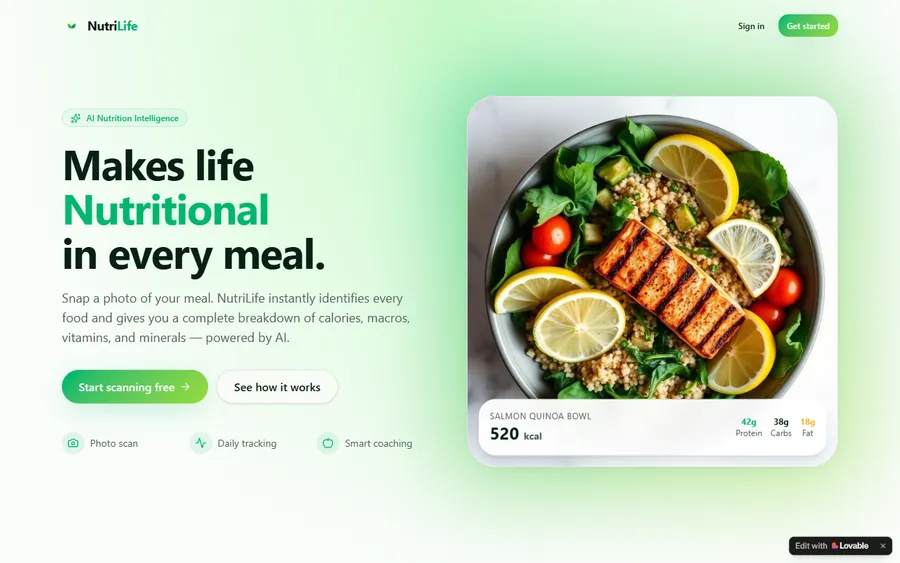
An AI nutrition coach that reads what you eat and works you toward a target.
AI and ML
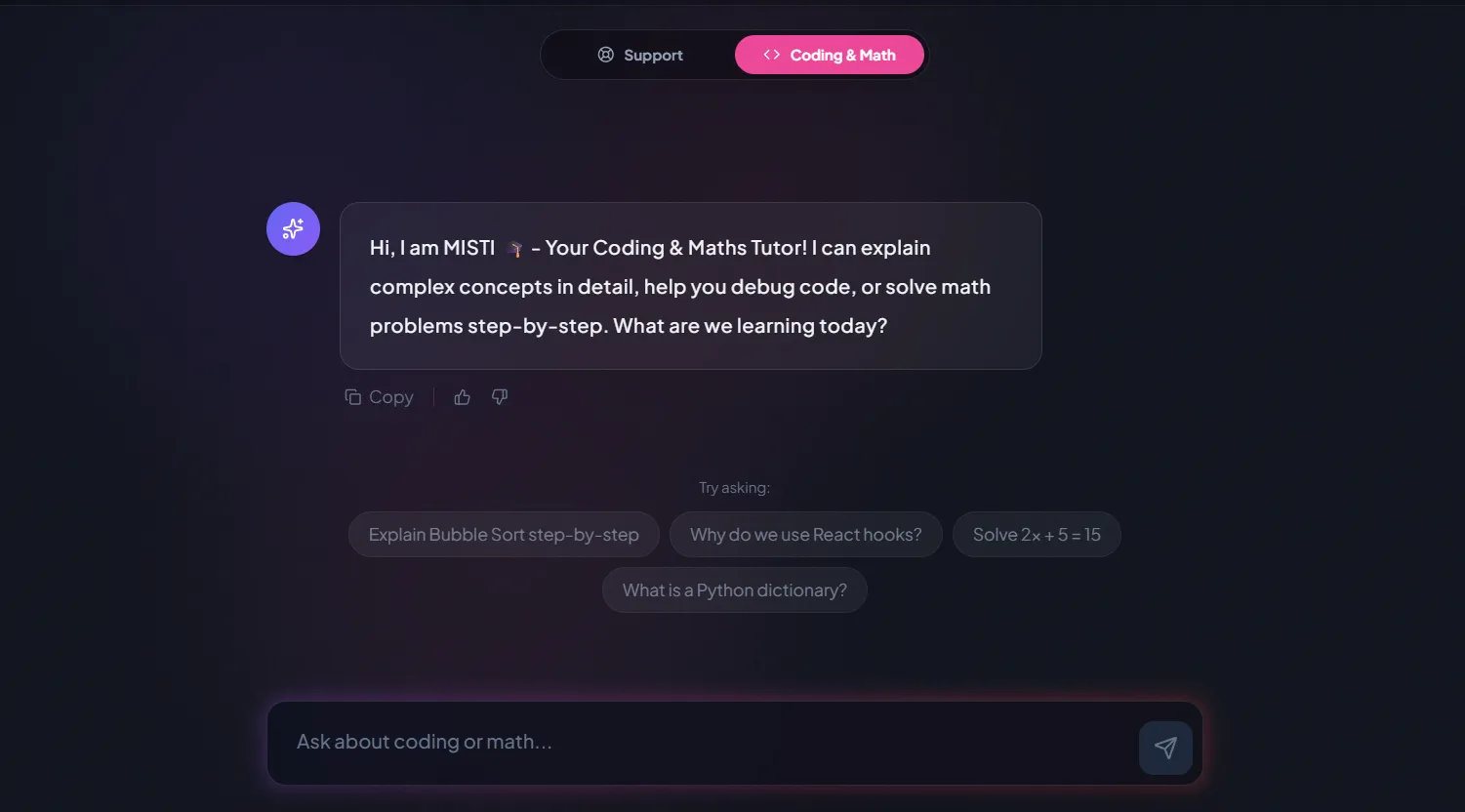
A chatbot that answers mathematics and programming questions, built and deployed by a student.

AI and ML
An assistant that helps a young person recognise unsafe situations online.
Web app
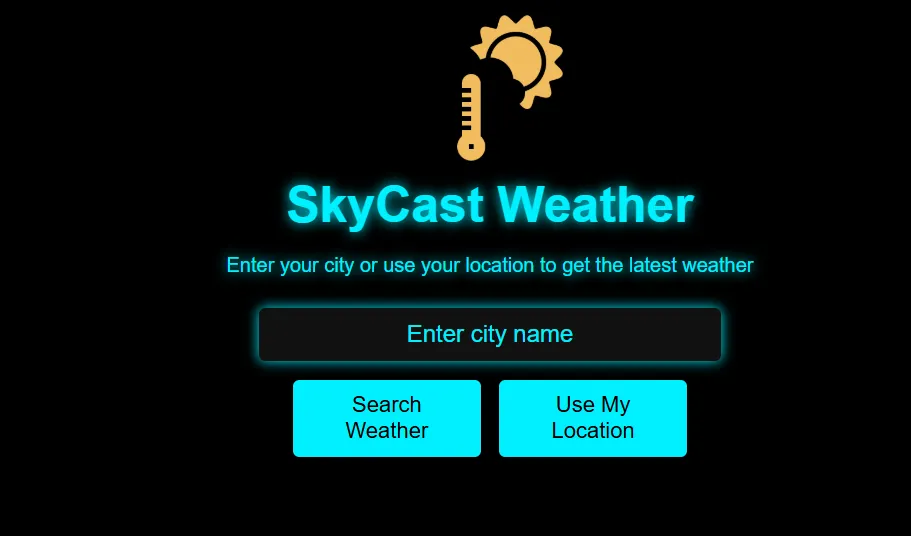
A weather forecasting site with live conditions for any location.
Fees
Billed monthly in US dollars at one rate for every country outside India, with nothing to sign up front and nothing to pay to join.
Free first class
USD 0
no card required
Group batch
USD 100
a month, billed in US dollars
One to one
USD 150
a month, billed in US dollars
What families say
Copied without edits from reviews that families and learners left for us on Google.
★★★★★
"The one step solution for my son. Modern Age Coders make learning coding so simple that kids love it. The teachers explain complex concepts clearly with practical exercises and interactive content."
Ria Mukherjee
Parent
★★★★★
"Modern Age Coders has been a game-changer for me. I struggled to grasp IT concepts and coding before joining, but their classes transformed everything. I can now confidently write complex programs with ease."
Samriddha Mondal
Student
★★★★★
"One of the most wonderful education centres out there. Education is not limited to school syllabus but focuses on skill development."
Vansh Agarwal
Student
★★★★★
"My child Dhairya is really enjoying the Modern Age Coders classes. This is his first online class and he eagerly looks forward to it. I can already see his improvement, and the teachers are very cooperative."
Sonam Oswal
Parent of Dhairya
★★★★★
"Modern Age Coders have wonderful teachers who teach in a clear, easy and practical way. The teacher boosts students' confidence and inspires them to learn without hesitation."
Sonu Goyal
Parent
★★★★★
"I highly recommend this computer coding class! The teachers are incredibly knowledgeable and passionate about coding."
Ritu Kedia
Parent
Manchester maths questions
Maths tuition is teaching outside school hours that follows the learner rather than a class: it finds the gaps, explains the ideas behind them and builds confidence step by step. Ours is live and online, in small groups of five to ten at one level or one to one.
There is no single right age. We teach from 6, when number sense and times tables are being built, and we also teach adults up to 67. The useful moment is when a learner first feels lost, before the gap grows.
Yes. We teach to the national curriculum for England and to whichever board the school uses, AQA, Edexcel or OCR, at Foundation or Higher tier, or to IGCSE where that is the course.
Yes. We teach the tables to 12 × 12 so that each fact can be rebuilt from another, which makes them stick. The check is statutory in Year 4 at state-funded schools in England.
Both. Sixth formers can add Further Maths topics alongside A level Maths, and keen younger pupils can work on UKMT-style problems in our competition maths course.
The mean shares the total equally; the median is the middle value when the data are in order. In our Metrolink data the mean gap is 952.9 metres and the median 819.5, because a few long gaps pull the mean up.
No. All lessons are live on video with a real teacher, so a learner anywhere in the city joins from home.
No. We teach carefully and report honestly on progress, but no tutor can promise a grade, and we do not.
Yes. We teach the GCSE content again at an adult pace, from whichever topic feels weakest. The entry is made through a college or exam centre, and we have no link with the NCETM, any Maths Hub or the university.
Nothing for the trial lesson. Ongoing places cost USD 100 per month in a small group or USD 150 per month one to one, with no joining fee and no minimum term.
Related
Our national maths pages by stage, and our coding page for the city.
Our national page on GCSE maths, by tier and board.
Pure, statistics and mechanics at sixth form.
Primary maths from Year 3 to the Year 6 tests.
Our page on coding for Manchester learners.
For families next door preparing for the Trafford test.
Our list of nations, cities, towns and maths pages.
Start here
Tell us the age or school year and which topic feels hardest. The trial is a proper lesson, and afterwards you get a frank account of where the learner stands.
Prefer to look around first? The course list and our note on teaching method are a good place to start.
WhatsApp us · +91 91233 66161 · connect@modernagecoders.com
Messages on WhatsApp get the fastest reply. The number has an Indian code because the team is in India; there is no UK office and every lesson happens online.
A priority demo is a full class of about 45 to 60 minutes. After the class the mentor sends a written skill report and a personal learning roadmap on WhatsApp. If you enrol, the demo fee is adjusted against your first month's fee. Share your demo Order ID with us on WhatsApp and we take it off.
Book a priority demo