Pick the course. Start this week.
Every mentor teaches from a structured programme, adapted live to your child. Open a course to see the full syllabus and enroll in minutes, or start with a Priority Demo and let the diagnostic pick the level for you.
 Best fit
Elementary Mathematics Masterclass
Counting to advanced problem solving: number sense, fractions, geometry and word problems, built concrete-first.
$100/mo group · $150/mo 1-on-1
View course & enroll
Middle School Mathematics Mastery
Ratios, negatives, algebra and geometry: the make-or-break years, taught for genuine ownership.
$100/mo group · $150/mo 1-on-1
View course & enroll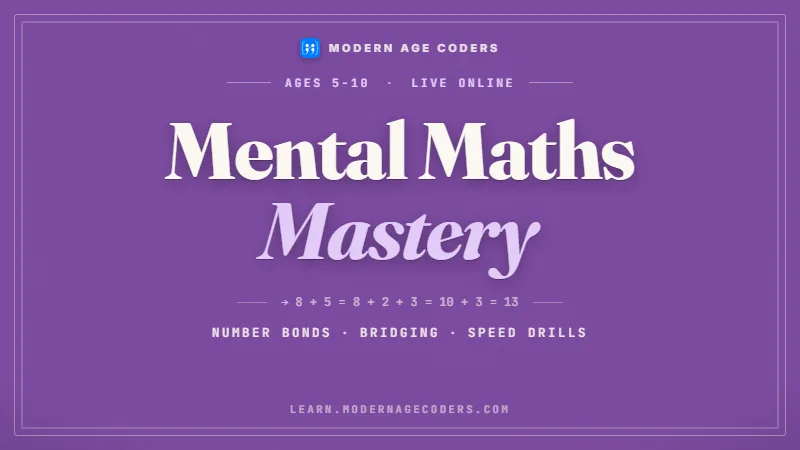
Mental Maths Mastery for Kids
Number sense, not tricks: bonds, strategies and estimation built into speed that never expires.
$100/mo group · $150/mo 1-on-1
View course & enrollThe Singapore Math method teaches every idea three times: with objects (concrete), with drawings, especially bar models (pictorial), and only then with symbols (abstract). It covers fewer topics per year and takes each to mastery. It works, Singapore's students have topped international math rankings for decades, but it needs a teacher trained to run the progression, not just a workbook. We provide that teacher: live 1-on-1 or small group, priced in your currency, 8 one-hour classes, Priority Demo first.
You bought the famous workbooks. The magic did not come in the box.
Singapore Math earned its reputation honestly. In international assessments like TIMSS and PISA, Singapore's students have sat at or near the top of the world in mathematics for decades, and the curriculum behind that result, developed by Singapore's Ministry of Education from the 1980s onward, became the most studied math teaching approach on earth. American and European publishers adapted it; homeschoolers adopted it; whole school districts converted.
Then families meet the gap. The workbooks are excellent, but the method's engine is not on the page, it is in the teaching moves: when to put blocks in a child's hands, when to move to a drawing, how to ask the question that makes the child build the bar model rather than watch one being built.
So a parent sits with the book, reaches a bar-model word problem, and hits the honest wall: they were never taught this way themselves. They solve it with algebra, the child copies without understanding, and the whole point, the child seeing the structure, quietly dies on the kitchen table.
That is the exact gap this program fills. Our mentors teach mathematics through understanding-first, concrete-before-abstract progression as a matter of philosophy, it is how we teach everything, and for families who want the Singapore method specifically, they run the full CPA progression live: real teaching, real questioning, real mastery checks, with the workbooks you already own folded in if you like.
Five pillars, not one workbook.
1 · CPA progression
Concrete, Pictorial, Abstract: every idea starts in the hands, moves to a drawing, and only then becomes symbols. Rooted in Jerome Bruner's research on how understanding forms.
2 · The bar model
The signature pictorial tool: quantities drawn as bars, so word problems become visible structure. It carries children from arithmetic all the way to the edge of algebra.
3 · Mastery over coverage
Fewer topics per year, taught deeper, not revisited annually in a spiral of forgetting. A topic is finished when the child can solve, explain and extend it.
4 · Number bonds & mental math
Numbers taught as decomposable (8 is 5 and 3, 10 needs 2 more), building the mental arithmetic that makes everything downstream fluent.
5 · Problem solving at the center
Word problems are not the dessert after computation practice; they are the curriculum's heart, where all the tools earn their keep.
What it is not
Not a brand, not a single publisher, not drill sheets with a flag on the cover. It is a philosophy of how mathematical understanding is built, and it requires teaching.
The bar model, on a problem that defeats most 4th graders.
Maya has $30 more than Jon.
How much does Jon have?
Without the method: most children guess-and-check, or grab the tempting wrong answer ($120 - $30 = $90, "Jon has $90!"). The relationships are invisible, so the child gambles.
With the bar model: the mentor asks the child to draw Jon's money as a bar. Maya's bar is the same bar plus a $30 chunk. Two equal bars and a $30 chunk together make $120. Now the child can see it:
Maya: [=======][+$30]
two equal bars = $120 - $30 = $90
one bar (Jon) = $90 ÷ 2 = $45
Maya = $45 + $30 = $75 ✓ check: 45 + 75 = 120
No algebra, no formula memorized, and here is the quiet payoff: this drawing is the equation 2x + 30 = 120, met four years before algebra class. Children taught this way walk into algebra recognizing an old friend. That is what "teaching for mastery" buys.
Eight signs the Singapore method is what your child needs.
Procedures without understanding
Your child computes correctly but cannot explain why, and forgets each method weeks after the test.
Word problems cause instant surrender
Computation is fine; the moment math arrives dressed in a story, everything collapses. Bar models fix exactly this.
Counting on fingers past grade 2
Number bonds never formed, so every calculation starts from scratch instead of from known facts.
The school spiral never sticks
Topics fly past yearly, half-learned each time. A mastery approach closes chapters instead of endlessly reopening them.
You use Singapore workbooks at home
Dimensions, Primary Mathematics or similar, and you have hit the limit of what an untrained adult can teach from them.
You are homeschooling math
You chose a Singapore-style curriculum for good reasons and want a trained teacher running the hard parts.
A move to or from Singapore
Your child needs to join, or smoothly leave, a system that assumes bar models and mastery pacing.
A capable child who finds school math boring
The method's depth, one problem, many routes, explain your thinking, is exactly what under-challenged children are missing.
If several of these landed, a Priority Demo will show you, not tell you, whether this teaching fits your child.
The CPA progression, live on a shared screen.
Concrete, digitally and at home
Virtual manipulatives on a shared board, plus the humble real things, coins, blocks, paper strips, your child holds up to the camera. Concrete means concrete.
The child draws the model
The mentor's discipline: never draw the bar model for the child. Questions lead the pencil; the understanding belongs to the one holding it.
Mastery checks before moving on
Solve it, explain it aloud, then extend it to a twist you have not seen. Three passes, then and only then, the next topic.
Number-bond fluency work
Short daily-style mental math woven into every hour, decompose, make ten, compensate, until fluency is a habit, not an event.
Your curriculum, folded in
Using Dimensions, Primary Mathematics, math mastery school texts, or nothing at all: the mentor aligns with what your child already has.
One mentor, compounding
The same teacher every class learns exactly where your child's understanding thins, and plans each hour against it.
What the method covers, stage by stage.
Mapped here in US grade terms for familiarity; the mentor meets your child at their actual stage, not their age, because in a mastery system the stage is what matters.
| Stage | Core territory | The signature tools at work |
|---|---|---|
| Early (K-2) | Number sense to 100, addition and subtraction as one family, early measurement and shapes | Number bonds everywhere; part-whole thinking; concrete materials doing the heavy lifting |
| Middle (3-4) | Multiplication and division to mastery, fractions as numbers (not pizza slices), area, two-step word problems | The bar model arrives in force: part-whole and comparison models turn word problems into pictures |
| Upper (5-6) | Fraction and decimal operations, ratio and percentage, rate, volume, angles, complex multi-step problems | Before-and-after bar models, branch models; problems that quietly rehearse algebra without the symbols |
| Bridge (6-8) | Negative numbers, early algebra, proportionality, the handover from models to symbols | Bar models translated into equations side by side, so algebra arrives as notation for ideas the child already owns |
The through-line: at every stage the child can draw what the numbers are doing. That single capability is the method's genuine export, and it transfers to any school system in the world.
A before-and-after problem, where bar models beat algebra for speed.
After Priya gave Sam $20, they had equal amounts.
How much did Priya start with?
The algebra route (fine, but heavy for an 11-year-old): let Priya have 3x, Sam have x, solve 3x - 20 = x + 20.
The bar model route: draw Priya as three units, Sam as one. Equal endings mean each must finish with two units. Priya gave away one unit's worth, and that unit was the $20.
After: Priya [u][u] Sam [u][u]
the moved chunk = 1 unit = $20
Priya started with 3 units = $60 ✓ check: 60-20 = 40 = 20+20
Ten seconds of drawing replaced an equation, and, more importantly, the child can defend every step. When algebra formally arrives a year later, x is just the unit bar with a new name. This is why the method's students transition into secondary math so smoothly.
From diagnostic to visible mastery.
Class 1 · The Priority Demo diagnostic
A real lesson that doubles as a stage check: where is number sense, where do word problems break, has the child ever met a bar model?
Weeks 1-3 · Number bonds and the first models
Mental-math foundations refreshed at the right stage while part-whole bar models make their first appearance on problems the child can nearly do.
Weeks 4-8 · The word-problem turn
Comparison models, two-step problems, and the habit that changes everything: draw before you calculate. Parents usually notice the confidence shift here.
Months 3+ · Mastery pace
Topic by topic up the ladder, each closed properly: solve, explain, extend. School results follow as a side effect of actual understanding.
Ongoing · The handover to algebra
For older children, models and symbols run side by side until the symbols stand alone, the method's graduation moment.
What one full hour of method teaching looks like.
Every class is a full 60 minutes, live and interactive, the format the method actually requires, because CPA teaching is a dialogue, not a broadcast:
0-10 min · Number-bond warm-up
Quick-fire mental math at the child's stage: make ten, doubles, compensation. Fluency built in small daily doses.
10-35 min · New idea, run through CPA
Concrete materials first, the child's own drawing second, symbols last, with the child talking through every step.
35-50 min · Problems that earn the tools
Word problems where today's model does real work, attempted solo, then unpicked together question by question.
50-60 min · Explain-back and extend
The child teaches the idea back, then meets one twist. What survives explaining is what is actually learned.
Children wait for these classes. Not because math became easy, but because understanding feels good and the hour is genuinely theirs. A Priority Demo lets you watch it happen. See exactly how we teach →
Who this genuinely fits, and who it does not.
A strong fit if…
• Your child computes without understanding, or word problems are the wall, the two gaps this method was built to close.
• You are homeschooling with Singapore workbooks, or your school uses a mastery curriculum, and you want a teacher trained in the actual method.
• Homework has become a nightly negotiation and you want a calm expert to take over the teaching.
• You want one mentor who knows your teen, not a rotating cast or an app with streaks.
Honestly not the fit if…
• Your child cannot yet engage with a screen and a teacher for a full hour. By grade 4 nearly every child can, provided the hour is genuinely interactive, and ours are, and the concrete materials on screen usually win over even the youngest holdouts.
• You want homework done for the child. We teach the child to do it, which is slower on night one and far faster by week four.
• You want a quick score patch for next week’s test. Mastery teaching is the opposite trade: slower in week one, dramatically ahead by month three, and we will say so upfront.
The courses behind the tutoring.
Every mentor teaches from a structured curriculum, adapted live to your child. If you prefer to see the full syllabus before you start, these are the programmes Singapore-method families join, matched to stage.
Premium teaching. One honest price.
You are paying for a real teacher, live, for a full hour, twice a week, the same format US tutoring centers charge $300 to $450 a month for. Our cost base is global, so the price is not.
1:1 Private Mentorship
$150 / month
- 8 live one-hour classes a month, 2 per week4 live one-hour classes a month, 1 per week
- A dedicated mentor who knows your child by name
- Diagnostic-led plan up the full mastery ladder
- Class recordings for revision · cancel any time
Small-Group Class
$100 / month
- 8 live one-hour classes a month, 2 per week
- A handful of children at the same level
- Same teaching method, gentle peer energy
- Recordings included · cancel any time
That is $18.75 per dedicated hour of 1-on-1 teaching, or $12.50 in a small group. No registration fee, no contract, and you can see a full class first with a Priority Demo. Read our zero-risk promise or compare with what US math tutoring costs in 2026.
Mentors who teach the why, in classes kids wait for.
Our mentors are trained in one method: understanding before procedure, concrete before abstract, the child talking more than the teacher. They teach both maths and coding, which matters more than it sounds, because a mentor who can turn "4 groups of 6" into a game your child wants to build has engagement tools a worksheet never will.
And because the same mentor stays with your child month after month, teaching compounds. They know that your daughter rushes when unsure, that your son shuts down after two wrong answers, and exactly which idea to revisit before it becomes a gap.
"My child Dhairya is really enjoying the classes. This is his first online class, and he eagerly looks forward to it. I can see his improvement."
Sonam Oswal, mother of Dhairya · verified Google review
"My son struggled with math for years. Integrating it into coding projects has transformed his understanding and confidence. Highly recommended!"
Shewta Singh, mother of Ishan · verified Google review
Your real options for Singapore-method teaching.
| Option | Typical cost | What it really is | Best for |
|---|---|---|---|
| Modern Age Coders | $100–$150 / month | 8 live one-hour classes with a mentor running the full CPA progression, your workbooks folded in | Families who want the actual method taught, not just its worksheets assigned |
| Workbooks alone | $50-$150 / year | Excellent materials with the teaching moves missing; parent becomes the untrained teacher | Confident parent-teachers with time and a math background |
| Singapore-brand online programs | $100-$300 / month | Video lessons plus exercises; strong content, but nobody watches your child think | Self-driven older students who mainly need structure |
| Local tutor with the workbook | $40-$100 / hour | Often teaches their own school method off Singapore pages, which defeats the purpose | When you have verified the tutor is genuinely method-trained |
| Kumon | $150-$220 / subject / month | Daily drill worksheets, the philosophical opposite of mastery-with-understanding | Pure calculation-speed building |
Competitor figures are typical published US prices as of July 2026. See our full comparisons: vs Kumon · what US math tutoring costs · best online math tutoring 2026.
Everything families ask about Singapore Math tutoring.
What exactly is the Singapore Math method?
The teaching approach developed by Singapore’s Ministry of Education from the 1980s: every concept moves Concrete to Pictorial to Abstract, word problems are modeled with bar drawings, numbers are taught as decomposable bonds, and the curriculum covers fewer topics per year to genuine mastery. It is a philosophy of how understanding forms, not a workbook brand.
Does it actually work, or is it hype?
Singapore’s students have ranked at or near the top of international mathematics assessments such as TIMSS and PISA for decades, which is why the approach has been studied and adapted worldwide. No method is magic, the results come from consistent mastery teaching, but the track record is as solid as it gets in math education.
What is a bar model and why is it such a big deal?
A way of drawing quantities as rectangular bars so their relationships become visible: part-whole, comparison, before-and-after. It turns word problems, the place most children break, into pictures a child can reason about, and it quietly rehearses algebraic structure years before algebra. It is the single most transferable tool in the method.
My child is at a regular school. Will this conflict with their classwork?
No, it runs underneath it. Understanding-first teaching makes school methods make sense rather than competing with them; a child who can draw what the numbers are doing handles any textbook’s procedure. Mentors also align homework support with your school’s expectations so nothing clashes.
We homeschool with Dimensions / Primary Mathematics. Can you teach from our books?
Yes, happily. The mentor folds your existing curriculum into the classes, teaches the lessons that need a trained teacher, and leaves you the practice layers. Many of our method families are homeschoolers who wanted exactly this division of labor.
What age range does this suit?
Roughly ages 5 to 13, kindergarten through the bridge into algebra, with the sweet spot at grades 1-6 where the CPA progression and bar models do their deepest work. Older students with understanding gaps also benefit: mastery repair works at any age.
Is my child too far behind, or too advanced, for a mastery approach?
Neither is possible, which is the approach’s quiet strength. The diagnostic finds the actual stage and teaching starts there: behind means gaps get closed properly for the first time; advanced means depth and extension instead of racing ahead on thin ice.
How is this different from how you teach math anyway?
Honestly, not by much, which is exactly why we offer it. Understanding before procedure, concrete before abstract, the child explaining rather than watching: that is our house method for all mathematics teaching. This program adds the specific Singapore toolkit, bar models, number bonds, mastery pacing, run faithfully for families who want the method by name.
What does it cost?
The fees for private 1-on-1 and small-group classes are shown in your own currency in the pricing section of this page. Billing is monthly, there is no contract and you can cancel any time.
Do you follow the actual Singapore MOE syllabus?
For families in or moving to Singapore, yes, we align with MOE syllabus stages and PSLE expectations on our dedicated Singapore tuition track. For everyone else, we teach the method mapped to your school system’s grades, which is what most international families actually need.
Can we try a class before enrolling?
Yes. Book a Priority Demo: a full live class of about 45 to 60 minutes, today or tomorrow, with a mentor reserved for your child. After the class the mentor sends a written skill report and a personal learning roadmap on WhatsApp. If you enrol, the demo fee is adjusted against your first month's fee.
More math help from Modern Age Coders.
Watch one full hour of real teaching. Free.
Book the demo class. Your child gets a real lesson with a real mentor, you get a stage diagnostic and a live look at CPA teaching, one full hour, free. If your child does not leave the hour lighter about math, walk away with our thanks.
Real student projects
What our students actually build
Every one is a real, live project shipped by a Modern Age Coders student. Explore more in Student Labs.
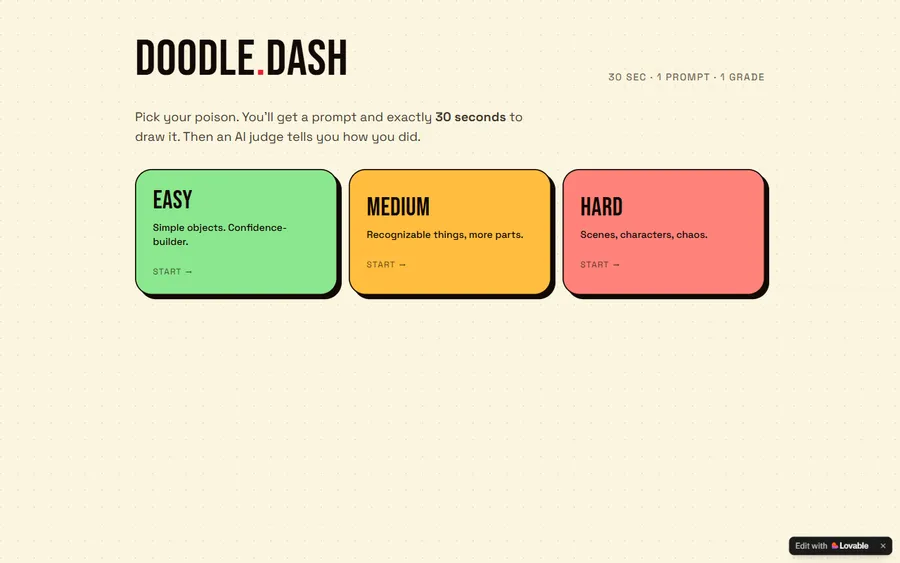 GameDoodle Dash: 30-Second Drawing ChallengePick a difficulty, get a prompt, and you have exactly 30 seconds to draw it, then an AI judge scores how close you got. Three modes from easy objects to chaotic scenes. Shubh vibe-coded it idea-first, wiring real AI image grading into a fast, addictive drawing game.by ShubhOpen the live project ↗
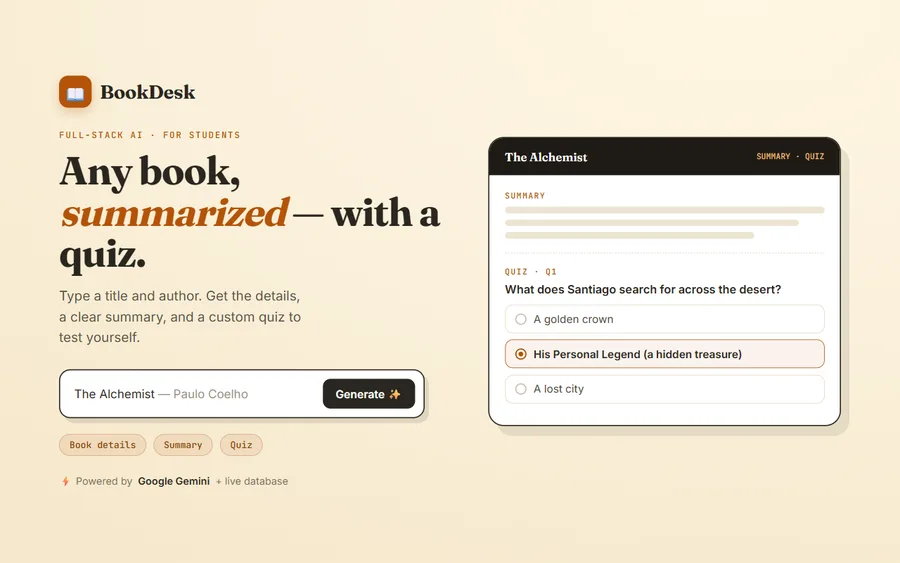 AI & MLBookDesk: AI Book Summaries & QuizzesType in any book name and author, and BookDesk pulls together the book's details, a clear summary and a custom quiz to test what you've learned, a genuinely useful study companion. Anika built it as a full-stack AI application, powered by Google Gemini with a live database behind it.by AnikaOpen the live project ↗
 AI & MLHairSync: AI Hairstyle Try-OnUpload a clear photo and try on any hairstyle before you commit, wolf cuts, curtain bangs, fades, braids and dozens of trending looks, rendered onto your own face by AI in seconds. Kriti vibe-coded this virtual try-on studio from a single idea into a working app.by KritiOpen the live project ↗