MLE / A1
Primary maths
Years 1 to 6, ending with SATs reasoning.
Open the syllabusLeeds · Maths for everyone from 6 to 67 · Taught live online
Walk around Headingley, Hyde Park or Burley and sooner or later you meet a hill. We measured how steep those hills are. Using open map data and a European height model, we worked out the average gradient of 124 streets in that corner of north-west Leeds. The steepest, Argie Road, climbs 29.7 metres in 321 metres: a gradient of 9.26%, or 1 in 10.8, or an angle of 5.29 degrees. Three ways of writing one hill, and GCSE learners need all three. This page shows how our online maths tutors teach Leeds learners, from the Year 4 multiplication check through GCSE and A level to Further Maths and adult maths, starting with the city's own slopes.
A maths page for Leeds · Primary, secondary, sixth form and adults · Unconnected with any Leeds school, college or university
How does maths tuition in Leeds work with Modern Age Coders?
Leeds learners study maths with us live on video, at any age between 6 and 67, either in a level-matched class of five to ten or one to one. For primary children that means times tables in time for the Year 4 check, KS2 maths and the reasoning in Year 6 SATs maths. Secondary pupils follow KS3 maths into GCSE, on AQA, Edexcel or OCR at foundation or higher tier, or IGCSE. Sixth formers take A level Maths, often with Further Maths, and adults join for Functional Skills maths, a GCSE maths resit or a confidence refresher. Real data runs through every course; in Leeds we use the gradients of 124 streets around Headingley and Burley, the steepest of which rises 1 in 10.8. Lessons start with a free trial, then cost USD 100 a month in a group or USD 150 a month one to one.
Leeds favourites
GCSE, A level and primary maths make up most Leeds enquiries. Everything else is in the catalogue lower down.
LDS / 1
AQA, Edexcel or OCR, foundation or higher, with gradients and trigonometry tested on real Leeds hills.
Open the syllabus →
LDS / 2
Sixth form maths in three strands, where a slope becomes a derivative and a block on an incline becomes mechanics.
Open the syllabus →
LDS / 3
Times tables, measures and fractions, building towards the reasoning in Year 6 SATs maths.
Open the syllabus →Age 6 to adult
Leeds schools follow the national curriculum for England. The table shows the stages a Leeds learner passes through and what our lessons concentrate on at each; adults simply start where they need to.
| Stage | Years | Where we focus |
|---|---|---|
| KS1 | 1 and 2 | Counting, number bonds, measuring length and height in metres and centimetres. |
| KS2 | 3 to 6 | Times tables for the Year 4 check, fractions, scale and the reasoning questions of Year 6 SATs. |
| KS3 | 7 to 9 | Ratio, percentages, straight-line graphs and the first meaning of gradient. |
| GCSE | 10 and 11 | Foundation or higher tier on AQA, Edexcel or OCR: gradients, Pythagoras and right-angled trigonometry. |
| A level | 12 and 13 | Pure, statistics and mechanics, from differentiation to forces on slopes; Further Maths if chosen. |
| Adults | Any age | Functional Skills maths, GCSE maths resits and refreshers for life and work. |
The multiplication tables check is taken in Year 4 at every state-funded school in England. We teach the tables so they connect: 6 × 12 is double 6 × 6, and a child who notices patterns like that recovers quickly from a blank moment.
Year 6 SATs maths includes plenty of measures and scale. A child who can say that 30 metres in 300 is the same as 1 in 10 has, without knowing it, met gradient, and we make that connection deliberately.
We teach GCSE to the learner's own board and tier. Gradient appears twice at GCSE, once in graphs and once in trigonometry, and the hill project below joins the two up.
Our national pages cover each stage in more depth: KS2, KS3, GCSE, IGCSE, A level and Further Maths.
About the Year 4 check: gov.uk, as read on 1 October 2026. The year groups shown are standard for English schools.
The Leeds project
Gradient is rise divided by run. To measure it for real streets you need two things: how long each street is, and how high each end sits. Both are freely available.
On 1 October 2026 we downloaded every named residential and local road in a rectangle of north-west Leeds that takes in Headingley, Hyde Park, Burley and Woodhouse and reaches the southern edge of Meanwood. Where a street is mapped in several pieces we joined them, and kept the 124 streets at least 250 metres long.
For the two ends of each street we looked up the ground height in EU-DEM, a European height model with a 25 metre grid. The heights across the area run from 36.2 metres to 118.6 metres above sea level.
The average gradient of a street is then its height difference divided by its mapped length. Half the streets have an average gradient below 2.18%, and 25 of them rise less than 1%. At the other end, 15 streets average more than 5%.
Two cautions matter. First, this is an average from end to end: a street that dips and rises can have a short section far steeper. Second, a 25 metre height grid smooths out small bumps, so short, steep pieces are blurred. Both are useful things for a student to say about any measurement.
| Street | Length | Height gained | Gradient | As 1 in n |
|---|---|---|---|---|
| Argie Road | 321 m | 29.7 m | 9.26% | 1 in 10.8 |
| Woodside View | 401 m | 32.1 m | 8.02% | 1 in 12.5 |
| Buckingham Road | 261 m | 20.4 m | 7.81% | 1 in 12.8 |
| Richmond Avenue | 320 m | 23.7 m | 7.38% | 1 in 13.5 |
| Woodsley Road | 528 m | 35.4 m | 6.70% | 1 in 14.9 |
| Church Lane | 713 m | 45.5 m | 6.38% | 1 in 15.7 |
At the flat end of the list, Stainbeck Avenue rises only 0.02% across 364 metres: its two ends sit at almost exactly the same height. That does not mean it is flat all the way along; it means the climb and the fall cancel out, which is the first caution above in action.
Data: OpenStreetMap contributors, one Overpass query on 1 October 2026; heights from OpenTopoData, EU-DEM v1.1, produced with funding from the European Union (Copernicus). Lengths, heights and gradients are Modern Age Coders' calculations and are not official road gradients.
From a ratio to an angle
The DfE asks GCSE learners to "interpret the gradient of a straight line graph as a rate of change". A hill is exactly that: height gained per metre travelled.
| Form | Working | Result |
|---|---|---|
| Rise over run | 29.7 ÷ 321 | 0.0926 |
| Percentage | 0.0926 × 100 | 9.26% |
| Ratio, 1 in n | 321 ÷ 29.7 | 1 in 10.8 |
| Angle, using tangent | tan⁻¹(29.7 ÷ 321) | 5.29° |
| Angle, using sine (if 321 m were the slope length) | sin⁻¹(29.7 ÷ 321) | 5.31° |
A gradient of 9.26% sounds gentle and an angle of 5.29 degrees sounds tiny, yet anyone who has cycled up a road like Argie Road knows it is hard work. The numbers are not wrong: they show how sensitive our legs are to small angles.
Students are often surprised that a 45 degree slope is a gradient of 100%, because rise equals run. Very few roads come close. Seeing the real figures for local streets fixes that sense of scale for good.
Strictly, gradient is rise over horizontal distance, which uses tangent. If you measure the length along the slope instead, you need sine. For Argie Road the two angles differ by only 0.02 degrees, 5.29 against 5.31.
That near-equality is no accident. For small angles, sine and tangent are almost the same, and an A level learner can show why with a diagram or a series expansion. It is also why a map length and a walking length differ so little on most roads.
Each stage takes something different from this. Primary children compare the heights and lengths and order the streets from steepest to flattest. KS3 learners calculate the percentages. GCSE students use tan⁻¹ to find the angles and discuss the caution about averages. A level students treat the street as a function of height against distance and ask where its derivative is largest.
All values are Modern Age Coders' calculations from the street lengths and heights above. GCSE wording: DfE, GCSE mathematics subject content.
Maths around Leeds
Leeds schools are part of a regional maths network, and the university runs public events. We describe their own public pages here; we are not involved in either.
The NCETM page names Trinity Academy, Halifax, as lead school of the West Yorkshire Maths Hub, which works with schools in Bradford, Calderdale and Leeds.
The University of Leeds describes Be Curious as its "annual family-friendly research open day with fun activities, challenges and inspiring talks".
The same page lists interactive events at Leeds Festival of Science, Leeds Light Night, Pint of Science and Soapbox Science, and summer schools for Year 12 students.
Maths Hubs support teachers and schools rather than families, so their work is seen in the classroom. Competitions also come through school: our UKMT maths challenge page describes how we prepare learners for the individual challenges.
For learners who want a timetable of contests, the UK competitions calendar lists maths and coding events by age group.
Some families in Leeds look at the selective schools of a neighbouring area. Our 11 plus maths page for Calderdale describes the test used there, and our 11 plus maths course covers the common formats.
Every lesson is online, so learners in Horsforth, Roundhay or Armley join from home. We group by level, which means a Leeds learner might share a class with someone in Bristol or Sheffield.
Sources: NCETM, West Yorkshire Maths Hub; University of Leeds, School of Mathematics, outreach and public engagement. Both read 1 October 2026. We are independent of the NCETM, the hub, the University of Leeds and all Leeds schools.
Adults
Adults are a large share of our Leeds learners. Some need a maths pass for a course or a job; some want to support their children; some just want to stop dreading numbers.
The GCSE course accepts adult resit candidates. A short check of what is secure comes first, so lessons go straight to the topics that matter for the mark.
Practical maths for work and training, from measures to data. Our Functional Skills maths page explains how it runs.
Percentages, ratio, graphs and basic trigonometry at an adult pace. More on our adult maths page.
The gradients project is a favourite with adult learners, especially cyclists and anyone who walks to work. Being able to turn "that hill nearly killed me" into "that hill averages 1 in 10.8" is a small, satisfying piece of mathematics that people tend to remember.
Steps up
These steps lead to the gradient work on this page. The free lesson tells us where a new learner should join the climb.
| Usually | Step | Ready to move on when the learner |
|---|---|---|
| Years 3 and 4 | 1. Measures | Knows the tables and converts between metres and centimetres |
| Years 5 to 7 | 2. Ratio and percentage | Writes 30 out of 300 as 10% and as 1 in 10 |
| Years 8 to 10 | 3. Graphs | Finds the gradient of a straight line and says what it means |
| Years 10 to 13 | 4. Trigonometry | Uses tan, sin and cos to move between a slope and its angle |
A learner joining late in GCSE can still make strong progress once ratio and algebra are secure, so those come first.
If the time left is not enough to close the gap, we say so honestly after the free lesson.
Many learners continue to A level Maths, often with Further Maths. Data lovers move on to our statistics and probability course.
Others rebuild the street gradients in Python using maths through coding.
Catalogue
Grouped by stage, from first numbers to degree-level maths.
MLE / A1
Years 1 to 6, ending with SATs reasoning.
Open the syllabusMLE / A2
Number sense and shape for young starters.
Open the syllabusMLE / A3
Calculating in the head with confidence.
Open the syllabusMLE / A4
Timed practice for selective school tests.
Open the syllabusMLE / B1
Ratio, graphs and algebra in Years 7 to 9.
Open the syllabusMLE / B2
Every board, both tiers, adult resits too.
Open the syllabusMLE / B3
For schools on the international papers.
Open the syllabusMLE / B4
Equations and graphs from the very start.
Open the syllabusMLE / C1
Calculus, data and forces for Years 12 and 13.
Open the syllabusMLE / C2
First-year degree topics.
Open the syllabusMLE / C3
Non-routine problems for UKMT and olympiads.
Open the syllabusMLE / C4
Data, chance and inference.
Open the syllabusMLE / D1
Statistics for analysts and managers.
Open the syllabusMLE / D2
Interest, mortgages and growth.
Open the syllabusMLE / D3
Using Python to explore slopes and data.
Open the syllabusMLE / D4
Speedy mental methods.
Open the syllabusLesson slots
Teaching runs on Indian Standard Time, which stays the same all year. From late March to late October, Leeds is four and a half hours behind; through the winter, five and a half. Slots are always confirmed in UK time.
After school, Monday to Friday
Primary and secondary learners.
Evenings, Monday to Friday
Sixth formers, resitters and adults.
Saturday or Sunday morning
Anyone who likes a weekend lesson.
The same person each week, so progress builds rather than restarts.
Brief, truthful updates after lessons on what to work on next.
Five to ten learners working at the same level.
Leeds streets and real numbers alongside past papers.
One to one for a learner who needs a sharper focus.
Methods are explained before they are practised.
Student work
Learners who began with measurement problems like the Leeds hills have gone on to build the projects below. More appear in the student labs.

AI and ML
An AI nutrition coach that reads what you eat and works you toward a target.
AI and ML
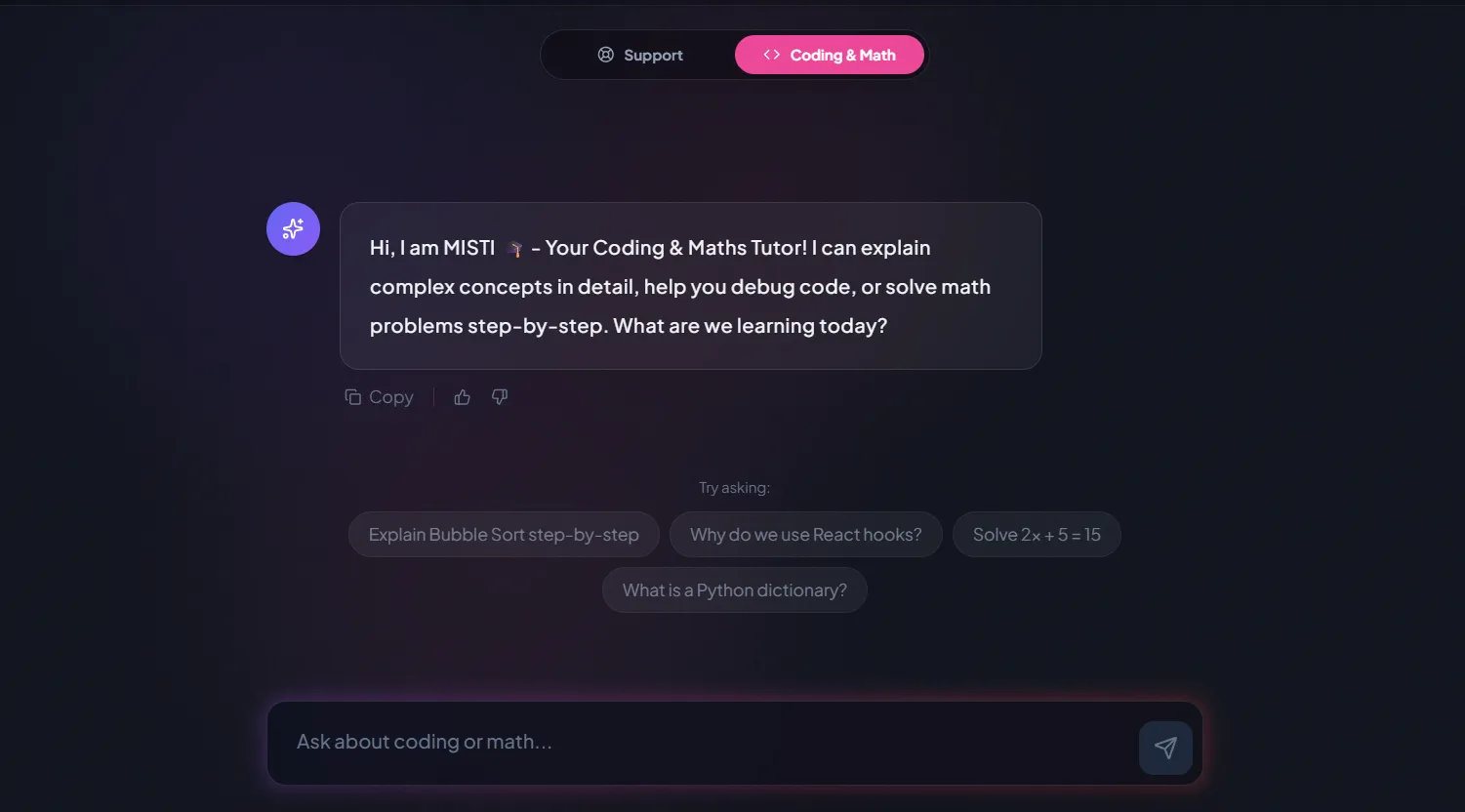
A chatbot that answers mathematics and programming questions, built and deployed by a student.

AI and ML
An assistant that helps a young person recognise unsafe situations online.
Web app
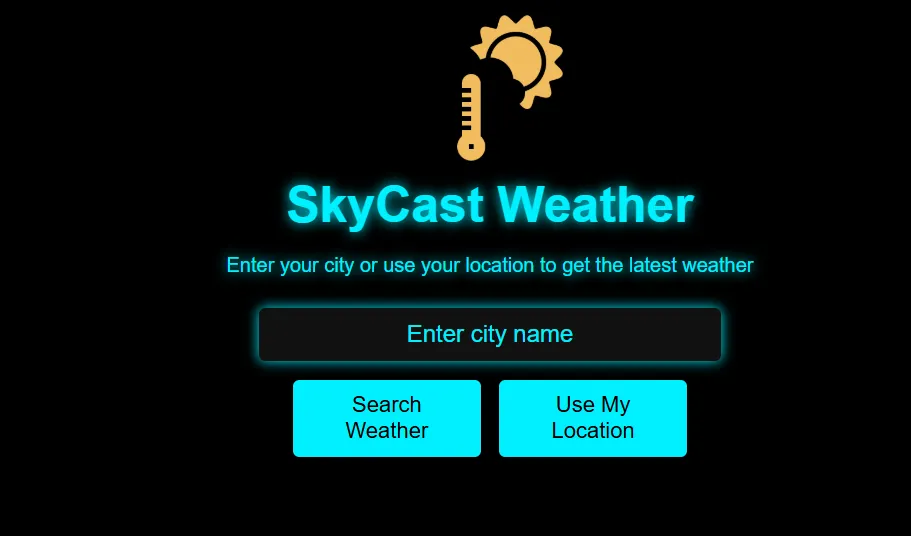
A weather forecasting site with live conditions for any location.
Fees
Monthly fees in US dollars, the same for every country apart from India. Nothing to pay to register and no contract.
Free first class
USD 0
no card required
Group batch
USD 100
a month, billed in US dollars
One to one
USD 150
a month, billed in US dollars
What families say
Families and learners in their own words, copied from Google without changes.
★★★★★
"The one step solution for my son. Modern Age Coders make learning coding so simple that kids love it. The teachers explain complex concepts clearly with practical exercises and interactive content."
Ria Mukherjee
Parent
★★★★★
"Modern Age Coders has been a game-changer for me. I struggled to grasp IT concepts and coding before joining, but their classes transformed everything. I can now confidently write complex programs with ease."
Samriddha Mondal
Student
★★★★★
"One of the most wonderful education centres out there. Education is not limited to school syllabus but focuses on skill development."
Vansh Agarwal
Student
★★★★★
"My child Dhairya is really enjoying the Modern Age Coders classes. This is his first online class and he eagerly looks forward to it. I can already see his improvement, and the teachers are very cooperative."
Sonam Oswal
Parent of Dhairya
★★★★★
"Modern Age Coders have wonderful teachers who teach in a clear, easy and practical way. The teacher boosts students' confidence and inspires them to learn without hesitation."
Sonu Goyal
Parent
★★★★★
"I highly recommend this computer coding class! The teachers are incredibly knowledgeable and passionate about coding."
Ritu Kedia
Parent
Leeds maths questions
With us, the first lesson is free. After that it is USD 100 a month for a group of five to ten learners at the same level, or USD 150 a month for one-to-one lessons. No registration fee and no fixed term.
A gradient of 10% means the ground rises 10 metres for every 100 metres you travel horizontally, which can also be written as 1 in 10 or as an angle of about 5.7 degrees. Argie Road in Leeds averages 9.26%, or 1 in 10.8.
For most learners it is, when lessons are live and the tutor can see the working as it happens. Our tutors follow every line on a shared board and pick up mistakes at once.
Yes. Our GCSE course is open to resit candidates of any age. We check which topics are secure, then concentrate where the marks are.
Yes, at foundation and higher tier, along with the IGCSE for learners at schools that enter it.
Yes. KS2 maths is taught in full, including the reasoning questions in the Year 6 papers and the tables practised for the Year 4 check.
Yes. Sixth formers taking Further Maths alongside A level Maths can study the extra content with us online, in a group or one to one.
Start from real slopes and triangles rather than from the formulas. When a learner sees that tan of an angle is simply rise over run, as on a Leeds street, sine and cosine become much easier to place.
No. We describe their public pages so families can find them, but we have no connection with either or with any Leeds school.
No. We teach carefully and report progress honestly, but no tutor can guarantee an exam grade.
Further reading
Maths guides by stage, coding in Leeds, and nearby maths pages.
How we teach GCSE by board and tier.
Our guide to sixth form maths.
The selective test used in Calderdale.
Our Leeds page for coding and AI.
Sheffield maths and its Supertram bearings.
All our UK places and maths pages.
Start here
Send us the learner's age or school year, the exam board if they have one, and which topic feels hardest. The first lesson is a real one, and you get a straight answer about where things stand.
Prefer to explore first? Browse the courses or our page on teaching method.
WhatsApp us · +91 91233 66161 · connect@modernagecoders.com
WhatsApp gets the quickest reply. The number has India's country code because our team is there; we have no Leeds office and teach everything online.
A priority demo is a full class of about 45 to 60 minutes. After the class the mentor sends a written skill report and a personal learning roadmap on WhatsApp. If you enrol, the demo fee is adjusted against your first month's fee. Share your demo Order ID with us on WhatsApp and we take it off.
Book a priority demo