LUM / A1
GCSE maths
Foundation and Higher for the main boards.
Open the syllabusLuton · Maths for ages 6 to 67 · Live online, groups or one to one
Anyone who has flown from Luton has seen the big white numbers painted at each end of the runway: 07 at one end, 25 at the other. Where do they come from? The official UK aeronautical publication gives the runway a true bearing of 074.38 degrees. That does not round to 07. It rounds to 07 only after you allow for the difference between true north and magnetic north, which the same publication puts at 1.23 degrees east. One painted number, and inside it sit bearings, rounding, decimals and a correction that most adults have never heard of. This page shows how we teach maths to Luton learners, from Key Stage 2 to A level and adult study, using that runway as our example.
A maths page only · From primary to A level and adult learners · Not affiliated with any Luton school or the airport
Maths tuition in Luton, quickly
We teach maths to Luton learners aged 6 to 67, live online. Primary pupils build number sense and tables on the way to the Year 6 SATs. In secondary school the work moves through KS3 to GCSE (Foundation or Higher, for AQA, Edexcel or OCR) or IGCSE. Sixth formers study A level, with Further Maths topics if they want them, and adults come to resit GCSE, to cover Functional Skills content or simply to feel at ease with numbers. A learner can study privately or in a class of five to ten at one level. Our Luton project explains the runway numbers: the UK aeronautical publication gives a true bearing of 074.38 degrees and a magnetic variation of 1.23 degrees east, so the magnetic direction is 073.15 degrees, which rounds to Runway 07. The opening lesson is free of charge. Continuing means USD 100 monthly for a shared class or USD 150 monthly for a teacher of your own.
The three most asked about in Luton
GCSE, A level and KS2 maths account for most first enquiries from Luton. Our other courses are listed below.
LTN / 1
Bearings, trigonometry and rounding sit on every GCSE paper; we teach them to the tier and board the school uses.
Open the syllabus →
LTN / 2
Vectors, radians and mechanics for sixth formers, with Further Maths topics for those who want them.
Open the syllabus →
LTN / 3
Times tables, place value and the reasoning that the Year 6 SATs ask for, built carefully from Year 3.
Open the syllabus →At every stage
Luton schools teach the national curriculum for England. This is how our lessons shift as a learner moves through it.
| Stage | Ages | Where we concentrate |
|---|---|---|
| KS1 | 5 to 7 | Counting, number bonds, simple shapes and turns. |
| KS2 | 7 to 11 | Angles measured in degrees, decimals to two places, every table up to 12, and the reasoning style of the SATs at the end of Year 6. |
| KS3 | 11 to 14 | Angle facts, bearings, rounding, ratio and the start of algebra proper. |
| GCSE | 14 to 16 | Both tiers for the three main boards; trigonometry and harder bearings for Higher. |
| A level | 16 to 18 | Pure, statistics and mechanics, and Further Maths topics on request. |
| Adults | 18 to 67 | Resitting GCSE, practical Functional Skills content, and numbers for the workplace. |
Primary children in Luton get most from us when they are secure with number. We teach the tables as a web of related facts, so 9 × 7 comes from 10 × 7 minus 7, and we keep checking them until they are automatic.
Angles first appear properly in KS2. A child who understands that a full turn is 360 degrees and a right angle is 90 is already halfway to the runway question on this page.
Bearings, rounding and trigonometry all arrive between Year 7 and Year 11, and they are often taught as separate tricks. We teach them together, because a real problem like a runway number needs all three at once.
Each stage has its own national page with us, starting at primary (KS2) and running through lower secondary (KS3), GCSE and A level to Further Maths tuition.
The age bands are the ones normally used in English schools. Details of the statutory tables check for Year 4 are published on the government website.
The Luton project
Two painted numbers, one official table and a rule written in a pilots' manual. Together they make a neat lesson in rounding.
NATS publishes the UK Aeronautical Information Publication, the official reference pilots use. Its entry for London Luton Airport, in the edition dated 1 October 2026, lists one runway, 2,162 metres long and 45 metres wide. It gives the direction of Runway 07 as a true bearing of 074.38 degrees and Runway 25 as 254.40 degrees.
True bearings are measured clockwise from true north, the direction of the North Pole. A compass does not point there. It points to magnetic north, and the publication says that at Luton the difference, called the magnetic variation, is 1.23 degrees east.
The rule for runway numbers is written in the Aeronautical Information Manual of the US Federal Aviation Administration: "The runway number is the whole number nearest one‐tenth the magnetic azimuth of the centerline of the runway, measured clockwise from the magnetic north." Azimuth here simply means bearing.
So the method is: change the true bearing to a magnetic one, divide by ten, and round to the nearest whole number. Every step is school maths.
| Step | Runway 07 end | Runway 25 end |
|---|---|---|
| True bearing (published) | 074.38° | 254.40° |
| Subtract the easterly variation, 1.23° | 073.15° | 253.17° |
| Divide by 10 | 7.315 | 25.317 |
| Round to the nearest whole number | 7 | 25 |
| Painted on the runway | 07 | 25 |
With an easterly variation, magnetic north lies 1.23 degrees clockwise of true north. A direction measured from magnetic north therefore reads 1.23 degrees less than the same direction measured from true north. With a westerly variation you would add instead.
This is the step most learners get backwards, and it is worth drawing: two north lines, a small angle between them, and the runway line crossing both.
The magnetic bearing 073.15 is 1.85 degrees away from 075, the point where rounding would tip it to 08. Turn the question round: if the variation had been more than 0.62 degrees west, the magnetic bearing would have been above 075.00, and the paint would say 08.
The publication also gives an annual change of 0.17 degrees east. Magnetic north moves, so a runway number is a rounded snapshot of something that drifts. We make no claim about past or future numbers at Luton; we only show the arithmetic.
Data: NATS, UK AIP, AIRAC 1 October 2026, EGGW AD 2.2 and AD 2.12; rule: FAA Aeronautical Information Manual, chapter 2, section 3. Both read on 1 October 2026. The working in the table is ours. This page is for maths teaching only and must never be used for navigation.
Checking the bearing ourselves
The publication also gives the latitude and longitude of the two runway thresholds. From those we can work out the bearing ourselves and see whether we agree.
The Runway 07 threshold is listed as 51° 52′ 19.25″ N, 0° 23′ 00.91″ W, and the Runway 25 threshold as 51° 52′ 37.36″ N, 0° 21′ 16.15″ W. To use them we first turn degrees, minutes and seconds into decimals: 51° 52′ 19.25″ is 51 + 52 ÷ 60 + 19.25 ÷ 3,600 = 51.872014 degrees.
Next we change the differences into metres. Going north, one degree of latitude is roughly 111.2 kilometres everywhere. Going east, one degree of longitude shrinks as you move away from the equator, by a factor of cos(latitude), about 0.618 at Luton.
Doing that, the second threshold lies 559.4 metres north and 1,997.7 metres east of the first. That is a right-angled triangle. The DfE content says GCSE learners should know the trigonometric ratios and "apply them to find angles and lengths in right-angled triangles". Here tan θ = 1,997.7 ÷ 559.4, so θ = 74.36 degrees from north.
The published figure is 074.38. A more exact method on a sphere gives 074.35. Our three answers agree to within 0.03 of a degree, which is a satisfying check on both the data and the method.
| Method | Bearing | Comment |
|---|---|---|
| Published true bearing | 074.38° | The official figure in the UK AIP. |
| Sphere formula | 074.35° | A level and beyond: great-circle bearing. |
| Flat triangle with cos(latitude) | 074.36° | GCSE trigonometry with one sensible correction. |
| Flat triangle, cos(latitude) forgotten | 080.19° | The slip: east distances come out too large. |
Treat a degree of longitude as if it were the same length as a degree of latitude, and the east distance comes out about 1.6 times too big. The bearing then comes out at 080.19 degrees. Subtract the variation and you get 078.96, which rounds to 08: a wrong runway number from one missing factor.
This is why we ask learners to estimate before they calculate. A runway that looks more east-north-east than east should not come out at 80 degrees.
The two thresholds are 2,074.6 metres apart by our calculation, less than the published runway length of 2,162 metres, because the threshold markings do not sit at the very ends of the paved runway.
The two published bearings, 074.38 and 254.40, differ by 180.02 degrees, not exactly 180. On a curved Earth the bearing at the far end of a straight path is very slightly different, a fact that A level students find surprising and satisfying.
Coordinates from the NATS UK AIP, EGGW AD 2.12. GCSE wording from DfE, GCSE mathematics subject content. All conversions, distances and bearings are Modern Age Coders calculations.
Maths around Luton
Public programmes and national papers a Luton family may hear about. We run none of them.
On the NCETM website, Luton appears among the council areas served by the Enigma Maths Hub, whose lead school is in Milton Keynes. Maths Hubs help teachers and schools; they do not teach children directly.
Each year many UK secondary schools put pupils in for the UKMT maths challenge papers, which favour thought over speed. Our approach to coaching for them is on the maths challenges page.
Every Year 4 pupil at a state-funded school in England takes the multiplication tables check. Our Year 4 practice page has more.
Learners who enjoy the runway puzzle usually enjoy competition problems, because both start with a simple-looking question and reward a careful look at what is really being asked.
Our competitions calendar lists national events by age, and the Intermediate Olympiad page covers the next round.
All lessons are live online, so a learner in Stopsley, Leagrave, Bury Park or Farley Hill joins from home. Classes are formed by level, so classmates may live in Milton Keynes or Manchester.
Adults who travel through the airport often find the runway question the most memorable maths they have done in years.
Hub information comes from the Enigma Maths Hub page on the NCETM site, checked on the first of October 2026. Modern Age Coders has no tie to the NCETM, any Maths Hub, the UKMT, London Luton Airport, NATS or any school in Luton.
Learning as an adult
Adults make up a real share of our learners. Many need a GCSE pass for work or study; others want to stop feeling anxious about numbers.
We rebuild the course from your weakest area, at a pace that fits round work. The exam is entered through a college or exam centre, and we prepare you for it.
Practical maths: measures, percentages, money, timetables and charts. Read more on our Functional Skills maths page.
Rounding sensibly, reading tables of figures and checking a calculation by estimating first, the same habits the runway project builds.
A common story from Luton adults: they were handed rules at school but never the reasons. We do the opposite, and the rules tend to stick as a result. Our adult maths page says more.
Steps we follow
Start wherever the learner is; the free lesson tells us where that is.
| Typical years | Step | Shows it has landed when the learner |
|---|---|---|
| Years 3 to 5 | 1. Turns and degrees | Knows a right angle is 90 degrees and a full turn 360 |
| Years 6 to 8 | 2. Bearings | Gives a bearing as three figures, measured clockwise from north |
| Years 8 to 10 | 3. Rounding with purpose | Rounds to the accuracy a question needs and explains why |
| Years 10 to 13 | 4. Trigonometry | Finds an angle from two sides and checks it with an estimate |
Learners who join us in Year 11 are welcome. We check angle facts and fractions first, because trigonometry questions usually fail there.
If there is more to rebuild than time allows, we say so honestly after the first lesson.
Learners who enjoy this often go on to maths through coding, where the bearing calculation becomes a few lines of Python, or to statistics and probability.
Those who love a puzzle tend to try competition maths.
Course list
First come the courses UK families look for most: GCSE, A level, 11 plus and IGCSE. Open a card to see its syllabus.
LUM / A1
Foundation and Higher for the main boards.
Open the syllabusLUM / A2
All three strands of the A level.
Open the syllabusLUM / A3
Selective-test maths for Years 5 and 6.
Open the syllabusLUM / A4
The international GCSE papers.
Open the syllabusLUM / B1
Years 1 to 6, ending with the SATs.
Open the syllabusLUM / B2
Arithmetic in the head, done reliably.
Open the syllabusLUM / B3
For children aged 6 and 7.
Open the syllabusLUM / B4
Bead-frame sums for younger learners.
Open the syllabusLUM / C1
Angles, bearings, algebra and ratio.
Open the syllabusLUM / C2
For algebra that never quite clicked.
Open the syllabusLUM / C3
Data handling and chance.
Open the syllabusLUM / C4
For learners entering UKMT challenges.
Open the syllabusLUM / D1
For adults returning to higher study.
Open the syllabusLUM / D2
Percentages, interest and costs.
Open the syllabusLUM / D3
Averages, spread and regression for analysts.
Open the syllabusLUM / D4
Pattern-based tricks for quick arithmetic.
Open the syllabusOur timetable
Teaching is done from India. In winter India runs 5 hours 30 minutes ahead of Luton, and from late March to late October the gap is 4 hours 30 minutes. We always quote slots in UK time.
Weekdays from 4pm
Children in primary school or Years 7 to 9.
Weekday evenings
Exam-year pupils, sixth formers and working adults.
Weekend mornings
Learners of every age.
One teacher follows the learner, week after week.
A short note after lessons: what clicked, what to revisit.
Grouped by level so nobody is lost or bored.
Runway data, timetables and census figures as well as past papers.
One to one before an exam or for a particular gap.
We train learners to predict an answer before calculating it.
Student work
Learners who began with problems like this one went on to build the projects shown here. The student labs include many others.

AI and ML
An AI nutrition coach that reads what you eat and works you toward a target.
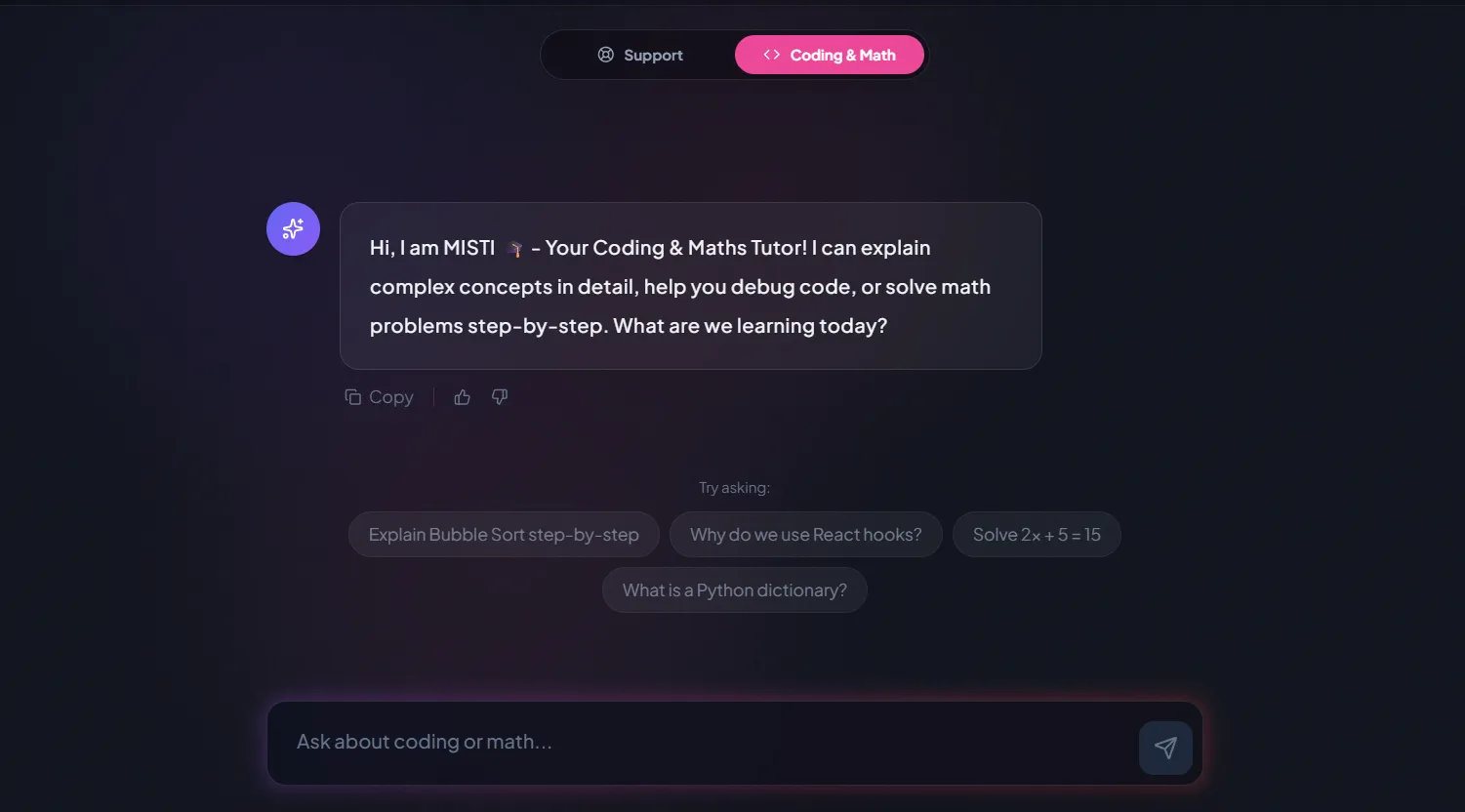
AI and ML
A chatbot that answers mathematics and programming questions, built and deployed by a student.

AI and ML
An assistant that helps a young person recognise unsafe situations online.

Web app
A weather forecasting site with live conditions for any location.
Fees
A single monthly price in US dollars for everyone outside India, with no registration fee and no lock-in.
Free first class
USD 0
no card required
Group batch
USD 100
a month, billed in US dollars
One to one
USD 150
a month, billed in US dollars
What families say
Copied exactly from reviews left on our Google profile by families and learners.
★★★★★
"The one step solution for my son. Modern Age Coders make learning coding so simple that kids love it. The teachers explain complex concepts clearly with practical exercises and interactive content."
Ria Mukherjee
Parent
★★★★★
"Modern Age Coders has been a game-changer for me. I struggled to grasp IT concepts and coding before joining, but their classes transformed everything. I can now confidently write complex programs with ease."
Samriddha Mondal
Student
★★★★★
"One of the most wonderful education centres out there. Education is not limited to school syllabus but focuses on skill development."
Vansh Agarwal
Student
★★★★★
"My child Dhairya is really enjoying the Modern Age Coders classes. This is his first online class and he eagerly looks forward to it. I can already see his improvement, and the teachers are very cooperative."
Sonam Oswal
Parent of Dhairya
★★★★★
"Modern Age Coders have wonderful teachers who teach in a clear, easy and practical way. The teacher boosts students' confidence and inspires them to learn without hesitation."
Sonu Goyal
Parent
★★★★★
"I highly recommend this computer coding class! The teachers are incredibly knowledgeable and passionate about coding."
Ritu Kedia
Parent
Luton maths questions
A bearing is a direction given as an angle measured clockwise from north, always written with three figures. East is 090 degrees, south is 180 and a direction just north of east might be 074.
Lesson one is on us. To continue, Luton families pay USD 100 per month for a class seat, or USD 150 per month when the teacher works with their child alone. Nothing is charged to register.
Whichever one the school uses, whether AQA, Edexcel or OCR, at Foundation or Higher tier. Pupils at schools that sit IGCSE are taught to that syllabus instead.
Not at all. Plenty of our Luton learners resit in their twenties, thirties or later. We find the topics that let you down and rebuild from there; a college or exam centre handles the entry.
Yes. Year 5 leaves room to secure fractions, decimals and long multiplication properly, so Year 6 becomes practice rather than panic. Earlier still, the Year 4 tables check is a useful milestone.
Yes. Alongside single A level maths, a confident student can take on topics like complex numbers, matrices and further mechanics. Mention the board and modules when booking.
Start with right-angled triangles drawn to scale, name the sides from the angle you care about, and check every answer against a rough estimate.
For a child who enjoys puzzles, yes: the problems train careful reading and clear reasoning, which help in every exam. Entries go through school; our competition course covers the thinking.
No travel at all. Our teaching happens over live video, so a laptop or tablet at home in Luton is all a learner needs.
We will not make that promise, because nobody can keep it honestly. What we promise is careful teaching and a clear account of progress.
Related
National maths pages, our coding page for the town and a nearby maths page.
Both tiers and every board.
Sixth form maths in full.
Practical maths for adults.
Our coding page for Luton.
The same Maths Hub area, a grid road project.
All our UK pages.
Start here
Send us the learner's year group and the part of maths that causes the most groans at home. We teach a genuine lesson first and then give you a straight account of the starting point.
Want to look around first? There is our course catalogue and an explanation of our teaching.
WhatsApp us · +91 91233 66161 · connect@modernagecoders.com
WhatsApp is quickest. The number carries India's code because our teachers are based there; we have no Luton premises and every lesson is online.
A priority demo is a full class of about 45 to 60 minutes. After the class the mentor sends a written skill report and a personal learning roadmap on WhatsApp. If you enrol, the demo fee is adjusted against your first month's fee. Share your demo Order ID with us on WhatsApp and we take it off.
Book a priority demo