UK / RC1 / 01
Early Maths Foundations
Quantities, ten-frames and parts of numbers, through play.
Open the syllabusEngland · EYFS · Reception, ages 4 to 5
Search for Reception maths and you meet a wall of worksheets, apps and printable packs. The official picture is much smaller and kinder. In England, a Reception child's maths is described by two early learning goals, Number and Numerical Patterns, six short sentences in all, and the class teacher judges them from what the child does in everyday play, with no test to sit and no written evidence needed. This page explains those six sentences in plain words, the two checks that happen in Reception, what the government's 2026 screen advice says about under-fives, and maths play that fits into a normal day. It also says honestly when a live online class helps a four or five year old, and when it does not.
Live teaching since 2020 · 10,000+ students · From the EYFS statutory framework in force from September 2026
In short
Reception maths in England is set by the Department for Education's EYFS statutory framework. By the end of Reception, children at the expected level have a deep understanding of numbers to 10, subitise up to 5, recall number bonds to 5, count beyond 20, compare quantities and explore patterns such as odds, evens and doubles. Teachers judge this in the EYFS Profile, completed by 30 June. Modern Age Coders offers short live Early Maths Foundations sessions, 1-on-1 or in a group, for ages 4 to 7. The first class is free, and we are independent of schools and the DfE.
Courses for the youngest
Early Maths Foundations is the one written for this age. The other two are for later, so a family can see where the road goes.
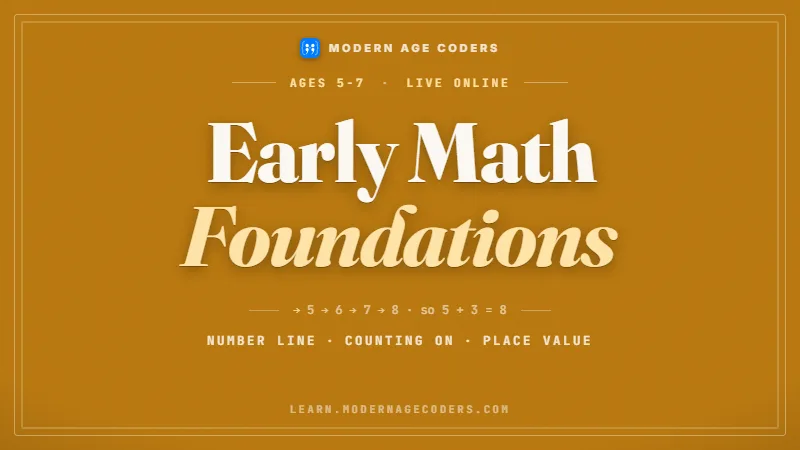
RC / 01
Listed for ages 4 to 7: counting that means something, numbers to 10 on a ten-frame, breaking numbers into parts.
Open the syllabus →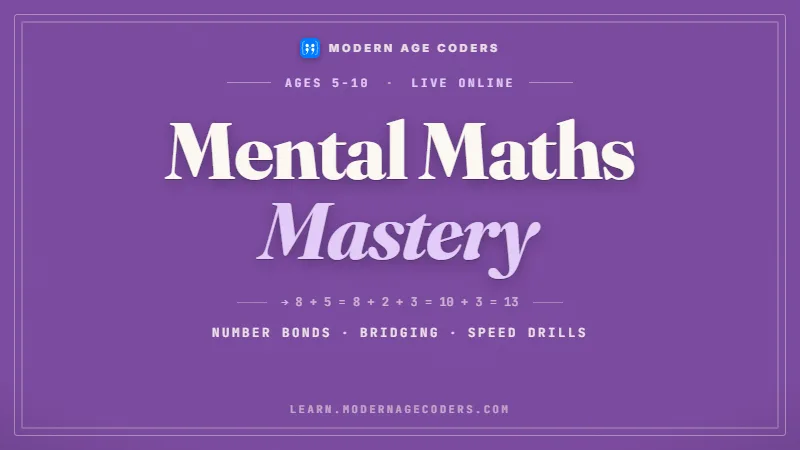
RC / 02
For ages 5 to 10, once bonds and doubles are settled and a child enjoys seeing numbers at a glance.
Open the syllabus →
RC / 03
The course for Year 1 onwards, when numbers to 100 and the equals sign arrive.
Open the syllabus →The two goals
Two early learning goals cover maths, with three sentences each. They describe a child "at the expected level of development" at the end of the EYFS, usually the end of Reception.
The framework that applies from September 2026 opens its maths section with one clear idea: "Developing a strong grounding in number is essential so that all children develop the necessary building blocks to excel mathematically." It asks settings to give children frequent, varied chances to count and to handle quantities, naming the equipment in a phrase every parent can copy at home: "using manipulatives, including small pebbles and tens frames for organising counting". The goals themselves are short, and they are worth reading in full.
| Goal | Children at the expected level of development will | What it looks like at home (our gloss) |
|---|---|---|
| Number | Have a deep understanding of numbers to 10, including the composition of each number. | Knows that 7 can be 5 and 2, or 4 and 3, or 6 and 1, and can show it with objects |
| Number | Subitise (recognise quantities without counting) up to 5. | Glances at four buttons and says "four" without pointing at each one |
| Number | Automatically recall (without reference to rhymes, counting or other aids) number bonds up to 5 (including subtraction facts) and some number bonds to 10, including double facts. | Says straight away that 3 and 2 make 5, and that 5 take away 1 leaves 4 |
| Numerical Patterns | Verbally count beyond 20, recognising the pattern of the counting system. | Counts on past twenty: twenty-one, twenty-two, and notices it repeats the ones |
| Numerical Patterns | Compare quantities up to 10 in different contexts, recognising when one quantity is greater than, less than or the same as the other quantity. | Tells you which plate has more grapes, even when the smaller pile is spread out |
| Numerical Patterns | Explore and represent patterns within numbers up to 10, including evens and odds, double facts and how quantities can be distributed equally. | Finds that 6 socks pair up and 7 leave one over, and shares 8 sweets fairly between two |
Three things in the framework change how a parent should read that table. First, the goals are not a syllabus: "The ELGs should not be used as a curriculum or in any way to limit the wide variety of rich experiences that are crucial to child development." Second, the judgement is a whole picture of the child, what the framework calls a "holistic, best-fit judgement". Third, there is no pile of evidence to build: "Recorded, written or photographic evidence is not required." The teacher draws on knowing the child.
The framework sets out "seven areas of learning and development", and mathematics is one of four specific areas, alongside literacy, understanding the world, and expressive arts and design.
The three prime areas, communication and language, physical development, and personal, social and emotional development, come first. A child who can listen, take turns and hold a pencil is better placed for every maths goal.
The maths programme asks that children look for patterns, spot connections, "'have a go', talk to adults and peers about what they notice and not be afraid to make mistakes".
That last phrase is the one to keep in mind at home. A four year old who happily guesses and checks is doing exactly what the framework hopes.
Source: Department for Education, Early years foundation stage (EYFS) statutory framework, the version for group and school-based providers in force from September 2026, read on 31 October 2026. The middle column is quoted exactly; the right-hand column is our own illustration.
How it is judged
Not one that a child can pass or fail. There are two separate checks in the Reception year, and they do quite different jobs.
Early in the year comes the Reception Baseline Assessment. The framework describes it as "a short assessment, taken within the first six weeks of a child starting reception", covering early mathematics, literacy, communication and language. Its purpose is narrow: the results are compared with the same children's Key Stage 2 results seven years later, to measure a school's progress. The framework is blunt about what it is not: "The data, including numerical scores, is not shared with external bodies, including schools, teachers, pupils or parents/carers." Teachers receive short narrative statements instead, and "There is no expected standard and children cannot pass or fail."
| Reception Baseline Assessment | EYFS Profile | |
|---|---|---|
| When | Within the first six weeks of starting Reception | In the final term, no later than 30 June |
| How long | Not timed, designed to take around 20 minutes | Built up over the year from everyday observation |
| Who does it | A trained adult the child knows | Usually the Reception class teacher |
| What it covers | Early maths, literacy, communication and language | All 17 early learning goals, including the two for maths |
| What families get | Nothing: scores are not shared with parents | The results, with a chance to discuss them |
| What it is for | A starting point for primary progress measures | A picture of the child and their readiness for Year 1 |
The EYFS Profile is the one that matters to a family. For each goal the teacher notes whether the child is meeting the expected level or is "not yet reaching expected levels", which the framework calls "emerging". Providers "must share the results of the Profile with parents and/or carers", and the framework adds that "Year 1 teachers must be given a copy of the Profile report", so the next teacher starts September already knowing the child. An emerging judgement in maths is information, not a label: it tells the Year 1 teacher where to begin.
Which of the six maths statements does my child show easily, and which are still emerging? What does that look like in class?
What do you use in class for counting and bonds, such as ten-frames or pebbles, so that we can use the same at home?
A child reaches compulsory school age on whichever of 31 December, 31 March or 31 August comes first after their fifth birthday, as the framework's footnote notes. Most children start Reception before that date.
In exceptional cases, and only with the parents' agreement, a child can stay in EYFS provision longer; the Profile is then completed once, before Year 1.
Source: DfE EYFS statutory framework, paragraphs 2.11 to 2.21 and Annex B, statutory guidance for the Reception Baseline Assessment, read on 31 October 2026. The count of 17 goals is ours, made by listing each goal heading in the framework.
Screens at four
Sometimes, in small doses, with a parent beside them. The government-commissioned 2026 advice on under-fives is the right yardstick, and we would rather say so than sell more screen time.
In March 2026 the Early Years Screen Time Advisory Group published an independent report for the government. Its suggested message to parents of two to five year olds is to keep screen time to no more than an hour a day, "ideally through short chunks (30 minutes or less) and not during mealtimes or near to bedtime. Keep solo screen use to a minimum." The same report found that an adult watching and talking alongside a child, which it calls co-viewing, "improves language and thinking skills". It also says plainly that it did not set out to advise early years educational settings.
| The advice says | So in our early maths sessions |
|---|---|
| Short chunks, 30 minutes or less | A Reception session is short, and the teacher ends it early if attention has gone |
| Keep solo screen use to a minimum | We ask for a parent or older sibling in the room for the whole session |
| Interaction helps; passive watching does not | The child talks, counts aloud and moves real objects; there are no videos to sit through |
| Balance with play away from screens | Each session ends with one off-screen game for the days in between |
| Not near bedtime | We suggest an after-school or weekend morning slot, never late evening |
A child who loves numbers and keeps asking for more, where a patient teacher can follow their curiosity in a way an app cannot.
A family that would like ideas and a little structure for home play, and a parent who wants to see how a teacher handles counting and bonds.
A child who is tired after school, unsettled by screens, or simply happier building and drawing. Many four year olds are in that group, and that is fine.
Most children in Reception need nothing beyond school and everyday play. We say this in the free class if it is true for your child.
Our early course is honest about its age range. Early Maths Foundations is listed for ages 4 to 7, so a Reception child fits at the young end of it. The wider school teaches from age 6, and many families find that the summer of Reception or the start of Year 1 is a better moment to begin regular classes than the first term of school.
Source: Early Years Screen Time Advisory Group, Screen use by children aged under five: independent report, March 2026, read on 31 October 2026. The right-hand column of the table is our own practice, not part of the report.
Play at home
One small game for each of the six goal sentences. All are our own, need nothing you have to buy, and take five minutes.
| Game (ours) | You need | How to play | Goal statement it serves |
|---|---|---|---|
| Hide and Seek Five | Five pebbles and a cup | Hide some pebbles under the cup. The child sees what is left and says how many are hiding. | Composition of numbers, and bonds to 5 |
| Flash Plate | A paper plate and dried pasta | Show a plate with 1 to 5 pieces for two seconds, then cover it. "How many did you see?" | Subitise up to 5 |
| Ten-Frame Breakfast | An egg box with two rows of five | Fill it with grapes or blueberries. How many spaces are empty? What makes 10? | Deep understanding of numbers to 10 |
| Stair Count | A staircase or a long hallway | Count each step aloud, then keep counting past 20 in the hallway: twenty-one, twenty-two. | Count beyond 20 |
| More or Fewer? | Two handfuls of buttons | Spread one pile out wide and bunch the other. Which has more? Line them up to check. | Compare quantities up to 10 |
| Sock Pairs | The laundry basket | Pair the socks. Did every sock get a partner? That number is even. One left over means odd. | Evens, odds, doubles and fair sharing |
Worksheets are not wrong, but most of the six statements are things a child does or says, not things they write. Subitising is a glance; comparing a spread-out pile with a bunched one is a judgement about real objects; recall "without reference to rhymes, counting or other aids" is something you hear in a quick answer. A sheet of drawn dots can only show some of that. If your child enjoys colouring sums, keep it. If they resist, the games above cover the same ground.
More, fewer, the same, altogether, left over, double, half, first, next, and how many. The framework's maths programme stresses vocabulary as well as number.
Ask "How do you know?" and wait. A four year old explaining that three and three is six because "they match" is reasoning, not just recall.
Still counting each object one by one for two or three items late in the spring term, or unsure which of two small groups is bigger.
Not yet counting past ten in the summer term. Teachers see a wide range at this age, and a short conversation usually helps more than extra practice.
Worked examples
Our own examples, written as a parent and child might meet them. The child talks and moves objects; nobody writes anything down.
Set-up (ours). Six toy cars and two "garages", a pair of shoeboxes.
Play. Park all six in one garage: six and nothing. Move one across: five and one. Keep moving one at a time: four and two, three and three.
Talk. "Did the number of cars change?" The child sees that six stays six however it is split.
Why it matters. This is the framework's "composition of each number". It is the root of every later bond.
Set-up (ours). Two dice, one showing the five pattern and one with five pasta pieces scattered.
Ask. "Which is quicker to see?" Most children say the dice pattern straight away.
Connect. The dice five is four corners and one in the middle: four and one more.
Why it matters. Recognising small amounts at a glance frees attention for bigger questions later.
Question (ours). "Show me four fingers on this hand, and four on that one. How many?"
First time. The child counts all eight fingers. That is fine.
Later. Repeated over a few weeks with real objects, double four becomes a known fact: eight, said at once.
Why it matters. The goal asks for doubles recalled without counting or aids. Practice with objects gets a child there; drilling the words alone does not.
Question (ours). "Share these nine strawberries fairly between you and me."
Play. One for you, one for me, until one is left.
Talk. "Is it fair? What could we do with the last one?" Children often suggest cutting it, which is a lovely early idea of a half.
Why it matters. It meets "how quantities can be distributed equally", and nine leaving one over is the odd number pattern.
Practice set for a parent to try (ours, with answers). (1) Put 5 pebbles on the table and hide 2 in your hand; how many is the child looking at? (2) Show 4 buttons for two seconds; how many? (3) "What do I need with 3 to make 5?" (4) Count aloud from 17; what comes after 20? (5) Which is more, 7 spread out or 8 bunched up? (6) Can 10 apples be shared fairly by two people? Answers: (1) 3; (2) 4; (3) 2; (4) 21; (5) 8, which the child can check by lining them up; (6) yes, 5 each, so 10 is even.
Our early classes
Short, spoken and hands-on, with a grown-up in the room. The teacher leads the play; the parent learns the games to use all week.
For a four or five year old we usually suggest 1-on-1, so the teacher can follow the child's pace and stop when attention fades.
A group of 15 to 20 suits an older or very sociable child, often in the summer of Reception or in Year 1, where the energy of other children helps.
Give a Reception child test papers or timed drills. Neither of the Reception checks is a test to prepare for.
Claim any link with a school, nursery, local authority or the Department for Education. We are an independent online school.
Through the year
Roughly how the six goal statements build over the year. Children move at very different speeds at four and five.
| Stone | Often around | What a parent might notice |
|---|---|---|
| 1. One number for each thing | Autumn term | Touches each object once while counting, and knows the last number said is how many |
| 2. Small amounts at a glance | Late autumn to spring | Says "three" for three items without counting, up to five |
| 3. Inside the numbers to 10 | Spring term | Shows a number as two parts in more than one way, and fills a ten-frame |
| 4. Quick bonds, and past 20 | Summer term | Recalls bonds to 5 and doubles, compares groups, and counts on beyond 20 |
Matching one count to one object sounds simple and is a real achievement. Rushing past it causes trouble later.
Families with a slightly older child can read our kindergarten maths page, written for the same age in the US system.
Year 1 builds numbers to 100 and the equals sign on exactly these foundations.
Sessions can pause over school holidays.
Catalogue
Only the first band is written for Reception. The others show what follows in the primary years.
UK / RC1 / 01
Quantities, ten-frames and parts of numbers, through play.
Open the syllabusUK / RC1 / 02
Seeing numbers at a glance, then bonds that stick.
Open the syllabusUK / RC1 / 03
Beads that make tens and ones visible.
Open the syllabusUK / RC2 / 01
Numbers to 100, adding, shape, time and money.
Open the syllabusUK / RC2 / 02
Patterns and spatial puzzles for ages 6 to 9.
Open the syllabusUK / RC2 / 03
Step-by-step thinking with puzzles and patterns.
Open the syllabusUK / RC3 / 01
Block coding once a child can follow a short sequence.
Open the syllabusUK / RC3 / 02
Simple animated stories and games.
Open the syllabusUK / RC3 / 03
First apps built from blocks, a little later on.
Open the syllabusSessions
Weekdays or weekends, flexible: choose your batch, or for a very personalised plan choose 1-on-1 at your convenience, weekend mornings or weekdays. Our teachers work from India and every session is offered in UK time, kept short for the youngest children.
After school
Once a snack and a rest are done.
Weekend morning
When most four year olds are freshest.
Holiday mornings
A gentle restart before term.
A parent or older sibling stays in the room, which is what the screen advice asks.
Pebbles, buttons and an egg-box ten-frame on the table, not just pictures on screen.
Children say and show answers; no worksheets or writing at this stage.
If attention has gone, the teacher stops and gives a game for later.
One short meeting with the teacher, with no payment taken.
Usually 1-on-1 for Reception; a group of 15 to 20 for an older child.
Student work
Small, cheerful pieces from regular classes with older children, none of them marked. Student labs has the full collection.

AI and ML
An AI nutrition coach that reads what you eat and works you toward a target.

AI and ML
A chatbot that answers mathematics and programming questions, built and deployed by a student.

AI and ML
An assistant that helps a young person recognise unsafe situations online.

Web app
A weather forecasting site with live conditions for any location.
Fees
The first session is free. After that there is a monthly fee, lower for a group place than for 1-on-1, and nothing is charged until a course and a regular time have been agreed with you.
Free first class
USD 0
no card required
Group batch
USD 100
a month, billed in US dollars
One to one
USD 150
a month, billed in US dollars
What families say
What parents wrote on Google, unedited.
★★★★★
"The one step solution for my son. Modern Age Coders make learning coding so simple that kids love it. The teachers explain complex concepts clearly with practical exercises and interactive content."
Ria Mukherjee
Parent
★★★★★
"Modern Age Coders has been a game-changer for me. I struggled to grasp IT concepts and coding before joining, but their classes transformed everything. I can now confidently write complex programs with ease."
Samriddha Mondal
Student
★★★★★
"One of the most wonderful education centres out there. Education is not limited to school syllabus but focuses on skill development."
Vansh Agarwal
Student
★★★★★
"My child Dhairya is really enjoying the Modern Age Coders classes. This is his first online class and he eagerly looks forward to it. I can already see his improvement, and the teachers are very cooperative."
Sonam Oswal
Parent of Dhairya
★★★★★
"Modern Age Coders have wonderful teachers who teach in a clear, easy and practical way. The teacher boosts students' confidence and inspires them to learn without hesitation."
Sonu Goyal
Parent
★★★★★
"I highly recommend this computer coding class! The teachers are incredibly knowledgeable and passionate about coding."
Ritu Kedia
Parent
Reception questions
Children at the expected level understand numbers to 10 and how each is made of smaller parts, see up to 5 at a glance, recall bonds to 5 and some to 10 including doubles, count beyond 20, compare groups up to 10, and explore odds, evens and fair sharing.
There are two: Number, and Numerical Patterns. Each has three statements in the EYFS statutory framework, and they describe the expected level of development at the end of the EYFS.
No test that a child can pass or fail. The Reception Baseline Assessment early in the year has no expected standard and its scores are not shared with parents, and the EYFS Profile at the end of the year is the teacher's judgement from everyday observation.
The EYFS Profile must be completed no later than 30 June, and schools must share the results with parents and explain how to discuss them. Year 1 teachers also receive a copy.
It means the child is not yet at the expected level for that goal. It helps the Year 1 teacher know where to start, and it is common for some goals at this age.
They are fine if your child enjoys them, but most of the maths goals are things children do and say, such as seeing small numbers at a glance or comparing real piles. Short games with objects cover more of them.
The independent report published for the government in March 2026 suggests no more than an hour a day for two to five year olds, ideally in chunks of 30 minutes or less, with little solo use. Our sessions are short and need an adult in the room.
For some children, in small doses, with a parent alongside. Our Early Maths Foundations course is listed for ages 4 to 7, and we will tell you honestly in the free session if waiting until Year 1 would suit your child better.
Weekdays or weekends, flexible: choose your batch, or for a very personalised plan choose 1-on-1 at your convenience, weekend mornings or weekdays. Every time is given in UK time.
No. Modern Age Coders is an independent online school with no link to any school, nursery, local authority or the Department for Education.
Next steps
What comes after Reception, and pages for children who love number puzzles.
The same age group as Reception, in the US system.
The US equivalent of Year 2, for comparison.
Years 3 to 6, for the road further ahead.
Gentle maths contests, for later in primary school.
What a live class with us looks like.
Every UK page we publish, maths and coding.
Part of the guide: UK maths year by year, Reception to Year 11
More guides: UK maths exam boards and specification codes · UK selective school maths tests: 7+, 11+, 13+ and 16+ · UK university admissions: maths tests and computing applications · UK maths enrichment, competitions and able pupils
Start here
Leave a number and we will call at a UK time that fits around school and naps. The first session is short and playful, and you will come away with a couple of games to use at home either way.
Would you like to look first? The Early Maths Foundations course sets out its months and weeks, and how we teach explains our method.
WhatsApp us · +91 91233 66161 · connect@modernagecoders.com
A WhatsApp message reaches us fastest and costs nothing from a UK phone. Replies come from our team in India, from a number starting +91.
A priority demo is a full class of about 45 to 60 minutes. After the class the mentor sends a written skill report and a personal learning roadmap on WhatsApp. If you enrol, the demo fee is adjusted against your first month's fee. Share your demo Order ID with us on WhatsApp and we take it off.
Book a priority demo