UK / N51 / 01
First Python
For S2 and S3 students moving from blocks to typed code before the course starts.
Open the syllabusScotland · National 5 · S4
National 5 Computing Science has a structure that rewards reading it once, carefully. Software design and development is compulsory in both parts of the assessment, and between them those compulsory parts carry 80 of the 120 marks. After that, a candidate makes a choice between database design and web design in the question paper, and then makes that choice again in the assignment. The course specification says "Section 1 is mandatory, and candidates have the option to complete either section 2 or section 3" for the paper, and "Task 1 is mandatory, and candidates have the option to complete either task 2 or task 3" for the assignment. The two choices are independent. Most candidates make them by default, often late, and they are worth making on purpose. This page explains both, and how to prepare for the compulsory two-thirds that decides most of the grade.
Teaching live since 2020 · 10,000+ students · Built on the course specification line by line
In short
National 5 Computing Science is assessed by a question paper worth 80 marks and an hour and a half, and an assignment worth 40 marks completed within six hours. Software design and development, with computer systems in the paper, is compulsory in both and carries 80 of the 120 marks between them, so it decides most of the grade. Beyond that, a candidate chooses database design or web design in the paper, and separately chooses database or web in the assignment, and the two choices are independent. The assignment is set annually, supervised, open book and externally marked, and the paper has very few questions that test straight recall. Qualifications Scotland replaced SQA as the awarding body on 1 February 2026, and the existing course documents remain current. We teach both components. The first lesson is free, then USD 100 a month in a group or USD 150 one to one.
Start here
The compulsory programming, and one course for each of the two optional areas. Cards open the full syllabus.
N5 / 01
Software design and development is compulsory in both components and worth two-thirds of the marks. This is where most of the grade comes from.
Open the syllabus →
N5 / 02
For candidates choosing the database section and task, including entity-relationship design and SQL queries.
Open the syllabus →
N5 / 03
For candidates choosing the web section and task, covering structure, interface design and prototyping.
Open the syllabus →The choice you make twice
From the National 5 Computing Science Course Specification, May 2023 (version 3.0), valid from session 2023 to 24.
| Component | Compulsory part | Optional part: choose one |
|---|---|---|
| Question paper, 80 marks | Section 1: Software design and development, and Computer systems, 55 marks | Section 2 Database design and development, or Section 3 Web design and development, 25 marks |
| Assignment, 40 marks | Task 1: Software design and development, 25 marks | Task 2 Database design and development, or Task 3 Web design and development, 15 marks |
| Total, 120 marks | 80 marks, two-thirds of the course | 40 marks, one-third of the course |
Nothing in the specification ties the paper choice to the assignment choice. A candidate could answer the database section in the paper and complete the web task in the assignment, or the same area in both.
Most candidates choose the same area twice, usually whichever their class covered in more depth. That is often sensible, but it should be a decision rather than a default.
Choose on strength, and choose early. A candidate who knows by the start of S4 which area they will answer spends revision time where it counts, rather than half-preparing both and committing in the exam hall.
If one area clearly suits a student better, doing it twice consolidates it. If they are genuinely even, the assignment choice can reasonably follow whichever area has the more interesting task that year.
The number that matters most
Software design and development is compulsory in both components and together carries 80 of the 120 marks. Whatever a candidate chooses, programming decides most of the grade, which is where preparation should go first.
Sources: National 5 Computing Science Course Specification, May 2023, version 3.0; and the Qualifications Scotland National 5 Computing Science page, which states that "On 1 February 2026, Qualifications Scotland replaced SQA and became Scotland's new national awarding body. The documents on this page remain current and you can continue to use them."
The question paper
An hour and a half, three sections, of which a candidate answers two.
| Feature | What the specification says |
|---|---|
| Length and marks | 80 marks in 1 hour and 30 minutes, 67 per cent of the course assessment |
| Structure | Section 1 compulsory; then either section 2 or section 3 |
| How sections open | With short, stand-alone questions, predominantly C-grade questions in a simple or familiar context |
| How sections develop | Context-based questions with multiple parts, including designing solutions and writing code, with both C and A-grade marks |
| What is tested | The questions "assess application of understanding, with very few questions requiring direct recall of knowledge" |
Very few questions test straight recall. A candidate who has memorised definitions without using them will find the paper harder than one who has written a lot of code.
Questions ask candidates to design solutions and write code. Doing that by hand, without an editor, is a separate skill and needs practice of its own.
The harder questions ask candidates to integrate knowledge, explain in detail, or analyse, compare and evaluate. Those marks separate the top grades.
The questions also ask candidates to explain how a program works and to communicate computing ideas "clearly and concisely, using appropriate terminology", and to understand the legal implications and environmental impact of contemporary technologies. Explaining clearly in writing is practised far less than coding, and it carries real marks.
The habit that serves the whole paper is predicting what a program will do before running it, then explaining why. It is the same skill the harder questions reward, and it is set out with the research behind it on the problem-solving page.
The assignment
The coursework component is tightly controlled, and the conditions are worth knowing before it starts.
| Condition | What the specification says |
|---|---|
| Marks | 40 marks, 33 per cent of the course assessment |
| Tasks | Task 1 software design and development compulsory, then task 2 database or task 3 web |
| Who sets it | "Set by SQA, on an annual basis", now the responsibility of Qualifications Scotland |
| Supervision | "Conducted under a high degree of supervision and control" |
| Time | "Must be carried out within 6 hours", over "several shorter sessions" rather than one continuous session |
| Materials | "Conducted under open-book conditions, but supervised to ensure that the work presented is the candidate's own work" |
| Marking | Evidence is submitted for external marking, and all marking is quality assured |
Open-book conditions mean a candidate can consult materials, but the work is supervised and must be their own. Six hours is not long for a real programming task, and a candidate who has to look things up constantly will run out of time.
Fluency is what open book rewards. The notes help a candidate who already knows the material; they do not rescue one who does not.
We do not work on any candidate's assignment, and we will decline if asked. It is set each year, supervised, and externally marked as the candidate's own work.
What we teach is everything it draws on: designing a program before writing it, testing it properly, and building database or web solutions on projects of our own.
For the rules on AI and assessed work, which apply to coursework across the UK, the page on declaring AI sets out why identified AI content earns nothing even when properly acknowledged. For the wider Scottish system, including the stages and what comes after National 5, see coding and AI classes in Scotland.
Progression
A candidate is placed by what they can do unaided, which is what both components measure.
| Rung | When | What should be true |
|---|---|---|
| 1. Programming fluency | Before or early in S4 | Writing and debugging programs without copying examples, in the language the school uses |
| 2. Design before code | S4 | Planning a solution with the design techniques the course names, then implementing it |
| 3. The chosen area | S4 | Secure in either database or web design, chosen on purpose rather than by default |
| 4. Explaining and applying | Before the paper | Answering context questions in writing, and explaining how code works, rather than reciting |
Software design and development is compulsory in both components and worth 80 of 120 marks. Everything else sits on top of it.
The full topic order runs down the coding roadmap.
Choosing database or web early focuses a year of revision. Choosing late splits it.
After National 5 comes Higher, covered on the Higher Computing Science page.
The catalogue
Arranged around the compulsory two-thirds and the two optional routes. Where to begin is decided in the free lesson.
UK / N51 / 01
For S2 and S3 students moving from blocks to typed code before the course starts.
Open the syllabusUK / N51 / 02
Programming to the standard both components reward.
Open the syllabusUK / N51 / 03
Standard algorithms and efficient use of coding constructs, worked on paper.
Open the syllabusUK / N52 / 01
Entity relationships, data dictionaries and SQL for the database route.
Open the syllabusUK / N52 / 02
Structure, interface design and prototyping for the web route.
Open the syllabusUK / N52 / 03
A gentler way into web design for students who want a project first.
Open the syllabusUK / N53 / 01
Working with real data, which Higher and Advanced Higher lean on.
Open the syllabusUK / N53 / 02
Training and testing models, for students well ahead of the course.
Open the syllabusUK / N53 / 03
The wider theory behind computer systems, taught to whichever course a student is on.
Open the syllabusHow lessons work
Our teachers work from India on a clock that never changes, so Scotland is five and a half hours behind from October and four and a half from March. Slots are agreed in UK time.
After school
Where most S3 and S4 students settle.
Early evening
For students with sport, music or a long journey.
Weekend morning
Good for timed practice of a full paper.
Programming comes first and gets most of the time, because it carries most of the marks.
We help a candidate decide database or web at the start of S4, then prepare for that one properly.
Regular handwritten code, because the question paper asks for it and an editor hides weaknesses.
Short written explanations of how code works, marked, because the paper rewards them.
We never work on a candidate's assignment. We teach the skills it draws on.
Five to ten students at one stage, comparing solutions to the same problem.
Student work
Four projects from lessons, none of them assessed work. More in student labs.

AI and ML
An AI nutrition coach that reads what you eat and works you toward a target.
AI and ML
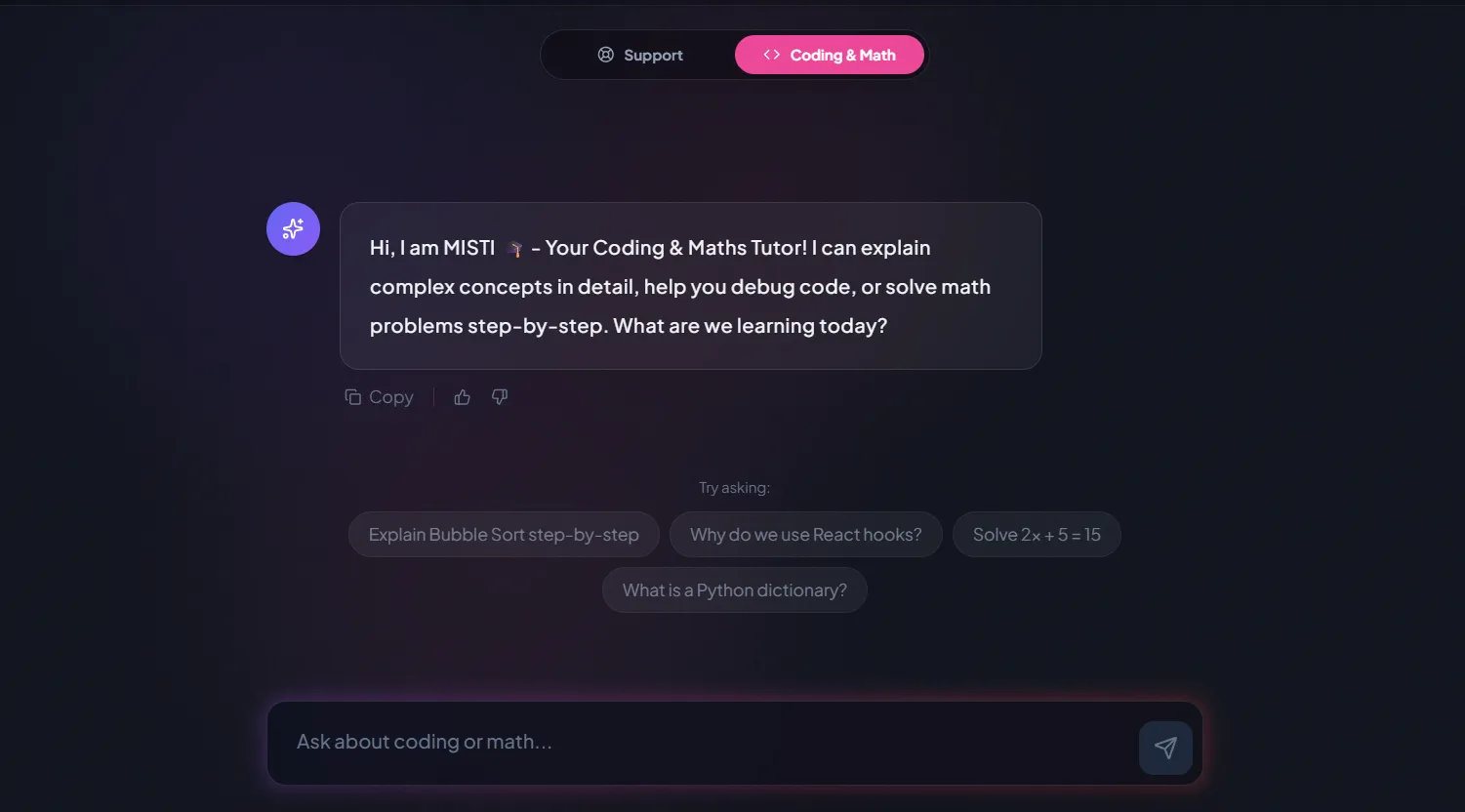
A chatbot that answers mathematics and programming questions, built and deployed by a student.

AI and ML
An assistant that helps a young person recognise unsafe situations online.
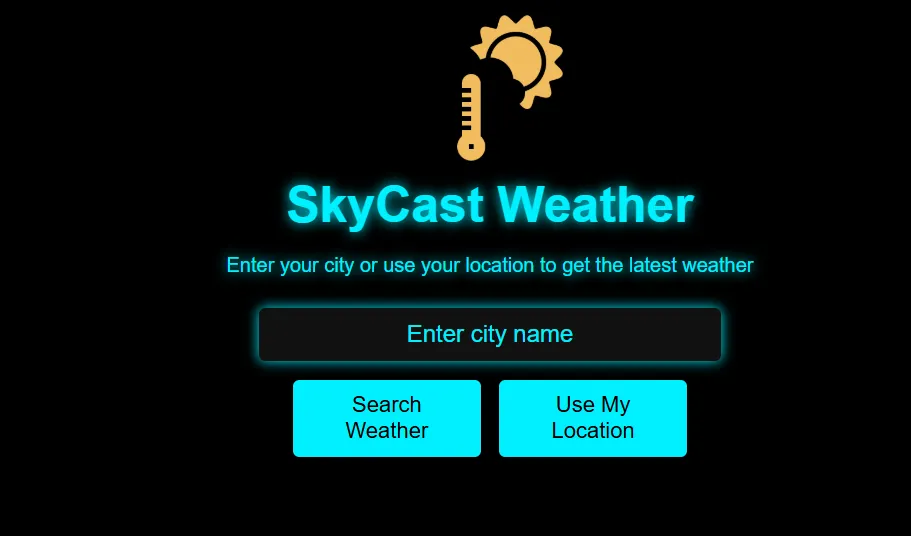
Web app
A weather forecasting site with live conditions for any location.
Fees
Priced monthly in US dollars, as it is for every family outside India. Nothing is charged before the free lesson, and nothing after it until a course and a weekly slot are fixed.
Free first class
USD 0
no card required
Group batch
USD 100
a month, billed in US dollars
One to one
USD 150
a month, billed in US dollars
What families say
Six Google reviews, printed exactly as families left them.
★★★★★
"The one step solution for my son. Modern Age Coders make learning coding so simple that kids love it. The teachers explain complex concepts clearly with practical exercises and interactive content."
Ria Mukherjee
Parent
★★★★★
"Modern Age Coders has been a game-changer for me. I struggled to grasp IT concepts and coding before joining, but their classes transformed everything. I can now confidently write complex programs with ease."
Samriddha Mondal
Student
★★★★★
"One of the most wonderful education centres out there. Education is not limited to school syllabus but focuses on skill development."
Vansh Agarwal
Student
★★★★★
"My child Dhairya is really enjoying the Modern Age Coders classes. This is his first online class and he eagerly looks forward to it. I can already see his improvement, and the teachers are very cooperative."
Sonam Oswal
Parent of Dhairya
★★★★★
"Modern Age Coders have wonderful teachers who teach in a clear, easy and practical way. The teacher boosts students' confidence and inspires them to learn without hesitation."
Sonu Goyal
Parent
★★★★★
"I highly recommend this computer coding class! The teachers are incredibly knowledgeable and passionate about coding."
Ritu Kedia
Parent
Questions about National 5 Computing Science
By a question paper worth 80 marks, lasting an hour and a half, and an assignment worth 40 marks, completed within six hours. The paper is 67 per cent of the course assessment and the assignment 33 per cent.
Software design and development, in both components, with computer systems in the paper. Together those compulsory parts carry 80 of the 120 marks.
Database design and development or web design and development, once in the question paper and once in the assignment.
The specification does not require it. The paper choice and the assignment choice are separate, though many candidates sensibly choose the same area in both.
It must be completed within six hours, usually over several shorter sessions rather than one continuous block.
It is conducted under open-book conditions but supervised to ensure the work is the candidate's own, and it is marked externally.
No. The specification says the questions assess application of understanding, with very few questions requiring direct recall.
Qualifications Scotland, which replaced SQA on 1 February 2026. It says the existing course documents remain current and can still be used.
No. It is set each year, supervised and externally marked as your own work. We teach the skills it draws on, using our own projects.
The first lesson is free. After that a group place is USD 100 a month and one-to-one teaching USD 150, charged monthly with nothing in advance.
Elsewhere on this site
The system around National 5, and the step after it.
The Scottish stages and qualifications, and the move to Qualifications Scotland.
What changes at Higher, the usual next step after National 5.
Why declared AI content earns nothing in assessed work.
The language most Scottish schools teach, and how the boards treat it.
What Ofcom found about British teenagers, AI and checking.
The national page, and the index of every UK page we publish.
Start here
Send a number and we will reply at a UK hour you choose. The lesson uses real National 5 material and ends with a straight view of which optional area suits the candidate.
Happier to browse first? Full syllabuses sit on the course pages, our method and its honest limits are in how we teach, and the coding roadmap shows what follows what.
WhatsApp us · +91 91233 66161 · contact@modernagecoders.com
The quickest route is WhatsApp, free from any UK phone. Our number is Indian, so a message from Glasgow or Aberdeen will show a +91 code, and that is us.