MOG / O / 01
Olympiad and competition maths
Pigeonhole, counting and construction, written out.
Open the syllabusUnited Kingdom · Year 11 and above · 22 September 2026
Most students meet written mathematics as a cliff. One year the papers are multiple choice and the next they want a proof, and nothing in between teaches the crossing. The Mathematical Olympiad for Girls is the gentlest bridge in the British system, and it is built that way on purpose: five problems in two and a half hours, of which two ask for a numerical answer and three ask for a full written explanation. A student can walk in able to do the first kind and learn, on paper, what the second kind wants. This page is about that difference, and about how to practise the half nobody has ever asked for.
Quoted from UKMT, with the date we read it · Problems written by us · Nothing promised about a result
In short
The Mathematical Olympiad for Girls is run by the UK Mathematics Trust and falls on "Tuesday 22nd September 2026". UKMT describes a paper of "2.5 hours" that "consists of five challenging problems": two ask for "numerical answers only" and three "require full written explanations". Eligibility is "England and Wales: Year 11 and above (younger students may be entered at the school's discretion)", "Scotland: S4 and above" and "Northern Ireland: Year 12 and above", and entry is discretionary through a school. On the same day UKMT runs the newer Mathematical Competition for Girls, an unlimited-entry paper of "five similar problems, but in the answer-only format", with some questions shared; "students cannot sit both the MCG and MOG". We teach the problem solving and the written argument, live online. The first class is free; a group place is USD 100 a month and one-to-one teaching USD 150.
Where to start
Pick by whether the gap is the mathematics or the writing.
MOG / 01
Counting, number theory and geometry in the olympiad idiom, with every solution written out.
Open the syllabus →
MOG / 02
For a student who can see the idea but loses time getting the algebra out.
Open the syllabus →
MOG / 03
Counting arguments done carefully, which is where a good many MOG problems live.
Open the syllabus →The paper
Facts read at UKMT's own pages on 20 September 2026.
| Part | What UKMT says | What it means on the day |
|---|---|---|
| Date | "Tuesday 22nd September 2026" | Early in the autumn term, before most competition seasons begin |
| Length | "2.5 hours" | Thirty minutes a problem, which nobody should spend evenly |
| The paper | "consists of five challenging problems" | Fewer, longer problems than any challenge paper |
| Two of them | Ask for "numerical answers only" | Familiar ground for a student coming from the Senior Challenge |
| Three of them | "require full written explanations" | The part that has to be learned, and the reason this page exists |
| England and Wales | "Year 11 and above (younger students may be entered at the school's discretion)" | Sixth formers and strong Year 11s, with younger students possible |
| Scotland | "S4 and above" | Scottish stages, not translated year groups |
| Northern Ireland | "Year 12 and above" | One year higher, matching the NI school year |
| Entry | Discretionary, arranged by a school | No qualifying score is needed; a teacher enters candidates |
Discretionary entry is the detail that changes who this paper is for. There is no threshold to clear first and no invitation to wait for. A teacher who thinks a student would enjoy it can enter her, which means the paper is available to students who have never done well in a timed multiple-choice round and might do very well given two and a half hours.
Answer sheets are uploaded the following day, by 11:59pm on Wednesday 23 September 2026, so a school needs to have thought about scanning before the morning arrives.
Two and a half hours for five problems is unusually generous, and the generosity is the design. These are problems meant to be thought about rather than recognised, and a student who finishes early has almost certainly not written enough on the three explained questions.
It falls in September, which makes it the first serious paper of the school year. That is worth planning around: the useful preparation happens in the summer term before, not in the fortnight after school goes back.
Sources: UKMT, Mathematical Olympiad for Girls, Mathematical Competition for Girls and the competitions calendar, read 20 September 2026. We have no connection with the UK Mathematics Trust.
The method
A worked case, written by us, that shows exactly what the three explained questions are asking for.
Here is a problem in the right spirit. In any group of people, some pairs are friends and the rest are strangers. What is the smallest size of group that must always contain three people who are all friends with each other, or three who are all strangers to each other? The answer is six. Written on a line by itself, that answer is worth almost nothing, and a student who has only ever sat answer-only papers has no idea why.
| Group size | Patterns checked | Patterns with no trio of mutual friends and no trio of mutual strangers |
|---|---|---|
| Five people | 1,024 | 12 |
| Six people | 32,768 | 0 |
Twelve of the 1,024 patterns on five people escape, and they are all the same shape: a ring. Seat five people in a circle, let each be friends with their two neighbours and strangers to the other two, and no trio is all friends or all strangers.
Pick any person. They have five relationships, so at least three are of the same kind, say three friends. If any two of those three are friends with each other, that pair plus the first person is a trio of friends. If none are, those three are a trio of strangers.
It checked all 32,768 patterns and found no exception, which is reassurance. The paragraph above is the proof, and it is what the three written questions on the paper are asking a student to produce.
Notice the shape of the good argument. It does not check cases; there are 32,768 of them and nobody has the afternoon. It picks an arbitrary person, counts their five relationships, and observes that three must match. That counting step is the pigeonhole principle, and it is one of the two or three techniques that unlock most olympiad counting problems.
Notice also how short it is. Five sentences, no algebra, complete. Students often believe a written solution must be long, and length is usually a sign that the key idea has not been found yet.
The practical exercise this suggests is small and repeatable. Take a problem whose answer is already known and write the reason in under ten lines, for a reader who has not seen the problem. Then leave it a day and read it back cold, and see whether it still convinces.
That is the whole difference between the two answer-only questions and the three explained ones, and it is trainable in a way that raw problem-solving ability is not.
The problem, the argument and the brute-force check are ours, written and run on 20 September 2026: all 1,024 friendship patterns on five people and all 32,768 on six were tested, with twelve escapes at five and none at six.
The choice
UKMT now runs two papers for girls on the same day, and a school has to choose one per student.
| Mathematical Olympiad for Girls | Mathematical Competition for Girls | |
|---|---|---|
| Entry | Discretionary, through a school | Unlimited entry |
| Problems | Five challenging problems | "five similar problems, but in the answer-only format" |
| Answers | Two numerical, three fully written | All answer only |
| Overlap | Its answer-only questions are the reference point | Similar in style and level, with some questions shared |
| Both at once | Not possible: "students cannot sit both the MCG and MOG" | Not possible, for the same reason |
The honest way to choose is to ask what a student has actually done before. A student who has never written a mathematical argument, and will not have practised one before late September, may get more out of a paper that asks only for answers, and can come to the written paper next year knowing what it wants.
A student who has written up solutions, even a handful, should sit the olympiad. The three explained questions are where the real learning is, and a half-finished written argument teaches more than five correct numbers.
What should not drive the decision is fear of a bad score. Neither paper is a qualification, neither appears on any record a school or university sees unless a student chooses to mention it, and both exist because UKMT wanted more girls sitting mathematics beyond the syllabus.
The other rungs are open in parallel. The Senior Mathematical Challenge falls on 7 October 2026 and the British Mathematical Olympiad follows in November, and a student can sit those as well as this.
How to practise
There is one exercise worth doing repeatedly, and it takes twenty minutes a week.
| When | What to do | Why |
|---|---|---|
| Summer term before | Work olympiad problems without a clock | Problem-solving grows slowly and cannot be hurried in September |
| Summer holidays | Write up one solution a week, properly | The writing is the half nobody has practised |
| Early September | Reread old write-ups cold and mark them yourself | A solution that convinced you in July often does not in September |
| The week before | One timed two-and-a-half-hour sitting | Stamina and pacing, not content |
| On the day | Read all five, then start with the one you can see into | Nothing rewards doing them in order |
The commonest preparation mistake for this paper is to spend all of it on the two answer-only questions, because they are the familiar kind and progress feels measurable. Three fifths of the paper wants something else.
The second is to read model solutions instead of writing any. Reading a good proof teaches style; writing a mediocre one and having it picked apart teaches the skill.
UKMT publishes its own past papers and full solutions free, which is the right place to meet the real style of the questions. We do not reproduce any of them here or in lessons; our problems are written by us in the same territory.
If a student finds she enjoys the written questions more than the answer-only ones, that is the signal to look at the competitions calendar and keep going.
Getting ready
A student moves up when the previous habit is automatic, whatever her year group.
| Stage | Rung | The sign it is secure |
|---|---|---|
| Years 9 to 10 | 1. Technique out of the way | Algebra and counting never interrupt the thinking |
| Years 10 to 11 | 2. Patience | Will stay with one problem for half an hour unprompted |
| Year 11 to 12 | 3. Ten honest lines | Writes a short argument that a classmate can follow |
| Years 12 to 13 | 4. Cold reading | Marks her own week-old solution and finds the gap in it |
Write up two problems already solved, fully, and have someone read them as a stranger would. That is the highest-value evening available.
Sit one timed paper for pacing, and do not add topics. Nothing in this paper needs content beyond school mathematics.
The Senior Mathematical Challenge is on 7 October 2026 and the British Mathematical Olympiad in November, both open to the same students.
The written habit is worth more at every level above this one, and it is what university mathematics is made of.
The full list
Sorted by the obstacle rather than the year group, with each syllabus a click away.
MOG / O / 01
Pigeonhole, counting and construction, written out.
Open the syllabusMOG / O / 02
Probability arguments that survive being questioned.
Open the syllabusMOG / O / 03
Algebra and geometry until they are out of the way.
Open the syllabusMOG / S / 01
The sixth-form course, taught so it stops eating the same evenings.
Open the syllabusMOG / S / 02
Foundation and higher, for a candidate still in Year 11.
Open the syllabusMOG / S / 03
For students in independent and international schools.
Open the syllabusMOG / C / 01
A short program, and then the sentence that makes it unnecessary.
Open the syllabusMOG / C / 02
Enough code to list every case before arguing about them.
Open the syllabusMOG / C / 03
Where careful counting meets a messy spreadsheet.
Open the syllabusMOG / N / 01
Searching, sorting and how long a method takes.
Open the syllabusMOG / N / 02
What counting and probability turn into later.
Open the syllabusMOG / N / 03
Problems solved against a clock and a judge.
Open the syllabusHow lessons run
Teaching is live on video from India, five and a half hours ahead of the UK in winter and four and a half in summer, at a time agreed and kept in UK time.
Weekday evening
The usual choice for Years 11 to 13.
Weekend morning
Long enough to work a problem to a finished argument.
Summer weeks
The right time to prepare for a September paper.
A teacher reads the argument cold and says where it stops being convincing.
Pigeonhole, extremal cases and construction are taught as a repertoire, not as tricks.
Enough for two approaches to meet, small enough for every solution to be read aloud.
Written by us in the same territory. UKMT publishes its own past papers and solutions.
For a student working beyond her year group, or one who prefers to think out loud alone.
We cannot enter anyone, and no score, award or invitation is promised by us.
Student work
Four published projects by students at our school, none of them competition entries. More on the student labs page.

AI and ML
An AI nutrition coach that reads what you eat and works you toward a target.
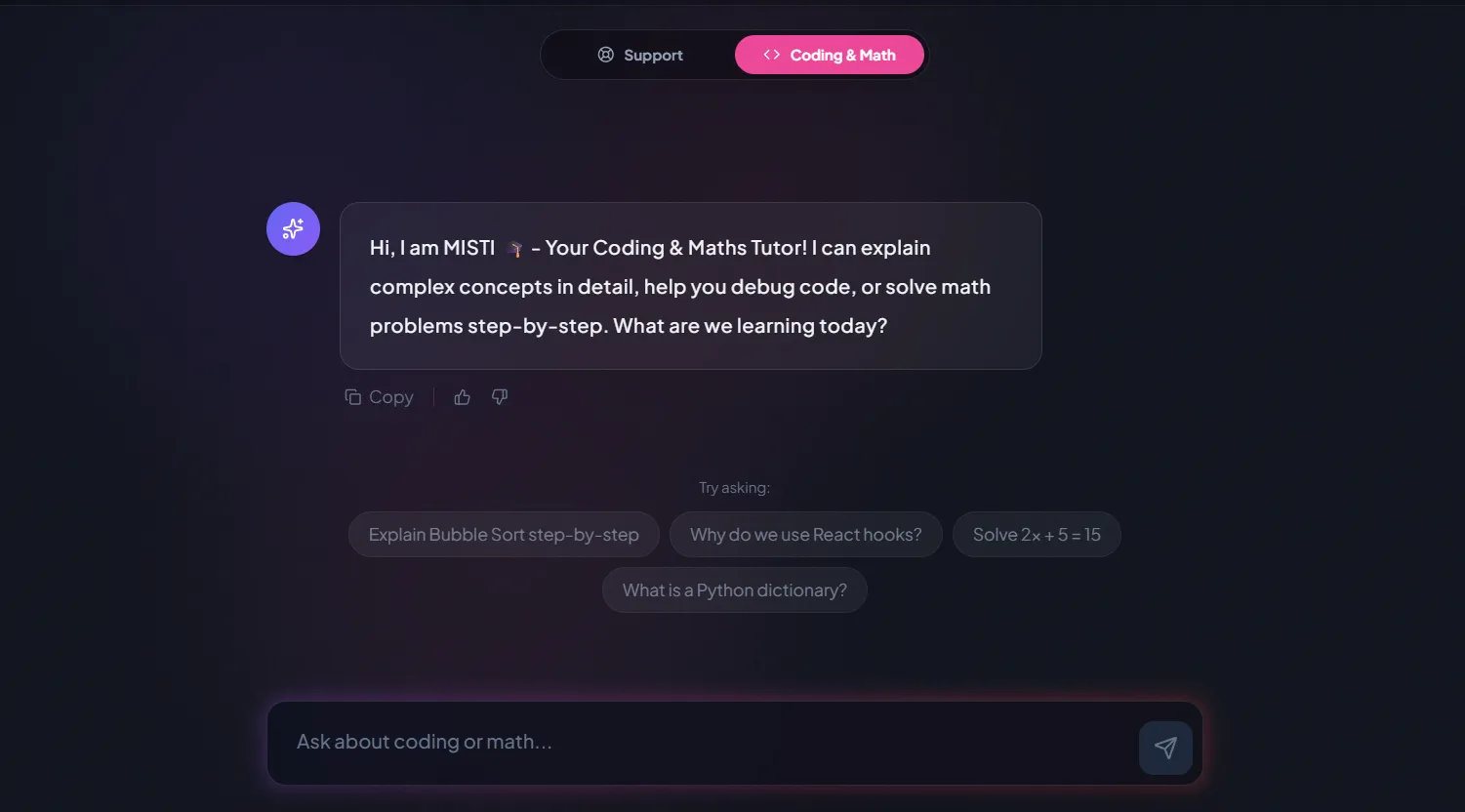
AI and ML
A chatbot that answers mathematics and programming questions, built and deployed by a student.

AI and ML
An assistant that helps a young person recognise unsafe situations online.

Web app
A weather forecasting site with live conditions for any location.
Fees
Priced monthly in US dollars for families outside India, with no registration fee and no minimum number of months.
Free first class
USD 0
no card required
Group batch
USD 100
a month, billed in US dollars
One to one
USD 150
a month, billed in US dollars
What families say
What families have said about us on Google, quoted without edits.
★★★★★
"The one step solution for my son. Modern Age Coders make learning coding so simple that kids love it. The teachers explain complex concepts clearly with practical exercises and interactive content."
Ria Mukherjee
Parent
★★★★★
"Modern Age Coders has been a game-changer for me. I struggled to grasp IT concepts and coding before joining, but their classes transformed everything. I can now confidently write complex programs with ease."
Samriddha Mondal
Student
★★★★★
"One of the most wonderful education centres out there. Education is not limited to school syllabus but focuses on skill development."
Vansh Agarwal
Student
★★★★★
"My child Dhairya is really enjoying the Modern Age Coders classes. This is his first online class and he eagerly looks forward to it. I can already see his improvement, and the teachers are very cooperative."
Sonam Oswal
Parent of Dhairya
★★★★★
"Modern Age Coders have wonderful teachers who teach in a clear, easy and practical way. The teacher boosts students' confidence and inspires them to learn without hesitation."
Sonu Goyal
Parent
★★★★★
"I highly recommend this computer coding class! The teachers are incredibly knowledgeable and passionate about coding."
Ritu Kedia
Parent
Mathematical Olympiad for Girls questions
UKMT gives Tuesday 22 September 2026, with paper answer sheets uploaded by 11:59pm the following day.
UKMT publishes it by nation: Year 11 and above in England and Wales, with younger students at the school's discretion; S4 and above in Scotland; Year 12 and above in Northern Ireland. Entry is discretionary and arranged by a school.
Two and a half hours and five challenging problems. Two ask for numerical answers only and three require full written explanations, which makes it the gentlest crossing in the British system from answer papers to proof.
No. Entry is discretionary rather than by invitation, so a teacher can enter a student who would enjoy the paper without her having cleared a threshold first.
A newer UKMT paper on the same day with unlimited entry, described as five similar problems in the answer-only format, similar in style and level to the MOG answer-only questions with some questions shared.
No. UKMT says plainly that students cannot sit both the MCG and the MOG, so a school chooses one per student.
If she has written up mathematical solutions before, even a few, the olympiad is where the learning is. If she has not, and will not have practised by late September, the answer-only paper is a reasonable first year, and the olympiad is there next year.
By writing ten honest lines about a problem already solved, then reading them back a week later as a stranger would. A good argument is usually short: if it is long, the key idea has probably not been found yet.
No. UKMT publishes its own past papers and full solutions free. Our practice problems are written by us in the same territory.
The first lesson is free. A group place is then USD 100 a month and one-to-one teaching USD 150, with nothing to join and no minimum term.
Related pages
The autumn rounds, the papers below this one, and the full calendar.
Three and a half hours, six problems, in November.
The intermediate papers, split by school year.
Dates for every contest, checked with the people who run them.
Where written solutions begin, at Year 8.
The four school systems, and every UK page.
How to tell a serious provider from a well-designed one.
Start here
Tell us the year group and whether she has written up a solution before. The free lesson takes one problem from a first reading to an argument on paper.
Rather read first? Syllabuses live on the course pages, the teaching approach on how we teach, and the order of topics on the roadmap.
WhatsApp us · +91 91233 66161 · contact@modernagecoders.com
WhatsApp is free from a UK mobile and reaches us fastest. Our number is an Indian one, which we say on every page, and we keep no office in Britain.