UK / DES / 01
Python for teens
From zero to games and tools.
Open the syllabusBronze, Silver, Gold · Ages 14 to 18 · Online
The Skills section of the Duke of Edinburgh's Award is about getting steadily better at one activity over a set number of weeks, and coding suits it well because progress shows on screen. The DofE names web design and coding an app among its examples, but your DofE Leader decides whether an activity counts. Modern Age Coders teaches Python and web coding live online, an hour a week, through our Python course for teens, as a group or 1-on-1. We are not a DofE Approved Activity Provider. This page sets out the section lengths at each level, the Assessor rules and a coding plan for each.
Built from dofe.org pages read 31 October 2026 · Not a DofE Approved Activity Provider
Can coding count for the Duke of Edinburgh Skills section?
Yes, if your DofE Leader agrees. The DofE says the Skills section is about developing personal interests and practical skills, and that "you should keep learning and get better at your activity". It names web design among possible Skills and coding an app among programme ideas. You need an average of 1 hour a week for 3 months at Bronze, 3 or 6 months at Silver and 6 or 12 months at Gold, with longer for direct entrants. School lessons do not count, since the DofE says core curriculum does not. Modern Age Coders teaches coding live online outside school, on our Python course for teens, in a batch of 15 to 20 or 1-on-1. We are not an Approved Activity Provider.
Where to begin
Pick the one that matches what you want to be able to show at the end. Every card opens the week-by-week syllabus.

DES / 01
From a first program to games and data projects; the natural Bronze or Silver choice from age 14.
Open the syllabus →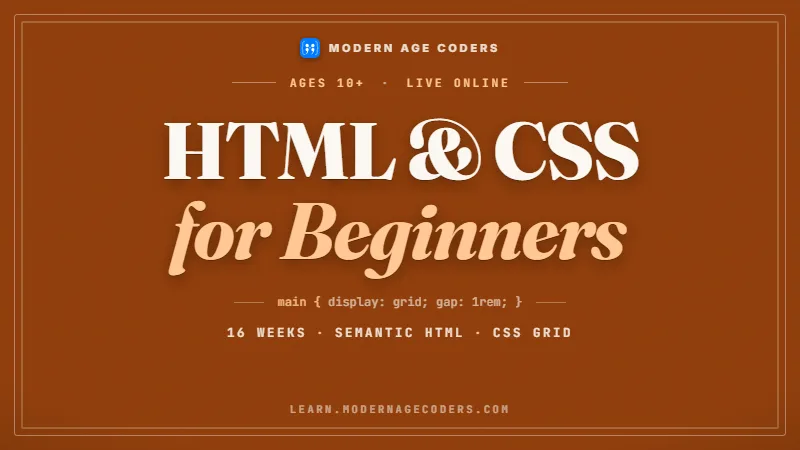
DES / 02
The DofE names web design as a Skill; build and publish real pages over a section.
Open the syllabus →
DES / 03
React and Node.js for a Gold Skills section of six or twelve months.
Open the syllabus →Does it count?
Coding is a natural Skill, but approval sits with your DofE Leader, not with us and not with this page. The DofE asks every participant to check before starting.
| Question | What the DofE says |
|---|---|
| What is the section for? | "Skills is about developing personal interests, and practical and social skills." |
| What must you show? | That you keep learning and get better at your activity, towards a goal that is challenging but achievable |
| Is coding an example? | Web design is named among Skills examples, and "coding the next big app" among programme ideas |
| Who checks it counts? | "Talk to your DofE Leader before you start your activity so they can check it's suitable." |
| Do school lessons count? | No: "Paid work and core curriculum does not count, as you need to do your DofE outside of work or school time." |
| Does the provider need DofE approval? | No: for Skills, the DofE says "an AAP licence is optional", and you can do the section with an organisation that has none |
| Skills or Volunteering? | "The Skills section is about learning, the Volunteering section is about using your skills for good in your community." |
Modern Age Coders is not a DofE Approved Activity Provider. The DofE says it "can only licence UK-based organisations", and our teachers work from India, so we cannot hold a licence. We do not use any DofE logo.
In the DofE's own suggested words for independent providers: "This activity may count towards your Duke of Edinburgh's Award Skills section. Please check with your DofE Leader before booking."
Taking coding lessons and improving is Skills. Running a coding club for younger children is Volunteering. A young person could do both in one programme, as long as the two activities are genuinely different.
If you already study GCSE Computer Science, ask your Leader early. Coding outside school is fine in principle, but the section should not simply repeat your school course.
Sources: DofE, Skills; DofE, Approved Activity Providers; DofE, Your DofE programme. All read 31 October 2026. The Duke of Edinburgh's Award is a registered charity; we are not connected with it.
How long
Between 3 and 18 months, depending on level, on which section you choose to make longer, and on whether you did the level below. The DofE expects an average of 1 hour a week throughout.
| Level | Start | Skills section | If you skipped the level below |
|---|---|---|---|
| Bronze | In the school year you turn 14 | 3 months/13 weeks, or 6 months if you pick Skills for the extra 3 months | Not applicable |
| Silver | In the school year you turn 15 | Physical and Skills: one for 6 months/26 weeks, the other for 3 months/13 weeks | An extra 6 months on Volunteering or the longer of Physical and Skills, so up to 12 months |
| Gold | After turning 16 | Physical and Skills: one for 12 months/52 weeks, the other for 6 months/26 weeks | An extra 6 months on Volunteering or the longer of Physical and Skills, so up to 18 months |
The DofE asks for "an average of 1 hour a week" on each section, usually weekly at Bronze. At Silver and Gold an activity can be done for longer but less often.
There are limits: you "cannot condense an activity to less than 1 session per month" and "cannot complete more than 6 hours in a month". All sections must be finished before your 25th birthday.
At Bronze you spend an extra 3 months on one of Volunteering, Physical or Skills, and the DofE says you should decide which before you start, though you can change your mind.
Choosing coding for the longer section gives 26 weeks, enough to move from first programs to a finished project. Our plans below are written for each possible length.
Our arithmetic on the DofE averages: a 13-week Skills section is about 13 hours of activity, a 26-week section about 26 hours and a 52-week section about 52 hours. Practice between lessons is extra and sensible, but the log should record the activity time honestly.
Source: DofE, Timescales, read 31 October 2026. The hour totals are our own arithmetic.
Assessors
Almost any independent adult who knows the activity. A coding teacher who has watched your progress over the weeks is the obvious choice, if your Leader is happy.
Our teachers are adults, unrelated to students and teach the activity every week, which matches the DofE description. If your DofE Leader agrees, you can ask the teacher who taught you whether they can act as your Assessor; your Leader has the final say on who assesses you.
If your Leader prefers someone else, we send progress notes to whoever they choose.
Over 13 weekly lessons the participant moved from printing text to writing a complete quiz game with a score, a high-score file and input checking. They debugged their own errors with growing independence and met their goal of a working game a friend could play.
That is the kind of note the DofE criteria point to: effort, perseverance and visible improvement. It is our invented example, not a real participant's report.
Source: DofE, Choosing Assessors, read 31 October 2026. The sample note is ours.
Coding plans
Three plans we wrote, one per section length. Each ends in something you can show your Assessor working. They are suggestions; your goal should be your own.
| Length | Plan | Weeks 1 to a quarter | Middle | Final weeks | Show at the end |
|---|---|---|---|---|---|
| 13 weeks (Bronze) | Python games | Variables, input, if statements | Loops, lists, a guessing game | A quiz game with a score and saved high score | A game a friend can play |
| 26 weeks (Bronze longer, or Silver) | Python plus a web page | Python basics and functions | Files, data, a small text adventure | An HTML and CSS page presenting the project | A published page and a working program |
| 52 weeks (Gold) | A full web app | HTML, CSS and JavaScript | React front end and a Node.js server | A database-backed app with users' data handled safely | A deployed app and a short write-up |
import random

secret = random.randint(1, 100)
tries = 0
while True:
    guess = int(input("Guess a number from 1 to 100: "))
    tries += 1
    if guess < secret:
        print("Higher")
    elif guess > secret:
        print("Lower")
    else:
        print("Got it in", tries, "tries")
        break
By week 8 participants add input checking so a typed word does not crash the game, which is exactly the kind of improvement an Assessor can see.
"By the end of my 13-week Skills section I will write a Python quiz game with at least ten questions, a score, and a high score that is saved between games, and fix my own errors using error messages."
It is challenging but achievable, specific enough to check, and it names a skill (debugging) as well as a product.
Week 5, 1 hour. Learned while loops. Wrote a times-table tester that keeps asking until the answer is right. Got stuck when the loop never ended; found I never changed the variable. Next week: lists, so the quiz can hold many questions.
Four lines: what you did, what went wrong, how you fixed it and what is next. The DofE asks you to add logs and evidence to eDofE.
The plans, code, goal and log entry are ours. Plans for under-18 participants use only tools suitable for their age.
Beyond the Award
It gives you something real to describe. The DofE itself says a Skills activity related to the subject you want to study can be written about in a UCAS personal statement.
At the end of a Skills section in coding you have a working project, a log of how you built it, and an Assessor's report on your effort and improvement. That is evidence of sustained independent learning, which is what selectors look for in any applicant.
For computing, maths or engineering applicants it is also directly relevant. We make no promise about any offer or place.
Many participants continue after the section ends. A Bronze game can grow into a Silver web project and a Gold app, each level building on the last.
For project ideas at sixth-form level, our computer science project ideas page has more, and the Coolest Projects page shows a place to share one.
You may change one activity in each section at each level, though the DofE does not recommend it and you restart preparation, training and assessment; the time on both activities adds up. If coding is not working out after a few weeks, talk to your Leader rather than drifting.
Source: DofE, Skills and Your DofE programme, read 31 October 2026.
Stages
Our coding stages, matched loosely to the three DofE levels. Many participants start at Bronze with no coding at all.
| Stage | Fits | Secure when |
|---|---|---|
| 1. First programs | Bronze | Writes a short Python program with input, decisions and a loop |
| 2. Structured code | Bronze longer or Silver | Uses functions and lists to build a game or tool |
| 3. The web | Silver | Presents a project on a page built with HTML and CSS |
| 4. Full applications | Gold | Builds and deploys a web app with a front end and a server |
The Skills section measures improvement, so a complete beginner has the most room to show progress.
Experienced coders set a harder goal instead.
School-age coding is covered on our KS3 computing page.
For a coding challenge with a deadline, try the National Cipher Challenge.
All related courses
Grouped by level. Every course page shows the syllabus week by week, which helps when setting a goal.
UK / DES / 01
From zero to games and tools.
Open the syllabusUK / DES / 02
Web design, a named DofE Skill example.
Open the syllabusUK / DES / 03
Interactive pages and browser games.
Open the syllabusUK / DES / 04
Unity and C# projects.
Open the syllabusUK / DES / 05
Python with real data.
Open the syllabusUK / DES / 06
Defensive, ethical skills.
Open the syllabusUK / DES / 07
React and Node.js applications.
Open the syllabusUK / DES / 08
Python to real models.
Open the syllabusUK / DES / 09
APIs and databases.
Open the syllabusHow lessons run
Weekdays or weekends, flexible: choose your batch, or for a very personalised plan choose 1-on-1 at your convenience, weekend mornings or weekdays. One lesson a week matches the DofE average of 1 hour. Every time is in UK time; our teachers are in India and teach to the UK calendar.
After school
Weekly group lessons for ages 14 to 18.
Weekday evening
For Gold participants at college or work.
Weekend morning
Groups and 1-on-1 lessons.
We help you write a goal your Leader can approve.
The DofE average, with dates you can log.
Each week ends with code that does something new.
Short progress notes your Assessor can draw on.
15 to 20 participants, or a private teacher.
Every plan ends with something that works.
Student work
Projects from teenagers in our classes. See student labs for more.

AI and ML
An AI nutrition coach that reads what you eat and works you toward a target.

AI and ML
A chatbot that answers mathematics and programming questions, built and deployed by a student.

AI and ML
An assistant that helps a young person recognise unsafe situations online.

Web app
A weather forecasting site with live conditions for any location.
Fees
Paid month by month, so a 13-week Bronze section costs about three months and a Gold section runs as long as it needs. The first lesson is free.
Free first class
USD 0
no card required
Group batch
USD 100
a month, billed in US dollars
One to one
USD 150
a month, billed in US dollars
What families say
Reviews from families on our Google profile, left as written.
★★★★★
"The one step solution for my son. Modern Age Coders make learning coding so simple that kids love it. The teachers explain complex concepts clearly with practical exercises and interactive content."
Ria Mukherjee
Parent
★★★★★
"Modern Age Coders has been a game-changer for me. I struggled to grasp IT concepts and coding before joining, but their classes transformed everything. I can now confidently write complex programs with ease."
Samriddha Mondal
Student
★★★★★
"One of the most wonderful education centres out there. Education is not limited to school syllabus but focuses on skill development."
Vansh Agarwal
Student
★★★★★
"My child Dhairya is really enjoying the Modern Age Coders classes. This is his first online class and he eagerly looks forward to it. I can already see his improvement, and the teachers are very cooperative."
Sonam Oswal
Parent of Dhairya
★★★★★
"Modern Age Coders have wonderful teachers who teach in a clear, easy and practical way. The teacher boosts students' confidence and inspires them to learn without hesitation."
Sonu Goyal
Parent
★★★★★
"I highly recommend this computer coding class! The teachers are incredibly knowledgeable and passionate about coding."
Ritu Kedia
Parent
DofE Skills questions
It can. The DofE names web design among Skills examples and coding an app among programme ideas, but your DofE Leader must agree that your activity is suitable before you start.
Three months, or 13 weeks, unless you choose Skills as the section you do for an extra three months, which makes it six months. Bronze as a whole takes at least six months, and you can start in the school year you turn 14.
At Silver, one of Physical and Skills lasts six months and the other three. At Gold, one lasts twelve months and the other six. Direct entrants who skipped the level below add six months to Volunteering or the longer of the two.
An average of one hour a week, says the DofE. At Silver and Gold you can do longer sessions less often, but no fewer than one session a month and no more than six hours in a month.
An adult over 18 who is independent of you, so not a family member, and who knows the activity and can follow your progress. If your Leader agrees, you can ask your coding teacher whether they can do it; your Leader has the final say.
Yes, if your Leader agrees. The DofE says you can do a Skills activity with an organisation that has no Approved Activity Provider licence, and its AAP rules mention activities offered in person or online.
No. The DofE licenses only UK-based organisations and our teachers work from India, so we cannot be one. For Skills an AAP licence is optional, and the activity may count if your DofE Leader approves it.
No. The DofE says core curriculum does not count, because the Award is done outside school or work time. Coding lessons you take outside school are different, but check with your Leader if they overlap a GCSE course.
Something challenging but achievable and easy to check at the end, such as a working game, a published web page or a deployed app, plus a skill like debugging your own errors. Our plans on this page give examples for 13, 26 and 52 weeks.
Weekdays or weekends, flexible: choose your batch, or for a very personalised plan choose 1-on-1 at your convenience, weekend mornings or weekdays. Times are confirmed in UK time.
Related pages
School computing, competitions and project showcases.
Programming in Years 7 to 9.
The Year 9 options question.
Share a finished project.
Code-breaking with Python.
A holiday of real projects.
All our UK pages.
Part of the guide: UK maths enrichment, competitions and able pupils
More guides: UK maths exam boards and specification codes · UK maths year by year, Reception to Year 11 · UK selective school maths tests: 7+, 11+, 13+ and 16+ · UK university admissions: maths tests and computing applications
Start here
Tell us your DofE level, how long your Skills section is and any coding you have done. After one lesson we help you draft a goal to take to your Leader.
Checking first? Every course page lays out its weeks, and how we teach explains a lesson.
WhatsApp us · +91 91233 66161 · connect@modernagecoders.com
For the quickest response use WhatsApp; our team in India answers from a +91 number.
A priority demo is a full class of about 45 to 60 minutes. After the class the mentor sends a written skill report and a personal learning roadmap on WhatsApp. If you enrol, the demo fee is adjusted against your first month's fee. Share your demo Order ID with us on WhatsApp and we take it off.
Book a priority demo