BIO / LANG / 01
Python from start to finish
Every core idea of the language, with prediction before running.
Open the syllabusUnited Kingdom · Round one in school · Live online preparation
The British Informatics Olympiad is the national programming competition for school students, and its first round is unusual: three questions, three hours, any programming language, sat in your own school on a day the school picks. Nobody watches you type, and nothing stops a plausible-looking program from being wrong on the cases the marker will try. That is what makes preparation different from revision. You cannot memorise your way through it, and you cannot tell by reading whether your solution is right. This page sets out what the organiser says round one involves, shows a testing method that finds the bugs reading never does, and explains what weekly practice with a teacher adds.
Original practice problems · No past papers reproduced · No results promised
In short
The British Informatics Olympiad sets round one as a 3-hour paper with three questions, answered in any programming language and taken in school on a day of the school's choosing, during December and January. The organiser opens it to students under 19 studying full-time at an establishment of Secondary or Further, not Higher, Education in mainland Britain. Strong entrants go to a final in Cambridge at Easter, and the top four finalists form the UK team for the International Olympiad in Informatics, which Uzbekistan hosted in 2026. Preparation is mostly two things: knowing a handful of algorithm patterns, and testing a solution hard enough to find your own mistakes. We teach both live online, with problems written fresh rather than copied from the organiser's papers. A first class is free; groups cost USD 100 a month and one-to-one USD 150.
Where to start
Most entrants need two things at once: more algorithms, and better testing. These build them.
BIO / 01
Contest-shaped problems with time limits, and the discipline of trying to break your own answer before the clock does.
Open the syllabus →
BIO / 02
Search, recursion, dynamic programming and the structures round one keeps reaching for.
Open the syllabus →
BIO / 03
For entrants whose programming is not yet fluent: the language first, so the contest is about the thinking.
Open the syllabus →What the organiser says
Everything in this table is quoted or summarised from olympiad.org.uk, read on 20 September 2026. Check it again before entering, because arrangements change year to year.
| Question | What the organiser states |
|---|---|
| What is it? | A 3-hour paper with three questions |
| In what language? | Answers may be written in any programming language |
| Where is it sat? | In school, on a day of the school's choosing |
| When? | During December and January; the 2026 window ran from 8 December 2025 to 23 January 2026 |
| Who may enter? | Students under 19 years of age studying full-time at an establishment of Secondary or Further, not Higher, Education in mainland Britain |
| What is submitted? | The student's computer programs, together with written answers to the problems |
| What comes next? | A final held in Cambridge at Easter |
| And after that? | The top four finalists make up the team for the International Olympiad in Informatics, hosted by Uzbekistan in 2026 |
Two details change how a student should prepare. The paper is sat in school, so a teacher has to enter the school and set a date: if nobody at school knows about it, that conversation is the first task, not the algorithms.
And because answers include written work as well as programs, a solution that is half explained is worth more than a program that silently fails. Practising the writing matters.
The language freedom cuts both ways. A student may use whatever they know best, but nothing in the room will tell them their program is wrong. Under exam conditions the only judge available is the student's own testing, which is why the next section is the heart of this page.
Students in Northern Ireland should check their eligibility with the organiser, since the rules quoted above say mainland Britain. The UK competitions calendar lists alternatives, including one in Belfast.
Source: British Informatics Olympiad 2026 and its rules page, read 20 September 2026. Modern Age Coders is not connected with the British Informatics Olympiad.
The habit that wins marks
Contest solutions fail on cases their author never imagined. The fix is not to imagine harder; it is to let a computer find them for you.
First solve the problem the obvious, stupid way: try every possibility. It will be far too slow for the real input, and that does not matter. It is your definition of the right answer.
Write a generator that makes tiny random inputs, small enough for the slow version to finish instantly, and seed it so any run can be repeated exactly.
Run both on thousands of cases and stop at the first disagreement. Because the case is tiny, you can read it, work it out by hand and see the bug.
undefined
| Measure | Result |
|---|---|
| Cases tested | 10,000 |
| Cases where the buggy fast solution disagreed | 1,872, or 18.7 per cent |
| First disagreement | Case 12, a five-row grid, brute force 0 routes against the fast solution's 1 |
| Cases where the corrected solution disagreed | None |
| Time to find the first bug | Under a second |
The bug was invisible on the examples in the question, which is exactly how contest mistakes behave. It only showed itself when a wall sat in the first row, and that arrangement did not appear in the sample input. Reading the code again would not have helped; a hundred hand-written tests might have missed it too.
The seed matters more than it looks. Recording it means a failing run can be reproduced exactly, by you tomorrow or by a teacher looking at your work. Without it, a bug that appears once and vanishes is the most frustrating thing in competitive programming.
undefined
A term of practice
A realistic shape for an autumn term before a December or January paper. It assumes a student can already write programs in one language.
| Weeks | Focus | What the student should be able to do by the end |
|---|---|---|
| 1 to 2 | Reading problems and brute force | Restate a problem in their own words and solve it slowly but correctly |
| 3 to 4 | Testing | Write a generator and a brute force, and find their own bug with a seeded run |
| 5 to 6 | Search and recursion | Enumerate arrangements, prune sensibly and know when recursion is the wrong tool |
| 7 to 8 | Dynamic programming and counting | Turn a counting problem into a table, and explain in writing why it is correct |
| 9 | Writing answers | Explain a method on paper clearly enough for a marker who never sees it run |
| 10 | Full three-hour practice | Sit three fresh questions in one sitting and manage the clock |
undefined
Where we fit
Preparation is mostly practice. A teacher shortens the time between a mistake and understanding it.
Problems at the right level each week, a person who reads both the program and the written explanation, and the testing habit above, taught until it is automatic.
We do not enter students, invigilate, mark, or have any role in the competition. We do not reproduce its papers and we promise no score, no place in the final and no team selection.
Everything on this page, from brute-force reasoning to seeded testing, is ordinary professional practice. A student who never sits the paper still keeps the skills.
Getting there
Most students arrive somewhere in the middle. The free class finds where.
| Stage | Step | The evidence it is secure |
|---|---|---|
| Before starting | 1. Fluent in one language | Can write and debug a 50-line program without help |
| Weeks 1 to 4 | 2. Slow but right | Solves a contest problem by brute force and proves it on small cases |
| Weeks 3 to 6 | 3. Tests properly | Finds a bug with a seeded generator rather than by rereading |
| Weeks 5 to 10 | 4. Fast and explained | Turns the slow answer into an efficient one and writes why it works |
Ask the organiser about arrangements before assuming there is no route. Meanwhile the skills carry over to other contests on the UK competitions calendar.
Team contests such as the Perse Coding Team Challenge suit students who prefer company to silence.
Finalists work on harder problems and tighter limits. The path beyond is the International Olympiad in Informatics, which the top four finalists reach.
Many entrants also practise on USACO, which runs online through the year.
The catalogue
Ordered roughly by where an entrant usually needs work. Each card opens its syllabus.
BIO / LANG / 01
Every core idea of the language, with prediction before running.
Open the syllabusBIO / LANG / 02
For younger entrants who are new to typed code.
Open the syllabusBIO / LANG / 03
For students whose school teaches Java and who want to enter in it.
Open the syllabusBIO / ALG / 01
Search, sorting, recursion and dynamic programming, reasoned on paper first.
Open the syllabusBIO / ALG / 02
Contest problems against the clock, with testing built into the routine.
Open the syllabusBIO / ALG / 03
For finalists and sixth formers pushing into harder rounds.
Open the syllabusBIO / EXTRA / 01
Counting, proof and case analysis, which informatics problems lean on.
Open the syllabusBIO / EXTRA / 02
Building something complete under time pressure.
Open the syllabusBIO / EXTRA / 03
For students whose interest runs towards the AI olympiad instead.
Open the syllabusHow preparation runs
Teachers work from India, five and a half hours ahead of the UK in winter and four and a half in summer, so most contest students take a weekday evening or a weekend morning, agreed in UK time.
Weekday evening
The common choice for Years 10 to 13 during term.
Weekend morning
Long enough for a full practice paper and a review.
Holiday intensives
For the weeks before a December or January sitting.
Every practice question is our own, in the competition's style; the organiser's papers stay on the organiser's site.
The teacher reads the code and the written explanation, not just the final output.
A generator and a brute force are part of the routine, not an afterthought.
Five to ten students at a similar level, comparing approaches to the same problem.
For a student with a date in the diary and specific gaps to close.
No promises about scores or selection, and no help during the paper itself.
Student work
Four published student projects. The student labs page has more.
AI and ML
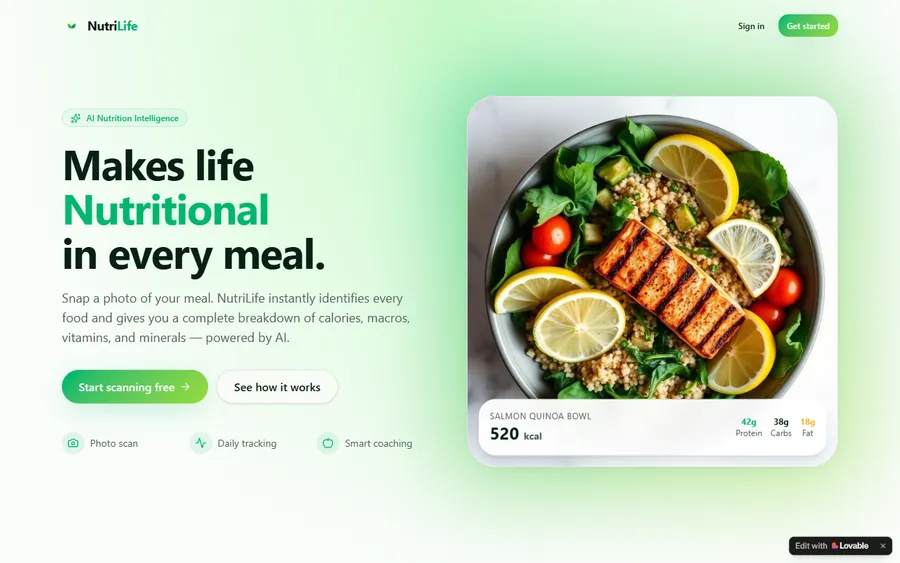
An AI nutrition coach that reads what you eat and works you toward a target.
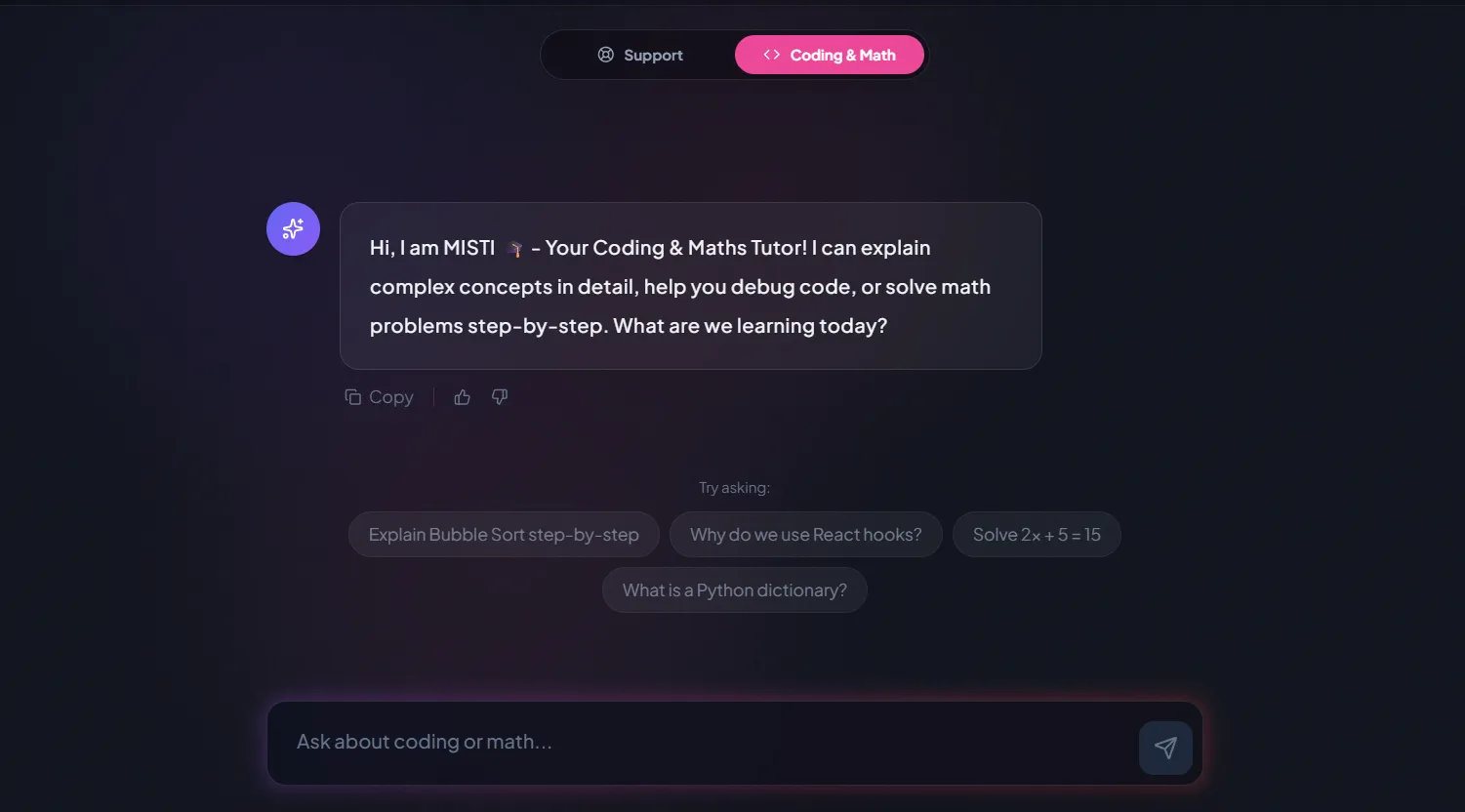
AI and ML
A chatbot that answers mathematics and programming questions, built and deployed by a student.
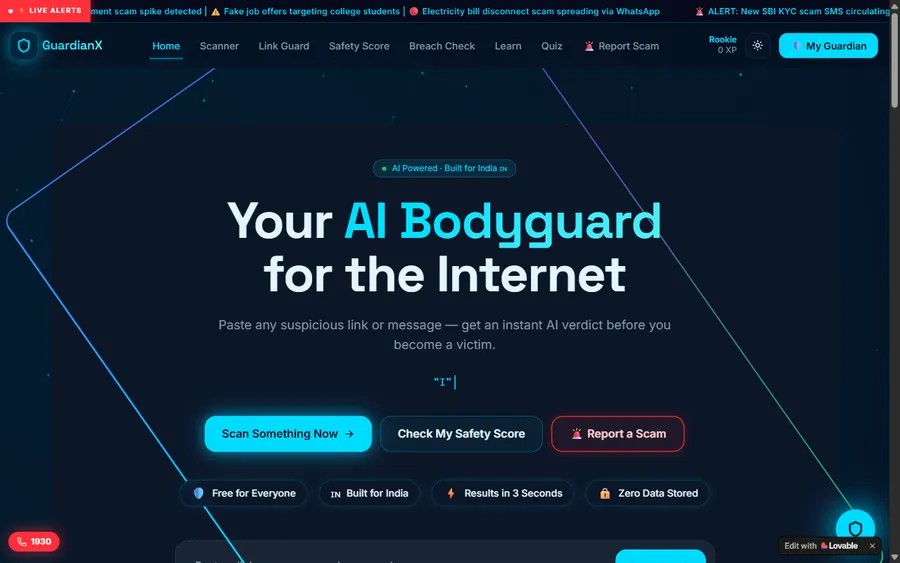
AI and ML
An assistant that helps a young person recognise unsafe situations online.
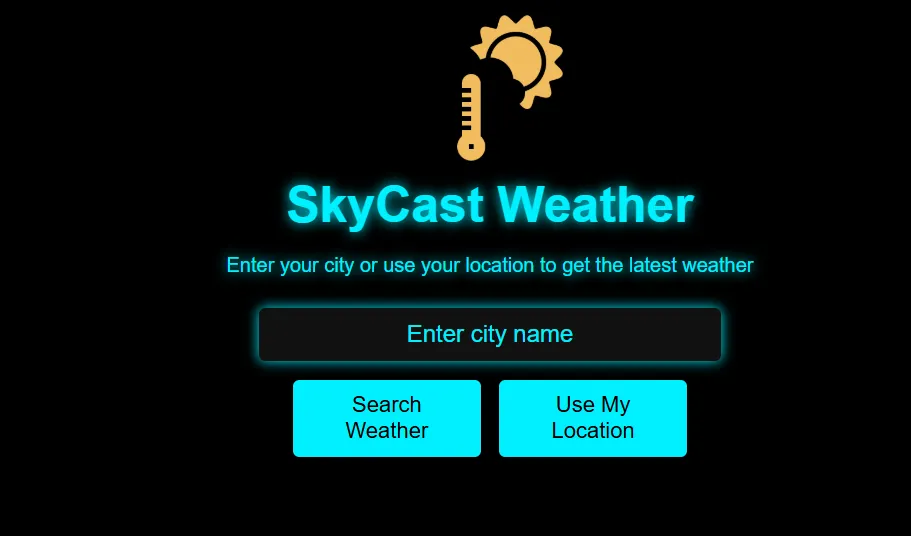
Web app
A weather forecasting site with live conditions for any location.
Fees
Monthly, in US dollars, the same rate as every country outside India. No joining fee.
Free first class
USD 0
no card required
Group batch
USD 100
a month, billed in US dollars
One to one
USD 150
a month, billed in US dollars
What families say
Google reviews from families, copied exactly.
★★★★★
"The one step solution for my son. Modern Age Coders make learning coding so simple that kids love it. The teachers explain complex concepts clearly with practical exercises and interactive content."
Ria Mukherjee
Parent
★★★★★
"Modern Age Coders has been a game-changer for me. I struggled to grasp IT concepts and coding before joining, but their classes transformed everything. I can now confidently write complex programs with ease."
Samriddha Mondal
Student
★★★★★
"One of the most wonderful education centres out there. Education is not limited to school syllabus but focuses on skill development."
Vansh Agarwal
Student
★★★★★
"My child Dhairya is really enjoying the Modern Age Coders classes. This is his first online class and he eagerly looks forward to it. I can already see his improvement, and the teachers are very cooperative."
Sonam Oswal
Parent of Dhairya
★★★★★
"Modern Age Coders have wonderful teachers who teach in a clear, easy and practical way. The teacher boosts students' confidence and inspires them to learn without hesitation."
Sonu Goyal
Parent
★★★★★
"I highly recommend this computer coding class! The teachers are incredibly knowledgeable and passionate about coding."
Ritu Kedia
Parent
Questions about the BIO
The organiser describes it as a 3-hour paper with three questions, answered in any programming language and taken in school on a day the school chooses, during December and January.
The organiser states it is open to students under 19 years of age studying full-time at an establishment of Secondary or Further, not Higher, Education in mainland Britain.
Whichever they write most fluently, since any language is allowed. Fluency matters more than the choice: three hours is not long enough to fight the language as well as the problems.
Strong entrants are invited to a final held in Cambridge at Easter, and the top four finalists make up the UK team for the International Olympiad in Informatics, which Uzbekistan hosted in 2026.
Solve problems slowly and correctly first, then test hard: write a brute force and a seeded random generator and compare. In our own run of 10,000 random cases, that method exposed a bug in 1,872 of them that reading the code had not revealed.
No. Practice problems are written fresh in the same style. The organiser publishes its own past papers, and that is where students should get them.
No. Entry is arranged by the school with the organiser. We teach the preparation, and we have no role in the competition itself.
Ask a computing teacher to look at the organiser's site, since the paper is sat in school on a date the school picks. In the meantime, other contests on our calendar page are open to individuals.
The first class is free. After that a group place is USD 100 a month and one-to-one teaching USD 150, with no joining fee and no annual contract.
A weekly slot agreed in the free class, usually a weekday evening or a weekend morning. India runs five and a half hours ahead of the UK in winter and four and a half in summer.
Related pages
Where the BIO sits among the rest.
Every UK coding, maths and AI contest we could confirm.
Where the top four finalists go next.
An online contest that runs through the year.
How the contests build on one another.
Seven checks for any provider.
The four school systems, and every UK page.
Start here
Send a number and we will arrange a free class at a UK time that suits. The class is a real contest problem, solved slowly, then tested until it breaks.
Prefer to read first? Each course page lists its syllabus, how we teach explains the method, and the roadmap shows the order of topics.
WhatsApp us · +91 91233 66161 · contact@modernagecoders.com
WhatsApp from a UK mobile costs nothing and is usually quickest. Our number is Indian and described as such; there is no UK office.