CFG / A / 01
Scratch for kids
Logic and sequence, before the typing.
Open the syllabusUnited Kingdom · One school year · November qualifier, February finals
Start with the thing that will otherwise waste your evening: the competition has a new name. The government now runs it as the TechFirst Girls Competition, delivered by the Department for Science, Innovation and Technology, after CyberFirst became part of TechFirst in September 2026, and gov.uk says the TechFirst Girls Competition runs in November. Almost every page you will find still calls it CyberFirst, and so does this one, because that is what people search for. What has not changed is the shape: one school year, teams of up to four, a teacher who registers them, an online round of puzzles from cryptography to logic, and regional finals for the teams that get through.
Sourced from gov.uk and the NCSC with the date we read it · No puzzle reproduced · Nothing promised about a final
In short
The competition most families search for as the CyberFirst Girls Competition is now the TechFirst Girls Competition. Gov.uk says "TechFirst is the government's flagship tech skills programme", delivered by the Department for Science, Innovation and Technology, and that "national competitions will run throughout the year with prizes to be won, including the TechFirst Girls Competition this November"; CyberFirst became part of TechFirst from September 2026, with the NCSC continuing to lead the cyber pathway. The NCSC's own announcements describe the competition itself: "girls in Year 8 in England and Wales, S2 in Scotland, and Year 9 in Northern Ireland" entering in "teams of up to four", registered by "a teacher at their school or a school guardian"; an online qualifying round of "puzzles, covering topics from cryptography to AI to logic"; and the highest scoring teams going "to one of 13 finals held across the UK". Since 2017 more than 43,000 girls have taken part. We teach the coding and logic underneath. A first class is free; a group place is USD 100 a month and one-to-one teaching USD 150.
Where to start
The qualifying round rewards puzzle thinking and a little code, in that order.
CFG / 01
The right level for most Year 8 entrants: typed code, logic and a first look at how AI systems work.
Open the syllabus →
CFG / 02
For a student who already writes Python and wants the loops and string work a cryptography puzzle needs.
Open the syllabus →
CFG / 03
Searching, counting and the idea of how many steps a method needs, which is what a logic puzzle is really testing.
Open the syllabus →The competition
Facts read at gov.uk and ncsc.gov.uk on 20 September 2026, with each attributed where it came from.
| Part | What the source says | Source |
|---|---|---|
| The programme | "TechFirst is the government's flagship tech skills programme opening pathways into the UK's fast-growing tech sector" | gov.uk guidance on TechFirst |
| The competition | "National competitions will run throughout the year with prizes to be won, including the TechFirst Girls Competition this November" | gov.uk guidance on TechFirst |
| The transition | CyberFirst became part of TechFirst from September 2026, with the NCSC continuing to lead the cyber pathway | gov.uk and NCSC |
| Who can enter | "Girls in Year 8 in England and Wales, S2 in Scotland, and Year 9 in Northern Ireland are encouraged to enter" | NCSC announcement |
| Team size | "teams of up to four" | NCSC announcement |
| Registration | "A teacher at their school or a school guardian must act as their mentor and register them" | NCSC announcement |
| The qualifying round | Online "puzzles, covering topics from cryptography to AI to logic" | NCSC announcement |
| The finals | The highest scoring teams go "to one of 13 finals held across the UK", "with one held in each of Scotland, Wales and Northern Ireland and in English regions" | NCSC announcement |
| Scale | "Since 2017, more than 43,000 girls have taken part in the CyberFirst Girls Competition" | NCSC announcement |
On dates we are deliberately vague, and here is why. The NCSC announcement we read gives a qualifying round opening at noon on a Monday in late November with finals on a Saturday in early February, but we could not establish which cycle that announcement belongs to, and gov.uk says only that the TechFirst Girls Competition runs "this November". Rather than print a date we cannot place in a year, this page describes the shape of the cycle and sends you to the organiser.
That shape is: an online qualifying round in November, sat by teams in school, and regional finals in February. A teacher registering a team in September or October is ahead of it.
The single-year-group rule is the thing most parents are surprised by. This is a Year 8 competition in England and Wales, S2 in Scotland and Year 9 in Northern Ireland: one cohort, nationally, with no discretion to enter a keen Year 7 or a strong Year 9 alongside them.
Which makes the timing worth knowing a year early. A girl in Year 7 who would enjoy this has one shot at it, next autumn, and a teacher who realises that in the summer term has time to form a team.
Sources: gov.uk, TechFirst and the NCSC CyberFirst Girls Competition pages, read 20 September 2026. The NCSC's competition page no longer carries the competition's details, which is part of why this page exists. Modern Age Coders is not connected with DSIT, the NCSC or IBM.
The method
Cryptography and logic puzzles look like different subjects. Underneath a great many of them is a single idea about information, and it can be taught in ten minutes.
I am thinking of a number between 1 and 1,000. You may ask yes or no questions. How many do you need to be certain? Most people guess a large number or say it depends on luck. The answer is exactly ten, it does not depend on luck, and knowing why changes how a team attacks a puzzle round.
| Possibilities | Questions needed | Why |
|---|---|---|
| 10 | 4 | 2 to the power 3 is 8, too few; 2 to the power 4 is 16 |
| 100 | 7 | 2 to the power 6 is 64, too few; 2 to the power 7 is 128 |
| 1,000 | 10 | 2 to the power 9 is 512, too few; 2 to the power 10 is 1,024 |
| 43,000 | 16 | Enough to identify any one of the girls who have entered since 2017 |
A good question splits the possibilities as near to evenly as it can. "Is it more than 500?" leaves 500 either way. "Is it 7?" leaves 999 if the answer is no.
Nine questions can distinguish at most 512 things, and there are 1,000. No cleverness gets round that, which is what makes it a bound rather than a tactic.
When a puzzle gives you a small number of chances, count how many possibilities each one can eliminate. If the arithmetic does not work, you are meant to find extra information somewhere, not guess harder.
We checked this by simulating every target from 1 to 1,000 rather than trusting the formula, because the formula is exactly the sort of thing that is right in general and wrong at the edges. It came out at ten, matching the arithmetic.
The habit worth teaching a team is to ask, before starting: how many possibilities are there, and how much does each move cut them down? Teams that do this stop brute-forcing puzzles that were never meant to be brute-forced.
It transfers directly to the cryptography end of a qualifying round. A cipher with a small number of possible keys can be broken by trying them all; one with an enormous number cannot, and the puzzle is then about finding a weakness rather than a bigger computer. Counting the possibilities tells you which kind you are looking at.
And it is a genuinely good thing for a thirteen-year-old to carry away from a competition, whatever their score: the difference between a problem that is hard and a problem that is impossible.
The figures are ours, computed on 20 September 2026 by simulating every possible target rather than applying the formula. No competition puzzle is reproduced anywhere on this page.
How to practise
The qualifying round is online, in school, and sat by four girls who may never have done anything like it.
| Worth doing | Why | Not worth doing |
|---|---|---|
| Splitting the puzzles by taste | A four-person team will contain someone who likes codes and someone who likes logic | Everyone working on the same puzzle at once |
| Writing down what has been ruled out | Most logic puzzles are won by elimination, and elimination that is not written down is lost | Holding the deductions in four separate heads |
| A little Python | Counting letters, trying possibilities and checking a pattern are all faster written down | A full programming course started in October |
| Counting the possibilities first | It tells the team whether to try everything or look for a shortcut | Guessing quickly to feel productive |
| Treating it as an afternoon out | It is a puzzle round for thirteen-year-olds, not an exam | Any talk of a result before the round |
The most useful thing a school can do is enter a team at all. More than 43,000 girls have taken part since 2017, and the great majority of them were not planning a career in cyber security when their teacher signed them up.
For a girl who enjoys it, the follow-on is not more cyber: it is programming. Almost everything interesting in the qualifying round gets easier once you can write twenty lines of Python.
We teach the coding and the logic and nothing about entering: registration is a teacher's job, and we have no role in the competition or any relationship with the people who run it.
Other competitions in the same term are on the competitions calendar, including the Bebras Challenge in November, which is open to every year group and needs no programming at all.
Getting ready
The competition comes once, in one school year, so the preparation that matters happens before it.
| Stage | Rung | The sign it is secure |
|---|---|---|
| Year 6 to 7 | 1. Enjoying puzzles | Will sit with a logic problem rather than ask for the answer |
| Year 7 | 2. Writing deductions down | Keeps a record of what has been ruled out and why |
| Year 7 to 8 | 3. A little code | Can write a loop that tries every possibility |
| Year 8 | 4. Counting first | Asks how many possibilities there are before starting |
Do one puzzle a week as a team, out loud, with someone writing down what has been eliminated. That is the round.
Do not start a programming course in October. A few lines of Python helps; a half-finished course does not.
Programming is the natural next step, and everything in the qualifying round becomes easier with it.
The competitions calendar lists what else is open, including contests with no year-group restriction at all.
The full list
Grouped by what a student can do now, with the syllabus behind each card.
CFG / A / 01
Logic and sequence, before the typing.
Open the syllabusCFG / A / 02
Games and apps, then a first look at AI.
Open the syllabusCFG / A / 03
Counting and patterns, written as programs.
Open the syllabusCFG / B / 01
Typed code and how AI systems actually work.
Open the syllabusCFG / B / 02
Strings, loops and functions, to fluency.
Open the syllabusCFG / B / 03
From blocks to real code, in a world she knows.
Open the syllabusCFG / C / 01
How many steps a method needs, and why it matters.
Open the syllabusCFG / C / 02
Taught to the board the school uses.
Open the syllabusCFG / C / 03
What is actually happening inside the tools she hears about.
Open the syllabusCFG / D / 01
A site with its own database.
Open the syllabusCFG / D / 02
Screens, taps and what the app remembers.
Open the syllabusCFG / D / 03
Patterns in real data rather than exercises.
Open the syllabusHow lessons run
Lessons are live on video from India, five and a half hours ahead of the UK in winter and four and a half in summer, at a time agreed and kept in UK time.
Early weekday evening
The usual slot for Years 7 and 8.
Later weekday evening
For older students.
Weekend morning
For a longer session on one problem.
Students say what they have ruled out and why, which is the habit a team round needs.
We run mixed groups by default and girls-only groups where a family prefers one.
Enough for a better method to surface, small enough that nobody stays quiet.
Written by us. We do not reproduce competition material.
For a student who would rather think aloud without an audience.
A teacher registers a team. We have no role in the competition and promise nothing about it.
Student work
Four things students here have made and published, none of them for a contest. The student labs page has more.
AI and ML
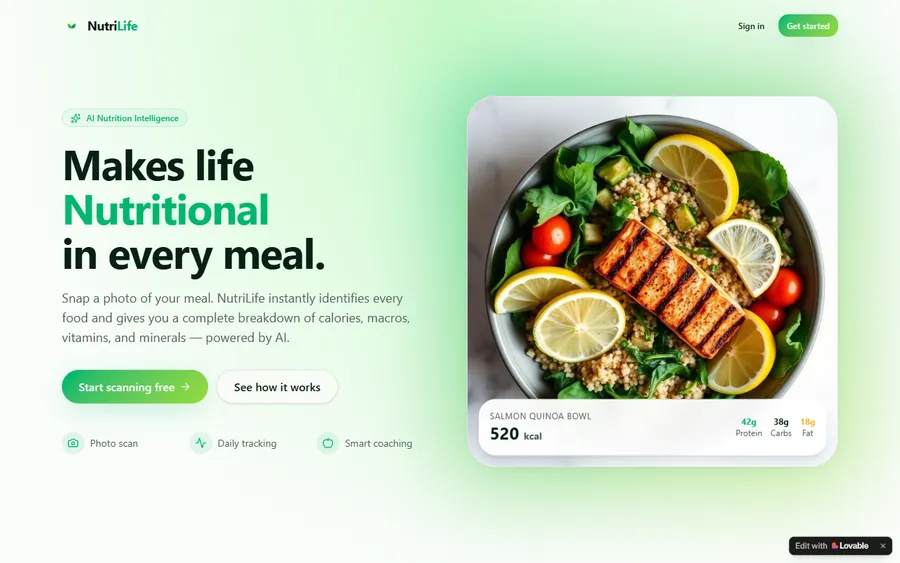
An AI nutrition coach that reads what you eat and works you toward a target.
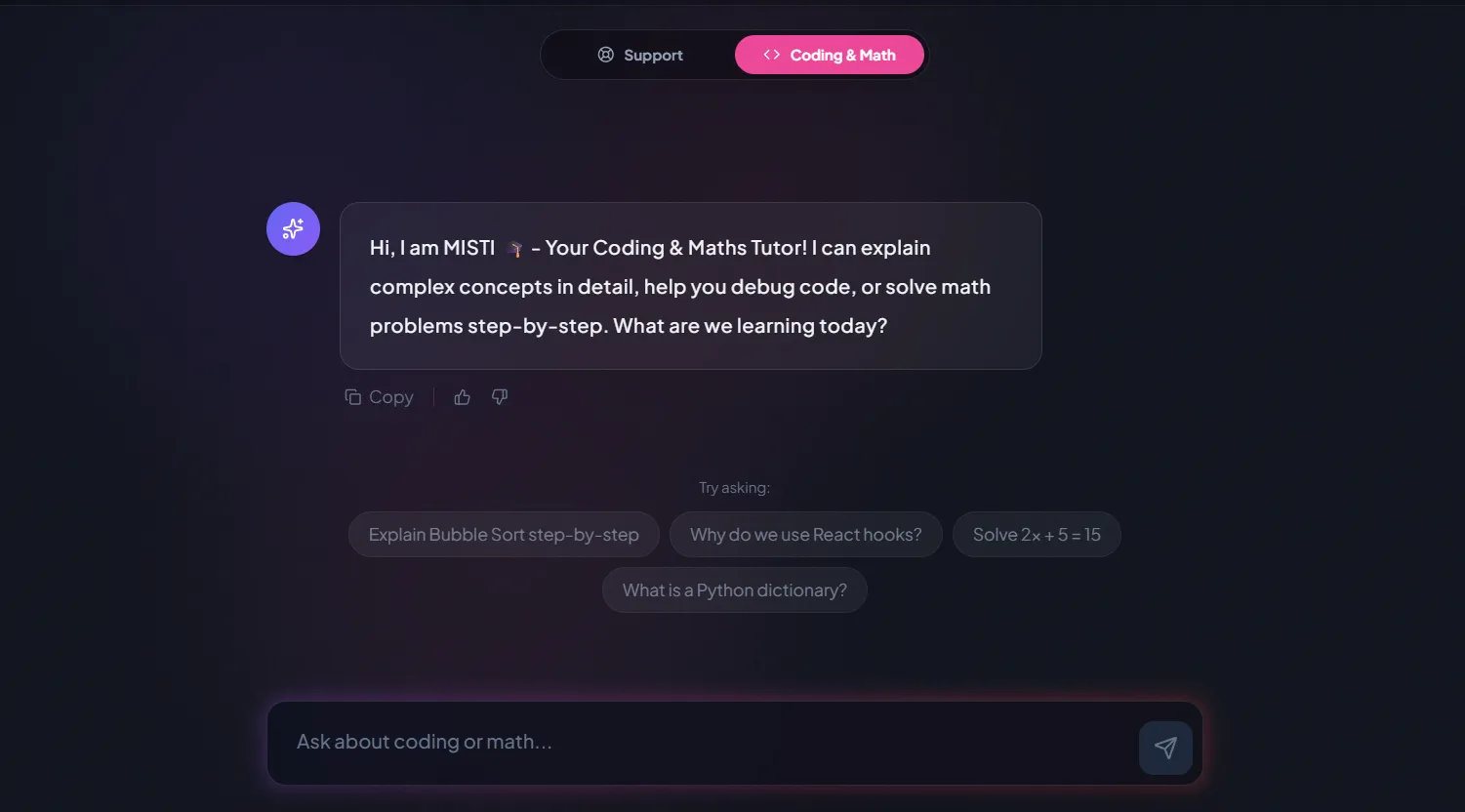
AI and ML
A chatbot that answers mathematics and programming questions, built and deployed by a student.
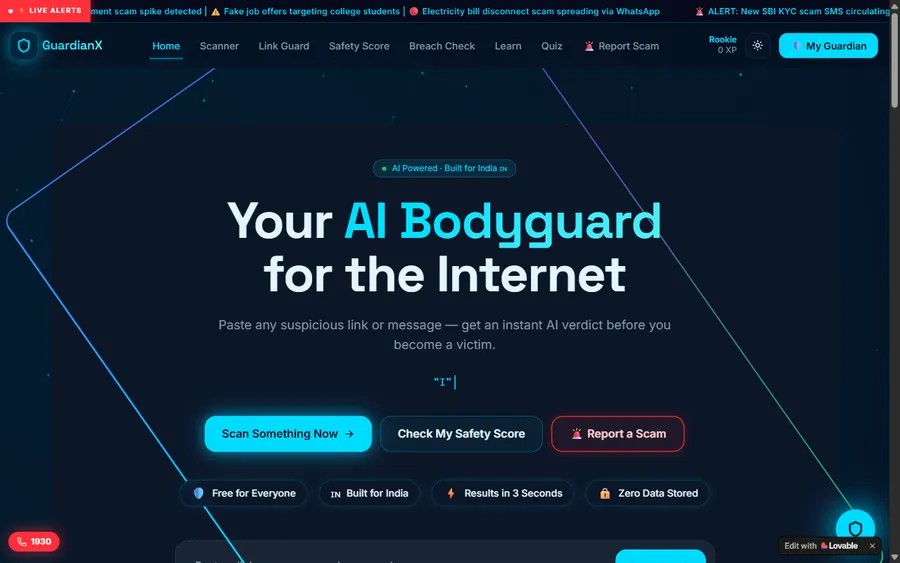
AI and ML
An assistant that helps a young person recognise unsafe situations online.
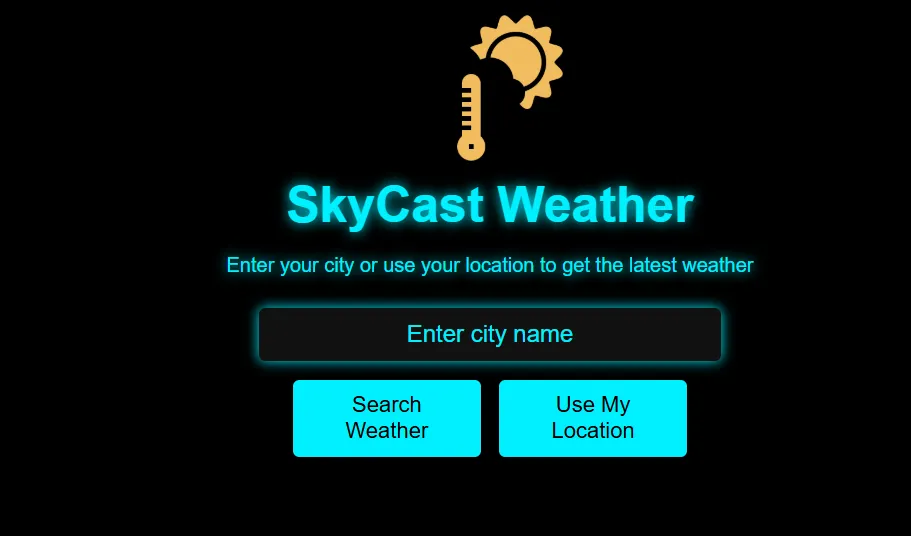
Web app
A weather forecasting site with live conditions for any location.
Fees
The same monthly price in US dollars wherever a family lives outside India. Nothing to join, and you can stop at the end of any month.
Free first class
USD 0
no card required
Group batch
USD 100
a month, billed in US dollars
One to one
USD 150
a month, billed in US dollars
What families say
Reviews left on our Google profile by families, printed as written.
★★★★★
"The one step solution for my son. Modern Age Coders make learning coding so simple that kids love it. The teachers explain complex concepts clearly with practical exercises and interactive content."
Ria Mukherjee
Parent
★★★★★
"Modern Age Coders has been a game-changer for me. I struggled to grasp IT concepts and coding before joining, but their classes transformed everything. I can now confidently write complex programs with ease."
Samriddha Mondal
Student
★★★★★
"One of the most wonderful education centres out there. Education is not limited to school syllabus but focuses on skill development."
Vansh Agarwal
Student
★★★★★
"My child Dhairya is really enjoying the Modern Age Coders classes. This is his first online class and he eagerly looks forward to it. I can already see his improvement, and the teachers are very cooperative."
Sonam Oswal
Parent of Dhairya
★★★★★
"Modern Age Coders have wonderful teachers who teach in a clear, easy and practical way. The teacher boosts students' confidence and inspires them to learn without hesitation."
Sonu Goyal
Parent
★★★★★
"I highly recommend this computer coding class! The teachers are incredibly knowledgeable and passionate about coding."
Ritu Kedia
Parent
CyberFirst Girls questions
Yes, under a new name. Gov.uk says the government runs a TechFirst Girls Competition in November, and CyberFirst became part of TechFirst from September 2026, with the NCSC continuing to lead the cyber pathway.
The NCSC's own announcement says girls in Year 8 in England and Wales, S2 in Scotland and Year 9 in Northern Ireland, in teams of up to four.
A teacher at the school or a school guardian must act as mentor and register the team. A family cannot enter a girl directly, and neither can we.
An online set of puzzles covering topics from cryptography to AI to logic, sat by the team.
The highest scoring teams go to one of 13 finals held across the UK, with one in each of Scotland, Wales and Northern Ireland and the rest in English regions.
The shape is a November qualifying round and finals in February. We do not print exact dates because gov.uk says only that the competition runs in November and we could not date the NCSC announcement that carries specific dates. Check the organiser.
The NCSC says more than 43,000 girls have taken part since 2017.
No. The round is puzzles rather than programming, though a little Python makes several kinds of puzzle much quicker. A full programming course started in October is not the answer.
Counting the possibilities. Ten yes or no questions can pin any number from 1 to 1,000 and nine cannot, because nine questions can only distinguish 512 things. Knowing whether a puzzle can be brute-forced saves more time than any trick.
The first lesson is free. A group place is then USD 100 a month and one-to-one teaching USD 150, with nothing to pay to register.
Related pages
What else is open to a Year 8 student in the autumn, and where the whole year is listed.
November, free, every year group, no programming.
Ten challenges from September to January.
Teams, hidden tests, January and March.
Dates for every contest, checked with the people who run them.
The four school systems, and every UK page.
How to tell a serious provider from a well-designed one.
Start here
Tell us the year group and whether she has written any code. The free lesson works through a real puzzle, and we say afterwards what we saw.
Rather read first? Syllabuses are on the course pages, the method on how we teach, and the topic order on the roadmap.
WhatsApp us · +91 91233 66161 · contact@modernagecoders.com
The quickest route to us is usually a WhatsApp message, which is free from a UK mobile. The number is Indian, as we state everywhere, and there is no office in Britain.