UK / MT1 / 01
Primary maths
The full primary number curriculum, times tables included.
Open the syllabusEngland · Year 4 · Ages 8 and 9
Every June, Year 4 children in England's state schools sit down at a screen for the multiplication tables check: 25 questions, each answered in six seconds or less. The six seconds were chosen on purpose. The Standards and Testing Agency's framework says the limit gives children time to show recall "whilst limiting pupils' ability to work out answers to the questions", and it was set after trialling three time limits with 1,124 pupils. So the check is not really about multiplication. It is about memory. A child who reaches 7 x 8 by counting up in sevens is doing real mathematics, but the limit was set precisely so that working it out would not fit. This page explains what the check measures, which tables it leans on, what the 2025 results show, and how practice that builds recall differs from practice that only builds speed.
Live teaching since 2020 · 10,000+ students · From the STA framework and DfE statistics
In short
The multiplication tables check is a statutory on-screen check taken in June by Year 4 pupils in England's state-funded schools. Each child answers 25 questions of the form 6 x 7, drawn from the 2 to 12 times tables, with six seconds to answer each and a three-second pause between them. There is no pass mark. The check is designed to test instant recall, not calculation: the six-second limit exists to stop children working answers out, and more questions come from the 6, 7, 8, 9 and 12 tables, which the framework calls the most difficult. In 2025 the average score was 21.0, and 37 per cent of eligible pupils scored full marks, the most common result. Modern Age Coders teaches Year 4 children to recall the tables, not just to compute them quickly, in short live lessons with extra time on the weighted tables and practice in six-second windows. The first lesson is free, then USD 100 a month in a group or USD 150 one to one.
Start here
Recall of the tables sits inside wider number sense. Each card opens a full syllabus.
Y4 / 01
Times tables within the whole primary number curriculum, placed by year group and a short check.
Open the syllabus →
Y4 / 02
Number facts held in memory and used without writing, for ages 5 to 10.
Open the syllabus →
Y4 / 03
For children who like a visual picture of number; recall still has to follow for the check.
Open the syllabus →Six seconds
From the Standards and Testing Agency's assessment framework and its 2026 administration guidance.
| Feature | The rule |
|---|---|
| Questions | 25, each worth one mark, in the form 6 x 7, not ordered by difficulty |
| Time | Six seconds per question, starting the moment it appears; the answer is accepted when time runs out |
| Between questions | A three-second pause, unless a child needs a Next button as an access arrangement |
| Answering | Keyboard, touchscreen or mouse with an on-screen number pad |
| Correcting | Not possible once the six seconds end or Enter is pressed |
| Forms | Several equivalent versions, one given to each child at random |
| Restarts | Only after a significant disruption, never just to have another go |
| Pass mark | None |
The framework is blunt about what it measures: "The MTC only assesses the instant recall of multiplication facts." Multiplication in wider contexts, word problems and written methods, is assessed elsewhere in Key Stage 2. The check exists to answer one narrow question, whether a child has the facts in memory by the end of Year 4, which the national curriculum expects: pupils "should have memorised their multiplication tables up to and including the 12 multiplication table".
Counting up in sevens to reach 7 x 8 takes eight steps. Doubling 7 x 4 takes two, plus the time to recall 7 x 4. Both are good mathematics, and both can take longer than six seconds under pressure, with typing still to do.
The framework says the limit was chosen to allow recall "without allowing enough time to work out the answer". It is doing its job when a clever method runs out of time.
The guidance notes: "Research suggests that, in this type of timed assessment, year 4 pupils may find a small benefit from using a keyboard or touchscreen rather than a mouse."
Schools choose the input method. Practising on the same kind of device a child will use in school removes one small source of lost seconds.
Source: Multiplication tables check assessment framework (STA, updated for 2022) and the Multiplication tables check administration guidance (STA, updated 27 April 2026), both on gov.uk.
Which tables count
Each version of the check draws from 121 facts, the 2 to 12 tables, within fixed limits per table.
| Table | Fewest questions | Most questions |
|---|---|---|
| 1 | Not included | Not included |
| 2 | 0 | 2 |
| 3, 4 and 5 | 1 each | 3 each |
| 6, 7, 8 and 9 | 2 each | 4 each |
| 10 | 0 | 2 |
| 11 | 1 | 3 |
| 12 | 2 | 4 |
The framework gives the reason plainly: "There is an emphasis on the 6, 7, 8, 9 and 12 multiplication tables because these have been determined to be the most difficult multiplication tables." The tables children learn first in Key Stage 1, the 2, 5 and 10, supply only three to seven of the 25 questions; the Key Stage 2 tables supply eighteen to twenty-two.
A child who knows the 2, 5 and 10 tables cold but hesitates on 7 x 8 or 12 x 9 has learned the part of the check that counts least. Practice time should follow the weighting.
The first number names the table, so 4 x 12 counts in the 4 table, but the framework also balances how often each second number appears. A child should know 12 x 4 and 4 x 12 as one fact.
Each supplies at most two questions, and the 1 table none at all. Fluency there is necessary but earns little on its own; the marks sit in the harder tables.
2025 results
From the Department for Education's official statistics on the June 2025 check. The 2026 figures are due in November 2026.
| Measure | Published figure |
|---|---|
| Average score, all pupils who took it | 21.0, up from 20.6 in 2024 |
| Full marks | 37 per cent of eligible pupils, the most common score, up from 34 per cent |
| Took the check | 96 per cent of eligible Year 4 pupils |
| Disadvantaged pupils | Average 19.3, up from 18.9 |
| Other pupils | Average 21.7, up from 21.3 |
| September-born pupils | Average 21.6 |
| August-born pupils | Average 20.4 |
| Highest region | London, 21.7 |
| Lowest regions | South East and East of England, 20.7 |
One detail is worth reading carefully. The averages are published rounded, 20.6 and then 21.0, but the release says the score "increased 0.3 points (based on unrounded figures)". Subtracting the rounded numbers would give a different answer, which is why we print each figure as the Department published it and do our own arithmetic on none of them.
Children born late in the school year scored lower on average: 20.4 for August-born pupils against 21.6 for September-born pupils. A child nearly a year younger than some classmates is being measured on the same day.
That is a reason for patience and a little more practice, not alarm. There is no pass mark, and the result is not a verdict on a child.
Schools see their pupils' scores from late June. They can compare their own average with national and local figures, but the guidance says they cannot view or benchmark against other individual schools' data.
The framework says the check helps schools spot children who need support, but it "is not intended as a diagnostic tool".
Source: Multiplication tables check attainment, 2024/25, Department for Education, and its announcement of the 2026 release for November 2026 (provisional).
How to practise
Speed is the symptom the check measures. Recall is the thing to build.
| Builds speed only | Builds recall | |
|---|---|---|
| Method | Faster counting up, quicker tricks | Short daily retrieval of the facts themselves |
| Order | Always the same, 1 x 7 to 12 x 7 | Mixed, so each fact is fetched on its own |
| Focus | All tables equally | More time on 6, 7, 8, 9 and 12 |
| Direction | One way round | Both ways round, as one fact |
| Timing | As fast as possible | Within six seconds, calmly |
| What it leaves | A quick method | The answer, already known |
Understanding still comes first. A child should know why 7 x 8 is eight sevens, see it as an array, and be able to derive it from 7 x 4 when stuck. Those are the foundations the curriculum builds. The check simply asks for the next stage, where the fact no longer needs deriving, and that stage comes from many short, spaced encounters with each fact rather than from one long session.
Short, frequent, mixed-order recall of the tables, with extra repetitions for the 6s, 7s, 8s, 9s and 12s and for any fact a child hesitates on.
Some practice in six-second windows on a keyboard or touchscreen, once recall is secure, so the format feels ordinary by June.
A score. There is no pass mark to guarantee, and children reach fluent recall at different speeds, as the month-of-birth figures show.
That anxiety is worth a few marks. If practice starts to worry a child, we slow down. The check is a snapshot, and schools can use the official practice area from late April to make it familiar.
Many of our younger students do maths and coding together. For children who enjoy building things, the Key Stage 2 coding page covers what the computing curriculum asks at this age, and the Primary Maths Challenge page is for children ready for puzzles beyond the tables.
Progression
Each rung is secure before the next. Most Year 4 children arrive part-way up.
| Rung | Usually | What should be true |
|---|---|---|
| 1. Meaning | Years 2 and 3 | Multiplication understood as groups and arrays; the 2, 5 and 10 tables known |
| 2. Derivation | Year 3 | Unknown facts worked out from known ones, such as doubling or adding one more group |
| 3. Recall | Year 4 | Every fact to 12 x 12 answered from memory, mixed order, both ways round |
| 4. Fluency | By June of Year 4 | Recall within six seconds, typed calmly, on the weighted tables especially |
Deriving facts is valuable mathematics, but it is the stage the six-second limit is built to see past.
A child stuck at rung two needs retrieval practice, not more strategies.
Short sessions several times a week beat a long session before the check.
After Year 4 the same recall carries straight into fractions, division and the rest of Key Stage 2.
The catalogue
Number facts first, then what comes after Year 4, then coding for children who like making things.
UK / MT1 / 01
The full primary number curriculum, times tables included.
Open the syllabusUK / MT1 / 02
Facts held in the head and used quickly.
Open the syllabusUK / MT1 / 03
A visual route into number for younger children.
Open the syllabusUK / MT2 / 01
For families aiming at grammar or independent school entry.
Open the syllabusUK / MT2 / 02
Fractions, ratio and early algebra, where the tables pay off.
Open the syllabusUK / MT2 / 03
From age 10, maths ideas explored by writing small programs.
Open the syllabusUK / MT3 / 01
Games and animations with blocks, a first taste of logic.
Open the syllabusUK / MT3 / 02
For children who would rather build a game than play one.
Open the syllabusUK / MT3 / 03
For a younger brother or sister, ages 4 to 7.
Open the syllabusHow lessons work
Our teachers are in India, where the clock stays put all year, so England is four and a half hours behind in summer and five and a half in winter. Lesson times are set in UK time.
After school
Short sessions, which eight-year-olds manage well.
Early evening
Before tea, while attention is fresh.
Weekend morning
A slightly longer lesson with games.
Facts asked out of sequence, so each one is recalled rather than counted from the last.
More repetitions for the 6, 7, 8, 9 and 12 tables, matching the check.
4 x 12 and 12 x 4 practised together as one fact.
Timed practice only once recall is secure, and never in a way that frightens a child.
Arrays and derivations taught properly, so recall rests on meaning.
Five to ten children at one stage, with games that keep it light.
Student work
Four projects from lessons, none of them tests. More in student labs.
AI and ML
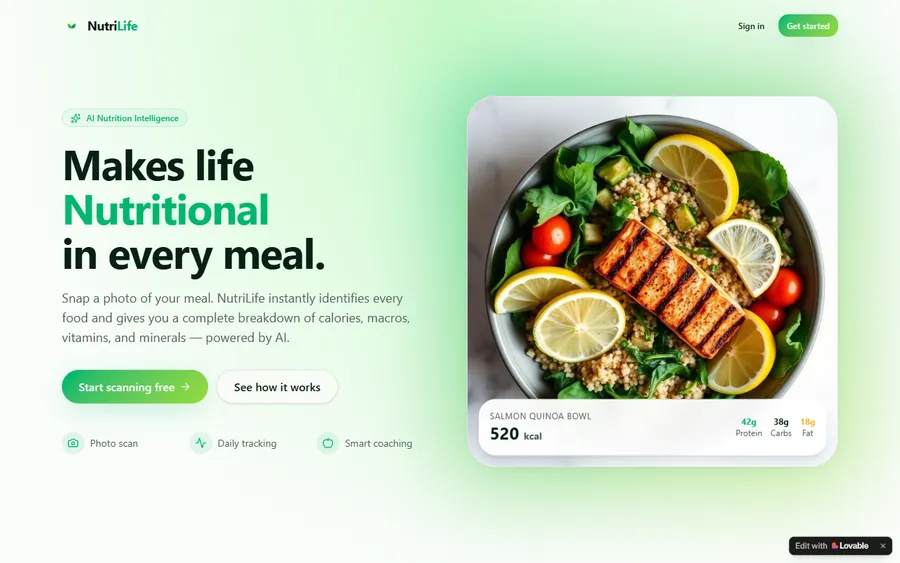
An AI nutrition coach that reads what you eat and works you toward a target.
AI and ML
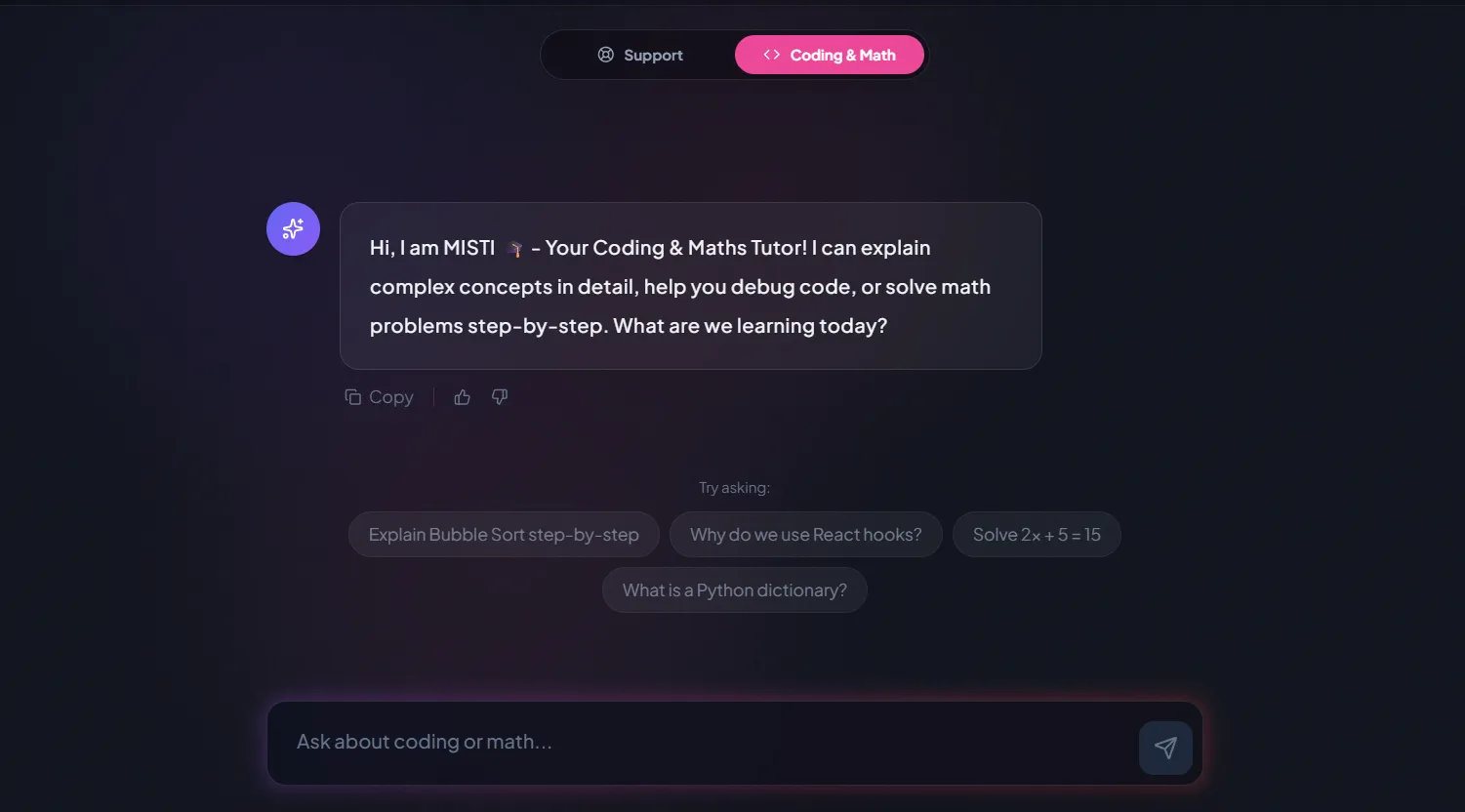
A chatbot that answers mathematics and programming questions, built and deployed by a student.

AI and ML
An assistant that helps a young person recognise unsafe situations online.

Web app
A weather forecasting site with live conditions for any location.
Fees
One monthly fee in US dollars, the rate for every family outside India. The first lesson is free, and nothing is charged until a course and a weekly time are settled.
Free first class
USD 0
no card required
Group batch
USD 100
a month, billed in US dollars
One to one
USD 150
a month, billed in US dollars
What families say
Google reviews from parents, exactly as they posted them.
★★★★★
"The one step solution for my son. Modern Age Coders make learning coding so simple that kids love it. The teachers explain complex concepts clearly with practical exercises and interactive content."
Ria Mukherjee
Parent
★★★★★
"Modern Age Coders has been a game-changer for me. I struggled to grasp IT concepts and coding before joining, but their classes transformed everything. I can now confidently write complex programs with ease."
Samriddha Mondal
Student
★★★★★
"One of the most wonderful education centres out there. Education is not limited to school syllabus but focuses on skill development."
Vansh Agarwal
Student
★★★★★
"My child Dhairya is really enjoying the Modern Age Coders classes. This is his first online class and he eagerly looks forward to it. I can already see his improvement, and the teachers are very cooperative."
Sonam Oswal
Parent of Dhairya
★★★★★
"Modern Age Coders have wonderful teachers who teach in a clear, easy and practical way. The teacher boosts students' confidence and inspires them to learn without hesitation."
Sonu Goyal
Parent
★★★★★
"I highly recommend this computer coding class! The teachers are incredibly knowledgeable and passionate about coding."
Ritu Kedia
Parent
Questions about the multiplication tables check
A statutory on-screen check taken in June by Year 4 pupils in England's state-funded schools. It has 25 questions from the 2 to 12 times tables, with six seconds to answer each.
No. The guidance states there is no expected pass mark. Higher scores show more fluent recall, and schools use the results to see which children need more support.
The framework says the limit gives time to recall an answer while limiting the chance to work it out. It was set after the Standards and Testing Agency trialled three limits with 1,124 pupils.
The 6, 7, 8, 9 and 12 tables, with two to four questions each, because the framework judges them the most difficult. The 2 and 10 tables supply at most two each, and the 1 table none.
The average score was 21.0 out of 25, and 37 per cent of eligible pupils scored full marks, which was the most common result. The 2026 figures are due in November 2026.
August-born children averaged 20.4 in 2025 against 21.6 for September-born children. A child nearly a year younger than some classmates may simply need longer, and there is no pass mark to miss.
Schools decide. The guidance notes that Year 4 pupils may find a small benefit from a keyboard or touchscreen rather than a mouse, so practising on a similar device helps.
No. The multiplication tables check is an assessment for schools in England. The other nations have their own approaches to primary maths.
Schools can give pupils access to an official practice version, the try it out check, from late April. It has three practice questions and then 25 questions, and gives no score.
The first lesson is free. After that there is one monthly fee in US dollars, lower for a group place than for one-to-one teaching, with the amounts in the fees section and nothing paid ahead.
Elsewhere on this site
Coding at this age, maths puzzles, and what comes next.
What the computing curriculum asks of children aged 7 to 11.
Puzzles for children ready to go beyond the tables.
For families looking ahead to grammar school entry.
Gentle maths and coding contests to start with.
The English system from primary school upward.
Every UK page we publish, in one place.
Start here
Leave a number and we will call at a UK time that suits your family. The first lesson is gentle, finds which facts are already secure, and ends with a plan.
Want to read first? Every course page sets out its syllabus, how we teach explains our approach with young children, and student labs shows what they make.
WhatsApp us · +91 91233 66161 · contact@modernagecoders.com
WhatsApp is quickest and free from a UK phone. It reaches our office in India, so the number starts +91.