PATH / 01
AI Literacy for Kids
The universal first course: judgement before accounts, from age 6, parents welcome in any session.
Open the syllabusFor deciding parents · No panic sold here · Worldwide
Every ad answering this question profits from your yes, including, in fairness, ours. So here is the version we would want as parents: "learn AI" means three different things, judging it, building with it, and building it, and they have different answers, different starting ages, and different children they suit. One of the three has become as basic as road safety and we recommend it for essentially every child. The other two are wonderful, optional, and should follow your child's actual curiosity rather than your feed's actual anxiety. This page separates the three, gives you the ready signals for each, and names the fears you can safely put down.
Live online · ages 6 to 67 · taught from India, worldwide · from USD 100 a month · first class free
Start here
If the framework below lands, these are the three doors it points at, in the order most families walk them.
PATH / 01
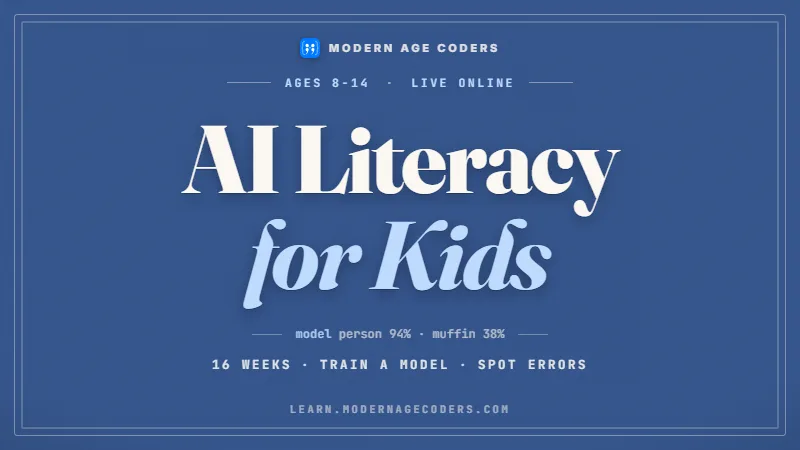
The for-everyone course: what AI is, why it errs, how to check it, taught from age 6 with no child accounts anywhere in the design.
Open the syllabus →
PATH / 02
The makers' door: games and tools shipped weekly, for the child who lights up when something they imagined starts existing.
Open the syllabus →
PATH / 03
The deep door: training real models and learning why they behave as they do, for the teenager who keeps asking how it knew.
Open the syllabus →The short answer
"Should my child learn AI" is three questions. Should they learn to judge AI output, literacy: yes, essentially every child, starting as young as 6 with concepts and no accounts, because they already live among these systems. Should they learn to build with AI, vibe coding and app building: if they enjoy making things, from 6 with age-appropriate tools, and it should follow interest rather than fear. Should they learn to build AI itself, machine learning: only the genuinely curious, typically from the teen years. The falling-behind panic is a sales device; a calm start beats a scared one in every outcome we can measure. Modern Age Coders teaches all three paths live, worldwide, from USD 100 a month, first class free with parents welcome.
The separation
Conflating these is how families buy the wrong course, and how the wrong course convinces a child that "AI is not for me". Kept apart, each question answers itself.
| Judging it | Building with it | Building it | |
|---|---|---|---|
| What it is | Knowing what AI is, why it errs, when to check | Making apps, games and tools by directing AI | Training and understanding models themselves |
| Who needs it | Essentially every child | Children who love making things | The persistently curious minority |
| Sensible start | 6 to 8, concepts only, no accounts | 6 in blocks; 13 for real tools | Usually 13 plus, maths tolerance helps |
| Driven by | Necessity, like road safety | Interest, and only interest | Fascination, self-selected |
| Wrong reason to start | There is none; it is baseline | A parent's fear of falling behind | Prestige or someone else's child |
The table's most useful row is the last one. Literacy tolerates any motivation because it is short, universal and protective, the swimming-lesson of the digital decade. The building tracks do not: they run on wanting to make things, and a child enrolled on fear produces the saddest object in education, a finished course and a closed door. Our own literacy page covers the first column at depth, and what is vibe coding opens the second.
Inoculation
You are about to shop in a market that runs on parental fear, ours included if we let it. Read both columns once and the ads lose their teeth.
"AI will run the world by 2030.
 Children who start NOW will lead.
 The rest will be left behind.

 Limited seats in this batch.
 Special price ends Sunday.
 Your child's future cannot wait."

# Note what it never mentions:
# your actual child. Any child
# fits this ad. That is the tell.
Every sentence points at your fear and away from your child. Deadlines and disappearing prices are pressure dressed as scarcity; learning has neither.
AI systems will sit inside most
 work and daily life. Judging their
 output is becoming a basic skill.

 Children who learn it calmly do
 fine whenever they start. Panic
 buys the wrong course.

 Building tracks are optional and
 wonderful, for children who like
 building. Watch YOUR child.
 Then choose. There is time.

# A true pitch survives being read
# slowly. This one does.
Notice the true version still ends in a decision, just an unhurried one, centred on the one variable the ads ignore: which child you actually have.
One more inoculation, since you will meet it everywhere: the falling-behind claim. In six years of teaching we have watched eleven year old starters draw level with eight year old starters within months, every time, because the real prerequisites are reading, logic and curiosity, which ordinary childhood builds. The gap that does not close easily is a different one: between children taught to check machine output and children taught to accept it. That gap is worth your attention. The stopwatch is not.
Reading your child
For literacy, the only signal needed is age six and the ability to sit with a group for an hour, because the track is universal by design. For building with AI, watch for the child who modifies rather than consumes: house rules renegotiated, game settings tweaked, a "what if it could" spoken aloud at the screen. For building AI itself, the tell is the question behind the question: not "how do I make it stop losing" but "how did it decide that", asked more than once, unprompted.
The strongest green light of all is boringly simple: the child asks to continue after the free class. We weight that one answer above everything a parent tells us, and we built the free class partly so families could collect it cheaply.
A school term already at capacity: a child with no slack learns nothing from one more scheduled hour, whatever the subject. A sibling's enthusiasm doing the choosing: the younger child deserves their own door, found at their own speed. Or a recent string of educational purchases that did not stick: pause, let appetite return, and note that the door has no closing time, since our oldest beginners are in their sixties.
What should never drive the timing is the feed: a viral clip of somebody's nine year old shipping an app is content, not evidence, and the family it should influence least is yours. When in doubt, take the free class, ask the child, and believe their answer.
The catalogue
Each path has a first course and a natural continuation, so a yes today does not need re-deciding every term.
PATH / 01
The universal first course: judgement before accounts, from age 6, parents welcome in any session.
Open the syllabusPATH / 02
The makers' first course: Scratch games and teacher-driven AI, shipping something small most weeks.
Open the syllabusPATH / 03
The bridge course: real Python for the child whose curiosity outgrew blocks, still no AI accounts needed.
Open the syllabusPATH / 04
The deep path's proper start: training and evaluating real models, for teens who kept asking why.
Open the syllabusFamilies comparing onward steps also look at Vibe Coding for Teens · AI Tools Mastery for Teens · Scratch Complete · Python for Teens · Visual ML with Orange · CBSE Computational Thinking, Kids · Hackathon Prep for Kids. Everything else is on the catalogue.
Fees
Two flat figures in US dollars, every country outside India, and no version of the Sunday-deadline trick anywhere on this site. The price on the day you are ready will be the price today.
Free first class
USD 0
no card required
Group batch
USD 100
a month, billed in US dollars
One to one
USD 150
a month, billed in US dollars
What learners and families say
Real reviews from real families. We neither write nor commission them.
★★★★★
"The one step solution for my son. Modern Age Coders make learning coding so simple that kids love it. The teachers explain complex concepts clearly with practical exercises and interactive content."
Ria Mukherjee
Parent
★★★★★
"Modern Age Coders has been a game-changer for me. I struggled to grasp IT concepts and coding before joining, but their classes transformed everything. I can now confidently write complex programs with ease."
Samriddha Mondal
Student
★★★★★
"One of the most wonderful education centres out there. Education is not limited to school syllabus but focuses on skill development."
Vansh Agarwal
Student
★★★★★
"My child Dhairya is really enjoying the Modern Age Coders classes. This is his first online class and he eagerly looks forward to it. I can already see his improvement, and the teachers are very cooperative."
Sonam Oswal
Parent of Dhairya
★★★★★
"Modern Age Coders have wonderful teachers who teach in a clear, easy and practical way. The teacher boosts students' confidence and inspires them to learn without hesitation."
Sonu Goyal
Parent
★★★★★
"I highly recommend this computer coding class! The teachers are incredibly knowledgeable and passionate about coding."
Ritu Kedia
Parent
The rest of the series
This page is the decision. Each answer it can produce has its own page waiting, from literacy to agents.
Questions deciding parents ask
No, and we say this as people who sell the classes. The field's foundations, curiosity, logic, reading, precise language, are exactly what childhood already builds, and a child who starts AI literacy at 11 catches a panicked 8 year old starter within months. The falling-behind framing sells courses and ruins the fun; the honest framing is that this is a good time to start calmly, not a last chance to start desperately.
Literacy for every child, because judging machine output is becoming as basic as reading. The other two follow interest, not strategy: building with AI suits makers who light up at shipping things, and building AI itself suits the smaller group who keep asking why the machine answered that way. Start with literacy, watch which question your child asks next, and let that question choose the second course.
Literacy is the one we would not delay, for the same reason you would not delay teaching a child to cross roads they already walk beside: your child is likely already inside AI-shaped feeds and tools, and the checking habit protects them now. The building tracks wait beautifully. A year later, the tools will be better, the child will be more capable, and nothing real will have been lost.
Push literacy gently, the way you would push swimming: a safety skill does not require enthusiasm, only completion. Do not push the building tracks, because building runs on wanting to build, and a conscripted maker learns resentment faster than syntax. Often the interest arrives sideways anyway, through games, music, sport statistics or a sibling's project, and the door stays open at every age from 6 to 67.
Six is right for the beginnings of literacy: what is a computer guess, can the machine be wrong, how did it learn. Taught through games and stories, no accounts, no screens beyond what the teacher shows. It is too young for the mainstream tools, whose own terms say 13, and any programme that puts a 6 year old on a chat account has failed your first vetting question. Concepts young, accounts later, in that order.
Some tasks will keep automating, and nobody honest will promise your child a specific job in 2040. What we can say with confidence is directional: the person who can judge, direct and check machine output will be employable across far more futures than the person who can only consume it. You are not buying a career guarantee; you are buying range, and range is the rational purchase under uncertainty.
Emphatically, and early matters here: research and our own classrooms agree that girls opt out of technical subjects through accumulated small signals, not ability. Our batches are mixed, our teachers are deliberate about airtime, and the project-first format helps because a girl who has shipped something real has evidence no stereotype survives. If your daughter is curious, that curiosity is the green light.
Check what the school actually delivers, because coverage varies from excellent to a poster in the corridor. Where school does the concepts well, our tracks complement with the part schools rarely have room for: sustained project work with a live teacher and small batch. Where school coverage is thin, the literacy course fills the base. The free class doubles as a placement conversation and we will tell you plainly if school has it covered.
USD 100 a month for live group batches of five to eight, USD 150 a month for one to one, the same in every country we serve outside India, monthly, no joining fee, stop at any month end. The first class is free without a card, and nothing on this page requires deciding before you have watched one.
One free class, chosen by age band, with you sitting in. It costs ninety minutes, it shows you your own child meeting the material rather than a brochure's child, and it converts this page's framework into a specific recommendation for your specific child, including, sometimes, the recommendation to wait. That honesty costs us enrolments and buys us the 4.9 rating, and we consider it a good trade.
Start
Everything on this page is a framework, and frameworks lose to evidence. The evidence you need costs ninety minutes: one free class in the right age band, you in the room, your child meeting the material. Afterwards, ask them one question, "do you want to go back next week", and believe the answer. We will give you our honest read too, including the read that says wait, because a student who arrives wanting to be there is the only kind we know how to teach well.
Deeper reading for the deciding weeks: the literacy case in full, the operational parents guide, and turning screen time into skill.
WhatsApp us · +91 91233 66161 · connect@modernagecoders.com
Live classes from India to families everywhere; the number rings in India. The form books one conversation, and "we decided to wait" is an answer our mentors accept the first time you say it.