Table of Contents
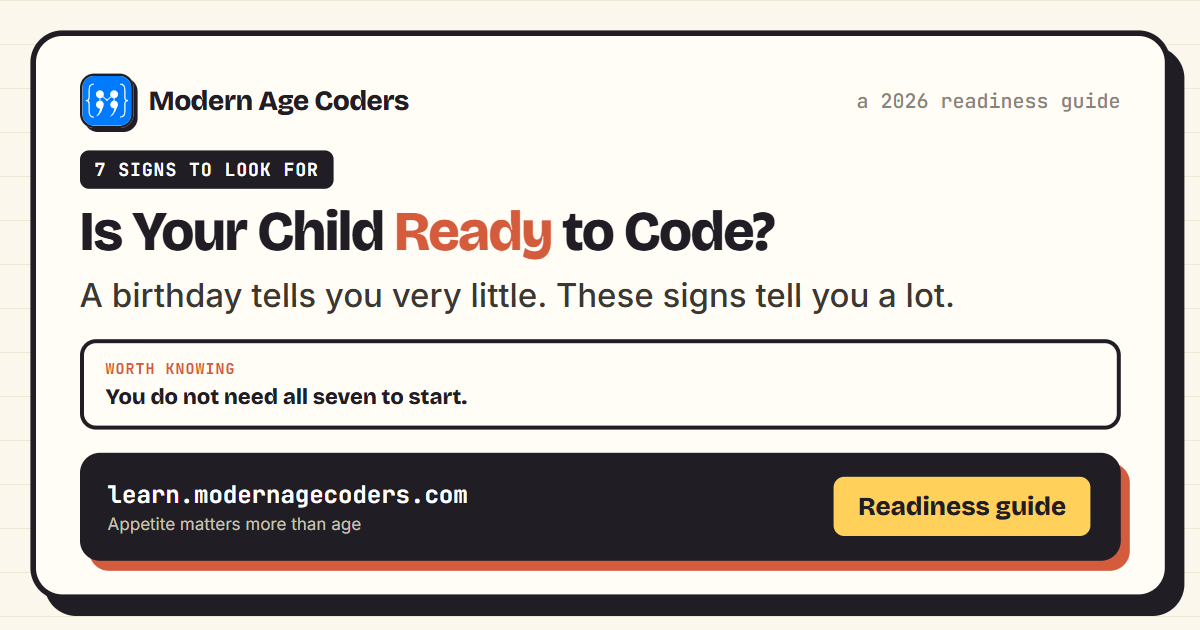
Parents often ask whether their child is old enough for coding. It is the wrong question. A birthday tells you very little; readiness is about a handful of signs that a child is set up to enjoy and get something out of it. Here are seven to look for, what each one actually looks like at home, and what to do once you see them.
The short answer
A child is ready to start coding when they can follow simple step-by-step instructions, enjoy puzzles and building, are curious about how things work, and can concentrate for a short guided session. Many children are ready from around age six with visual, block-based tools. Appetite matters far more than age, so watch for the signs rather than waiting for a particular number.
The seven signs, and what they look like at home
| Sign | What it looks like at home |
|---|---|
| Follows simple instructions | Completes a two or three step task, like get your shoes, put them by the door, then wash up, without repeating |
| Enjoys puzzles and building | Chooses Lego, jigsaw puzzles or building games over just watching a screen |
| Asks how things work | Wants to know why a toy stopped working or how an app actually does something |
| Can focus for a short session | Sits through 10 to 20 minutes of a guided activity without needing constant redirection |
| Likes making things | Prefers inventing their own game or story over only playing ones others made |
| Handles small frustrations | Tries again after a tower falls or a level is failed, instead of giving up entirely |
| Shows interest in screens and games | Already drawn to games or apps, energy that can be redirected into building instead of only consuming |
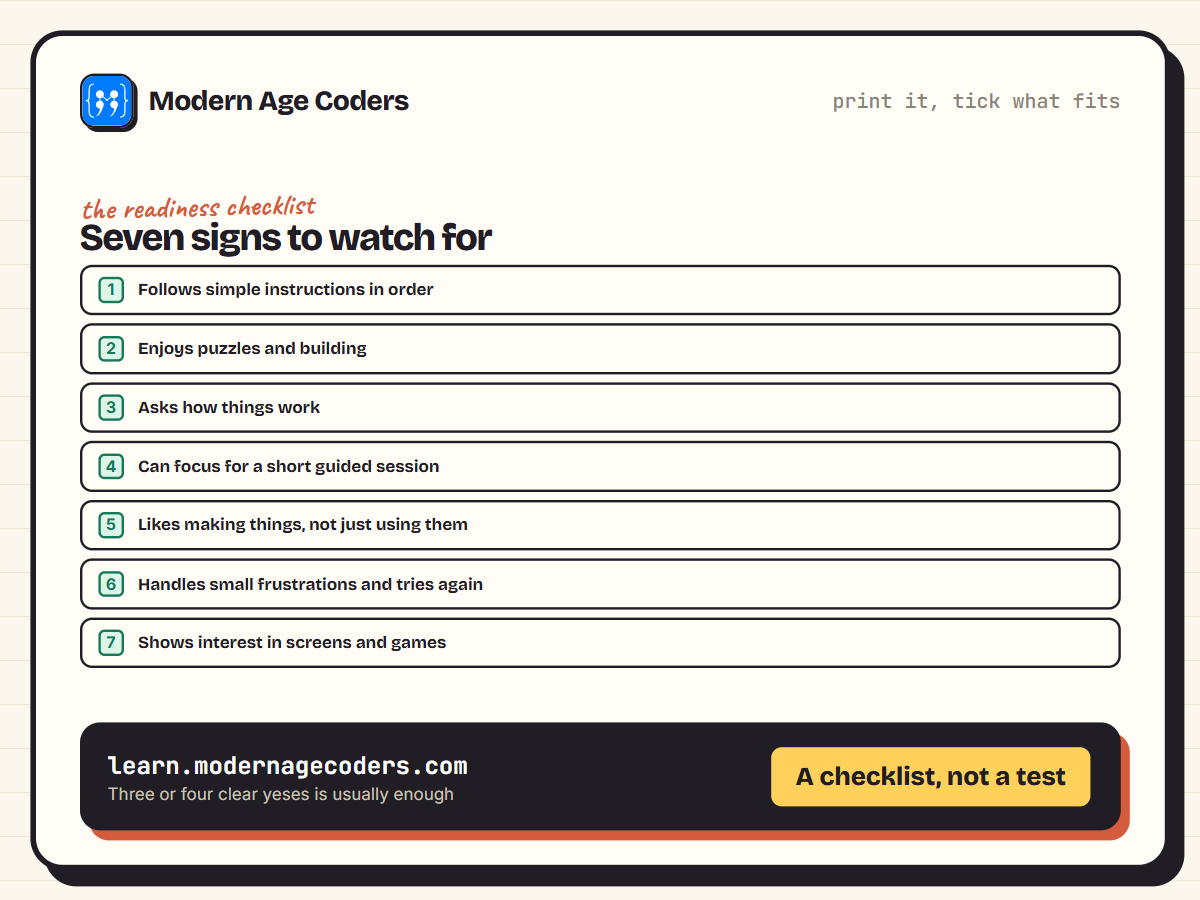
You do not need every sign present at full strength. Three or four of these showing up clearly is usually enough to start, especially with a playful, low-pressure first class. Readiness is a direction, not a checklist you must complete perfectly.
Why age matters less than you think
Two children of the same age can be worlds apart in readiness, and that is normal. This is why a good teacher matches the level to the child, not to the birthday on the form. A six year old who is curious and can follow steps may be more ready than an older child who is not. Watch your own child rather than a chart.
How to start once the signs are there
Begin with visual, block-based coding like Scratch, where children build programs by snapping colourful blocks together, so they learn the logic without worrying about typing or syntax. Keep early sessions short and playful. When a child is comfortable and hungry for more, usually somewhere around ages eleven to thirteen, they are ready to move to a real text language such as Python. A live class with a mentor keeps the level right and the child motivated.
Children do not need another app that teaches them to copy code. They need a mentor who teaches them to think.
, Shivam Khemka, Founder of Modern Age Coders
The bottom line
If your child follows simple steps, enjoys building, asks how things work, and can focus for a short session, they are ready to start coding, whatever their age. Modern Age Coders teaches coding and maths live in small batches for ages 6 to 67, and matches the level to the child rather than the birthday. We are rated 4.9 across 547 Google reviews, and there is a free demo class first, so you can see how ready your child really is.
Frequently Asked Questions
Look for signs rather than a specific age: your child can follow simple step-by-step instructions, enjoys puzzles and building, asks how things work, can focus for a short guided session, and likes making things rather than only using them. If those are there, your child is ready to start, often from around age six with visual tools.
Many children are ready from around age six with visual, block-based tools like Scratch that teach the logic of coding through play. Most move to a text language such as Python around ages eleven to thirteen. Readiness depends on the individual child, so a good teacher matches the level to the learner.
Probably not, if they can follow simple instructions and enjoy building and puzzles. Very young children start with playful, visual tools and short sessions, guided by a parent or teacher. The goal at that age is thinking skills through play, not typing, so age is rarely a barrier when the tools fit.
Some frustration is normal and even useful, because coding teaches that a bug is information, not failure. What matters is that the child can try again after a wobble. A patient teacher frames mistakes as part of the process, which builds resilience rather than discouragement.
Start with visual, block-based coding like Scratch, keep sessions short and playful, and move to a real language such as Python when the child is comfortable and wants more. A live class with a mentor keeps the level right and the child engaged, which matters more than any particular tool.
No. Three or four of the signs showing up clearly is usually enough, especially if the first sessions are short, playful and low-pressure. Waiting for a child to tick every box before starting usually just delays something they would have enjoyed sooner.
That is fine too. Readiness often develops through exposure rather than appearing fully formed first. A short, playful, no-pressure taste of block-based coding can itself be what sparks curiosity and focus, so trying a single relaxed session is a reasonable way to find out rather than waiting indefinitely.