SOLO / 01
Copilot Studio Agents, Teens
Private-only: assistants that act, built under a teacher's continuous watch, with parents in the setup loop.
Open the syllabusAges 6 to 67 · Private, live, online · Your time zone · Worldwide
Group classes are our default recommendation and we say so on every page of this site, which is exactly why this page can be honest about the cases where they are wrong: the learner with a specific deadline, the one far ahead or far behind their age, the one who goes quiet in company, the family whose week defeats any fixed timetable, and the agents courses, where private supervision is not a preference but a requirement. This page explains what actually changes when the batch disappears, how a private syllabus gets built and reviewed, and when we will tell you to save your money and join a group instead.
Live online · ages 6 to 67 · taught from India, worldwide · one to one at USD 150 a month · first session free
Start here
Two courses where private is the only format, and one example of the everything-else rule: any course we run, taken privately.
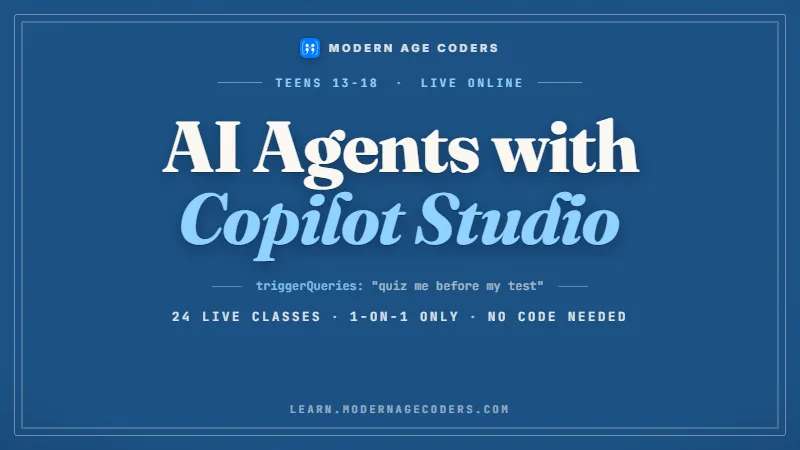
SOLO / 01
One to one by requirement, not preference: software that takes actions gets a teacher watching every action, every session.
Open the syllabus →
SOLO / 02
Terminal agents on your real work, privately, at hours a working adult can actually hold, with the syllabus following your stack.
Open the syllabus →
SOLO / 03
Python for Teens shown as the example: every course in the catalogue runs one to one when the learner's situation calls for it.
Open the syllabus →The short answer
One to one AI and coding classes put a single learner with the same teacher every week, on a written milestone map built from a goal interview and reviewed with the family monthly, at hours pinned to the learner's time zone. It is the right format for specific deadlines, outliers ahead or behind their age band, quiet students, impossible schedules, and the AI agents courses, which are private-only at every age because acting software needs individual supervision. It is the wrong format for learners who feed on peers, which is why our default advice remains the group batch. Modern Age Coders teaches one to one worldwide at USD 150 a month flat, ages 6 to 67, first session free.
The honest matrix
We sell both formats, so this table has no thumb on the scale. Find your learner in the left column and trust the row.
| The learner | Better format | Because |
|---|---|---|
| Chasing a deadline: exam, competition, interview | One to one | The syllabus can sprint; a batch cannot |
| Far ahead or far behind their age band | One to one | Both directions of mismatch waste a batch year |
| Goes quiet in company | One to one, at least first | A voice found in private survives a later batch |
| A schedule no timetable fits | One to one | The slot follows the life, session by session |
| Learning the agents courses | One to one, required | Acting software needs watched actions |
| Motivated by peers, rivals and demo days | The group, clearly | Private teaching cannot supply an audience |
| A beginner with no special constraints | The group, usually | Peers plus lower fee beats bespoke, most times |
The last two rows are the ones a sales page would delete, and they are the reason to trust the first five. Roughly speaking, for every three families who ask about one to one, we recommend it to two and talk the third into a batch, because a misfit format churns within a term and helps nobody. If your learner fits several rows at once, deadline plus quiet, say, the free session is where we read the combination and give you a recommendation with reasons attached.
The difference, at the moment it matters
A student's code fails and they do not know why. This moment is where all teaching formats show their true shape, so here it is in both, honestly.
7:41  Ana's tracker crashes. She
      raises a hand. The teacher is
      mid-thread with Rafael.
7:44  Her turn. A hint, not a fix:
      "read what line 12 believes."
7:46  Meanwhile Priya hits the SAME
      bug aloud. Ana hears the
      thinking, catches hers first.
7:52  Both fixed. The batch saw two
      routes to one answer.

# Slower per student. Richer per
# room. This is the format working.
The queue is real and so is the compensation: a batch multiplies examples, and half of what students learn is watching a peer stuck differently. We sell this format proudly.
7:41  The tracker crashes. The
      teacher was already watching
      the screen, and says nothing.
7:42  "Talk me through what you
      expected line 12 to do."
7:45  The gap between belief and
      code surfaces, in her own words.
7:47  Fixed. Now the syllabus BENDS:
      "That is the third state bug
      this month. Today becomes a
      state masterclass. Ready?"

# The stuck moment did not wait,
# and then it rewrote the lesson.
The bending is the product. No batch can turn one student's recurring weakness into today's entire lesson; a private teacher does it before the kettle boils.
Neither panel is the winner; the learner decides which one is. A student who thrives on the left panel's room energy loses something real in the right panel's quiet, and a student who needed the right panel's immediacy was treading water on the left. Our job in the free session is to tell you which panel we just watched your learner belong to, and our track record of recommending the cheaper format when it fits is, we would argue, the best reason to trust the recommendation either way.
The machinery
"Personalised" is the most abused word in education, so here is ours as a checkable process rather than an adjective.
What does a win look like in six months, in the family's own words: an exam grade, a shipped app, a portfolio, confidence, an agent that runs the shop's reminders. Vague goals are fine; the interview's job is to make them concrete enough to build against.
The free session is a working session, and the teacher reads level from the work itself: what the learner reaches for, what they avoid, where they stop. Ten minutes of real building places more accurately than any form ever filled.
Three to six months of waypoints from where the learner is to where the goal sits, in plain language the family can read. It is a map rather than a cage: its whole purpose is to make deviations visible and deliberate instead of accidental.
Each week's plan is rebuilt from what last week revealed, which is the right panel's superpower made routine: recurring weaknesses become dedicated sessions, unexpected strengths pull milestones forward, and nothing waits for a batch to catch up.
Fifteen minutes, once a month: what moved, what stalled, whether the map still points at the right hill, and the honest conversation if it does not, including the occasional recommendation to switch formats, pause, or declare the goal reached early.
The catalogue
The agents family is one to one by requirement. The rest of the catalogue is one to one whenever the matrix above says so.
SOLO / 01
Private-only: assistants that act, built under a teacher's continuous watch, with parents in the setup loop.
Open the syllabusSOLO / 02
Private-only: terminal coding agents on real work, scheduled around a working life rather than against it.
Open the syllabusSOLO / 03
The kids, teens and college tracks all run privately for deadline sprints, outliers and quiet builders.
Open the syllabusSOLO / 04
The adult favourite privately: your business numbers stay between you and one teacher, which owners appreciate.
Open the syllabusAlso frequently taken one to one: Codex and Claude Code for Teens · Copilot Studio Agents, College · Copilot Studio Agents, Professionals · Python and AI for Kids · AI and ML for Teens · Python Zero to Advanced · Generative AI Masterclass. The full catalogue is on the courses page.
Fees
The private premium here is deliberately small, because we price the format for the families who need it. Both figures are monthly, worldwide outside India, with the exit permanently unlocked.
Free first session
USD 0
no card required
One to one
USD 150
a month, billed in US dollars
Group batch, for comparison
USD 100
a month, five to eight students
What learners and families say
Real reviews from real families. We neither write nor commission them.
★★★★★
"The one step solution for my son. Modern Age Coders make learning coding so simple that kids love it. The teachers explain complex concepts clearly with practical exercises and interactive content."
Ria Mukherjee
Parent
★★★★★
"Modern Age Coders has been a game-changer for me. I struggled to grasp IT concepts and coding before joining, but their classes transformed everything. I can now confidently write complex programs with ease."
Samriddha Mondal
Student
★★★★★
"One of the most wonderful education centres out there. Education is not limited to school syllabus but focuses on skill development."
Vansh Agarwal
Student
★★★★★
"My child Dhairya is really enjoying the Modern Age Coders classes. This is his first online class and he eagerly looks forward to it. I can already see his improvement, and the teachers are very cooperative."
Sonam Oswal
Parent of Dhairya
★★★★★
"Modern Age Coders have wonderful teachers who teach in a clear, easy and practical way. The teacher boosts students' confidence and inspires them to learn without hesitation."
Sonu Goyal
Parent
★★★★★
"I highly recommend this computer coding class! The teachers are incredibly knowledgeable and passionate about coding."
Ritu Kedia
Parent
The rest of the series
This page is the private format. What to learn inside it, at every age and ambition, lives across the rest of the series.
Questions about private teaching
Different rather than lonelier, and it depends entirely on the learner. A private session is a working partnership with one adult who knows your project completely, which many students find more social than a batch, not less, because every minute is conversation. What one to one genuinely lacks is peers: the demo day audience, the batchmate whose different mistake teaches you something. Students who want both often do a term of each, and we will say honestly in the free session which reading we get from your learner.
Concretely: the first month contains a goal interview and a placement, out of which comes a written milestone map for that one learner, three to six months long, reviewed with the family monthly. The weekly session plan is rebuilt around whatever last week revealed, which is the thing a fixed batch syllabus cannot do. When we say the syllabus follows the learner, that map and those monthly reviews are the mechanism, and you can ask to see them at any point.
Yes, by design, because the compounding value of one to one is a teacher who holds the learner's whole history: what they avoid, what unlocked them in March, which explanation style lands. If a teacher becomes unavailable long-term, the handover includes the milestone map and session notes, and the family meets the incoming teacher before anything changes. Random teacher rotation defeats the format and we do not do it.
Yes, in both directions, and it is a conversation rather than a contract change. The common patterns: adults doing the clumsy first two months privately and then joining a batch; a teen leaving a batch for a private sprint before an exam or competition and returning after; a child who went quiet in a group finding their voice one to one. Format is a tool, and the right answer can change with the season.
The slot is pinned to your clock, not ours, and one to one is the format for lives that fixed batch times cannot fit: shift workers, travelling parents, athletes with training calendars, students juggling school systems. Rescheduling inside a week is normal rather than penalised, because the alternative is a missed session nobody benefits from. The teacher keeps the odd hours; that is part of what the fee buys.
Each learner gets their own enrolment and their own sessions, and this is pedagogy rather than billing: two siblings are two different learners with different paces, different gaps and, usually, a strong opinion about each other's answers. What families sometimes do instead is enrol both and schedule the sessions back to back, which keeps one screen-time window for the household while giving each child a session that is entirely theirs.
Almost everything we teach runs in both formats: vibe coding, Python, web, app development, analytics, machine learning. The exception is the AI agents family, Copilot Studio and the terminal coding agents, which we teach one to one only at every age, because software that takes actions needs a teacher watching every action, an argument made in full on the agents pages. If you came to this page for agents, the format question is already answered.
Yes, the same promise as everywhere on this site: the first session is free, no card, and it is a real working session with the actual teacher, not a separate salesperson. For one to one it doubles as the start of the goal interview, so nothing about it is wasted if you continue, and nothing about it obligates you if you do not.
USD 150 a month, flat, in every country we serve outside India, billed monthly with no joining fee and no minimum stay. For comparison, group batches are USD 100, so the private premium is deliberately small: we price the format for families who need it rather than as a luxury tier. The agents courses, which are one to one only, sit at the same USD 150.
Send the form and tell us two things on the callback: who is learning, and what a win would look like in six months, even roughly. The free session takes it from there, and by its end you will have met the likely teacher, seen the format working on your learner's actual level, and heard our honest read on whether one to one or a batch serves this particular goal better.
Start
Tell the mentor who calls what a six-month win would look like, however roughly, and the free session is built around it: a real working hour with the teacher who would actually take the engagement, a placement read from real building rather than a form, and at the end, our honest recommendation, one to one, a group batch, or a different plan entirely. Families arrive expecting a pitch and leave with a map, which is the exchange this whole page has been describing.
Comparing formats first? The beginner page shows the group world's on-ramp, AI agents for teens explains the private-only requirement in depth, and how we teach covers the method both formats share.
WhatsApp us · +91 91233 66161 · connect@modernagecoders.com
All private sessions are live video taught from India to your time zone; the number rings in India. Sending the form schedules one call, and hearing "a group would serve you better" on it costs the same as everything else here: nothing.