KIDS / 01
AI Literacy for Kids
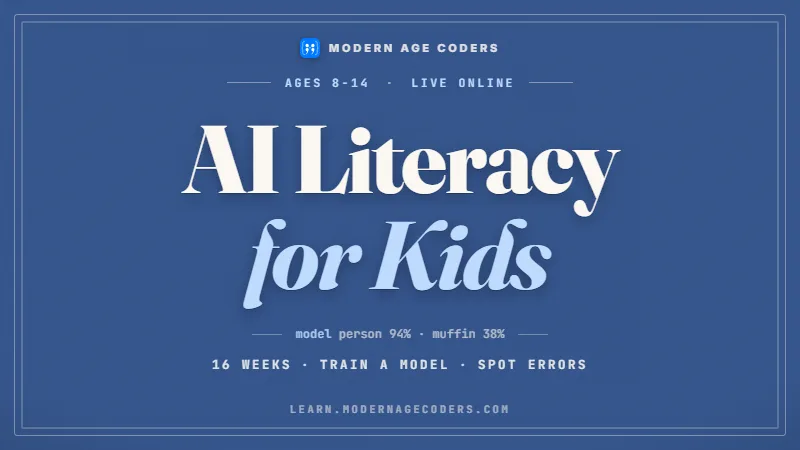
The concepts track: projects 8, 9 and 10 live here, plus the checking habits that last a lifetime.
Open the syllabusAges 6 to 12 · No child accounts anywhere · Worldwide
Here is the awkward fact under most "AI for kids" content: every mainstream AI chat platform sets its minimum age at 13, so lists that send your eight year old to a chatbot are breaking terms in the first step. It turns out the constraint is a gift. The deepest ideas in AI, training, data, bias, confidence, the difference between following rules and learning, can all be taught to a 7 year old with a camera, a browser tool that needs no sign-in, some cardboard, and a parent willing to play robot. This page is ten such projects, each honest about the concept it smuggles in, plus the classes where a teacher runs them with a batch of children weekly.
Live online · ages 6 to 67 · taught from India, worldwide · from USD 100 a month · first class free
Start here
Every project below is a class exercise somewhere in these three courses, run by teachers who know exactly where each age gets stuck.
KIDS / 01
The concepts course: the robot game, the biased classifier and the confidence meter live here, alongside the why-machines-err foundations.
Open the syllabus →
KIDS / 02
The builders' course: Scratch games and gadgets shipped most weeks, with the teacher driving any AI demonstration on screen.
Open the syllabus →
KIDS / 03
The bridge course: real Python for children whose curiosity outgrows blocks, still without a single child AI account.
Open the syllabus →The short answer
Children aged 6 to 12 can do real AI projects without any child accounts, which matters because every mainstream AI chat platform sets its floor at 13. The working toolkit is browser-based training tools that need no sign-in, Scratch, unplugged games, and a parent or teacher driving any account-gated tool. Ten projects on this page cover the core concepts honestly: camera classifiers teach training and data, the deliberately biased robot game teaches why AI errs, rule-following bots teach the difference between programmed and learned behaviour. Modern Age Coders runs these as live classes for kids at USD 100 a month for groups of five to eight, USD 150 one to one, first class free with parents welcome.
The list
Run them in any order, though one to three make the friendliest start. The concept column is for you; the child just gets a brilliant afternoon.
1. The rock-paper-scissors umpire. Train a no-sign-in browser classifier on the three hand shapes, then play against the family. Teaches: a machine learns from examples, and more examples make it fairer. 2. The pet mood detector. Sleepy cat versus alert cat, from your own photos. Teaches: the machine only knows the moods you showed it, which is the training-data idea in one sentence. 3. The sound switch. Claps versus snaps versus silence, triggering different pictures. Teaches: classification is not just for images. 4. The drawing guesser. Play the public browser game where a neural network guesses sketches. Teaches: the machine recognises patterns from millions of other children's drawings, and fails charmingly on original ones.
5. The rule-bot. A chat character whose every reply the child writes as if-then blocks. Teaches: this is programming, not learning, and the bot will never say anything the child did not put in. 6. The face-paint mirror. Effects that follow a face using sensing blocks. Teaches: detection versus understanding, since the sprite tracks a face without knowing it is one. 7. The fairness scoreboard. A two-player game where the child must make the scoring fair for a younger sibling. Teaches: rules encode values, the gentlest possible introduction to why AI fairness is hard.
8. The breakfast robot. A parent becomes a robot that must be taught to make breakfast from examples; the full script is below. Teaches: training, generalisation, and the weekend failure that explains half of real-world AI mistakes. 9. The biased sorting hat. The child trains a sibling-robot to sort toys, but the training examples are secretly skewed, so the robot keeps misfiling dinosaurs. Teaches: biased data makes biased machines, felt rather than lectured. 10. The confidence game. Family members guess mystery objects from three clues and must bet points on how sure they are. Teaches: being 60 per cent sure is different from knowing, which is exactly how a classifier's confidence works.
When a family wants a taste of the describe-and-steer loop before 13, the account holder is you: the child dictates a story machine's behaviour, you type, and the child judges and redirects the output. The child practises precision and judgement, the platform's terms stay intact, and the account, the history and the off switch all stay in adult hands. This is exactly how our teachers run AI demonstrations in the kids courses, scaled to a batch.
The best fifteen minutes on this page
Project eight in full. One parent, one child, zero screens, and the deepest idea in machine learning delivered before the toast pops.
PARENT   becomes ROBOT. Robot knows
         nothing. Robot only learns
         from examples.
CHILD    teaches by showing:
         "Monday: cereal, milk, spoon."
         "Tuesday: cereal, milk, spoon."
         "Wednesday: cereal, milk, spoon."
ROBOT    on Thursday, unprompted:
         cereal, milk, spoon. Applause.
CHILD    beams. The robot LEARNED.

# Let this success really land.
# The failure only works after it.
Play the robot honestly: no winks, no shortcuts. The child must genuinely feel that examples, not instructions, produced the behaviour.
SATURDAY arrives. Family wants
         pancakes, like every Saturday.
ROBOT    serves: cereal, milk, spoon.
CHILD    "No! It's Saturday!"
ROBOT    "I was only ever shown
         weekdays. To me, every day
         is a weekday."
CHILD    goes quiet. Then:
         "...we have to teach it
         Saturdays TOO?"

# That sentence is the whole lesson:
# machines fail where their examples end.
A child who has met the Saturday problem owns the idea behind most real AI failures: the world contained something the training data did not. Professionals relearn this weekly.
Everything else on the page is this game wearing different costumes. The pet mood detector fails on the one expression you never photographed; the sorting hat misfiles the dinosaurs it barely saw; the drawing guesser shrugs at your child's genuinely original monster. Each failure is the Saturday problem again, and by the third meeting the child starts predicting it, which is the moment concept becomes intuition. That transfer, engineered weekly, is what the literacy track exists to do, and the building version of the same journey starts at what is vibe coding.
For the grown-ups
The map from afternoon fun to actual curriculum, so you know what you are watching.
| Projects | The concept underneath | Where it matters later |
|---|---|---|
| 1, 2, 3: the classifiers | Machines learn from examples; data is the teacher | All of machine learning, from year 7 to PhD |
| 4: the drawing guesser | Pattern recognition at scale, and its limits | Why models are brilliant and brittle at once |
| 5: the rule-bot | Programmed versus learned behaviour | The most clarifying distinction in AI |
| 6: the face mirror | Detection without understanding | Healthy scepticism about what machines "know" |
| 7: the fairness scoreboard | Rules encode values | Every AI ethics conversation they will ever have |
| 8, 9: robot and sorting hat | Generalisation, and biased data making biased machines | Reading AI headlines accurately, for life |
| 10: the confidence game | Probability as honest uncertainty | Statistics, and trusting model outputs wisely |
A note on sequencing for families who want the arc rather than an afternoon: concepts first, blocks second, text later is the ordering that works, and there is no rush at any stage. A child who spends a whole year on projects like these enters the teen tools at 13 with judgement already installed, which is the single best predictor we see of what happens next. The wider question of whether and when to start at all is treated honestly on should my child learn AI.
The catalogue
Projects at home are wonderful and occasionally combustible. The classes add the concept underneath, the batch of peers, and a teacher who has seen every way a seven year old can get stuck.
KIDS / 01
The concepts track: projects 8, 9 and 10 live here, plus the checking habits that last a lifetime.
Open the syllabusKIDS / 02
The building track: Scratch projects 5, 6 and 7 and far beyond, shipped weekly with demo moments.
Open the syllabusKIDS / 03
The bridge: text coding for the child who finished blocks hungry, still with zero child AI accounts.
Open the syllabusKIDS / 04
The pure foundation: for children who want the whole Scratch world before the AI angle enters at all.
Open the syllabusFamilies at this age also look at Web Development for Kids · App Development for Kids · Hackathon Prep for Kids · CBSE Computational Thinking, Kids · Canva AI Design · Vibe Coding for Teens, the road ahead · AI and ML for Teens, further still. The map is on the catalogue.
Fees
Kids classes carry the same flat figures as everything we teach, in US dollars, monthly, no lock-in. The projects on this page stay free forever either way; the classes are the guided, peered, weekly version.
Free first class
USD 0
no card required
Group batch
USD 100
a month, billed in US dollars
One to one
USD 150
a month, billed in US dollars
What learners and families say
Real reviews from real families. We neither write nor commission them.
★★★★★
"The one step solution for my son. Modern Age Coders make learning coding so simple that kids love it. The teachers explain complex concepts clearly with practical exercises and interactive content."
Ria Mukherjee
Parent
★★★★★
"Modern Age Coders has been a game-changer for me. I struggled to grasp IT concepts and coding before joining, but their classes transformed everything. I can now confidently write complex programs with ease."
Samriddha Mondal
Student
★★★★★
"One of the most wonderful education centres out there. Education is not limited to school syllabus but focuses on skill development."
Vansh Agarwal
Student
★★★★★
"My child Dhairya is really enjoying the Modern Age Coders classes. This is his first online class and he eagerly looks forward to it. I can already see his improvement, and the teachers are very cooperative."
Sonam Oswal
Parent of Dhairya
★★★★★
"Modern Age Coders have wonderful teachers who teach in a clear, easy and practical way. The teacher boosts students' confidence and inspires them to learn without hesitation."
Sonu Goyal
Parent
★★★★★
"I highly recommend this computer coding class! The teachers are incredibly knowledgeable and passionate about coding."
Ritu Kedia
Parent
The rest of the series
This page is the kids' project box. The teen years, the decisions and the deeper tracks each have their own page.
Questions about kids and AI projects
Yes, and that constraint shaped the whole list. The browser-based training tools on this page work without signing in, Scratch runs without an account unless you want to save online, the unplugged games need cardboard and a straight face, and anywhere a grown-up account genuinely helps, the parent or teacher holds it and drives. Every mainstream AI chat platform sets 13 as its floor, so an under-13 project list that requires child accounts is breaking terms by design. This one is built not to.
The unplugged games work from 6, sometimes 5 with a patient sibling. The camera classifiers land beautifully from about 7, when children can hold the idea of examples teaching a machine. The Scratch builds span 7 to 12 depending on reading. The parent-driven story machine works at any age because the adult carries the account and the child carries the ideas. Nothing here has a cliff: an older child just makes a fancier version.
Three of the ten projects use no screen at all, and they are, honestly, the three that teach the deepest ideas. The screen projects are production rather than consumption: a child training a classifier is running experiments, predicting outcomes and revising, which is the scientific method wearing a fun hat. Our usual advice is to judge by what remains afterwards: these projects leave working artefacts and dinner-table stories, which is the opposite of what scrolling leaves.
Scratch itself is coding, and that is part of the point: project six exists precisely to teach the difference. A child who builds a rule-following bot in Scratch and then trains a learning classifier next week has personally felt the line between programmed behaviour and learned behaviour, which is the single most clarifying distinction in all of AI education. Most adults never get it this concretely.
Start with the project nearest their obsession. The drawing guesser feels like a game and is one. The pet mood detector works on a beloved animal. A watcher usually becomes a builder the first time something they trained gets a prediction right, because being the cause is a different pleasure from being the audience, and it is mildly addictive in the good direction. If three projects in they still only want to watch, that is real information too, kindly gathered.
A laptop or desktop with a camera covers everything on the list; the camera matters more than the specs, since half the fun is training on faces, hands and pets. The unplugged games need paper, a pen and a family member willing to be a robot. Nothing requires a purchase, a subscription, an install beyond a browser, or a device newer than roughly eight years old.
The account-free constraint does most of the safety work: no child profile exists to leak. Two habits complete it, and we teach both in class: camera projects train on things and gestures rather than on other people without asking, and nothing trained on family photos gets uploaded or shared beyond the browser it runs in. The browser-based tools on this list process locally or without an account precisely so that a training session leaves no trail.
The projects are deliberately theme-neutral, and the classifiers train on whatever the child loves, dance moves, drawings, the cat. In our experience the framing matters more than the content: presented as science experiments and making, rather than as computer stuff, the gender gap in enthusiasm simply does not appear at this age. Our batches are mixed and our girls-specific pages exist for families who want that emphasis.
USD 100 a month for a live group batch of five to eight children, USD 150 a month one to one, the same figures in every country we serve outside India, billed monthly with no joining fee. The first class is free, no card, and parents are welcome to sit in on any session at this age, not just the first one.
Two good roads. Free: pick project one this weekend, run it as written, and let the child demand the next one, which they usually do. Taught: send the form, and the free class runs a classifier build live with a teacher who knows exactly where seven year olds get stuck. The taught road adds the concept underneath each project and the batch of other children, which is where the confidence compounds.
Start
Forty-five minutes into the first session, your child will have taught a machine to tell two things apart, things they chose, and watched it succeed and then fail exactly where this page predicts. The teacher narrates the why at kid level, the batch laughs at the failures together, and you watch the whole thing from the next chair if you wish. No accounts get created, nothing gets uploaded, and the only thing your child takes away is the story they will tell you at dinner.
Reading first instead? The deciding guide handles whether and when, the literacy page holds the full curriculum this feeds, and coding for girls carries the emphasis some families want.
WhatsApp us · +91 91233 66161 · connect@modernagecoders.com
Live classes from India to families everywhere; the number rings in India. The form books the free session only, and the ten projects above remain yours to run regardless.