IGM / PRE / 01
Middle school maths
Pre-algebra and geometry, the ground Paper 1 is built on.
Open the syllabusPeru · Cambridge IGCSE Mathematics 0580 · Ages 13 to 16
Your child sits Cambridge IGCSE Mathematics at a school in Peru, the papers are in English, and the grade matters for what comes next. This page sets out what the 0580 exam actually asks for in 2025, 2026 and 2027, how the IGCSE years fit beside Peruvian secundaria, why the Core or Extended choice is made early, and the one accuracy habit that quietly decides marks. It ends with how a week of tutoring from India fits a Lima evening.
Live online maths in English since 2020 · 10,000+ students worldwide · Core and Extended
In short
Modern Age Coders offers IGCSE maths tutoring for students in Peru: live online lessons taught in English by maths mentors based in India, covering Cambridge IGCSE Mathematics 0580 at Core and Extended level. Students work through both tiers' non-calculator and calculator papers, the nine syllabus topics and the accuracy rules that cost marks. Learners join a group of fifteen to twenty or study one to one, at an hour that suits the family in Peru time. We teach alongside the school; Cambridge sets and marks the exam.
Courses for IGCSE students
The IGCSE course itself, a firm algebra base for students who joined a Cambridge school late, and the Diploma maths that many IGCSE students in Peru move on to.
IGM / 01
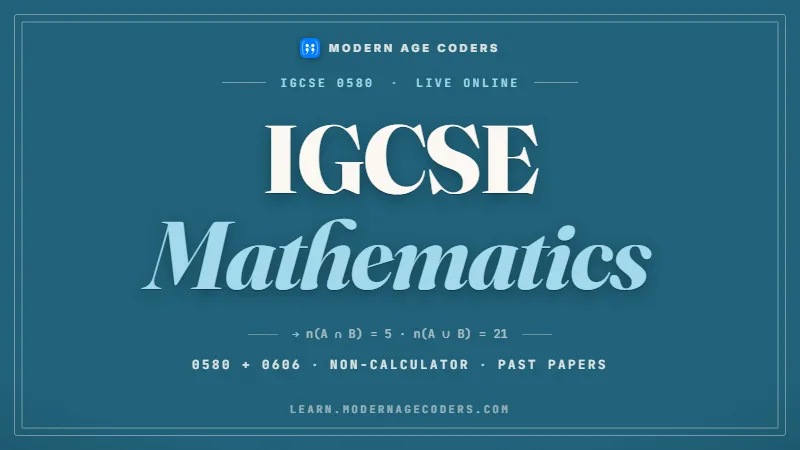
Core, Extended and Additional Mathematics, built around the 0580 topics. Non-calculator fluency and written working get as much time as the calculator papers, because both carry half of the grade.
Open the syllabus →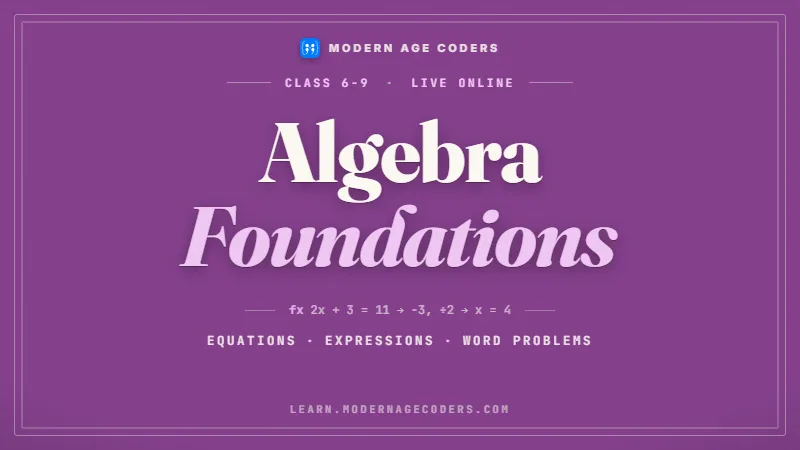
IGM / 02
For a student who arrived from a Spanish-medium colegio into an IGCSE class and finds the algebra moving too fast. Expressions, equations and graphs, rebuilt in English before the Extended content asks for them.
Open the syllabus →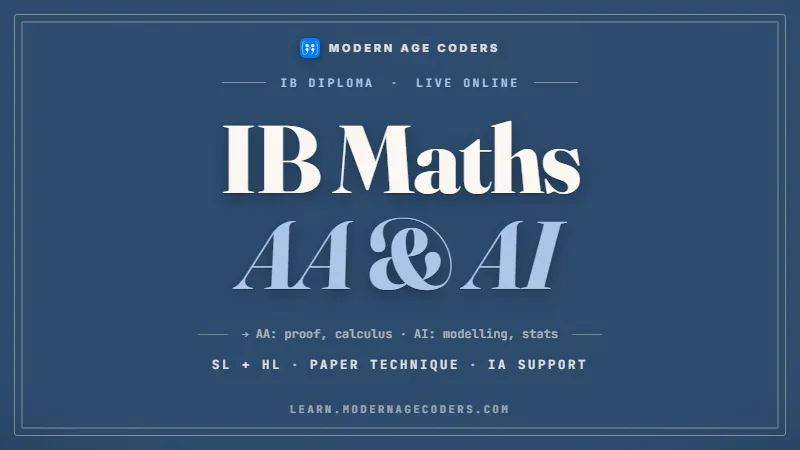
IGM / 03
Where many Cambridge students in Peru go next if their school offers the IB Diploma. SL and HL in both courses, with help on the internal assessment; the school and the IB set and mark the work.
Open the syllabus →Who asks
Mostly families whose child studies maths in English at a school that enters students for Cambridge exams, and a smaller group who are moving into or out of that system. The reasons differ; the exam does not.
They meet the syllabus in class every week but want someone to go deeper, check working line by line, and push them from a safe C to the Extended grades. Often the gap is not knowledge but method: answers that are right but not shown, or rounded too soon.
A child who moved from a Spanish-medium colegio into an IGCSE class at 13 or 14 meets English mathematical language and new topics at once. Vectors, surds or set notation may never have come up in their old school, and the class does not wait.
Parents of a 12 or 13 year old who will start IGCSE next year, or a family returning to Peru from abroad who want the maths to stay in English. Starting a term early with the algebra base is usually worth more than cramming in the final months.
One thing we cannot tell you is how many schools in Peru teach Cambridge IGCSE. Cambridge's own school finder builds its results in the browser and gives no Peru list we could read and check, and we found no MINEDU register of Cambridge schools, so we print no count and name no school. If your child's school enters students for 0580, everything below applies to them.
If what your family wants is maths in English generally rather than a Cambridge exam, our Spanish-language page on a maths teacher who teaches in English covers that, and the Peru overview lists every course we teach there.
The 0580 papers
Two written papers per candidate, one without a calculator and one with, at either Core or Extended tier. Cambridge's syllabus for exams in 2025, 2026 and 2027 sets it out as below, and the June and November series are the ones open to schools outside India.
| Paper | Tier | Calculator | Time | Marks | Share of grade |
|---|---|---|---|---|---|
| Paper 1 | Core | Not allowed | 1 hour 30 minutes | 80 | 50% |
| Paper 3 | Core | Scientific calculator required | 1 hour 30 minutes | 80 | 50% |
| Paper 2 | Extended | Not allowed | 2 hours | 100 | 50% |
| Paper 4 | Extended | Scientific calculator required | 2 hours | 100 | 50% |
Source: Cambridge International, Cambridge IGCSE Mathematics 0580 syllabus for 2025, 2026 and 2027 (Version 3), assessment overview, read on 9 November 2026. Core candidates take Papers 1 and 3 and can be awarded grades C to G; Extended candidates take Papers 2 and 4 and can be awarded grades A* to E. Exams run in the June and November series, plus a March series for schools in India only.
Cambridge writes that the Core content is meant for students aiming at grades C to G and the Extended content for students aiming at A* to C. Extended contains everything in Core plus more, such as exponential growth and decay, surds and harder algebra.
Because the tier caps the grade, the decision matters. A Core candidate cannot be awarded higher than C, however well they do. A student who may be capable of Extended but is not yet secure needs the extra content taught in time for the school's entry decision, not after it.
For this syllabus Cambridge has made one paper at each tier a dedicated non-calculator paper. Half of the grade therefore rests on arithmetic, fractions, standard form and algebra done by hand, with clear working.
Students who grew used to doing everything on a calculator feel this first. The skills are not hard, but they have to be fast and reliable under time pressure: two hours for 100 marks on the Extended paper leaves little room for slow long division.
Cambridge also states that the syllabus and its assessment materials exist in English only, and it designs each IGCSE subject around roughly 130 guided learning hours, a figure it calls guidance rather than a rule. Private candidates may enter for 0580 through a centre that accepts them, and a candidate can retake the whole qualification as often as they wish. One administrative trap is worth a parent's attention: once the entries deadline passes, an entry on the A* to G grading scale cannot be switched to the 9 to 1 scale.
Schools decide tier, entry and series; we do not enter candidates, and we are not a Cambridge school or exam centre. Our job is to make sure the student is ready for whichever papers the school chooses.
IGCSE and secundaria
Cambridge describes IGCSE as a qualification for 14 to 16 year olds. MINEDU fixes a normative age for every grade, counted on 31 March of each school year, and on that rule 14 to 16 falls in 3°, 4° and 5° de secundaria.
| Secundaria grade | Normative age on 31 March | Cambridge stage, roughly (ours) |
|---|---|---|
| 1° de secundaria | 12 | Before IGCSE: number and algebra base |
| 2° de secundaria | 13 | Before IGCSE, or the first IGCSE year at some schools |
| 3° de secundaria | 14 | IGCSE course, first year |
| 4° de secundaria | 15 | IGCSE course, second year; exams for many |
| 5° de secundaria | 16 | IGCSE exams, or the start of a Diploma course |
Sources: MINEDU, Edades normativas para la educación básica ("Se considera la edad normativa al 31 de marzo de cada año"); Cambridge International, Cambridge IGCSE page ("qualification for 14 to 16 year olds"); both read on 9 November 2026. The third column is our own approximate mapping; each school sets its own IGCSE timing.
The CNEB, MINEDU's national curriculum, gives secundaria 4 periods of maths a week on the regular school day and 6 on the full school day, each period lasting 45 minutes. By our multiplication that is 180 or 270 minutes a week.
Schools that teach Cambridge courses set their own timetables, so this is the national reference, not a description of any one school. It still explains why a student who moves between systems can find the pace so different.
We teach alongside school and never in place of it. The school decides the grade a student is in, the tier and the series; Cambridge sets and marks the papers. We do not award Peruvian or Cambridge grades.
What we add is time with one mentor in English: working shown properly, topics the class went through too quickly, and timed practice for both papers. For 5° de secundaria students also facing a Peruvian university exam in Spanish, our page for 5to de secundaria explains how families balance the two.
An accuracy lesson
Cambridge asks for non-exact answers to 3 significant figures, and in the same breath tells candidates to "avoid rounding figures until they have their final answer". Here is a lesson we teach Extended students that shows, with real output, how much that second rule matters.
A machine is worth 2,500 when new and loses 13% of its value every year. In which year does its value first fall below half of the original? This is exponential decay, which the 0580 syllabus lists for Extended candidates with depreciation as its example.
Logarithms are not on the syllabus, so a student answers by trial: multiply by 0.87 again and again until the value drops under 1,250. Many students write each year's value to 3 significant figures as they go, which feels tidy and exam-like.
The tidy way gives year 6. The correct answer is year 5. At the end of year 5 the true value is 1,246.05, which is below 1,250, but rounded to 3 significant figures it becomes exactly 1250 and looks as if it has not crossed the line.
So the student who rounded every year compared a rounded number with the threshold, and lost a whole year. Nothing in the method was wrong except when the rounding happened.
from math import floor, log10

def sf3(x):
    # round x to 3 significant figures
    return round(x, 2 - floor(log10(abs(x))))

value = 2500
half = value / 2

hasty = value
year = 0
while hasty >= half:
    year += 1
    hasty = sf3(hasty * 0.87)   # rounded every single year
    print("Year", year, int(hasty))
print("Hasty answer: year", year)
It prints Year 1 2180, Year 2 1900, Year 3 1650, Year 4 1440, Year 5 1250 and Year 6 1090, then Hasty answer: year 6.
careful = value
year = 0
while careful >= half:
    year += 1
    careful = careful * 0.87    # every digit kept until the end
print("Careful answer: year", year)
print("Value then:", round(careful, 2), "which is", int(sf3(careful)), "to 3 s.f.")
Run straight after Version 1, it prints Careful answer: year 5 and Value then: 1246.05 which is 1250 to 3 s.f.
The lesson we want students to keep is short: compare the unrounded value, then round only what you write down. On paper that means keeping the full calculator display, or the exact expression 2500 × 0.875, until the last line. In Python it means rounding inside the print, never inside the loop.
We then turn it round. Students change the rate to 12% and predict, before running anything, whether the two versions will still disagree. They also explain in two English sentences why the loop condition says >= and what would change with >. Reasoning about the program is the point; Python simply makes the error impossible to argue with.
All four problems are ours, written for this page; none comes from a Cambridge paper. Answers: no, 198; 9,260; year 7 (the value then is about 943); the program agrees, year 7.
Maths in English
Rarely in the mathematics itself. Most lost marks we see come from notation and wording that differ between the maths a child learnt in Spanish and the maths Cambridge writes in English.
| In Spanish-medium school | In a Cambridge paper | Why it costs marks |
|---|---|---|
| 3,5 (comma for decimals) | 3.5 (point for decimals) | A comma in an answer can read as a thousands separator |
| 1.000.000 (point between thousands) | 1 000 000 or 1,000,000 | A point between groups looks like a decimal point |
| cifras significativas | significant figures (s.f.) | Students mix them up with decimal places |
| un billón (a million million) | a billion (a thousand million) | A factor of a thousand, in standard form questions |
| área y perímetro, volumen | mensuration | The topic name itself is unfamiliar on the contents page |
| "a lo más", "por lo menos" | "at most", "at least" | Inequality questions turn on these two phrases |
Our own notes from teaching. Peruvian official documents write decimals with a comma (INEI, for example, writes 84,7% for internet access in Lima Metropolitana); the 0580 syllabus writes them with a point and asks for 3 significant figures unless a question says otherwise.
The 0580 syllabus prints a table of command words with fixed meanings. "Show (that)" asks for "structured evidence that leads to a given result", so the answer is already known and the steps are the marks. "Write down" means "give an answer without significant working". "Explain" means say why or how, with evidence.
A student reading in a second language tends to skim these words, and then writes a bare answer where working was the mark, or pages of working where a single line was enough.
We ask students to say their method aloud in English before writing it. If they cannot explain why a step is there, the examiner will not see why either. It is slow at first and then saves more time than any shortcut.
Mentors speak clearly and at the student's pace, and repeat an idea in simpler words where needed. Students who are still building their English usually find the mathematics is the easier half.
Understanding, not past papers alone
Past papers come at the end, not the start. A student who has only practised question types is stuck the first time Cambridge words something differently, and the Extended papers do exactly that.
Every method is taught from a reason first: why the angle in a semicircle is a right angle, why 0.87 is the multiplier for a 13% fall. A student who knows the reason can rebuild a method they have half forgotten.
Non-calculator sessions build speed with fractions, indices and algebra by hand. Calculator sessions train full-accuracy working and checking. Both get regular timed practice before exam season.
Cambridge weights the Extended papers 50 to 60% towards analysing, interpreting and communicating mathematics, against 30 to 40% on Core. Higher grades depend on explaining, so explaining is what we practise.
We do not hand students answers to copy, from a tutor or from an AI tool. Younger students do not use adult chatbot accounts in class, and older students may use AI only to question their own reasoning after they have solved a problem. Cambridge gives teachers at registered schools access to its own large resource bank, which we do not have and do not claim; we work from the public syllabus and from problems we write ourselves. We are not connected with Cambridge International.
Lima times
Whatever time suits your family. Lima keeps UTC minus 5 in every season and India keeps UTC plus 5:30, a fixed gap of ten and a half hours. Read the rows as clock conversions only.
| Peru time | India time | A typical use |
|---|---|---|
| 06:30 | 17:00 | A short session before the school bus |
| 08:00 | 18:30 | A Saturday morning paper under timed conditions |
| 15:00 | 01:30, next day | Straight after school, by arrangement |
| 18:00 | 04:30, next day | After homework, for a one-to-one |
| 20:00 | 06:30, next day | An evening review before a mock |
Source: IANA time zone database, zones America/Lima (UTC minus 5; Peru last changed its clocks for summer in 1994) and Asia/Kolkata (UTC plus 5:30), checked against INACAL's official Peru time on 8 November 2026. The conversions are ours.
When you book, you choose the hour on your own clock and the mentor sees the same moment in India time. Because neither country changes its clocks, a lesson set for 18:00 in Lima stays at 18:00 through June revision and November exams. A student needs a computer, a reliable connection and a way to show handwritten working: a phone camera or a simple drawing tablet both work.
Stages
These stages are ours, not Cambridge's. We use them to place a student, plan their weeks, and tell parents plainly where things stand.
| Stage | Usual point | The student can | Paper skill |
|---|---|---|---|
| 1. Fluent by hand | Before IGCSE | Work with fractions, negatives and indices without a calculator | Non-calculator accuracy |
| 2. Algebra in English | First IGCSE term | Form and solve equations from an English sentence | Reading command words |
| 3. Core secure | First IGCSE year | Answer every Core topic with working shown | Papers 1 and 3 in time |
| 4. Extended content | Second IGCSE year | Handle surds, functions, vectors and exponential change | Multi-step Extended questions |
| 5. Full accuracy | Before mocks | Carry unrounded values to the end and round once | Accuracy marks kept |
| 6. Exam ready | The final term | Finish Papers 2 and 4 in time and check them | Timed full papers |
Stage 3 is where the Core or Extended conversation with the school becomes real. If a student is secure there by the middle of the course, Extended is usually within reach.
Our notes after lessons say what was covered, what is still weak and what comes next, in plain English.
Round once, at the end, and compare the unrounded value with any threshold.
If you cannot say why a line of working is there, the examiner cannot either.
Further courses
All taught live in English by a mentor who stays with the student, in a group or one to one.
IGM / PRE / 01
Pre-algebra and geometry, the ground Paper 1 is built on.
Open the syllabusIGM / PRE / 02
Number patterns and graphs explored in Python, ages 10 to 15.
Open the syllabusIGM / PRE / 03
Number sense for younger students, long before the non-calculator paper.
Open the syllabusIGM / WITH / 01
Topics 8 and 9 in more depth, from data to chance.
Open the syllabusIGM / WITH / 02
The companion Cambridge subject, full syllabus.
Open the syllabusIGM / WITH / 03
For students who find the syllabus too easy.
Open the syllabusIGM / NEXT / 01
Pure, mechanics and statistics, the British route on.
Open the syllabusIGM / NEXT / 02
Core pure and applied options for strong mathematicians.
Open the syllabusIGM / NEXT / 03
Algebra to calculus, for students heading elsewhere.
Open the syllabusHow lessons run
Any day, any time, flexible: choose a batch, or for a very personalised plan choose 1-on-1 at the hour that suits your family.
Early mornings
Peru mornings fall in the Indian evening, an easy hour for a mentor.
Evenings in Lima
Later slots work too; tell us the hour and we match a mentor to it.
One to one
A plan built around one student's papers, gaps and school dates.
Students show handwritten steps by camera and the mentor marks them live.
Non-calculator and calculator practice, never one without the other.
Evidence for the school's Core or Extended decision, not a guess.
Mathematical terms said slowly and written down as they arise.
Topics covered, errors spotted, the next target.
The same person each week, who learns how the student thinks.
Student work
Some of our maths students also code, and their projects often start from a piece of mathematics they met in class. A few are below; the student labs page has more.

AI and ML
An AI nutrition coach that reads what you eat and works you toward a target.

AI and ML
A chatbot that answers mathematics and programming questions, built and deployed by a student.

AI and ML
An assistant that helps a young person recognise unsafe situations online.

Web app
A weather forecasting site with live conditions for any location.
Fees
Fees are set in US dollars and paid by card. Your bank changes each payment into soles at the rate it uses that day, so the soles figure on your card statement can drift a little between months.
Free first class
Free
no card required
Group batch
$100 USD
a month, eight live classes
One to one
$150 USD
a month, eight live classes
What families say
What parents and students have written on Google, copied exactly.
★★★★★
"The one step solution for my son. Modern Age Coders make learning coding so simple that kids love it. The teachers explain complex concepts clearly with practical exercises and interactive content."
Ria Mukherjee
Parent
★★★★★
"Modern Age Coders has been a game-changer for me. I struggled to grasp IT concepts and coding before joining, but their classes transformed everything. I can now confidently write complex programs with ease."
Samriddha Mondal
Student
★★★★★
"One of the most wonderful education centres out there. Education is not limited to school syllabus but focuses on skill development."
Vansh Agarwal
Student
★★★★★
"My child Dhairya is really enjoying the Modern Age Coders classes. This is his first online class and he eagerly looks forward to it. I can already see his improvement, and the teachers are very cooperative."
Sonam Oswal
Parent of Dhairya
★★★★★
"Modern Age Coders have wonderful teachers who teach in a clear, easy and practical way. The teacher boosts students' confidence and inspires them to learn without hesitation."
Sonu Goyal
Parent
★★★★★
"I highly recommend this computer coding class! The teachers are incredibly knowledgeable and passionate about coding."
Ritu Kedia
Parent
Families in Peru ask
No. Every lesson is live, online and taught in English, which is also the only language Cambridge offers 0580 in. Mentors speak clearly, adjust their pace and accent to the student, and write key terms on screen, so a student whose English is still growing can follow the mathematics.
Cambridge IGCSE Mathematics 0580, in the version for exams in 2025, 2026 and 2027, at Core and Extended level. Our IGCSE course also covers Additional Mathematics. If a school uses another board's IGCSE, tell us at the free lesson and we will say honestly how much overlaps.
The school decides. Cambridge intends Core for students aiming at grades C to G and Extended for A* to C, and a Core candidate cannot get above C. We can show you where your child stands on the Extended content so that the conversation with the school is based on evidence.
One paper at each tier is taken without a calculator: Paper 1 for Core, 1 hour 30 minutes and 80 marks, and Paper 2 for Extended, 2 hours and 100 marks. Each counts for half of the grade, so mental and written arithmetic matter as much as calculator skill.
Any day, any time, flexible: choose a batch, or for a very personalised plan choose 1-on-1 at the hour that suits your family. Peru is on UTC minus 5 all year and India on UTC plus 5:30, so 18:00 in Lima is 04:30 the next morning in India.
No. We are not a Cambridge school or exam centre, and we are not connected with Cambridge International. Entries go through the school, or for a private candidate through a centre that accepts private candidates. We prepare the student for the papers.
We do not award Cambridge or Peruvian grades; Cambridge marks the exam and the school reports on its own work. A student who completes one of our courses receives our own certificate of completion.
Usually not, if you start early enough before the exam. We first rebuild algebra and number in English, then the IGCSE topics in order of need. The free lesson shows how large the gap is, and one-to-one lessons close it faster than a group.
Yes, near the end and under time limits, after the topics are understood. Most of our teaching uses problems we write ourselves, so that a student learns to handle unfamiliar wording rather than memorising familiar questions.
By card, in US dollars. Your bank converts each charge into soles, so the amount on your statement can change a little from month to month. The first lesson is free and no card is needed to book it.
Also on this site
More for families in Peru with a Cambridge or IB student.
A topic-by-topic guide to the syllabus.
For students taking the harder companion paper.
Diploma maths for students in Peru, explained in Spanish.
Coding taught in English for Lima families.
How to choose the format for maths lessons.
A live lesson described step by step.
Part of the guide: Every Peru page
More guides: Coding and AI classes in Peru · En español: clases de programación en inglés · Start here: English-medium coding in Lima · By age and stage: AI and coding for professionals · Subjects and courses: AI agents course · Guides to choosing: An English-taught option to Crack The Code · Regions of Peru: Amazonas region · Cities: Arequipa: coding for every age · Lima and Callao districts: Programación para niños en Ancón
Start here
In the free lesson the mentor gives your child a few questions from both tiers, some without a calculator, and watches how they set out their working. Afterwards you hear which stage they are at, whether Extended looks realistic, and whether a group or one-to-one plan fits better.
Rather read first? How we teach follows one lesson minute by minute, and each IGCSE course on our course list carries its own syllabus.
WhatsApp us · +91 91233 66161 · connect@modernagecoders.com
Lessons are live video calls with mentors in India, conducted in English. For a quick reply, message us on WhatsApp in English.
A priority demo is a full class of about 45 to 60 minutes. After the class the mentor sends a written skill report and a personal learning roadmap on WhatsApp. If you enrol, the demo fee is adjusted against your first month's fee. Share your demo Order ID with us on WhatsApp and we take it off.
Book a priority demo