★★★★★
"The one step solution for my son. Modern Age Coders make learning coding so simple that kids love it. The teachers explain complex concepts clearly with practical exercises and interactive content."
Ria Mukherjee
Parent
CBSE, ICSE and ISC mathematics · Class 6 to 12 · session 2026-27
Most online maths tuition in India is a recorded lecture or a crowd. Ours is a live class of five to ten students in the same class and on the same board, twice a week, with one teacher who knows which chapter each child is stuck on. The CBSE Class 10 year is paced across all fourteen chapters with sample-paper mocks; the Class 11 jump is taught as the new subject it really is; ICSE students get the ICSE syllabus, not a CBSE class with the name changed. Fees are a flat monthly amount, shown on this page, and the first class is a free demo.
Live online · 100% online · batch of 5 to 10 · same teacher all year · first class free
Start here
One course per stage of school, each already running as a live batch: the Class 10 board course, the middle-school ladder for Classes 6 to 8, and the high-school course for Classes 9 to 12.
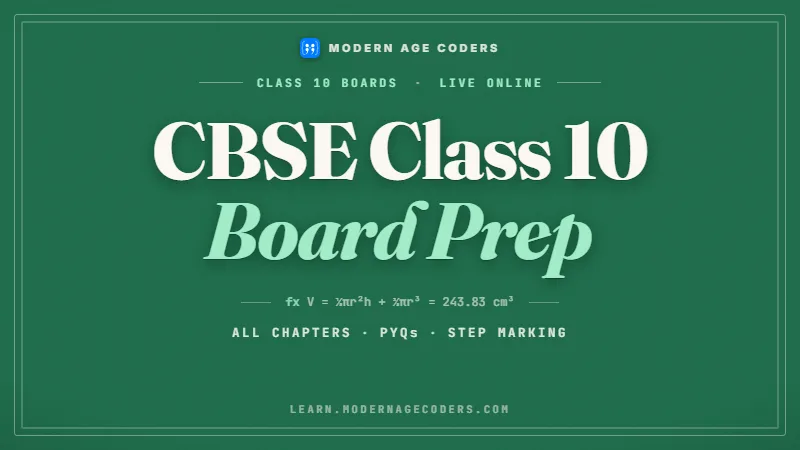
Class 10 / the board year
All fourteen chapters of the 2026-27 syllabus, Standard (041) and Basic (241), with competency and case-study practice and sample-paper mocks, across ten months.
Open the syllabus →
Classes 6 to 8 / the foundation
Integers, fractions, ratio, the first algebra and geometry, taught for understanding, because this is where the gaps that surface in Class 9 begin.
Open the syllabus →
Classes 9 to 12 / the climb
Algebra to trigonometry to calculus and statistics, the ground the Class 11 and 12 syllabus and the JEE both stand on, taught so the Class 11 jump is a step and not a cliff.
Open the syllabus →Ans. The short version
Modern Age Coders teaches CBSE, ICSE and ISC mathematics live online for Class 6 to 12, in batches of five to ten students grouped by class and board, with one teacher for the whole year and two one-hour live classes a week. Classes 6 to 8 build the foundation the later years depend on; Classes 9 and 10 are taught for the board, with the Class 10 year paced across all fourteen chapters of the 2026-27 CBSE syllabus in both Standard and Basic, with sample-paper mocks; Classes 11 and 12 are taught as the new subject they are, with JEE foundation work for students who want it. ICSE and ISC students follow their own syllabus. Each session ends with a short set the student does alone and the teacher marks before the next class. The first class is a free demo, and the group batch fee is shown on this page in your own currency, with no admission fee and the option to stop at any month end.
Q1. What does each class need, and what do we do about it?
The syllabus is public and every tutor claims to cover it. What differs is whether the teaching is aimed at the place where students of that class actually lose marks. Here is that place, class by class, and the batch's answer to it.
| Class | What the board asks | Where students fall | What the batch does |
|---|---|---|---|
| Classes 6 and 7, CBSE and ICSE | Integers and the number line, fractions and decimals, the first algebra, basic geometry, ratio and proportion, data handling | The first letters in place of numbers, and negative numbers; a child confused here is still confused in Class 9 | Concrete before abstract, word problems before formulas, and a short marked set after every class so a confusion lasts days, not years |
| Classes 8 and 9 | Algebraic identities and factorisation, linear equations in two variables, polynomials with the factor and remainder theorems, quadrilaterals and circles, coordinate geometry, statistics and probability | The complexity jump: students who were comfortable suddenly are not, usually on polynomials and proofs | Proof taught as a habit, not a chapter; the JEE foundation course alongside for students who want problems without formulas |
| Class 10, CBSE | Real numbers, polynomials, pairs of linear equations, quadratics, arithmetic progressions, triangles, coordinate geometry, trigonometry and its applications, circles, areas and volumes, statistics, probability: fourteen chapters, Standard (041) or Basic (241) | Competency and case-study questions that ask a familiar idea in an unfamiliar costume, and the trigonometry and heights-and-distances chapters | A ten-month pace across all fourteen chapters, case-study practice from the first term, sample-paper mocks in the last, and a plan built around the board's own weightings |
| Class 10, ICSE | The ICSE Mathematics syllabus: commercial mathematics, algebra, geometry, mensuration, trigonometry, statistics, probability and coordinate geometry | Time: the paper rewards students who can present a solution cleanly and quickly, and punishes rough working | The ICSE syllabus taught as itself, with the presentation of a solution practised from the start, not the CBSE batch renamed |
| Classes 11 and 12, CBSE and ISC | Sets and functions, trigonometric functions, complex numbers, permutations and combinations, the binomial theorem, sequences and series, then calculus, vectors and three-dimensional geometry, probability | The jump: students who scored 90 and above in Class 10 routinely struggle in Class 11, and integration in Class 12 is the hardest topic on the syllabus because there is no single method | Taught as a new subject from the first week, with the ideas behind calculus before the techniques, and JEE-level problems for students who want them |
| Every class | A syllabus set by the board for the session | Recordings watched instead of classes attended | Live and attended; session notes and the marked set the same evening; a catch-up slot after a run of school tests |
One thing about the boards themselves. CBSE and ICSE cover most of the same mathematics in Classes 6 to 10, in a different order and with a different emphasis: the ICSE paper leans harder on presentation and on commercial mathematics, and the CBSE paper, since the competency-based questions arrived, on applying a known idea in a new setting. Our batches are grouped by board as well as class, so a child is never taught the other board's exam. In Class 11 and 12 the same holds for CBSE and ISC.
For the board examination timetable itself, the boards publish their own dates each session and schools circulate them; we pace the Class 10 and Class 12 batches to the school's calendar rather than printing a date here that the board has not yet fixed.
Q2. Where do the marks actually go?
Ten thousand students later, the pattern is stable. Most lost marks are not from hard topics but from four habits, and each one is fixable in a batch small enough that the teacher sees it.
The Class 6 to 8 gap
A child unsure of integers, fractions or the first algebra in Class 6 carries it silently into Class 9, where it surfaces as "not good at maths." The batch for Classes 6 to 8 is built to catch it early: concrete first, then symbols, and a marked set after every class so the teacher knows within a week.
Rote before reasoning
A student who has memorised the quadratic formula and never seen why it works cannot handle the competency question that asks it sideways. We teach the idea, then the technique, then the exam question, in that order, because the board now asks in that order too.
The Class 11 jump
Functions, complex numbers, permutations and the first calculus are not harder Class 10 maths; they are different thinking. Students who treat Class 11 as more of the same fall in the first term. We teach it as a new subject from the first week, and the JEE foundation course runs alongside for those who want the harder problems.
Presentation and time
On the ICSE paper especially, a correct answer with rough working loses marks, and a slow method loses the last question. Every batch practises writing a solution the examiner can follow, and the Class 10 and 12 mocks are sat under the board's time.
The full class-by-class guide, including the topics students find hardest and how online tuition works day to day, is in our CBSE maths tuition guide. Students who find the logic of code easier than the logic of arithmetic often take Maths Through Coding alongside, and Class 8 to 10 students aiming at JEE add the JEE foundation course.
Q3. Why understanding beats memorising on a board paper
A polynomials question of the kind every board paper sets: "Find the remainder when x cubed minus 3x squared plus 4x minus 5 is divided by x minus 2." Watch what happens to a memorised method when the paper changes one word.
Divide x^3 - 3x^2 + 4x - 5 by (x - 2)
by long division:
x^2 - x + 2, remainder -1.

# Then the paper asks:
# "For which value of k does x - 2
#  divide x^3 - 3x^2 + 4x + k exactly?"
# Student sets up the division again,
# with k in it, and stalls. Four marks
# gone on a two-line question.
Correct on the first question, lost on the second, because the method was a procedure and not an idea. This is the competency question doing exactly what it was designed to do.
Remainder theorem: dividing p(x) by (x - a)
leaves remainder p(a).
p(2) = 8 - 12 + 8 - 5 = -1.  Remainder -1.

"For which k does (x - 2) divide exactly?"
Exactly means remainder 0, so p(2) = 0:
8 - 12 + 8 + k = 0, so k = -4.

# Two lines each. The second question
# is the same idea in a new costume,
# which is what the board now asks.
Same syllabus, same chapter, one idea understood instead of one procedure memorised. That is what the first class of every week is for, and why the marked set after it matters.
Every chapter has a version of this, from the number line in Class 6 to integration in Class 12. The plan below is built so the idea always comes before the technique.
Q4. How does the batch work through the year?
Two live classes a week, in a batch of five to ten from the same class and board, with the same teacher all year. One class teaches; the other practises, marks and rehearses.
Twenty questions across the previous year's syllabus, sat alone and walked through together. It tells the teacher which earlier chapters are shaky, and it tells you honestly where your child stands before any tuition begins.
We follow the sequence the child's school follows, so tuition and school reinforce each other. Each idea is taught before its technique, then met in the exam's own question shapes, attempted live and marked live.
Four or five questions, done alone, marked before the next class. The teacher opens every session with what the sets showed, so a confusion lasts days rather than a term.
For Class 10 and Class 12, the whole syllabus is finished with time to spare, case-study and competency practice starts in the first term, and the last weeks are sample-paper mocks under the board's time, reviewed question by question.
Class 10 students who continue with us start the Class 11 syllabus early, as the new subject it is. Students who want more take the JEE foundation course alongside from Class 8, and the olympiad course if the school enters them for contests.
Batch timings are after-school and weekend slots in Indian Standard Time, fixed on the call; Gulf families on the CBSE syllabus join the same batches in their own evening, and the fee for families outside India is shown in your own currency on this page.
Q5. Is this batch right for my child?
A Class 6 to 12 student on the CBSE, ICSE or ISC syllabus who needs the maths explained rather than repeated, in a batch small enough that the teacher knows which chapter they are stuck on. A Class 10 or 12 student who wants the board year paced with mocks rather than crammed in March. A family that wants the fee before the call.
A Class 9 student for whom the complexity jump has arrived. A Class 11 student who scored well in Class 10 and is struggling now. A CBSE family in the Gulf whose school follows the same syllabus and who wants an evening batch in their own time zone. A student aiming at JEE who wants the foundation built properly from Class 8.
A family looking for a recorded course to watch later, because every class here is live and attended. A student on a state board we do not batch for, who should ask us on the call before enrolling. A family looking for a two-week revision blast the fortnight before the board paper.
Q6. What does it cost?
Billed monthly, no admission fee, stop at any month end. The free demo class comes first, or book a Priority Live Demo for a full class today or tomorrow.
Group batch · by class and board
₹1,499
per month
Mini batch
₹2,999
per month
One to one
₹4,999
per month
What families say
Real reviews from real families. We neither write nor commission them.
★★★★★
"The one step solution for my son. Modern Age Coders make learning coding so simple that kids love it. The teachers explain complex concepts clearly with practical exercises and interactive content."
Ria Mukherjee
Parent
★★★★★
"Modern Age Coders has been a game-changer for me. I struggled to grasp IT concepts and coding before joining, but their classes transformed everything. I can now confidently write complex programs with ease."
Samriddha Mondal
Student
★★★★★
"One of the most wonderful education centres out there. Education is not limited to school syllabus but focuses on skill development."
Vansh Agarwal
Student
★★★★★
"My child Dhairya is really enjoying the Modern Age Coders classes. This is his first online class and he eagerly looks forward to it. I can already see his improvement, and the teachers are very cooperative."
Sonam Oswal
Parent of Dhairya
★★★★★
"Modern Age Coders have wonderful teachers who teach in a clear, easy and practical way. The teacher boosts students' confidence and inspires them to learn without hesitation."
Sonu Goyal
Parent
★★★★★
"I highly recommend this computer coding class! The teachers are incredibly knowledgeable and passionate about coding."
Ritu Kedia
Parent
Related pages
The pages for the board subjects that sit next to maths, the competitions, and the live courses this page is built on.
Questions parents ask
Both, and ISC for Classes 11 and 12, in separate batches. Classes are grouped by class and by board, so a CBSE Class 9 student and an ICSE Class 9 student are in different rooms with different papers in front of them. The mathematics overlaps heavily in Classes 6 to 10, but the order, the emphasis and the exam shape differ, and we teach to the paper the child will actually sit.
The CBSE Class 10 batch follows our board prep course: all fourteen chapters of the 2026-27 syllabus in both Standard (041) and Basic (241), paced across ten months, with competency and case-study practice from the first term and sample-paper mocks under the board's time in the last weeks. ICSE Class 10 students get the ICSE syllabus and the presentation practice the ICSE paper rewards.
Any class from 6 to 12. Most families start in Class 6 to 8, where the foundation gaps begin, or in Class 9, where the complexity jump arrives. A Class 11 student who scored well in Class 10 and is now struggling is one of our most common starts, and the honest answer is that they are not alone: Class 11 is a new subject.
Five to ten, from the same class and board, with one teacher for the whole year. That size is small enough that every student is asked questions by name and the teacher knows which chapter each child is stuck on, and large enough that a student hears other people's questions, which are often better than the textbook's. A mini batch of three to four and one-to-one tuition are also available.
Yes. The Class 10 batch is built on the CBSE syllabus published for session 2026-27, and every other batch follows the current syllabus for its class and board in the order the child's school teaches it, so tuition and school reinforce each other rather than compete.
It is planned for. The teacher opens the next session with a short catch-up, the session notes and the marked set go out the same evening, and after a run of missed classes around school examinations we arrange a one-off catch-up slot. Classes are live and attended, not sold as recordings, and the catch-up is how continuity is kept.
Class 11 and 12 batches teach the CBSE and ISC syllabus for understanding, which is the ground JEE stands on, and students who want the harder problems take the JEE foundation course from Class 8 to 10 alongside. We do not sell JEE ranks; we teach the mathematics properly and say honestly, after the placement check, whether a student is ready for competitive-level problems.
Yes, and many families in the batches are exactly that. The syllabus is the same CBSE syllabus your school follows, the batches run in Indian evening slots that fall in the early evening in the UAE, Oman, Saudi Arabia, Qatar, Kuwait and Bahrain, and the fee for families outside India is shown in your own currency on this page.
Session notes and the marked practice set the same evening, yes; recordings as a substitute for attending, no. Every class is live because the teaching depends on the student being asked questions and answering them. If a class is missed, the catch-up described above is how it is recovered.
A mentor calls within a few hours, asks which class and board your child is on and which chapters are giving trouble, and books a free demo class at a time that suits you. The demo is a real session on the chapter your child is currently studying, taught the way the batch teaches, with the teacher showing the idea before the technique. There is no card, no admission fee and no pressure on the call.
Start
Book it and your child joins a live session on the chapter their school is teaching right now: the idea explained, one exam-shaped question attempted and marked, and the honest verdict on where the gaps are. You watch from the next chair. If you would rather see a full 45-60 minute class today or tomorrow, book a Priority Live Demo instead; its fee is adjusted against your first month if you enrol.
Read first instead? The CBSE maths tuition guide walks Class 6 to 12 chapter by chapter, and the olympiad chooser covers the competitions many of the same students sit.
WhatsApp us · +91 91233 66161 · contact@modernagecoders.com
Every session is a live video class. Sending the form books a callback and nothing else; no seat is reserved or lost by it.