MCV / A1
Early maths
Number, shape and pattern for the youngest learners.
Open the syllabusCoventry · Maths for learners aged 6 to 67 · Live lessons online
Trace the Coventry ring road on a map and it looks roughly round. Roughly is not a number, so we measured it. One carriageway, followed all the way round in OpenStreetMap, is 3,677.6 metres long and encloses 97.49 hectares. A perfect circle with the same perimeter would hold about 10% more; a square with the same perimeter would hold about 13% less. On the scale mathematicians use to score roundness, the ring road reaches 0.906 out of 1. Perimeter, area, π and ratio all sit inside GCSE, so one road carries a whole course; below we use it to explain how we teach Coventry learners, starting with eight-year-olds learning tables and ending with sixth formers and adults.
A maths page for Coventry · Children, teenagers and adults · Not linked to any Coventry school or university
How does our maths tuition in Coventry work?
Anyone in Coventry aged 6 to 67 can learn maths with us over live video, sharing a class with five to ten others at a matching level or working alone with a tutor. Primary learners work on times tables for the Year 4 check, KS2 maths and Year 6 SATs reasoning. At secondary school that means KS3 maths followed by GCSE (AQA, Edexcel or OCR, foundation or higher) or the IGCSE route. Sixth formers study A level Maths and, where they choose, Further Maths. Adults come for Functional Skills maths, a GCSE maths resit or a refresher. Our Coventry example measures the ring road: its 3,677.6 metre loop encloses 97.49 hectares, about 90.6% of what a circle could hold with the same perimeter. The trial costs nothing; regular lessons are USD 100 per month as part of a group or USD 150 per month on your own.
Common starting points in Coventry
GCSE, primary and A level maths account for most Coventry enquiries. Every other course is in the full list below.
COV / 1
Foundation or higher on AQA, Edexcel or OCR, with geometry practised on real shapes like the ring road.
Open the syllabus →
COV / 2
Multiplication facts, fractions, area and perimeter, and the reasoning in SATs papers.
Open the syllabus →
COV / 3
Pure, mechanics and statistics for Years 12 and 13; Further Maths is taught alongside on request.
Open the syllabus →All ages
Coventry schools follow the national curriculum for England. The table shows what each stage covers and where our lessons spend their time; adults slot in wherever they need to.
| Stage | Typical age | What our lessons stress |
|---|---|---|
| KS1 | 5 to 7 | Number bonds, counting patterns, shapes and simple measuring. |
| KS2 | 7 to 11 | Times tables before the Year 4 check, perimeter and area of rectangles, fractions, and SATs reasoning in Year 6. |
| KS3 | 11 to 14 | Algebra, angles, ratio, area of compound shapes and the circle formulas. |
| GCSE | 14 to 16 | Foundation or higher tier on the school's board, including circles, arcs, sectors and trigonometry. |
| A level | 16 to 18 | Pure maths, mechanics and statistics; Further Maths for learners who want the extra modules. |
| Adults | 18 to 67 | Functional Skills maths, GCSE maths resits and refreshers at an adult pace. |
State-funded schools in England give the multiplication tables check to every Year 4 pupil, so Coventry eight-year-olds meet it too. In our lessons the tables are linked facts: 8 × 7 is double 4 × 7, and a child who can see that is never completely stuck.
Perimeter and area arrive in KS2 and are often confused. We separate them early with fences and fields, then return to them in Year 6 when SATs maths asks children to reason about shapes rather than just measure them.
For GCSE we work to the learner's exam board and tier, AQA, Edexcel or OCR. Circles, π and area appear on every specification, and the ring road project on this page covers most of that content in one connected problem.
Stage-by-stage detail lives on our national pages: KS2 maths, KS3 maths, GCSE maths, A level maths and Further Maths.
Year 4 check details: gov.uk collection page, checked on 1 October 2026. Key stage ages follow the normal pattern in English schools.
The Coventry project
A circle encloses more area than any other shape with the same perimeter. That makes a neat test for any loop on a map: compare its area with the area of a circle drawn from the same length of string.
On 1 October 2026 we downloaded every mapped section of the A4053 from OpenStreetMap. The road is a dual carriageway, so each direction is mapped separately, in sections with names such as Ringway Queens, Ringway Swanswell and Ringway St Johns. Following the sections that run clockwise gives one complete loop of 44 pieces and 131 mapped points.
Around that loop the carriageway measures 3,677.6 metres. The area inside it, worked out from the coordinates of the 131 points, is 974,929 square metres, or 97.49 hectares. These are our measurements of the mapped line; the real road is wider than a line, so they describe the shape, not the tarmac.
A circle with a circumference of 3,677.6 metres has radius 3,677.6 ÷ 2π, which is 585.3 metres, and area π × 585.3², which is 1,076,258 square metres. So the ring road encloses 974,929 ÷ 1,076,258, or about 90.6%, of the most it could.
A square with the same perimeter would have sides of 919.4 metres and an area of 845,291 square metres, about 78.5% of the circle. The ring road sits comfortably between the two: rounder than a square, less round than a circle.
| Shape | Perimeter | Area enclosed | Roundness score |
|---|---|---|---|
| Coventry ring road, clockwise carriageway | 3,677.6 m | 974,929 m² | 0.906 |
| Circle with the same perimeter | 3,677.6 m | 1,076,258 m² | 1.000 |
| Square with the same perimeter | 3,677.6 m | 845,291 m² | 0.785 |
The score in the last column is 4π × area ÷ perimeter². It equals exactly 1 for a circle, π ÷ 4 for any square, and less for longer, thinner shapes. The ring road scores 0.9059.
It is a good formula for a GCSE learner to rearrange: substitute the circle's area and circumference and watch everything cancel to 1. Then try it for a square and see π ÷ 4 appear.
Here is a puzzle we set in lessons. Pretend the ring road is a circle. Work out the radius from its area, then divide the perimeter by twice that radius. For a true circle you get π. For the ring road you get 3.30.
The extra 0.16 is a measure of how far the road wanders from a circle. The distance from the centre of the loop to the road varies from 424 metres to 654 metres, and the widest span across it is 1,234 metres.
Data: OpenStreetMap contributors, ways tagged A4053, one Overpass query on 1 October 2026. Lengths and areas are Modern Age Coders' calculations on a local flat projection; the other carriageway did not form a closed loop in our download and is left out. GCSE wording: DfE, GCSE mathematics subject content, which asks learners to "calculate: perimeters of 2D shapes, including circles; areas of circles".
A primary method, tested
Before any formula, children estimate area by laying a grid over a shape and counting squares, adding half for each square the edge cuts through. We did exactly that for the ring road with four sizes of grid.
| Grid square | Fully inside | Cut by the edge | Estimate | Error |
|---|---|---|---|---|
| 200 m | 14 | 22 | 1,000,000 m² | +2.57% |
| 100 m | 72 | 48 | 960,000 m² | −1.53% |
| 50 m | 345 | 94 | 980,000 m² | +0.52% |
| 25 m | 1,467 | 188 | 975,625 m² | +0.07% |
Even the coarsest grid, with only 36 squares touching the shape, gets within 3% of the true area. The rule of counting half for each edge square works because, on average, the edge cuts squares roughly in half.
The errors do not shrink smoothly. The 200 metre grid overestimates, the 100 metre grid underestimates, and only after that do the estimates settle. That surprises children who expect each finer grid to be a little better than the last.
At GCSE the same idea returns as the trapezium rule and, at A level, as integration: chop a shape into thin pieces, add them up and let the pieces get smaller. A Coventry learner who has counted squares on the ring road has already met the idea behind calculus.
Our area figure of 974,929 square metres came from the shoelace method, which adds up cross products of neighbouring coordinates. It is quick to code, and A level learners enjoy proving why it works.
All grid counts and errors are Modern Age Coders' calculations, compared with the 974,929 m² shoelace area of the same 131 mapped points.
Maths beyond our lessons
Coventry has a busy maths scene outside the classroom. We list some of it so families can find it. We are independent of every organisation named here.
The NCETM names Tudor Grange Academy, Solihull, as lead school of the Origin Maths Hub, which works with schools in Coventry, Solihull, Rugby, Warwick, Stratford-on-Avon, North Warwickshire, and Nuneaton and Bedworth.
The Mathematics Institute at the University of Warwick lists Saturday afternoon Maths Circles: "On-campus, Saturday afternoon problem-solving sessions for pupils who love maths."
The same page describes Royal Institution Masterclasses as "Saturday sessions on campus for Year 9 and Year 12 pupils run by our staff and students." Places come through schools.
The Mathematics Institute is in the Zeeman Building, and its postcode, CV4 7AL, lies inside the Coventry council area. Its outreach page also lists Mathematical Problem Solving Classes for Year 12, described as "a suite of 10 weekly, face to face classes", and a free family Maths Art afternoon on 14 November, "Most suitable for families with children from 5 years old and up".
Competition fans can read how we coach for the three UK Mathematics Trust individual challenges on our UKMT maths challenge page.
Families in and around Coventry sometimes ask about selective schools. Our 11 plus maths page for Warwickshire describes the test used there; this Coventry page is about maths for every age.
Lessons are online, so a learner in Earlsdon, Tile Hill or Wyken joins from home. We group by level, not location, and a Coventry learner may share a class with someone in Leeds or Cardiff.
Sources: NCETM, Origin Maths Hub; University of Warwick, Mathematics Institute, outreach events for schools; postcode lookup from postcodes.io. All read 1 October 2026. We have no link with the NCETM, the hub, the University of Warwick or any Coventry school.
Grown-ups
Adults make up a steady part of our Coventry learners. Many need a maths qualification; others want to help their children or feel sure of the numbers at work.
Our GCSE course welcomes resit candidates. We spend the first lessons finding what is secure, then rebuild the shaky topics in an order where each one helps the next.
Applied maths for work and further study, from measures and money to charts. Our Functional Skills maths page has the detail.
Fractions, percentages and area for home projects and work. See also our adult maths classes.
Adults tend to love the counting-squares table. Many have measured a room for flooring or a garden for turf, and seeing that half a square per edge is a sensible rule, with the error to prove it, turns a school memory into a tool.
Building up
These four steps are the route through the geometry on this page. A newcomer's starting step is decided in the trial lesson.
| Usually | Step | Secure when the learner |
|---|---|---|
| Years 3 and 4 | 1. Tables and squares | Knows the tables and finds an area by counting squares |
| Years 5 and 6 | 2. Rectangles and composites | Separates perimeter from area and works out L-shapes |
| Years 7 to 9 | 3. Circles | Uses πr² and 2πr with sensible rounding |
| Years 10 to 13 | 4. Comparing shapes | Builds a ratio like 4πA ÷ P² and explains what it shows |
A learner who starts late in GCSE can still improve a great deal, as long as weak foundations are fixed first. Algebra and fractions get attention before anything else.
If the time left is shorter than the gap, we will say so honestly after the free lesson.
Most go on to A level Maths, some with Further Maths. Learners who like data choose our statistics and probability course.
Others turn the shoelace method into code through maths through coding.
Course list
Four groups, from early number to university maths. Each card links to the full syllabus.
MCV / A1
Number, shape and pattern for the youngest learners.
Open the syllabusMCV / A2
Years 1 to 6 in full, SATs reasoning included.
Open the syllabusMCV / A3
Working sums out quickly and correctly.
Open the syllabusMCV / A4
Timed practice in the style of selective tests.
Open the syllabusMCV / B1
Algebra, geometry and number for Years 7 to 9.
Open the syllabusMCV / B2
AQA, Edexcel or OCR, at either tier.
Open the syllabusMCV / B3
The international papers, start to finish.
Open the syllabusMCV / B4
For learners whose algebra never settled.
Open the syllabusMCV / C1
Pure, mechanics and statistics.
Open the syllabusMCV / C2
Problem solving for UKMT and olympiads.
Open the syllabusMCV / C3
Calculus and linear algebra.
Open the syllabusMCV / C4
Probability, distributions and inference.
Open the syllabusMCV / D1
Interest, budgets and growth.
Open the syllabusMCV / D2
The numbers behind analysis.
Open the syllabusMCV / D3
Geometry and data with Python.
Open the syllabusMCV / D4
A visual way into mental calculation.
Open the syllabusTimetable
Our teachers work on Indian Standard Time, which never changes. Coventry runs four and a half hours behind India from spring to autumn and five and a half through the winter; every booking is confirmed on UK time.
Weekday afternoons
Straight after school for primary and secondary.
Weekday evenings
Sixth formers and adults after work or college.
Weekends
Morning lessons for those who prefer them.
The same teacher each week, who knows the learner's habits.
Short notes after lessons about progress and next steps.
Everyone at one level, so no one waits and no one is lost.
Ring roads, plans and real data alongside exam questions.
One to one for a specific gap or a close deadline.
Learners explain a method before practising it.
Student work
Students who started with measuring problems like the ring road have gone on to build the projects below. The student labs have many more.

AI and ML
An AI nutrition coach that reads what you eat and works you toward a target.
AI and ML
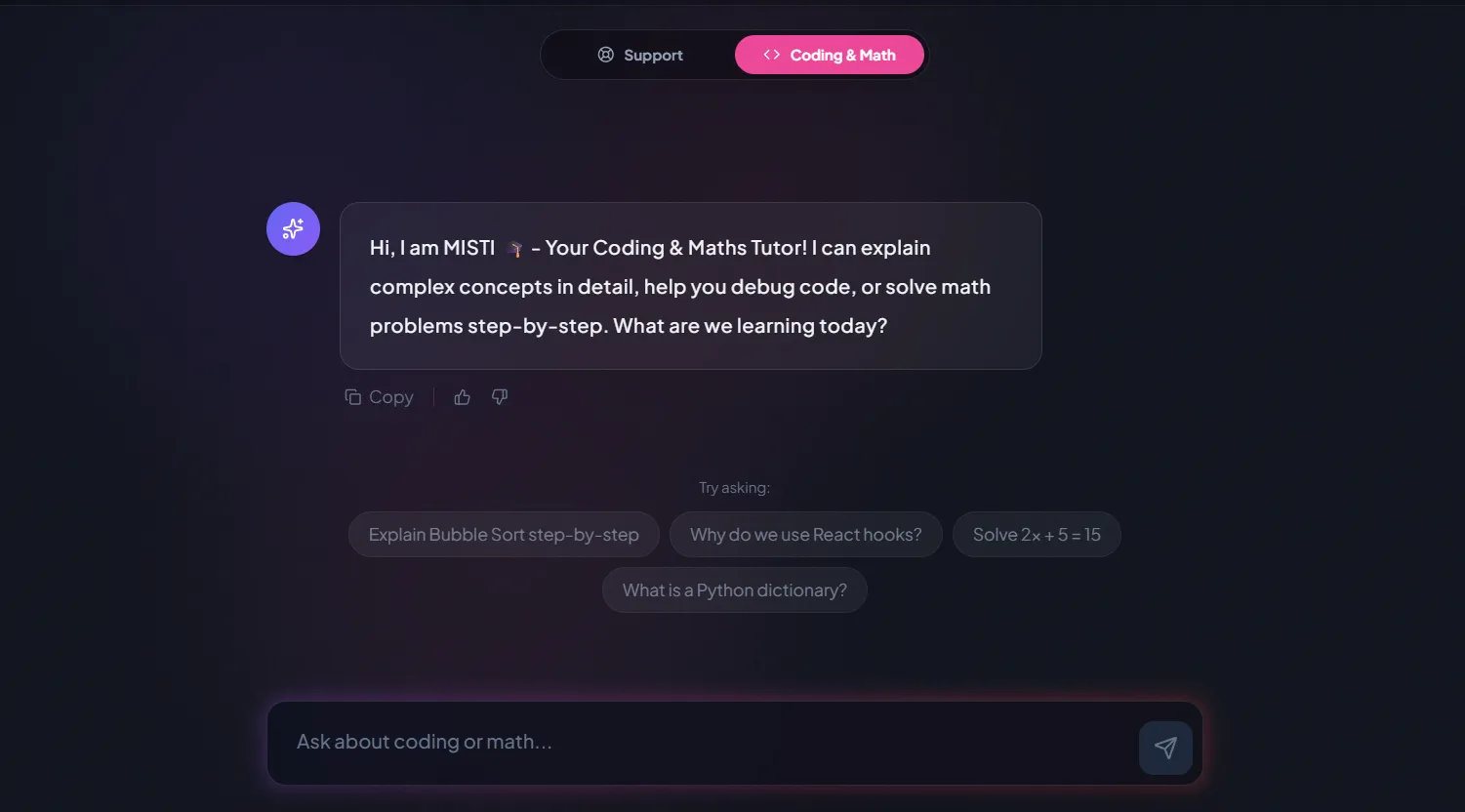
A chatbot that answers mathematics and programming questions, built and deployed by a student.

AI and ML
An assistant that helps a young person recognise unsafe situations online.
Web app
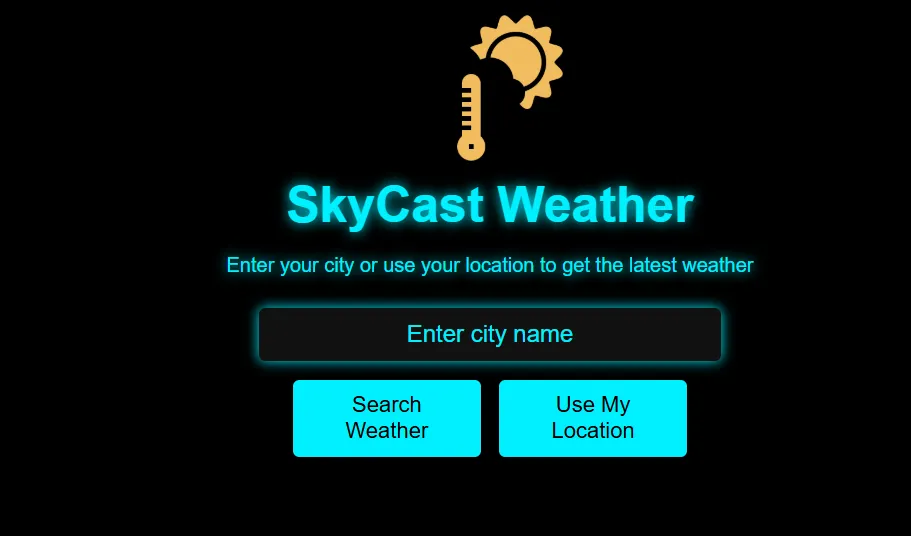
A weather forecasting site with live conditions for any location.
Fees
Charged each month in US dollars, at the same rate for all countries outside India. No enrolment fee, no contract.
Free first class
USD 0
no card required
Group batch
USD 100
a month, billed in US dollars
One to one
USD 150
a month, billed in US dollars
What families say
What Coventry and other families wrote on Google, unedited.
★★★★★
"The one step solution for my son. Modern Age Coders make learning coding so simple that kids love it. The teachers explain complex concepts clearly with practical exercises and interactive content."
Ria Mukherjee
Parent
★★★★★
"Modern Age Coders has been a game-changer for me. I struggled to grasp IT concepts and coding before joining, but their classes transformed everything. I can now confidently write complex programs with ease."
Samriddha Mondal
Student
★★★★★
"One of the most wonderful education centres out there. Education is not limited to school syllabus but focuses on skill development."
Vansh Agarwal
Student
★★★★★
"My child Dhairya is really enjoying the Modern Age Coders classes. This is his first online class and he eagerly looks forward to it. I can already see his improvement, and the teachers are very cooperative."
Sonam Oswal
Parent of Dhairya
★★★★★
"Modern Age Coders have wonderful teachers who teach in a clear, easy and practical way. The teacher boosts students' confidence and inspires them to learn without hesitation."
Sonu Goyal
Parent
★★★★★
"I highly recommend this computer coding class! The teachers are incredibly knowledgeable and passionate about coding."
Ritu Kedia
Parent
Coventry maths questions
Nothing for the first lesson. Then USD 100 a month for a group of five to ten learners, or USD 150 a month for one-to-one lessons. There is no enrolment fee and you can stop at any time.
Perimeter is the distance around the outside of a shape, measured in units such as metres. Area is the amount of surface inside it, measured in square units such as square metres. The Coventry ring road has a perimeter of 3,677.6 metres and encloses 974,929 square metres.
Usually, yes. What matters is that a real teacher is present in real time and can watch the working unfold; ours follow each line on a shared board, so a slip in step two is fixed before it spoils step five.
Yes. Adults of any age join our GCSE course to resit. We find out what is already secure and then concentrate on the topics that will make the most difference.
AQA, Edexcel and OCR, at foundation and higher tier, plus the IGCSE papers for learners at schools that enter them.
We do. Primary lessons run right through KS2, so the explaining questions of the Year 6 papers get as much attention as the tables Year 4 pupils are checked on.
Yes. Sixth formers who take Further Maths with A level Maths can study the extra content with us, in a group or one to one.
As soon as a learner starts to struggle. Gaps in times tables or algebra are far quicker to close early than in the months before an exam, though we also help learners who start late.
No. We mention their public activities so families can find them. We have no link with either, or with any Coventry school.
No. We teach carefully and report progress honestly, but nobody can guarantee an exam grade and we do not pretend to.
Related pages
Our maths pages by stage, our coding page for the city and nearby maths pages.
Our national GCSE page.
The extra A level modules.
The selective test used in Warwickshire.
Our Coventry page for coding and AI.
Our Birmingham maths page and its canal project.
Every UK page we publish.
Start here
Tell us the learner's age or school year, any exam board, and which topic feels hardest. The first lesson is a full lesson, and you get an honest view of where things stand afterwards.
Browsing first? Look through our courses or read how lessons work.
WhatsApp us · +91 91233 66161 · connect@modernagecoders.com
WhatsApp is the fastest way to reach us. Our number starts with India's code because the team is in India; there is no Coventry office and all teaching is online.
A priority demo is a full class of about 45 to 60 minutes. After the class the mentor sends a written skill report and a personal learning roadmap on WhatsApp. If you enrol, the demo fee is adjusted against your first month's fee. Share your demo Order ID with us on WhatsApp and we take it off.
Book a priority demo