UK / Y31 / 01
Elementary Maths
Year 3 place value, columns and fractions.
Open the syllabusEngland · Year 3 maths · ages 7 to 8
Year 3 opens Key Stage 2, and for many seven year olds it is the first time maths is written down in columns. Numbers stretch to 1000, the 3, 4 and 8 times tables arrive together, fractions stop being only halves and quarters of a cake and start sitting on a number line, and the clock face gains Roman numerals. None of this is tested nationally in Year 3, which is exactly why gaps can slip past unnoticed until the times tables check in Year 4. Below we set out what the Department for Education's programme of study asks of Year 3, how it grows out of Year 2 and into Year 4, and how we tutor it, with four examples we wrote ourselves.
Live teaching since 2020 · 10,000+ students · Built from the DfE Year 3 programme of study
In short
Year 3 maths is the first year of Key Stage 2 in the national curriculum for England, for children aged 7 to 8. The Department for Education's programme of study introduces formal column addition and subtraction with up to three digits, the 3, 4 and 8 times tables, place value to 1000, tenths, and adding fractions with the same denominator. There is no national test in Year 3; a child in Year 3 during 2026 to 2027 meets the multiplication tables check in June 2028. Modern Age Coders teaches Year 3 maths live online, 1-on-1 or in a group of 15 to 20, through its Elementary Maths course. The first class is free, and we are independent of every school and of the DfE.
Courses for Year 3
Most Year 3 children start with the first. The other two suit a child who needs quicker number facts, or one who loves puzzles more than worksheets.
Y3 / 01
Its lower Key Stage 2 level follows the Year 3 programme: place value, column methods, fractions and measures.
Open the syllabus →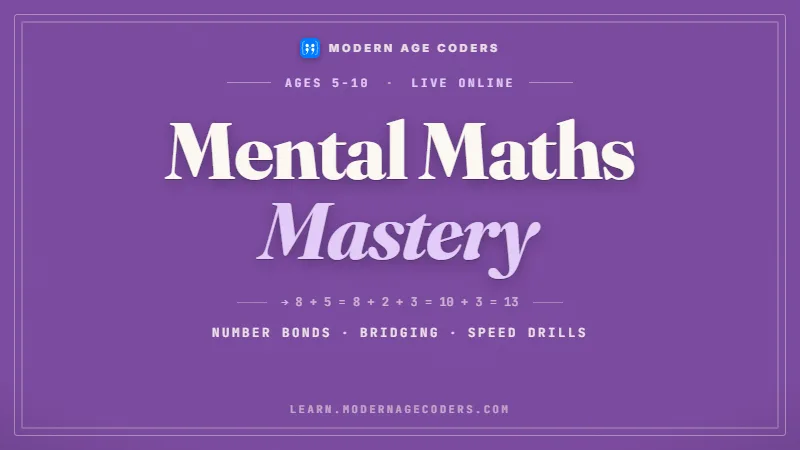
Y3 / 02
For a child who counts on fingers for 4 × 8: number facts held in memory, built a little each week.
Open the syllabus →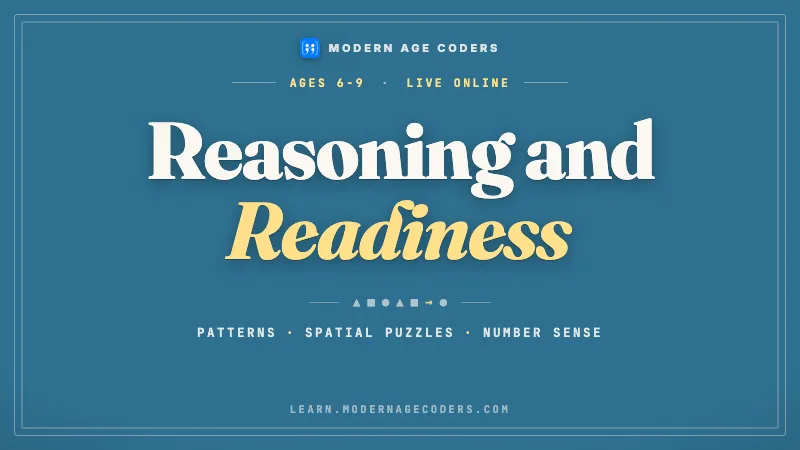
Y3 / 03
Patterns, shapes and quantity puzzles for curious six to nine year olds, with no test drilling.
Open the syllabus →Year 3 content
Year 3 adds three-digit place value, written column methods, three new times tables, tenths and fractions as numbers. Everything in the table below is statutory in the DfE programme of study, summarised by area.
For the two years of lower Key Stage 2, Years 3 and 4, the curriculum sets one main aim: that pupils "become increasingly fluent with whole numbers and the four operations, including number facts and the concept of place value". It adds that they should "develop efficient written and mental methods and perform calculations accurately with increasingly large whole numbers." Year 3 is where the written part of that sentence starts.
| Area | What a Year 3 child is taught |
|---|---|
| Place value | Read, write, compare and order numbers to 1000; the value of each digit in a three-digit number; 10 or 100 more or less; count in 4s, 8s, 50s and 100s |
| Adding and subtracting | Mental sums of a three-digit number and ones, tens or hundreds; columnar addition and subtraction with up to three digits; estimating and checking with the inverse |
| Multiplying and dividing | The 3, 4 and 8 tables; two-digit times one-digit, moving from mental to written methods; scaling and correspondence problems |
| Fractions | Counting in tenths; fractions of a set; fractions as numbers; equivalent fractions with small denominators shown in diagrams; adding and subtracting with the same denominator within one whole |
| Measurement | Lengths in m, cm and mm, mass and capacity; perimeter of simple shapes; change in pounds and pence; analogue clocks with Roman numerals I to XII; 12-hour and 24-hour clocks; days in each month and leap years |
| Geometry | Draw 2-D shapes and make 3-D ones; angles as a turn; right angles, half-turns and full turns; horizontal, vertical, perpendicular and parallel lines |
| Statistics | Bar charts, pictograms and tables; one-step and two-step questions such as how many more or fewer |
Two details in the non-statutory notes show the thinking behind the year. Place value is taught flexibly: the guidance writes 146 both as 100 + 40 and 6 and as 130 + 16, because a child who can see 146 as thirteen tens and six ones is ready for exchanging in column subtraction. And money is kept simple: pupils record pounds and pence separately, since decimal money waits until Year 4.
From the Year 3 programme of study and the lower Key Stage 2 introduction in the DfE's mathematics programmes of study: key stages 1 and 2, read on 31 October 2026.
Year 2 to Year 4
Every strand takes one step up: one more digit, three more tables, written methods instead of objects, and fractions that are counted rather than only shaded. We put the three years side by side from the programme of study.
| Strand | Year 2 | Year 3 | Year 4 |
|---|---|---|---|
| Place value | Two-digit numbers, to at least 100 | Three-digit numbers, to 1000 | Four-digit numbers and beyond 1000 |
| Times tables | 2, 5 and 10 | 3, 4 and 8 | All tables up to 12 × 12 |
| Written methods | Objects, pictures and mental methods | Column addition and subtraction with up to three digits | Columnar methods with up to 4 digits; short multiplication |
| Fractions | One third, one quarter, two quarters, three quarters | Tenths; unit and non-unit fractions as numbers | Hundredths; decimal equivalents |
| Time | To five minutes | To the nearest minute; Roman numerals on the clock | Converting between analogue and digital 12- and 24-hour clocks |
Reading down the Year 3 column, the pattern is that Year 3 does the hard conceptual work while the numbers are still small. Exchanging a ten for ten ones is the same idea whether the number has three digits or six, and Year 3 is where a child either understands it or learns to copy the steps. The same is true of fractions: the Year 3 notes ask children to place fractions on a number line and to "go beyond the [0, 1] interval", which is the first sign that a fraction is a number in its own right.
The end of Year 2 expects number bonds to 20. A child still counting on for 8 + 7 will find column addition slow, because every column is a bond.
Our KS2 maths tuition page describes how we rebuild from earlier years without making a child feel behind.
Year 4 finishes the tables to 12 × 12 and pushes column methods to four digits. Everything Year 4 adds rests on Year 3 columns and Year 3 tables.
For the June check at the end of Year 4, see our multiplication tables check explainer.
Year 2, Year 3 and Year 4 statutory statements from the DfE primary mathematics programme of study.
Column methods
Year 3 is the year of the first formal written method. The statutory wording is to "add and subtract numbers with up to three digits, using formal written methods of columnar addition and subtraction", and the checking habit comes with it.
The programme of study pairs the method with a safeguard. Children are to "estimate the answer to a calculation and use inverse operations to check answers", so a subtraction is checked by adding back, and every answer is compared with a rough guess first. The DfE's Mathematics Appendix 1 shows examples of the column layouts, while saying the examples are not an exhaustive list and do not set out a fixed progression, which is why your child's school may lay the columns out a little differently from how you learned them.
Smaller from larger. In 452 minus 178 a child writes 8 minus 2 in the ones column instead of exchanging. The answer comes out too large and they cannot see why.
Exchanging across a zero. 503 minus 178 needs a hundred broken into tens before a ten can be broken into ones. This two-step exchange is the single most common Year 3 stumble we see.
Place value before procedure. If 503 can be read as 4 hundreds, 9 tens and 13 ones, the exchange is just a renaming, not a trick.
Estimate first, add back after. 500 minus 180 is about 320, so an answer of 435 is wrong before it is checked. The curriculum asks for both habits for this reason.
Mental methods do not stop when columns arrive. The statutory list keeps mental addition and subtraction of "a three-digit number and ones", "a three-digit number and tens" and "a three-digit number and hundreds" in the same year. We teach a child to ask first whether a sum needs a column at all: 347 + 200 does not, and 347 + 286 probably does.
Statutory wording from the Year 3 addition and subtraction requirements; layouts in Mathematics Appendix 1 of the same DfE document.
The 3, 4 and 8 tables
The 3, 4 and 8 times tables, with their division facts, on top of the 2, 5 and 10 from Year 2. The requirement is to "recall and use multiplication and division facts for the 3, 4 and 8 multiplication tables".
The 4 and 8 tables arrive together for a reason the guidance states directly: "Through doubling, they connect the 2, 4 and 8 multiplication tables." Double a 2-table fact and you have a 4-table fact; double again and you have an 8-table fact. The 3 table stands apart and usually takes the longest. The notes also show children using the order of multiplication to make a sum easier, with the example 4 × 12 × 5 rearranged as 4 × 5 × 12, which is 20 × 12, which is 240.
The curriculum says that by the end of Year 4 pupils "should have memorised their multiplication tables up to and including the 12 multiplication table". Year 3 supplies three of the tables that check uses.
For a child in Year 3 during 2026 to 2027, the DfE lists the check "within the 2-week period from Monday 5 June 2028", when they will be in Year 4.
The Curriculum and Assessment Review, reporting in November 2025, wrote: "We believe the priority at Key Stage 2 should be ensuring all pupils build competence in multiplicative reasoning and problem-solving."
It described that reasoning as including "multiplication and division scaling, repeated addition, arrays, and whole number rates", which is the Year 3 multiplication strand almost word for word.
The review also led the government to plan a revised national curriculum, to be published in 2027 for first teaching in 2028. For the current school year the DfE says assessment arrangements "will remain unchanged", so a Year 3 child is taught today's programme of study. We will update this page when the revised one is published.
Sources: DfE Primary assessments: future dates (updated 12 October 2026) and the Curriculum and Assessment Review final report and government response, November 2025.
Worked examples
Each one uses statutory Year 3 content. The questions are ours; none comes from a school scheme or a test.
Question (ours). 503 − 178.
Ones first. 3 take away 8 will not go, and the tens column holds 0, so there is no ten to borrow yet.
Rename twice. Change 5 hundreds into 4 hundreds and 10 tens, then change one of those tens into 10 ones. The top number now reads 4 hundreds, 9 tens and 13 ones.
Subtract. 13 − 8 = 5, 9 − 7 = 2, 4 − 1 = 3, giving 325. Check with the inverse: 325 + 178 = 503.
Question (ours). Mia collected 28 conkers and gave away three quarters of them. How many did she give away?
One quarter first. Quarters mean 4 equal groups, and 28 ÷ 4 = 7, a fact from the 4 table.
Three of them. 3 × 7 = 21.
Answer. 21 conkers, leaving 7. A fraction of a set is a division and then a multiplication, which is why Year 3 fractions and the 4 table are taught in the same year.
Question (ours). A doll has 4 T-shirts and 3 pairs of shorts. How many different outfits can it wear?
List one row. The first T-shirt goes with each of the 3 pairs of shorts: 3 outfits.
Repeat the row. Each of the 4 T-shirts gives 3 outfits, so the list has 4 rows of 3.
Answer. 4 × 3 = 12 outfits. The curriculum calls this a correspondence problem, in which some objects are connected to others, and it is a child's first look at multiplication as counting combinations.
Question (ours). A film starts at 2:45 pm and ends at 4:10 pm. How long is it?
To the next hour. 2:45 to 3:00 is 15 minutes.
Whole hours. 3:00 to 4:00 is 1 hour.
The rest. 4:00 to 4:10 is 10 minutes. Adding the pieces gives 1 hour and 25 minutes. Counting on in jumps is safer than subtracting times, because there are 60 minutes in an hour, not 100.
Practice set (ours, answers below). (1) What is 100 less than 692, and 10 more? (2) 8 × 6. (3) 264 + 359 in columns. (4) Two sevenths plus four sevenths. (5) The perimeter of a rectangle 9 cm long and 4 cm wide. (6) Which number does XI stand for on a clock? (7) 96 ÷ 8. Answers: (1) 592 and 702; (2) 48, which is double 8 × 3; (3) 623; (4) six sevenths; (5) 26 cm; (6) 11; (7) 12, because 8 × 12 = 96.
Our tutoring
By making place value solid before the columns, the doubling links clear before the 8 table, and fractions visible before they are written. The plan below is ours, adjusted after the first class.
A group of 15 to 20 seven and eight year olds suits a child who is broadly on track and enjoys answering alongside others.
1-on-1 suits a child who is anxious about maths, who missed parts of Year 2, or who is racing ahead and needs harder problems.
Set hours of worksheets for a seven year old, or promise a score in a check that is two years away.
Claim any link with your child's school, a local authority or the DfE. We are an independent online school.
Progress
We look for each one in a short task during class. Nothing here is a formal assessment.
| Milestone | Usual time | What the child can do |
|---|---|---|
| 1. Three-digit numbers | Autumn term | Reads, writes and partitions numbers to 1000 in more than one way |
| 2. Columns that work | Autumn to spring | Adds and subtracts three-digit numbers in columns, including across a zero, and checks with the inverse |
| 3. Three new tables | Spring term | Recalls the 3, 4 and 8 tables and uses them to divide |
| 4. Fractions and time | Summer term | Finds fractions of a set, adds same-denominator fractions and works out durations on a clock |
Column subtraction is place value written down. When partitioning is secure, exchanging stops being frightening.
Children who enjoy number puzzles might like our Primary Maths Challenge page later in primary school.
The 3, 4 and 8 tables are three of the eleven tables the June check draws on.
We pause in school holidays if you would like a break.
Catalogue
Core maths for lower Key Stage 2, faster number facts, and some making and thinking for children who like to build.
UK / Y31 / 01
Year 3 place value, columns and fractions.
Open the syllabusUK / Y31 / 02
For a child still securing Year 2 number.
Open the syllabusUK / Y31 / 03
Pattern and shape puzzles for ages 6 to 9.
Open the syllabusUK / Y32 / 01
Tables and bonds held in memory.
Open the syllabusUK / Y32 / 02
Beads that make place value visible.
Open the syllabusUK / Y32 / 03
Calculation patterns, later in primary.
Open the syllabusUK / Y33 / 01
Sorting, ordering and if-then puzzles.
Open the syllabusUK / Y33 / 02
First games, with angles and counting.
Open the syllabusUK / Y33 / 03
For later: the Year 6 papers.
Open the syllabusLessons
Weekdays or weekends, flexible: choose your batch, or for a very personalised plan choose 1-on-1 at your convenience, weekend mornings or weekdays. Our teachers work from India and every slot we offer is set in UK time.
After school
Short and lively for seven year olds.
Early evening
Once clubs and tea are done.
Saturday or Sunday morning
Unhurried time for longer problems.
Numbers drawn as hundreds, tens and ones before any column is set out.
The 4 and 8 tables grown from the 2 table, not learned as strangers.
Estimating is part of every calculation, as the curriculum asks.
Children explain one step each lesson, which builds the vocabulary Year 3 expects.
A full live class to meet the tutor and see the approach.
A Year 3 group of 15 to 20, or one tutor for one child.
Student work
Ordinary class work rather than marked assessments. You can browse more in student labs.

AI and ML
An AI nutrition coach that reads what you eat and works you toward a target.

AI and ML
A chatbot that answers mathematics and programming questions, built and deployed by a student.

AI and ML
An assistant that helps a young person recognise unsafe situations online.

Web app
A weather forecasting site with live conditions for any location.
Fees
Your first class costs nothing. After that there is a single monthly fee, lower for a group place and higher for 1-on-1, taken only once the course and a weekly slot are agreed. You can stop at any time.
Free first class
USD 0
no card required
Group batch
USD 100
a month, billed in US dollars
One to one
USD 150
a month, billed in US dollars
What families say
What parents wrote about us on Google, unedited.
★★★★★
"The one step solution for my son. Modern Age Coders make learning coding so simple that kids love it. The teachers explain complex concepts clearly with practical exercises and interactive content."
Ria Mukherjee
Parent
★★★★★
"Modern Age Coders has been a game-changer for me. I struggled to grasp IT concepts and coding before joining, but their classes transformed everything. I can now confidently write complex programs with ease."
Samriddha Mondal
Student
★★★★★
"One of the most wonderful education centres out there. Education is not limited to school syllabus but focuses on skill development."
Vansh Agarwal
Student
★★★★★
"My child Dhairya is really enjoying the Modern Age Coders classes. This is his first online class and he eagerly looks forward to it. I can already see his improvement, and the teachers are very cooperative."
Sonam Oswal
Parent of Dhairya
★★★★★
"Modern Age Coders have wonderful teachers who teach in a clear, easy and practical way. The teacher boosts students' confidence and inspires them to learn without hesitation."
Sonu Goyal
Parent
★★★★★
"I highly recommend this computer coding class! The teachers are incredibly knowledgeable and passionate about coding."
Ritu Kedia
Parent
Year 3 questions
The programme of study expects numbers to 1000, column addition and subtraction with up to three digits, the 3, 4 and 8 times tables, tenths, simple fractions of amounts, perimeter, and telling the time to the minute, including Roman numerals on a clock face.
The 3, 4 and 8 tables, with their division facts. They build on the 2, 5 and 10 tables from Year 2, and the guidance links the 2, 4 and 8 tables through doubling.
No. Year 3 has no national test. Schools assess children in their own way, and the next national check is the multiplication tables check in June of Year 4.
For a child in Year 3 during 2026 to 2027, the DfE lists the check in the two weeks from Monday 5 June 2028, when they will be in Year 4.
Usually because of exchanging, especially across a zero, as in 503 take away 178. Children who can rename 503 as 4 hundreds, 9 tens and 13 ones find it straightforward; children who learned only the steps tend to get lost.
Tenths, unit fractions such as one fifth, non-unit fractions such as three fifths, equivalent fractions shown with diagrams, and adding or subtracting fractions with the same denominator as long as the answer stays within one whole.
Start with place value and the Year 2 number bonds and tables. Most Year 3 difficulties trace back to these, and fixing them makes columns and fractions much easier.
A few minutes most days is enough at seven or eight. Short, regular practice of tables and a single column sum does more than one long session at the weekend.
Weekdays or weekends, flexible: choose your batch, or for a very personalised plan choose 1-on-1 at your convenience, weekend mornings or weekdays. All times are given in UK time.
No. Modern Age Coders runs on its own, teaching from the published national curriculum with no tie to any school, local authority or government body.
More primary maths
What comes before Year 3, around it and after it.
Years 3 to 6 taken together.
The June check that follows Year 3.
How recall is practised for it.
Our wider UK maths offer for children.
Coding for the same age group.
The UK hub for all our pages.
Part of the guide: UK maths year by year, Reception to Year 11
More guides: UK maths exam boards and specification codes · UK selective school maths tests: 7+, 11+, 13+ and 16+ · UK university admissions: maths tests and computing applications · UK maths enrichment, competitions and able pupils
Start here
Share a phone number and we will ring at a UK time that works for you. In the class the tutor looks at place value, a column sum and a few times tables, then tells you what to work on first.
Prefer to read before booking? The Elementary Maths course sets out its full syllabus, and how we teach describes the method behind every class.
WhatsApp us · +91 91233 66161 · connect@modernagecoders.com
Messaging us on WhatsApp is usually fastest and costs nothing from a UK mobile. Our team in India replies from a +91 number.
A priority demo is a full class of about 45 to 60 minutes. After the class the mentor sends a written skill report and a personal learning roadmap on WhatsApp. If you enrol, the demo fee is adjusted against your first month's fee. Share your demo Order ID with us on WhatsApp and we take it off.
Book a priority demo