UK / Y71 / 01
Middle School Maths
Number, algebra and geometry for 11 to 14.
Open the syllabusEngland · Year 7 maths · ages 11 to 12
In primary school, the national curriculum told schools what to teach in each year. In Year 7 that stops. Key Stage 3 maths is a single programme of study for Years 7, 8 and 9 together, and each secondary school decides what goes in which year. At the same time the maths itself changes character: letters replace boxes, negative numbers are calculated with rather than only counted, ratio gets its own notation, and fractions are worked with in every form. There is no national test until GCSE. This page explains what that shift means for a Year 7 student, what the school already knows on day one, and how we tutor the year, with four worked examples of our own.
Live teaching since 2020 · 10,000+ students · Built from the DfE KS3 programme and the 2025 review
In short
Year 7 maths is the first year of Key Stage 3 in England, for students aged 11 to 12. Unlike primary school, the DfE key stage 3 programme of study covers Years 7 to 9 as one list, so each secondary school chooses its own order; most Year 7 courses consolidate KS2 number and introduce algebraic notation, negative numbers, prime factorisation and ratio. There is no national maths test in Year 7. Modern Age Coders tutors Year 7 maths live online, 1-on-1 or in a group of 15 to 20, through its Middle School Maths course, aligned to your child's school scheme. The first class is free, and we are independent of all schools.
Courses for Year 7
The first follows the core of a Year 7 scheme of work. The second gives algebra extra time, which is where many Year 7s wobble. The third is for students who like to see maths run.

Y7 / 01
Pre-algebra, number and geometry for 11 to 14 year olds, matched week by week to your child's school topics.
Open the syllabus →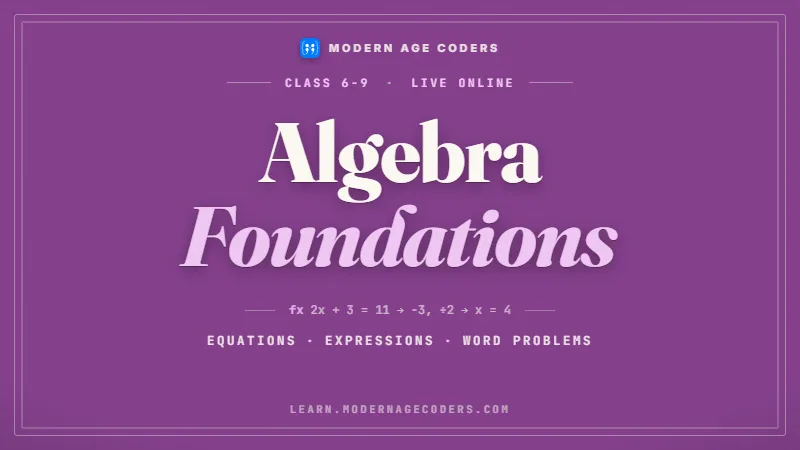
Y7 / 02
Notation, expressions, substitution and first equations, taught slowly enough to stick.
Open the syllabus →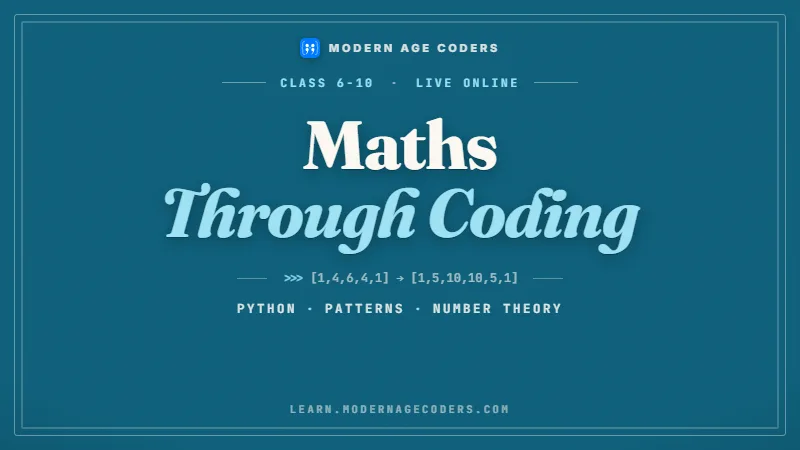
Y7 / 03
Primes, sequences and negative numbers explored in Python, for ages 10 to 15.
Open the syllabus →Year 6 to Year 7
Three things change at once: the curriculum stops being split by year, the content becomes more abstract, and national testing pauses. The table puts Year 6 and Key Stage 3 side by side from the two DfE programmes.
| Year 6 (primary) | Key Stage 3 (Years 7 to 9) | |
|---|---|---|
| How it is written | A separate statutory list for Year 6 | One list for all three years; the school sets the order |
| Number | Numbers to 10 000 000; rounding, but not to significant figures | Place value for integers of any size; powers and roots; standard form; decimal places and significant figures |
| Algebra | Simple formulae and missing numbers | Notation such as ab and 3y; simplifying, expanding, rearranging; solving linear equations; straight-line graphs |
| Ratio | Informal sharing; pupils "might use the notation a:b" | Ratio notation, simplest form, part to part and part to whole; direct and inverse proportion |
| Statistics and probability | Pie charts, line graphs and the mean | Mean, mode, median and range; the 0 to 1 probability scale; scatter graphs |
| National testing | KS2 tests in May | None in KS3; schools set their own assessments |
The DfE describes the Key Stage 3 programme as "organised into apparently distinct domains, but pupils should build on key stage 2 and connections across mathematical ideas". The word apparently is doing a lot of work. A Year 7 lesson on algebra is really a lesson on the structure of arithmetic, which is why the programme lists the aim to "use algebra to generalise the structure of arithmetic".
The programme also tells schools how to pace students: "Decisions about progression should be based on the security of pupils' understanding and their readiness to progress to the next stage." In Year 7 that usually means more consolidation of primary number than parents expect. It is not a sign that the school is going slowly; it is the curriculum working as written.
From the DfE's mathematics programmes of study for key stages 1 and 2 and for key stage 3, read on 31 October 2026.
What Year 7 covers
Because the order is the school's choice, there is no official Year 7 list. In our experience most Year 7 schemes start with the Key Stage 3 statements that extend primary number, plus first algebra. These are the ones we see most.
The first working-mathematically aim in the programme is to "consolidate their numerical and mathematical capability from key stage 2 and extend their understanding of the number system and place value to include decimals, fractions, powers and roots". That sentence is a fair summary of most Year 7 autumn terms.
Negative numbers in all four operations: the programme asks for the four operations "applied to integers, decimals, proper and improper fractions, and mixed numbers, all both positive and negative".
Primes, factors and multiples with a new tool, prime factorisation, "including using product notation and the unique factorisation property". Inequality symbols, including "≠", "≤" and "≥", appear too.
Notation first: "ab in place of a × b" and "3y in place of y + y + y and 3 × y". Then collecting like terms, substituting values and simple equations.
Percentages are redefined with more reach. Students learn to "work with percentages greater than 100%", which is new after primary school.
Some schools also start geometry in Year 7 with angle facts and the properties of shapes, and statistics with averages and charts. If you can, ask the school for its Key Stage 3 scheme of work or topic list; most share one. A tutor who knows the order can teach alongside it instead of against it.
Statutory content quoted from the DfE key stage 3 programme of study (DFE-00179-2013). The typical Year 7 ordering is our own observation, not a DfE requirement.
What schools know
More than many parents realise. The Curriculum and Assessment Review notes that secondary schools can see incoming pupils' detailed key stage 2 results, and the government expects schools to assess from the start of Year 7.
The Review, published in November 2025, says: "Primary schools can access pupils' detailed results, including their responses to each question, as can secondary schools for incoming Year 7 students." The STA's 2027 arrangements make results available on 6 July to "key stage 3 ( KS3 ) schools with a year 7 intake", the same day primary schools see them.
There is no national test in Key Stage 3. As the Review puts it, "Since Key Stage 3 assessments were cancelled in 2008, schools have developed and administered their own assessments."
The government's response adds that it expects every secondary school to identify gaps "as part of their ongoing formative assessment from the beginning of Year 7 onwards".
The Review lists three Key Stage 3 problems, including "poor curriculum continuity from Key Stage 2", and says it heard that "the breadth of topics at Key Stage 2 has resulted in significant challenges for primary to secondary transition".
In other words, a wobbly first term in Year 7 maths is common, and it is recognised at national level.
How each school uses this information, including whether and when it sets students for maths, is the school's own decision, and we make no claim about any school's practice. The government also plans a revised national curriculum for first teaching from September 2028, and says it expects schools to assess progress in maths in Year 8; a child in Year 7 now will meet that next year. Until the revised programme is published, Year 7 follows the 2013 programme described here.
Sources: Curriculum and Assessment Review final report and government response (November 2025); STA, 2027 KS2 assessment and reporting arrangements.
Worked examples
Each uses Key Stage 3 content that Year 7 schemes commonly teach. The questions are ours, written for this page.
Question (ours). One bus leaves every 84 minutes and another every 90 minutes. They leave together at 6 am. When do they next leave together?
Prime factorise. 84 = 2 × 2 × 3 × 7 and 90 = 2 × 3 × 3 × 5.
Lowest common multiple. Take each prime the most times it appears in either: 2 × 2 × 3 × 3 × 5 × 7 = 1260 minutes.
Answer. 1260 minutes is 21 hours, so at 3 am the next day. The highest common factor, 2 × 3 = 6, answers a different question: the largest equal groups both numbers split into.
Question (ours). −7 − (−12).
Read it as a difference. How far is it from −12 up to −7 on a number line? That distance is the answer.
Count. From −12 to −7 is 5 steps to the right.
Answer. 5. Rewriting as −7 + 12 gives the same result, and seeing why the two match is worth more than the rule "two minuses make a plus".
Question (ours). Simplify 3a + 5b − a + 2b, then find its value when a = 4 and b = −1.
Collect like terms. 3a − a = 2a and 5b + 2b = 7b, so the expression is 2a + 7b.
Substitute. 2 × 4 + 7 × (−1) = 8 − 7 = 1.
Check with the original. 12 + (−5) − 4 + (−2) = 1. Both forms agree, which is what simplifying means: the same value, written more simply.
Question (ours). A seedling was 40 cm tall in May and 52 cm tall in July. Write the July height as a percentage of the May height.
Fraction first. 52 out of 40 is 52/40 = 1.3.
Convert. 1.3 × 100 = 130%.
Interpret. 130% of the May height, or an increase of 30%. A percentage above 100 simply means more than the whole you started from.
Practice set (ours, answers below). (1) Write 360 as a product of prime factors. (2) Put in order, smallest first: −0.5, −2, 0.3, negative one quarter. (3) Two thirds plus three quarters minus one sixth. (4) 4 × (−6) − (−10). (5) Simplify 5(x + 3) − 2x. (6) Write five eighths as a decimal. (7) Write 45 as a percentage of 36. Answers: (1) 2 × 2 × 2 × 3 × 3 × 5; (2) −2, −0.5, negative one quarter, 0.3; (3) one and one quarter; (4) −14; (5) 3x + 15; (6) 0.625; (7) 125%.
Our tutoring
By finding the primary gaps the Review warns about, teaching the school's own Year 7 topics alongside the class, and building algebra on number sense. The steps are ours and change after the first class.
A group of 15 to 20 Year 7 students suits a child who is broadly coping and likes the energy of a class.
1-on-1 suits a child who has lost confidence since Year 6, whose school order differs from the group, or who is ready for harder problems.
A particular maths set, a test result or a GCSE grade.
Any link with your child's school or the DfE. We are an independent online school, paid only by families.
Progress
We look for each in a short task in class. They are our own markers, not a school or national measure.
| Marker | Usually by | What the student can do |
|---|---|---|
| 1. Primary number secure | October half term | Fractions, decimals and long division without hesitation |
| 2. Negatives in all four operations | Christmas | Adds, subtracts, multiplies and divides with negative numbers and can explain why |
| 3. Algebra as language | Spring term | Uses notation correctly, simplifies, substitutes and solves a one-step or two-step equation |
| 4. Connections | Summer term | Moves between fractions, decimals and percentages, including above 100%, and uses prime factors to solve a problem |
Most Year 7 difficulty is unfinished Year 6 maths showing up in a new setting.
Students who like a challenge may enjoy our UKMT maths challenge page.
Year 8 schemes lean heavily on algebra and proportional reasoning.
Classes can pause in the school holidays.
Catalogue
Key Stage 3 maths, stretch for keen students, and coding that uses the same ideas.
UK / Y71 / 01
Number, algebra and geometry for 11 to 14.
Open the syllabusUK / Y71 / 02
From notation to equations.
Open the syllabusUK / Y71 / 03
For rebuilding unfinished Year 6 number.
Open the syllabusUK / Y72 / 01
Problem solving beyond the scheme.
Open the syllabusUK / Y72 / 02
Proof-style problems for strong students.
Open the syllabusUK / Y72 / 03
Quick mental checks.
Open the syllabusUK / Y73 / 01
Python for number and algebra.
Open the syllabusUK / Y73 / 02
Games built with coordinates.
Open the syllabusUK / Y73 / 03
Averages and chance, in depth.
Open the syllabusLessons
Weekdays or weekends, flexible: choose your batch, or for a very personalised plan choose 1-on-1 at your convenience, weekend mornings or weekdays. Tutors are based in India, and all slots are scheduled in UK time.
After school
Before secondary homework piles up.
Evening
After clubs and the bus home.
Weekend morning
Unrushed time for algebra.
Topics taught in the sequence your child meets them in class.
Every algebra rule tested on numbers first.
Primary number repaired without going backwards.
Students explain, the tutor probes, the error is found.
A full lesson at Year 7 level before any payment.
A Year 7 group of 15 to 20, or private 1-on-1.
Student work
From regular lessons, none graded. More of them in student labs.

AI and ML
An AI nutrition coach that reads what you eat and works you toward a target.

AI and ML
A chatbot that answers mathematics and programming questions, built and deployed by a student.

AI and ML
An assistant that helps a young person recognise unsafe situations online.

Web app
A weather forecasting site with live conditions for any location.
Fees
You pay nothing for the first class. After that it is one monthly fee, lower in a group than for 1-on-1, which begins once you have picked a course and a weekly slot. You can stop whenever you like.
Free first class
USD 0
no card required
Group batch
USD 100
a month, billed in US dollars
One to one
USD 150
a month, billed in US dollars
What families say
Google reviews written by parents, unchanged.
★★★★★
"The one step solution for my son. Modern Age Coders make learning coding so simple that kids love it. The teachers explain complex concepts clearly with practical exercises and interactive content."
Ria Mukherjee
Parent
★★★★★
"Modern Age Coders has been a game-changer for me. I struggled to grasp IT concepts and coding before joining, but their classes transformed everything. I can now confidently write complex programs with ease."
Samriddha Mondal
Student
★★★★★
"One of the most wonderful education centres out there. Education is not limited to school syllabus but focuses on skill development."
Vansh Agarwal
Student
★★★★★
"My child Dhairya is really enjoying the Modern Age Coders classes. This is his first online class and he eagerly looks forward to it. I can already see his improvement, and the teachers are very cooperative."
Sonam Oswal
Parent of Dhairya
★★★★★
"Modern Age Coders have wonderful teachers who teach in a clear, easy and practical way. The teacher boosts students' confidence and inspires them to learn without hesitation."
Sonu Goyal
Parent
★★★★★
"I highly recommend this computer coding class! The teachers are incredibly knowledgeable and passionate about coding."
Ritu Kedia
Parent
Year 7 questions
There is no official Year 7 list, because the Key Stage 3 programme covers Years 7 to 9 together and each school sets the order. Most Year 7 courses consolidate primary number and add negative numbers, prime factorisation, fraction arithmetic, percentages and first algebra.
It is more abstract rather than simply harder. Letters, negative numbers and ratio notation are new, and the Curriculum and Assessment Review recognised that moving from primary to secondary maths is often difficult.
There is no national test in Key Stage 3. Schools set their own assessments, which the Review notes they have done since Key Stage 3 national tests were cancelled in 2008.
Yes. Secondary schools with a Year 7 intake can access results from early July, and the Review notes they can see detailed results, including responses to each question.
That is each school's decision, and practice varies. Ask your child's school how and when it groups students for maths; we make no claim about any particular school.
Not if the gaps are found early. The KS3 programme expects schools to build on Key Stage 2, and a tutor can close fraction, decimal and times tables gaps inside the new Year 7 topics.
Only when the teacher asks. Key Stage 3 develops written and mental methods alongside calculators, and secure arithmetic makes algebra far easier.
Ask your child to explain the method aloud before writing, and check one answer by putting the numbers back in. You do not need to know the method yourself to ask good questions.
Weekdays or weekends, flexible: choose your batch, or for a very personalised plan choose 1-on-1 at your convenience, weekend mornings or weekdays. All times are in UK time.
No. We run separately from every school. Our tutors teach to the published Key Stage 3 programme and your child's own scheme, but have no tie to any school or to the DfE.
More secondary maths
Before Year 7, alongside it, and beyond.
Years 7 to 9 as one stage.
The results your school receives.
Our wider UK offer for ages 11 to 18.
For strong problem solvers.
Coding at the same stage.
Every UK page we publish.
Part of the guide: UK maths year by year, Reception to Year 11
More guides: UK maths exam boards and specification codes · UK selective school maths tests: 7+, 11+, 13+ and 16+ · UK university admissions: maths tests and computing applications · UK maths enrichment, competitions and able pupils
Start here
Leave a phone number and we will call at a convenient UK time. In the class the tutor tries fractions, negative numbers and a little algebra, asks what your child is studying at school, and suggests where to start.
Want the detail first? The Middle School Maths course lists its full syllabus, and how we teach explains the way our lessons work.
WhatsApp us · +91 91233 66161 · connect@modernagecoders.com
WhatsApp gets the fastest answer and is free from UK mobiles. The reply comes from our India office, on a +91 number.
A priority demo is a full class of about 45 to 60 minutes. After the class the mentor sends a written skill report and a personal learning roadmap on WhatsApp. If you enrol, the demo fee is adjusted against your first month's fee. Share your demo Order ID with us on WhatsApp and we take it off.
Book a priority demo