MCD / A1
First steps in number
Counting, comparing and shape for the youngest.
Open the syllabusCardiff · Maths for ages 6 to 67 · Live online lessons, in small groups or one to one
Ask which age group is the biggest in Cardiff and the census table seems to answer at once: the 35 to 49 band, with 67,407 people. Draw the bars properly and a different band towers over the rest. The 20 to 24 band holds 37,885 people, but it covers only five years of age, so it packs in 7,577 people for each year, against 4,494 for each year of the 35 to 49 band. That gap between a count and a density is exactly what WJEC asks of a GCSE student who meets a histogram with unequal class widths. This page sets out how we teach maths to Cardiff learners, from early number to A level and adult study, and uses the city's own census as the worked example.
Maths only on this page · Primary, secondary, sixth form and adult learners · Independent of every Cardiff school and university
In short
We are a maths tutor for Cardiff learners aged 6 to 67, teaching live online: primary maths under the Curriculum for Wales, secondary maths up to the WJEC GCSE Mathematics and Numeracy double award at Foundation or Higher tier, AS and A level Maths with Further Maths, and adult refreshers. Groups hold five to ten learners at one level, and one to one lessons are available. Our Cardiff example comes from Census 2021: the 35 to 49 age band has the most people, 67,407, yet the 20 to 24 band is the densest, at 7,577 people per year of age, because it is only five years wide. A first lesson is free; afterwards a group seat is USD 100 a month and private lessons USD 150 a month.
Where a Cardiff learner usually begins
Choose by stage. The complete list, from first counting to university maths, sits further down.
CDF / 1
Number, fractions, shape and the habit of explaining an answer, which the Curriculum for Wales asks of every learner.
Open the syllabus →
CDF / 2
Built on the English boards, so for Cardiff we steer it to the WJEC double award and its two tiers.
Open the syllabus →
CDF / 3
Pure, statistics and mechanics, with a route on to Further Maths for those who want it.
Open the syllabus →Maths in Wales
Wales runs its own curriculum and its own GCSEs, so a Cardiff family meets different names from a family in Bristol or Birmingham. Adults return at whichever point suits them.
| Stage | Usual ages | Our focus in lessons |
|---|---|---|
| Early primary | 5 to 8 | Counting, place value, adding and taking away with confidence, simple shapes. |
| Later primary | 8 to 11 | Times tables, written methods, fractions and decimals, and explaining a method out loud. |
| Years 7 to 9 | 11 to 14 | Algebra, ratio, negative numbers, angles, and the first real work with data. |
| WJEC GCSE | 14 to 16 | Mathematics and Numeracy at Foundation or Higher tier, including the financial maths unit and the non-calculator paper. |
| Sixth form | 16 to 18 | AS and A level Maths, and Further Maths for learners who want proof, matrices and more mechanics or statistics. |
| Adults | 18 to 67 | Rebuilding confidence, helping children with homework, and maths for work or study. |
Maths in Welsh schools sits inside the Mathematics and Numeracy Area of Learning and Experience. Hwb, the Welsh Government's education site, says progression there "involves the development of five connected and interdependent proficiencies which have no hierarchy": conceptual understanding, communication using symbols, fluency, logical reasoning and strategic competence.
That list matches how we teach. A learner who can do a calculation but cannot say why it works has fluency without understanding, and we work on both, at every age.
GCSE maths in Wales has changed. WJEC's GCSE Mathematics and Numeracy (Double Award) is taught from September 2025, with a first award in November 2026. It has two tiers of entry, and the specification says double award results are reported "on an eight grade scale from A*A*- GG".
Its units include Financial Mathematics and Other Applications of Numeracy, and a non-calculator paper. Our WJEC GCSE maths page goes into the units in detail.
Sources: Hwb, Curriculum for Wales: Mathematics and Numeracy; WJEC, GCSE Mathematics and Numeracy (Double Award) specification. Both read on 1 October 2026. The age ranges in the table are typical, not official.
The Cardiff project
The census publishes Cardiff's population in eleven age bands of different widths. Read them as plain counts and you get one answer; draw them as a histogram and you get another.
Census 2021 counted 362,308 usual residents in Cardiff. The table we used, TS007B on Nomis, splits them into broad age bands: under 5, 5 to 9, 10 to 15, 16 to 19, 20 to 24, 25 to 34, 35 to 49, 50 to 64, 65 to 74, 75 to 84, and 85 and over. The widths are not equal. Some bands span four years of age, some fifteen.
Draw an ordinary bar chart of the counts and the 35 to 49 band wins easily, with 67,407 people. But that band covers fifteen birthdays. Of course it holds more people than a band covering five.
A histogram fixes this by making area, not height, stand for the count. The height becomes the frequency density: the count divided by the class width. For Cardiff, the 20 to 24 band has a density of 37,885 ÷ 5 = 7,577 people per year of age, the tallest bar by a distance. The 35 to 49 band falls to 67,407 ÷ 15 = 4,493.8.
One more surprise sits in the middle. The 16 to 19 band and the 25 to 34 band have almost identical densities, 5,630.0 and 5,630.6, although one count is more than twice the other. Equal heights, very unequal areas.
| Age band | People (published) | Width, years | Frequency density |
|---|---|---|---|
| Under 5 | 19,069 | 5 | 3,813.8 |
| 5 to 9 | 21,504 | 5 | 4,300.8 |
| 10 to 15 | 25,422 | 6 | 4,237.0 |
| 16 to 19 | 22,520 | 4 | 5,630.0 |
| 20 to 24 | 37,885 | 5 | 7,577.0 |
| 25 to 34 | 56,306 | 10 | 5,630.6 |
| 35 to 49 | 67,407 | 15 | 4,493.8 |
| 50 to 64 | 59,697 | 15 | 3,979.8 |
| 65 to 74 | 28,874 | 10 | 2,887.4 |
| 75 to 84 | 16,507 | 10 | 1,650.7 |
| 85 and over | 7,117 | open | not drawn |
Data: ONS Census 2021, TS007B Age by broad age bands, via Nomis, Cardiff, read on 1 October 2026, Open Government Licence. Counts are as published. Widths and densities are Modern Age Coders' calculations. The ONS applies statistical disclosure control to census counts, so small areas are not exact; at the scale of a whole city the effect is small.
From GCSE to A level
Three questions turn the table above into a full lesson: what to do with the open band, how to compare two places of very different size, and what a histogram can hide.
The 85 and over band has no upper limit, so it has no width, and without a width there is no density. A textbook usually invents an end, such as 100. Try it: with an end at 100 the density is 7,117 ÷ 15 = 474.5; with an end at 95 it is 711.7. The bar's height depends on a guess.
This is why we do not draw that bar on the page. Saying so is part of the answer. WJEC asks students to "recognise that graphs may be misleading", and an invented class boundary is one of the quietest ways a graph misleads.
Wales has about eight and a half times as many people as Cardiff, so raw densities cannot be compared. Divide each density by the area's published total and multiply by 1,000, and both become people per 1,000 residents per year of age.
On that scale the Cardiff 20 to 24 bar stands at 20.91, while the same band for Wales stands at 12.08. The tallest bar for Wales as a whole is 50 to 64, at 13.69. A student who sees both histograms side by side understands what makes a university city's age profile different, without a single sentence of explanation.
| Age band | Cardiff | Wales |
|---|---|---|
| Under 5 | 10.53 | 9.98 |
| 16 to 19 | 15.54 | 11.38 |
| 20 to 24 | 20.91 | 12.08 |
| 25 to 34 | 15.54 | 12.31 |
| 50 to 64 | 10.98 | 13.69 |
| 75 to 84 | 4.56 | 7.10 |
The median is the next step. WJEC item 4.2.20 asks students to "construct and interpret histograms with unequal class widths, including calculating the median and other percentages of the distribution". Half of 362,308 is 181,154. Counting through the bands from the youngest, the halfway person falls in the 25 to 34 band, and a straight-line estimate inside that band places the median age at about 34.7, right at the top of it. We set the working as an exercise, because the reasoning matters more than the number.
WJEC wording from the GCSE Mathematics and Numeracy specification. Wales figures: Census 2021 TS007B for Wales (W92000004) on Nomis. The rates per 1,000 and the median estimate are ours.
Maths beyond lessons
Families often ask what exists outside school. We list what we found on public pages; we are not part of any of it.
Its own page calls it "a Welsh Government funded project which was launched in 2010", managed by the Mathematics Department at Swansea University and working with Cardiff and other Welsh universities.
The programme says students who plan to study AS or A level Maths "should have the opportunity to consider studying AS/A level Further Mathematics". Schools and colleges arrange this, often with online tuition.
The UK Mathematics Trust runs the Junior, Intermediate and Senior Mathematical Challenges, which many Welsh schools enter. Our competitions calendar lists them by age.
For a sixth former, Further Maths is where the subject opens up: complex numbers, matrices, proof by induction and more serious mechanics or statistics. Our Further Maths page explains how we teach it alongside A level Maths.
For a younger learner who enjoys puzzles, the histogram project above makes a good first taste of the kind of reasoning a challenge paper rewards: there is a trap in the obvious answer, and the point is to spot it.
A learner in Roath, Canton or Llanishen logs in from home for each live lesson. Classmates are grouped by level, not by postcode, so one might be in Swansea and another in Bristol.
We teach in English. Learners in Welsh-medium schools are welcome, and we work from the English versions of WJEC material.
Sources: Maths Support Programme Wales, what MSPW does; UK Mathematics Trust. Both read on 1 October 2026. Cardiff University's pages refused our automated request, so we quote nothing from them. We have no link with the MSPW, the UKMT, WJEC or any Cardiff school or university.
Grown-up learners
Many of our learners left school years ago. Some want a qualification, some want to help a child, and some simply want to stop feeling anxious about numbers.
Fractions, percentages and algebra from the beginning, with time to ask why. Adults often find the reasons land now in a way they never did in Year 9.
Parents learn the methods children use now, so evenings at the table stop turning into a clash between two ways of doing long division.
Spreadsheets, percentages, rates and charts for reports. Our adult maths page and Functional Skills page say more.
The census histogram works well with adults. Most have read a misleading chart at some point, in a newspaper or a work report, and the moment they see why the tallest bar was not the biggest group, they start checking the widths on every chart they meet.
The order we teach in
Each step depends on the one before. Learners slot in wherever they are; the trial lesson tells us which rung.
| Usually | Step | How we know it is secure |
|---|---|---|
| Primary | 1. Number sense | Explains why 6 × 7 is 42 using a fact they already know |
| Years 6 to 8 | 2. Proportion | Works with fractions, percentages and ratio without a calculator |
| Years 8 to 10 | 3. Algebra and data | Forms an equation from words and builds a frequency table |
| Years 10 to 13 | 4. Interpretation | Spots a misleading graph and says, in writing, what is wrong with it |
It is not too late, but the order matters. We secure number and proportion first, because a learner who is shaky on fractions loses marks on every paper, not just one.
If the time left is shorter than the gap, we say so plainly at the free lesson.
Plenty of learners carry on to statistics and probability or maths through coding, where the census table becomes a short program that draws its own histogram.
Others move on to competition problems, for the pleasure of the hard question.
Every course
Grouped by stage; each card leads to the full syllabus.
MCD / A1
Counting, comparing and shape for the youngest.
Open the syllabusMCD / A2
Every primary topic, with reasons as well as rules.
Open the syllabusMCD / A3
Quick, accurate sums done in the head.
Open the syllabusMCD / A4
Bead-frame arithmetic that becomes a mental picture.
Open the syllabusMCD / B1
Algebra, ratio, geometry and early statistics.
Open the syllabusMCD / B2
For a learner whose algebra needs firm ground.
Open the syllabusMCD / B3
Foundation or Higher tier, steered to WJEC for Cardiff.
Open the syllabusMCD / B4
Cambridge or Edexcel International entries.
Open the syllabusMCD / C1
Pure, mechanics and statistics.
Open the syllabusMCD / C2
Distributions, sampling and testing a claim.
Open the syllabusMCD / C3
Calculus and linear algebra for first-year study.
Open the syllabusMCD / C4
Unfamiliar problems with no recipe.
Open the syllabusMCD / D1
Interest, loans and investment, step by step.
Open the syllabusMCD / D2
The statistics and algebra behind analysis.
Open the syllabusMCD / D3
Python as a way to explore number and data.
Open the syllabusMCD / D4
Calculation shortcuts once the basics are firm.
Open the syllabusWhen lessons run
Our teachers work from India, which keeps the same clock all year. In winter India is five and a half hours ahead of Cardiff; during British Summer Time the gap is four and a half. Every slot is agreed and written in UK time.
Weekday, after school
Primary and secondary learners.
Weekday evening
Sixth formers and adults.
Saturday or Sunday morning
For anyone who learns better fresh.
The person who noticed a mistake last week checks for it again this week.
A short message home on what went well and what still needs work.
All at one level, so an explanation fits everyone in the room.
Census tables, weather records and maps sit next to textbook exercises.
For one stubborn topic, an exam close by, or a learner who prefers it.
We ask why a method works before we drill it.
Student work
Learners who began with tables and graphs went on to build the four projects below. The student labs hold many more.
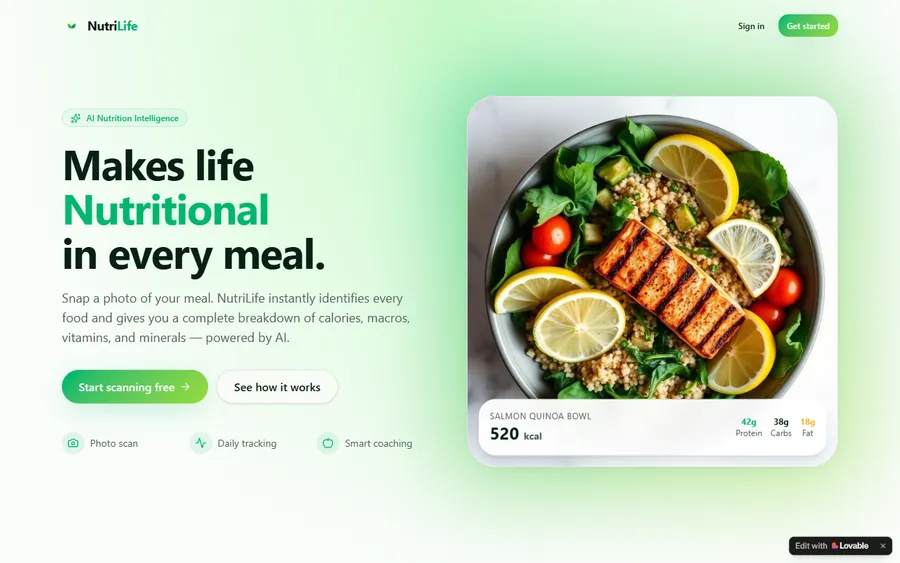
AI and ML
An AI nutrition coach that reads what you eat and works you toward a target.
AI and ML
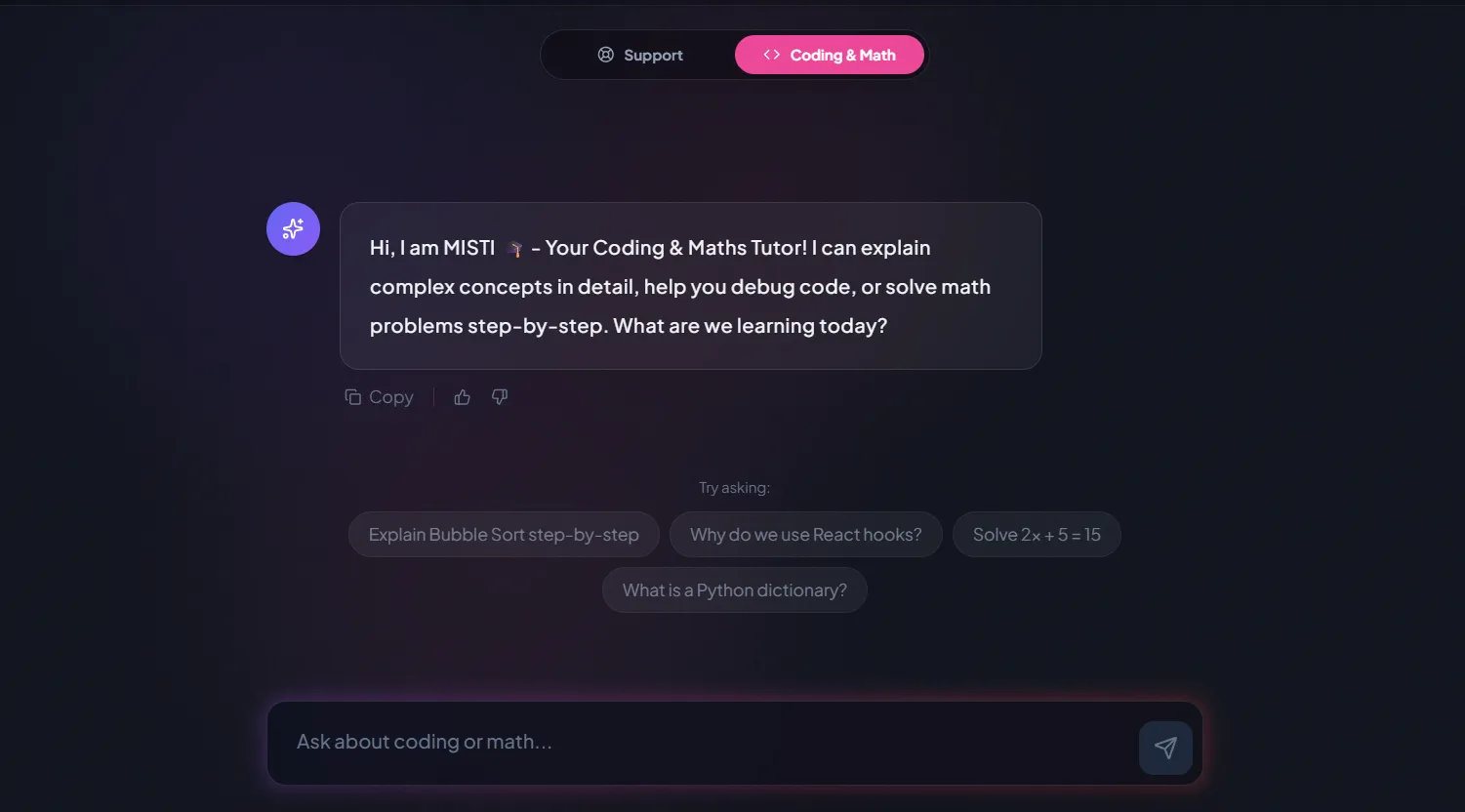
A chatbot that answers mathematics and programming questions, built and deployed by a student.

AI and ML
An assistant that helps a young person recognise unsafe situations online.
Web app
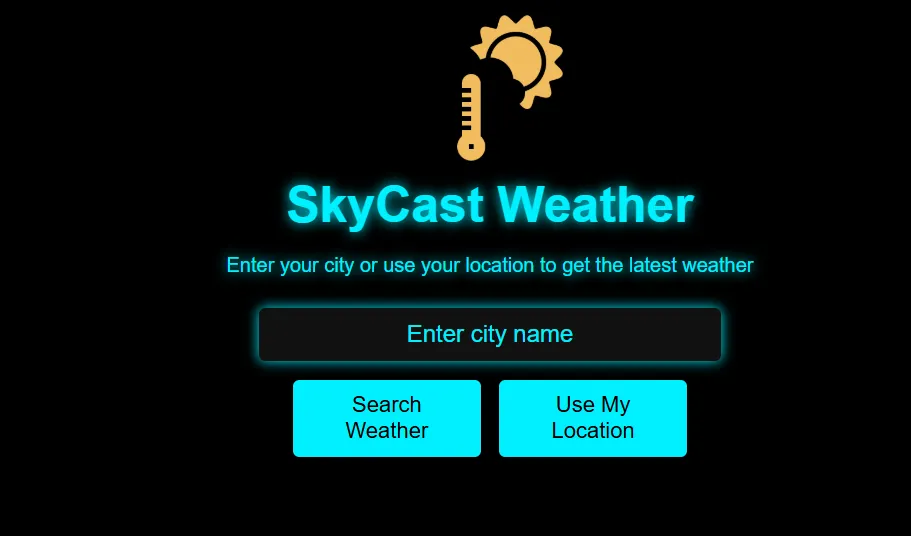
A weather forecasting site with live conditions for any location.
Fees
Charged monthly in US dollars at a single rate for every country outside India. There is no joining fee and nothing to sign in advance.
Free first class
USD 0
no card required
Group batch
USD 100
a month, billed in US dollars
One to one
USD 150
a month, billed in US dollars
What families say
Copied unchanged from reviews that families and learners posted about us on Google.
★★★★★
"The one step solution for my son. Modern Age Coders make learning coding so simple that kids love it. The teachers explain complex concepts clearly with practical exercises and interactive content."
Ria Mukherjee
Parent
★★★★★
"Modern Age Coders has been a game-changer for me. I struggled to grasp IT concepts and coding before joining, but their classes transformed everything. I can now confidently write complex programs with ease."
Samriddha Mondal
Student
★★★★★
"One of the most wonderful education centres out there. Education is not limited to school syllabus but focuses on skill development."
Vansh Agarwal
Student
★★★★★
"My child Dhairya is really enjoying the Modern Age Coders classes. This is his first online class and he eagerly looks forward to it. I can already see his improvement, and the teachers are very cooperative."
Sonam Oswal
Parent of Dhairya
★★★★★
"Modern Age Coders have wonderful teachers who teach in a clear, easy and practical way. The teacher boosts students' confidence and inspires them to learn without hesitation."
Sonu Goyal
Parent
★★★★★
"I highly recommend this computer coding class! The teachers are incredibly knowledgeable and passionate about coding."
Ritu Kedia
Parent
Cardiff maths questions
It is a chart where each bar's area, not its height, shows how many values fall in a class. The height is the frequency density, the count divided by the class width, so a wide class with many values can still have a short bar.
With us the first lesson is free. After that a place in a small group is USD 100 a month and one to one lessons are USD 150 a month, with no joining fee.
Yes. Our GCSE course is written for the English boards, and for Cardiff learners we steer the lessons to the WJEC specification, at Foundation or Higher tier, including the financial maths and non-calculator units.
Any age can work. Our youngest are 6, still building number sense, and our oldest are 67. The moment that matters most is the first sign of confusion, before it grows.
For most learners, yes. The teacher watches the working appear on a shared screen and reacts to each slip as it happens. Nothing is pre-recorded, and a group keeps one teacher.
Yes. We teach pure maths, statistics and mechanics at A level, and Further Maths for learners who want more proof and more advanced topics.
Yes, from complete beginners to adults returning to GCSE-level maths or preparing for maths at work. Adults join adult groups or have private lessons.
No, our lessons are in English. Learners from Welsh-medium schools are welcome, and we work from the English versions of WJEC material.
No. Grades depend on the learner, the paper and the day. What we promise is careful teaching and a frank monthly picture of progress.
No. We describe their public material so that families know about it. We have no connection with WJEC, the Maths Support Programme Wales, any university or any school.
Related
Our pages on maths in Wales, maths by stage, and coding in the city.
The double award GCSE, unit by unit.
Complex numbers, matrices and proof at sixth form.
Pure, statistics and mechanics.
Our page on coding for Cardiff learners.
Our page for learners across Wales.
Every nation, city and town we cover, plus the maths list.
Start here
Tell us the learner's age or school year and which topic causes the most trouble. The trial is a real lesson, and afterwards you hear honestly where things stand.
Want to look around first? Our courses and our page on how we teach are good places to begin.
WhatsApp us · +91 91233 66161 · connect@modernagecoders.com
Messages on WhatsApp get answered fastest. Expect an Indian country code: the team sits in India, there is no office in Wales, and every lesson is online.
A priority demo is a full class of about 45 to 60 minutes. After the class the mentor sends a written skill report and a personal learning roadmap on WhatsApp. If you enrol, the demo fee is adjusted against your first month's fee. Share your demo Order ID with us on WhatsApp and we take it off.
Book a priority demo