Table of Contents
Most children learn times tables the slow way: start at the 1s, recite up to the 12s, and repeat until it sticks. It works eventually, but it treats 10 x 4 and 7 x 8 as the same kind of problem, and they are not. One is a pattern a child can see in a second. The other is a genuinely hard fact that needs its own plan.
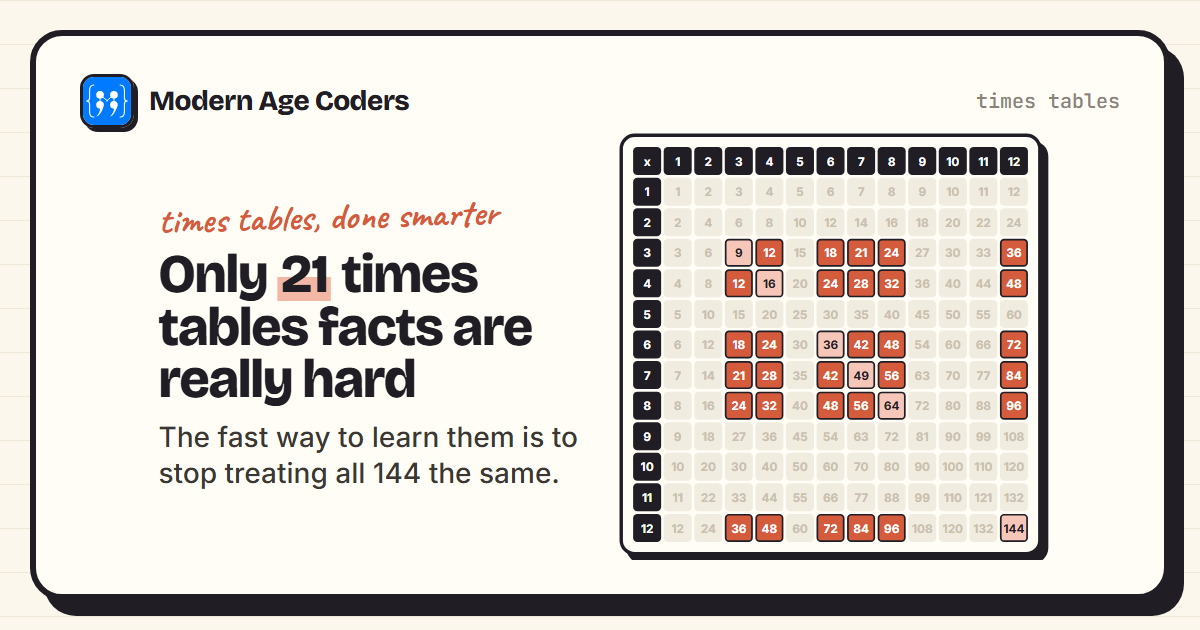
The fast way to learn times tables is to sort the facts first. When you do, something surprising happens: out of 144 facts on a 12 by 12 grid, only 21 need real memory work, and 6 of those are squares that many children find memorable anyway. This guide shows where that number comes from, the order to learn the tables in, the strategies for each one, and a five-minute daily method that makes the facts stay. It works for a 7-year-old starting out and for an adult who never quite got there.
Why only 21 facts are really hard
Here is the count, done properly. The code below lists every fact on the grid, merges pairs like 7 x 8 and 8 x 7, then removes the tables that follow an easy visible rule. The printout is its real output.
all_facts = [(a, b) for a in range(1, 13) for b in range(1, 13)]
print("Facts on a 12 by 12 grid:", len(all_facts))

# 7 x 8 and 8 x 7 are the same fact, so keep one of each pair
unique = {tuple(sorted(f)) for f in all_facts}
print("Different facts once order stops mattering:", len(unique))

easy_tables = {1, 2, 5, 10, 11, 9}   # each has a rule a child can see
left = {f for f in unique if not (set(f) & easy_tables)}
print("Facts left after the six pattern tables:", len(left))

squares = {f for f in left if f[0] == f[1]}
print("  of which squares (3x3, 4x4 ...):", len(squares))
hard = sorted(left - squares)
print("  the rest:", len(hard))
print(" ", ", ".join(f"{a}x{b}" for a, b in hard))Facts on a 12 by 12 grid: 144
Different facts once order stops mattering: 78
Facts left after the six pattern tables: 21
of which squares (3x3, 4x4 ...): 6
the rest: 15
3x4, 3x6, 3x7, 3x8, 3x12, 4x6, 4x7, 4x8, 4x12, 6x7, 6x8, 6x12, 7x8, 7x12, 8x12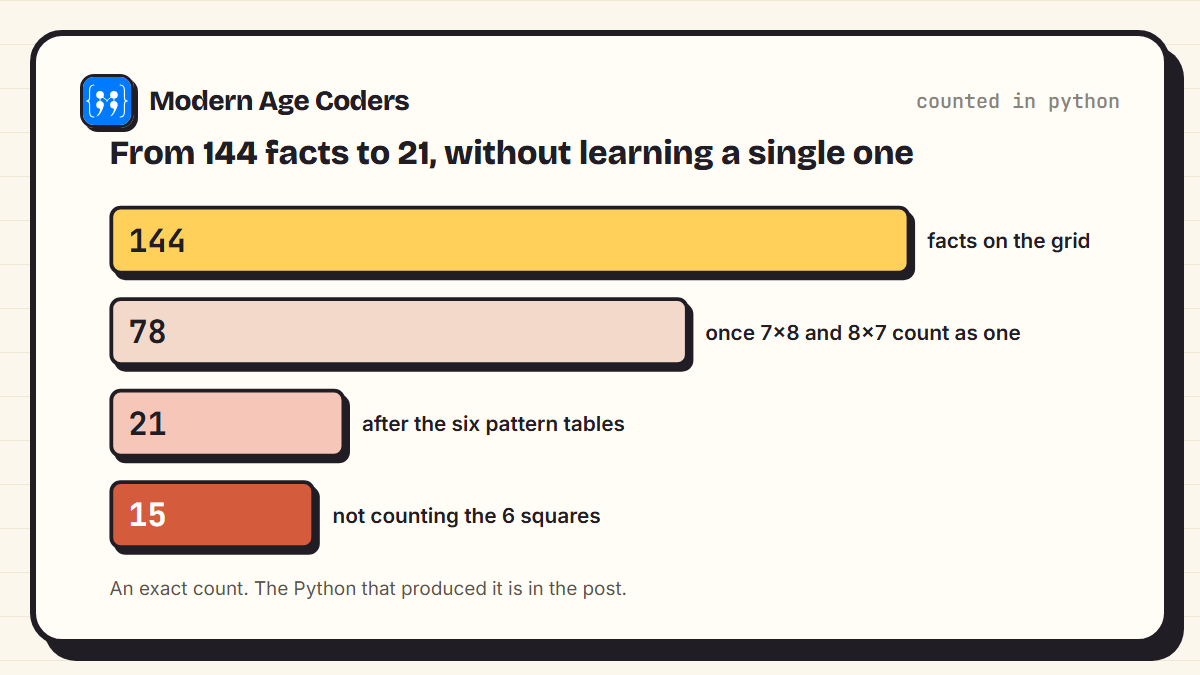
Look at the last line. Those fifteen, plus six squares (3 x 3, 4 x 4, 6 x 6, 7 x 7, 8 x 8 and 12 x 12), are the whole problem. Every other fact on the grid either follows a rule a child can see or is a mirror image of one they already know.
This matters for motivation as much as speed. A child told "learn your tables" faces 144 things. A child told "you already know most of these, and here are the 21 we are working on" faces a list that fits on one card.
The best order to learn times tables
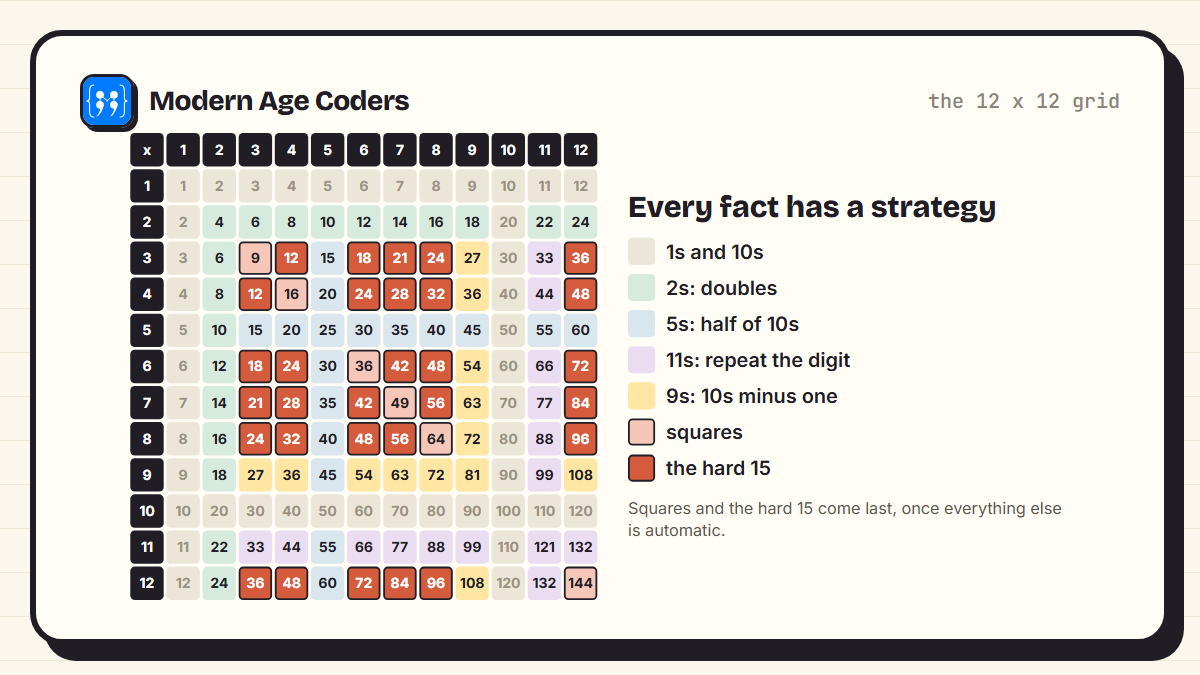
Order matters because each table should lean on the ones before it. This is the sequence we use with children aged 6 to 11, and with adults relearning:
- 1s and 10s. The 1s are the number itself. The 10s put a zero on the end. Most children can do both within a day.
- 2s. Doubles. If a child can double numbers up to 12, they know the 2s already.
- 5s. Half of the 10s. 5 x 8 is half of 80, so 40. They also end in 0 or 5, which is a built-in check.
- 11s. Up to 11 x 9 the answer repeats the digit: 11 x 6 is 66. Only 11 x 11 = 121 and 11 x 12 = 132 need learning.
- 9s. Ten lots minus one lot: 9 x 7 is 70 minus 7, which is 63. The digits of every answer up to 9 x 10 also add up to 9, which makes a good check.
- 4s and 8s. 4 is double double. 8 is double double double. 4 x 7: double 7 is 14, double 14 is 28.
- 3s and 6s. 3 is double plus one more. 6 is double the 3s, or the 5s plus one more group.
- 12s. Ten lots plus two lots: 12 x 7 is 70 plus 14, which is 84.
- 7s last. By now almost every 7s fact is known from another table. Only 7 x 7 is new.
Why the 7s go last
Children often dread the 7s. By the time you reach them in this order, 7 x 2, 7 x 3, 7 x 4, 7 x 5, 7 x 6, 7 x 8, 7 x 9, 7 x 10, 7 x 11 and 7 x 12 have already been learned from the other side. Showing a child that they only have one new 7s fact left is one of the most satisfying moments in the whole process.
Derive first, memorise second
A common worry is that strategies are a crutch, and a child who works out 6 x 7 will never just know it. The research and our experience point the other way. Derived facts are how memory gets built. The first twenty times a child works out 6 x 7 as 35 plus 7, it takes a few seconds. By the fiftieth time, the answer arrives before the working does. The strategy is scaffolding that comes down on its own.
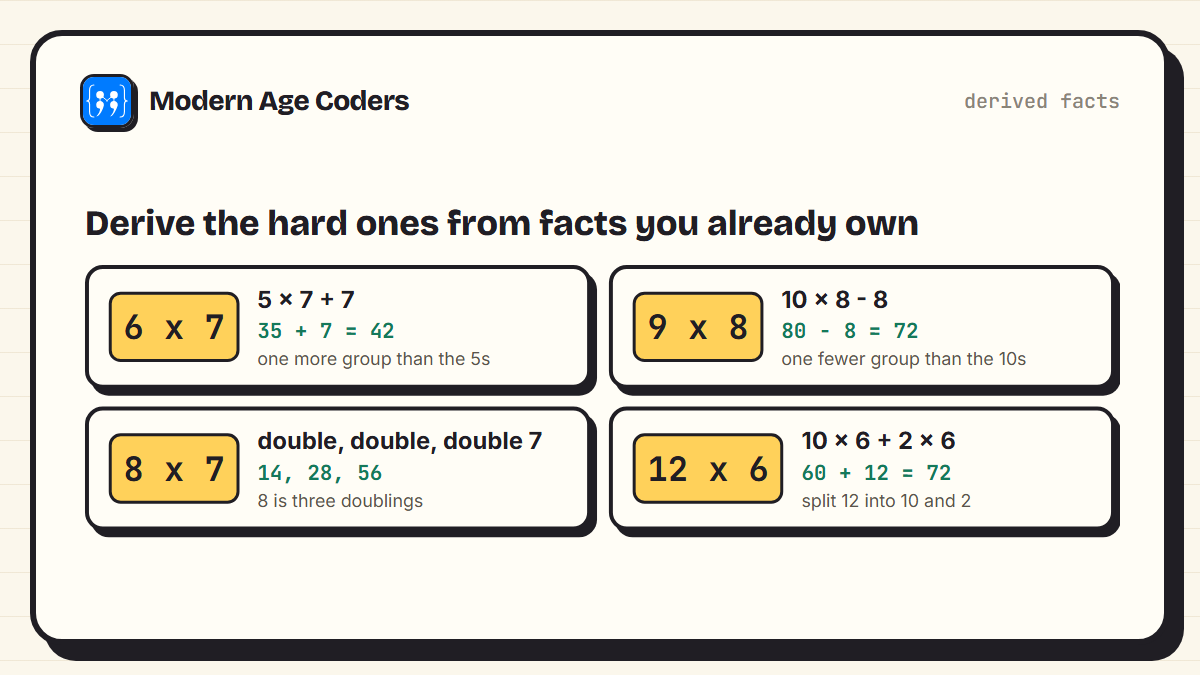
What does not work is memorising answers with no way back to them. A child who has learned "7 x 8 = 56" as a sound, not as a quantity, is stuck the moment memory slips. A child who knows 7 x 8 is double 7 x 4, which is double 28, can always recover it. That is the difference between knowing tables and understanding multiplication, and it shows up later in fractions, division and algebra.
- Near a 5 or 10: use the 5s or 10s and adjust. 6 x 8 = 5 x 8 + 8 = 48.
- An even number: halve and double. 8 x 6 = 4 x 12 = 48.
- A 4 or 8: keep doubling. 4 x 9: 18, 36.
- A 12: split into 10 and 2. 12 x 8 = 80 + 16 = 96.
The five-minute daily method
Once strategies are in place, the job is to move facts from "work it out" to "just know it". Two ideas from learning research do most of that work: retrieval practice (recalling an answer, not reading it) and spacing (reviewing a fact just as it is starting to fade). A three-box card system, often called the Leitner system after the German science writer who described it, combines both in something a family can run at the kitchen table.
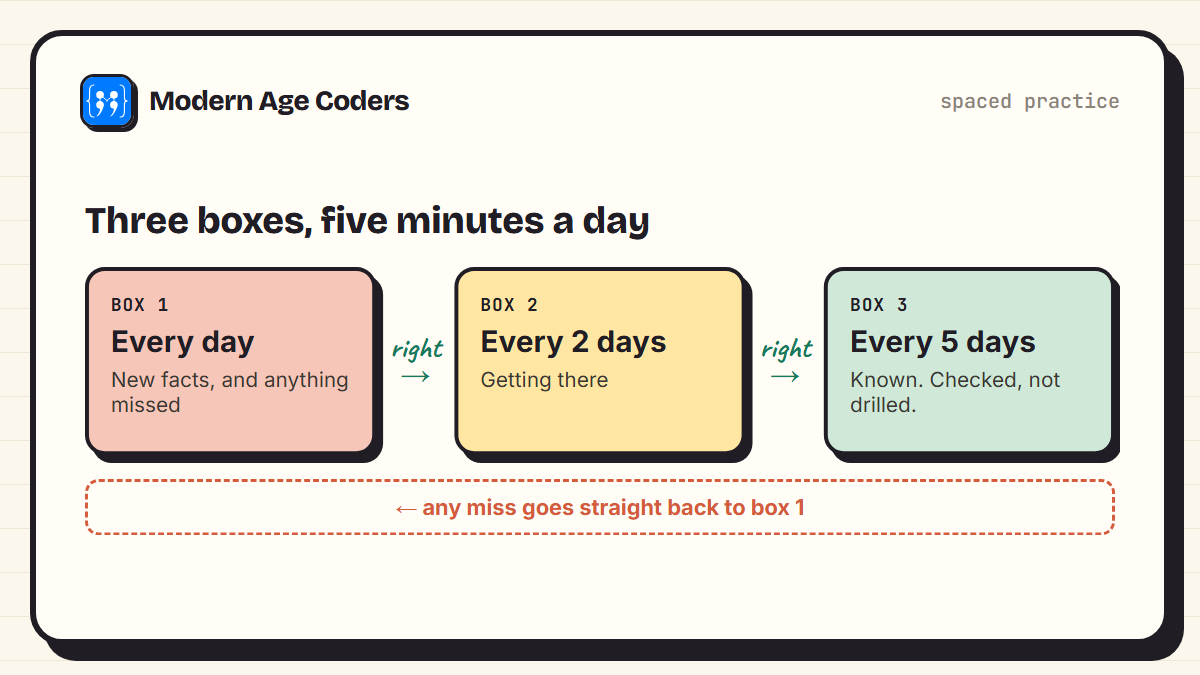
- Write each of the 21 hard facts on a card, question on the front and answer on the back.
- Everything starts in box 1. Each day, go through box 1. Every second day add box 2. Every fifth day add box 3.
- A quick, confident right answer moves the card up one box. A miss, or an answer that needed counting, sends it back to box 1.
- Stop at five minutes even if the box is not finished. Short and daily is the whole point.
Children who enjoy computers can build the system themselves, which is a small, real first program. This version simulates two days, with a random stand-in for the child's answers:
import random

# three boxes: new or missed facts, getting there, known
boxes = {1: [(6, 7), (7, 8), (8, 6), (12, 7)], 2: [(4, 6), (3, 8)], 3: [(6, 6)]}
review_every = {1: 1, 2: 2, 3: 5}          # box 1 daily, box 2 every 2 days, box 3 every 5

def todays_cards(day):
    return [f for box, facts in boxes.items() if day % review_every[box] == 0 for f in facts]

def answer(fact, correct):
    for box, facts in boxes.items():
        if fact in facts:
            facts.remove(fact)
            new_box = min(box + 1, 3) if correct else 1   # a miss always goes back to box 1
            boxes[new_box].append(fact)
            return new_box

random.seed(4)
for day in (1, 2):
    cards = todays_cards(day)
    print(f"Day {day}: {len(cards)} cards")
    for a, b in cards:
        correct = random.random() < 0.7         # stand-in for the child's answer
        moved_to = answer((a, b), correct)
print(f" {a} x {b} = {a*b:<3} {'right' if correct else 'missed'} -> box {moved_to}")Day 1: 4 cards
6 x 7 = 42 right -> box 2
7 x 8 = 56 right -> box 2
8 x 6 = 48 right -> box 2
12 x 7 = 84 right -> box 2
Day 2: 6 cards
4 x 6 = 24 right -> box 3
3 x 8 = 24 right -> box 3
6 x 7 = 42 missed -> box 1
7 x 8 = 56 missed -> box 1
8 x 6 = 48 missed -> box 1
12 x 7 = 84 right -> box 3Notice how the facts sort themselves. Anything answered correctly stops appearing every day, so practice time goes to the facts that need it. That is exactly why this beats reciting a whole table top to bottom, which spends most of its time on facts the child already knows. If your child likes this kind of thing, it is a good sign they would enjoy learning coding and maths together.
Games that practise tables without worksheets
Cards and boxes cover the memory side. Games cover the fun, and they are especially good for younger children or anyone who has come to dread maths. All of these need nothing more than a deck of cards or two dice.
- Multiplication war. Each player turns over two cards and multiplies them. The biggest product wins all four cards. Take out the picture cards, or count them as 10, 11 and 12.
- Dice race. Roll two dice, multiply, and move that many squares on a 100 square. First to 100 wins. Use two 12-sided dice later on.
- Fact of the day. One hard fact goes on the fridge. Anyone in the family can ask it at any moment, and the child can ask it back.
- Beat yesterday. One minute on the clock, as many facts from box 1 as possible. The only score that counts is yesterday's.
For more ideas in the same spirit, see our guides to making maths fun for kids and mental maths tricks with worked examples.
How fast is fast enough?
"Fluent" means the answer comes from memory, not from counting. A useful benchmark comes from England, where every Year 4 pupil in a state school takes the Multiplication Tables Check in June: 25 questions on tables up to 12 x 12, with 6 seconds to answer each one. There is no pass mark, but the design tells you what fluency looks like. Six seconds is enough to recall and type an answer and not enough to count up in 7s. If your child is preparing for it, our Year 4 Multiplication Tables Check practice page explains the format in detail.
In the United States, the Common Core standards set a similar goal: by the end of Grade 3, students should know from memory all products of two one-digit numbers. In India, most schools introduce tables around Classes 2 and 3 and expect them to be secure before Class 5, when long multiplication and division lean on them heavily.
| Stage | What it looks like | What to do |
|---|---|---|
| Counting | Counts up in 7s on fingers to find 7 x 6 | Teach a strategy for that table |
| Deriving | Says "5 x 7 is 35, plus 7 is 42" in a few seconds | Keep practising. This is progress, not a problem |
| Recalling | Answers 42 in under 3 seconds without visible working | Move the card to the next box |
| Automatic | Uses 6 x 7 inside bigger problems without slowing down | Check occasionally, then leave it alone |
Speed pressure has a cost
Timed tests help some children and badly hurt others. If your child freezes, cries, or starts saying they are "bad at maths" when the clock comes out, drop the timer for a few weeks and focus on derived facts. Anxiety blocks recall far more than a missing fact does. Our guide on helping a child with maths anxiety covers this in detail.
How long it takes, and when to worry
With the order above and five minutes a day, most children get the whole grid fluent in roughly 6 to 10 weeks. That is a planning estimate from teaching, and it assumes the child already understands what multiplication means, groups of things, rather than treating it as a list of words to remember.
It is worth a closer look if a child of 9 or 10 still counts on fingers for most facts after a term of steady practice, cannot say whether 6 x 7 is closer to 40 or 70, or mixes up addition and multiplication facts often. None of that means something is wrong, but it usually points to a gap underneath the tables, such as place value or number sense, and drilling harder will not fix it. Our article on why children struggle with maths goes through the common causes.
Times tables matter most when division arrives. Every divide step in long division is a times tables fact in reverse, which is why children who hesitate on 7 x 8 find long division so much harder than it needs to be.
Nobody needs to memorise 144 facts. They need 21 facts, a way to work out the rest, and five minutes a day.
How we teach it
Times tables are one small part of our live online maths classes, and they show our approach clearly: children work out a rule for themselves before they see it written down, and mistakes are treated as information about what to practise next, not as failures. You can read more about that on how we teach. Classes are one to one or in small groups of 5 to 10. For students who have fallen behind, our maths catch-up programme rebuilds the foundations in order.
Frequently asked questions
Learn the pattern tables first (1s, 10s, 2s, 5s, 11s and 9s), treat 7 x 8 and 8 x 7 as one fact, and derive the remaining 21 facts from ones you already know. Then practise those for five minutes a day with a spaced review system like three boxes of flashcards. Most children are fluent in 6 to 10 weeks.
A good order is 1s and 10s, then 2s, 5s, 11s and 9s, then 4s and 8s by doubling, 3s and 6s, 12s, and the 7s last. Each table then builds on the ones before, and by the time you reach the 7s only 7 x 7 is new.
In England, children are expected to know tables up to 12 x 12 by Year 4, around age 8 or 9, when they take the Multiplication Tables Check. In the US, Common Core expects all single-digit products by the end of Grade 3. Children who get there later can catch up quickly with the right method.
Multiply by 10 and subtract the number once: 9 x 7 is 70 minus 7, which is 63. Up to 9 x 10, the digits of each answer also add up to 9, which gives a quick way to check.
Forgetting usually means the facts were memorised as sounds without a way to work them out. Teach a strategy for each hard fact, then use short daily retrieval practice with spacing, reviewing missed facts more often than known ones. Five minutes daily beats half an hour at the weekend.
Yes. Tables are not really about getting a single answer. They are the base for fractions, division, factors, percentages and algebra, and a child who has to stop and calculate every product loses track of the bigger problem they are solving.
They can be, if they make the child recall answers rather than choose from options, and if they revisit missed facts more often. Many apps reward speed on facts a child already knows, which feels good and teaches little. Cards and a three-box system often work as well or better.