Skip to content
Math tutor, Burnaby, British Columbia

Math tutor in Burnaby

Who teaches math live to Burnaby students?

Modern Age Coders gives Burnaby students live online math tutoring, Grade 1 to Pre-calculus 12, with a teacher working one to one or with fifteen to twenty students at the same level. Grade 12 students usually choose Western Canada Grade 12 Math: Pre-calculus 12 and Math 30-1, and puzzle lovers take Waterloo Math Contests. Your first lesson is free.

Trigonometry is where many Burnaby teenagers first feel that math has turned against them. It arrives gently in Grade 10 with right triangles, speeds up in Pre-calculus 11 with the sine and cosine laws and their ambiguous cases, and in Pre-calculus 12 switches to radians, the unit circle and identities. Each step leans on the last. This page follows that thread through the BC curriculum, using the province’s own wording, and then teaches it on something every Burnaby student knows: the SkyTrain stations, as the City of Burnaby maps them in its open data. A worked problem, the CEMC contests that reward written solutions, and an honest note on prices follow.

Facts last verified 23 October 2026. Teaching is online; no Burnaby branch is claimed.

Math course picks for Burnaby

Courses Burnaby families pick first

Matched to stages of BC math, then confirmed in a free lesson once the teacher has watched the student solve something.
Browse the course atlas for more than one hundred options and use the coding roadmap to check prerequisites.

The four we are known for

Python, AI, vibe coding and agentic coding

These run underneath everything above. Every one is live and online, placed by ability rather than by age, and the first class is free.

BC math in Burnaby

Trigonometry through BC math, from Grade 10 to Pre-calculus 12

Public schools in Burnaby follow BC’s provincial curriculum. The phrases in the table are copied from the province’s curriculum site on 23 October 2026; the right-hand column is ours.

Where trigonometry appears in BC secondary math. Content wording from curriculum.gov.bc.ca; the summaries are ours
CourseThe province’s wordingWhat the student actually does
Mathematics 9“spatial proportional reasoning scale diagrams, similar triangles and polygons”Similar triangles, the idea every trigonometric ratio rests on
Foundations of Mathematics and Pre-calculus 10“right-triangle problems: determining missing sides and/or angles using trigonometric ratios and the Pythagorean theorem”Sine, cosine and tangent in right triangles
Pre-calculus 11“use of sine and cosine laws to solve non-right triangles, including ambiguous cases”Any triangle, plus angles in standard position in degrees and the unit circle
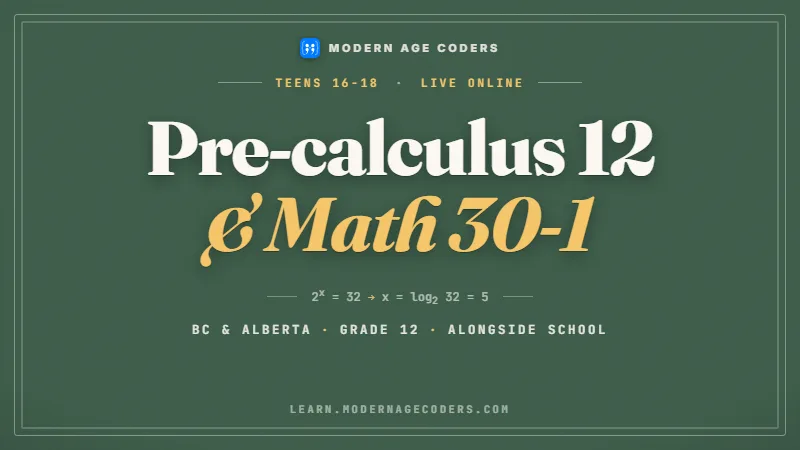
Pre-calculus 12“examining angles in standard position in both radians and degrees”Radians, graphs of trigonometric functions, equations and identities

Read top to bottom, the table explains why trigonometry trouble is rarely about trigonometry. A Pre-calculus 11 student who cannot apply the cosine law usually has a Grade 9 gap in similar triangles or a Grade 10 gap in rearranging an equation. A Pre-calculus 12 student lost in radians often never felt comfortable with angles in standard position the year before. Our first lesson with a Burnaby teenager therefore starts one course back, briefly, before it moves forward.

Special angles

Pre-calculus 11 lists “special angles, as connected with the 30-60-90 and 45-45-90 triangles”. Students who can sketch those two triangles from memory rarely need a calculator for exact values, and Pre-calculus 12 assumes they can.

Identities in Grade 12

Pre-calculus 12 asks students to use “identities to reduce complexity in expressions and solve equations”: Pythagorean, quotient, double angle, reciprocal, sum and difference. Proving an identity and solving an equation are different tasks, and we teach them as such.

Beyond trigonometry

The same senior courses also carry logarithms, polynomials and series. For calculus after Pre-calculus 12, our Calculus 12 tutor page sets out the course in full.

Our role beside school

Lessons with us run in parallel with a Burnaby student’s school course. We do not grant BC credits, and every mark and credit is the school’s. We are not connected with the BC Ministry of Education and Child Care, the City of Burnaby, TransLink or the Burnaby school district.

Burnaby data lesson

Solving a triangle drawn between three Burnaby SkyTrain stations

The City of Burnaby publishes the positions of the SkyTrain stations in the city as open data, in metres. Pre-calculus 11 students turn three of them into a triangle and solve it completely. The distances and angles below are our own calculations.

The layer is called SkyTrain Station, and the City describes it as points of ingress and egress for the Skytrain network. Our query on 23 October 2026 returned 11 stations, from Gilmore and Brentwood Town Centre in the north to Royal Oak and Edmonds in the south. Each comes with an easting and a northing in metres, so the distance between two stations is simply the Pythagorean theorem applied to the differences.

Triangle Metrotown (A), Brentwood Town Centre (B), Lougheed Town Centre (C): our straight-line distances between the City of Burnaby station points and our angles from the cosine law. City of Burnaby open data, queried 23 October 2026
MeasureValue
Side c, Metrotown to Brentwood Town Centre4,517.9 m
Side b, Metrotown to Lougheed Town Centre8,184.9 m
Side a, Brentwood Town Centre to Lougheed Town Centre7,877.8 m
Angle at Metrotown, A69.96°
Angle at Brentwood Town Centre, B77.44°
Angle at Lougheed Town Centre, C32.60°
Each side divided by the sine of its opposite angle8,385.6 m
Area, by one half of bc sin A17.37 km²

Two checks are built into the table. The three angles add to 180 degrees, and the sine law ratio comes out at 8,385.6 m for all three sides, exactly as it must. The area agrees too: one half of b times c times the sine of A gives 17.37 square kilometres, the same as the shoelace formula on the three coordinates. Here is the Python that computes the sides and angles:import json, math with open("skytrainstn.json", encoding="utf-8") as f: points = {feat["attributes"]["NAME"]: (feat["geometry"]["x"], feat["geometry"]["y"]) for feat in json.load(f)["features"]} A = points["METROTOWN STATION"] B = points["BRENTWOOD TOWN CENTRE STATION"] C = points["LOUGHEED TOWN CENTRE STATION"] a, b, c = math.dist(B, C), math.dist(A, C), math.dist(A, B) angle_A = math.degrees(math.acos((b*b + c*c - a*a) / (2*b*c))) angle_B = math.degrees(math.acos((a*a + c*c - b*b) / (2*a*c))) angle_C = 180 - angle_A - angle_B print("sides (m):", round(a, 1), round(b, 1), round(c, 1)) print("angles:", round(angle_A, 2), round(angle_B, 2), round(angle_C, 2)) print("sine law:", round(a / math.sin(math.radians(angle_A)), 1))

Closest and farthest

With 11 stations there are 55 pairs. The closest pair in our calculation is Metrotown and Patterson, 764.3 m apart; the farthest is Gilmore and Lougheed Town Centre at 8,679.9 m. Students find both with a loop before they guess.

Angles in standard position

Measured from east, anticlockwise, Brentwood Town Centre sits at 88.0 degrees from Metrotown, almost due north, and Lougheed Town Centre at 18.1 degrees. In Pre-calculus 12 terms those are 1.536 and 0.315 radians.

Negative angles

Edmonds lies south-east of Metrotown, so its angle in standard position comes out as minus 25.1 degrees. Students then find the positive coterminal angle, 334.9 degrees, which the Pre-calculus 11 content asks for by name.

What these numbers are not

Every distance here is a straight line between two points on the City’s map, not the length of the track and not a travel time. The trains follow a curving guideway, so a rider covers more than 4,517.9 m between Metrotown and Brentwood Town Centre. A good answer says which distance it means.

Contains information licensed under the Open Government Licence - British Columbia. The layer is published by the City of Burnaby under its Open Government Licence - City of Burnaby, which allows commercial use (licence). The City of Burnaby does not endorse this page or our classes, and TransLink has no part in it.

A worked problem, ours

Worked problem: the ambiguous case, settled by a map

Our own Pre-calculus 11 problem. It uses two sides and an angle from the station triangle, chosen so that the sine law offers two answers.

Question. In a triangle, side a is 7,877.8 m, side c is 4,517.9 m, and the angle C opposite side c is 32.6 degrees. Find angle A and side b. How many triangles fit these measurements, and which one matches the three Burnaby stations?

Step 1, use the sine law for A. sin A divided by a equals sin C divided by c, so sin A equals 7,877.8 times sin 32.6 degrees, divided by 4,517.9, which is about 0.9394. The calculator gives A = 69.96 degrees.

Step 2, look for the second angle. Sine is positive in the first and second quadrants, so 180 minus 69.96, or 110.04 degrees, has the same sine. Both are possible here, because 110.04 plus 32.6 is still less than 180. This is the ambiguous case the Pre-calculus 11 content names: two sides and an angle not between them can fit two different triangles.

Step 3, finish both triangles. If A is 69.96 degrees, B is 77.44 degrees and the sine law gives b = 8,184.9 m. If A is 110.04 degrees, B is 37.36 degrees and b = 5,088.4 m. Both are correct triangles.

Step 4, let the data decide. The real distance from Metrotown to Lougheed Town Centre, from the coordinates, is 8,184.9 m, so the stations form the first triangle. The algebra alone could not choose; extra information had to. Students who learn to ask what information would settle an ambiguity have learned something larger than a trigonometry rule.

Try it yourself. (1) Keep a and C the same and shrink c until only one triangle is possible; at what length does that happen? (2) Use the cosine law to find the distance from Patterson to Holdom from their coordinates, then check with the distance formula. (3) Convert the Gilmore angle from Metrotown, 99.2 degrees, to radians. We go through the answers in the free lesson.

Contests for Burnaby students

Contests that reward written solutions, 2026 to 2027

Trigonometry students who like explaining their reasoning do well in the CEMC contests that ask for full solutions. CEMC published the dates below for its North and South America sittings, and we checked them on 22 October 2026.

CEMC contests with written-solution questions, and a team contest, for 2026 to 2027. Formats and dates as CEMC lists them
ContestWho writes itFormatCEMC date
Fryer, Galois, HypatiaGrades 9, 10 and 114 questions, four questions, some answer-only and some full-solution, in 75 minutesWednesday 7 April 2027
EuclidFinal year of secondary school10 questions, a mix of answer only and full-solution, 2.5 hoursTuesday 6 April 2027
Canadian Team Mathematics ContestTeams of six, Grades 9 to 12Individual and team eventsFrom Wednesday 14 April 2027 in school

Full-solution questions are marked on the argument, not only the final number. That suits trigonometry well: a student who writes “by the cosine law”, substitutes cleanly and states why only one triangle is possible is doing exactly what these contests reward. CEMC’s weekly Problem of the Week, sent to educators for students from Grades 3 to 12 every Thursday, is good practice for writing short, complete solutions.

Entry through school

Students write these through a school, never alone, in CEMC’s own rules. A Burnaby student whose school skips the April contests can, CEMC says, look for another local school to take them in.

Free courseware

CEMC also publishes free courseware for Grades 4 to 12, and it is honest that no certificate or credential is awarded. We use it as reading, never as a substitute for a teacher checking the work.

Our own problems

Contest lessons use problems we write and label as ours. We never copy CEMC past papers or solutions, and we are not connected with CEMC. See our Fryer, Galois and Hypatia guide.

Math tutor price in Burnaby

Math tutor prices in Burnaby, compared fairly

Our prices are shown in the fees section below, in your own currency, so this text carries no figures. This is how we suggest a Burnaby family compares any two offers.

Three ways to compare math tutoring offers in Burnaby. Our answers are ours; we do not publish other tutors’ rates
ComparisonHow to work it outOur side of it
Cost per lesson taughtMonthly cost divided by lessons that really happenEight live classes a month
Cost per minute of student solvingWatch a lesson: who holds the pen?Students write on the shared board most of the lesson
Hidden costsTravel time, missed sessions, materialsNo travel; the pricing page sets out missed classes

For most Burnaby students a group class of fifteen to twenty at one level is enough to keep a course on track, with other students’ questions as a bonus. One to one is worth paying for when there is a sharp, specific problem: the ambiguous case refuses to make sense, identities feel like guesswork, or a Pre-calculus 12 final is a few weeks away. Many families use one to one for a term and then move to a group.

Learning ladder

From shapes in Grade 1 to radians in Grade 12

Grade bands are a guide only. Where a Burnaby student starts depends on what they can already explain in the free lesson.

Grades 1 to 3

Shapes and numbers

Counting, place value, simple shapes and measurement, all explained aloud.

Early Math FoundationsMental Maths for Kids
Grades 4 to 8

Angles and ratio

Fractions, ratio, angles, scale drawings and first equations, the base trigonometry needs.

Elementary Maths for Grades 1-5Middle School Mathematics Mastery
Grades 9 to 11

Triangles, then laws

Similar triangles, right-triangle trigonometry, then the sine and cosine laws in Pre-calculus 11.

High School MathematicsMaths Through Coding
Grade 12

Radians and identities

Pre-calculus 12 trigonometry, logarithms and series, with Euclid-style problems for keen students.

Western Canada Grade 12 MathWaterloo Math Contests
Math and AI

Will an AI solve a Burnaby student’s triangle for them?

It will give an answer. Whether it gives both answers, or the right one, is another matter.

Type the ambiguous-case question into a chatbot and it may return 69.96 degrees and stop, never mentioning the second triangle. Ask it for the distance between two stations and it may give a straight line when the question meant track length. A student who understands the sine law and the map catches both slips; one who copies the output does not.

So every lesson asks the student to sketch, estimate and justify before computing. AI tools appear only for students old enough under our age policy, and then only as a second opinion on finished work. Work handed in at school stays the student’s own.

The Pre-calculus 11 phrase “including ambiguous cases” is a small reminder that mathematics is about knowing when an answer is incomplete. The longer argument is in why problem solving beats copying in the age of AI.

Delivery

How live online math works for Burnaby

Lessons run at home on a laptop or desktop, so a student near Metrotown and one near Lougheed can share a teacher.

Lesson times

Weekdays or weekends, flexible: choose your batch, or for a very personalised plan choose 1-on-1 at your convenience, weekend mornings or weekdays.

Pacific time, all year

BC went to permanent UTC-7 after 8 March 2026, so Burnaby clocks stay put in November. Our teachers keep India time, 12 hours 30 minutes ahead, and invitations name the Pacific time.

Diagrams on screen

Trigonometry needs pictures. Teacher and student draw on one shared board, so every triangle is labelled before any formula is used.

Taught to the course

Lessons follow the student’s BC course, so Pre-calculus 11 and Foundations 11 students are not given the same plan.

Burnaby numbers

Numbers on 604, 778, 236, 672 or 257 all work in the form. Enter ten digits; the +1 is pre-filled.

Free first lesson

A complete lesson costs nothing and needs no card. It ends with a course, level and time we suggest.

No Burnaby centre

There is no Modern Age Coders centre in Burnaby, and we do not suggest otherwise. Teachers in India teach live online; the student needs a computer, a microphone and a steady connection.

Fees

Math tutoring fees for Burnaby families

Free lesson, group month, private month: each priced in your currency.

First classFree

A free, complete live lesson that ends with a course and level suggestion.

Group tuition$140 CAD

The monthly fee for eight live classes in a group of fifteen to twenty at one level.

Private tuition$210 CAD

The monthly fee for eight lessons with one teacher, at times you choose.

Burnaby families pay the same as families in any other part of Canada. Nothing is charged before the free lesson and an agreed plan; holidays and missed lessons are covered on the pricing page.

Reviews

Google reviews from families and students

Rated 4.9 across 547 Google reviews. These are real reviews, reproduced as written.

★★★★★

"The one step solution for my son. Modern Age Coders make learning coding so simple that kids love it. The teachers explain complex concepts clearly with practical exercises and interactive content."

Ria Mukherjee

Parent

★★★★★

"Modern Age Coders has been a game-changer for me. I struggled to grasp IT concepts and coding before joining, but their classes transformed everything. I can now confidently write complex programs with ease."

Samriddha Mondal

Student

★★★★★

"One of the most wonderful education centres out there. Education is not limited to school syllabus but focuses on skill development."

Vansh Agarwal

Student

★★★★★

"My child Dhairya is really enjoying the Modern Age Coders classes. This is his first online class and he eagerly looks forward to it. I can already see his improvement, and the teachers are very cooperative."

Sonam Oswal

Parent of Dhairya

★★★★★

"Modern Age Coders have wonderful teachers who teach in a clear, easy and practical way. The teacher boosts students' confidence and inspires them to learn without hesitation."

Sonu Goyal

Parent

★★★★★

"I highly recommend this computer coding class! The teachers are incredibly knowledgeable and passionate about coding."

Ritu Kedia

Parent

Free placement class

Book a free math lesson for a Burnaby student

Tell us the grade and the course. A Grade 5 child might begin with angles on a clock face; a Pre-calculus 11 student might begin with the station triangle.

+1

FAQ

Burnaby math tutoring questions

The questions Burnaby families ask us most often.

Is there a math tutor for Burnaby students?

We teach Burnaby students online. There is no Burnaby building; a teacher teaches each lesson live, either one to one or to a group of fifteen to twenty at one level.

How much does a math tutor in Burnaby cost with you?

The fees section shows a free first lesson, a monthly group fee and a monthly one-to-one fee, all in your currency. You pay only after the free lesson.

My teen is struggling with the sine and cosine laws. Can you help?

Yes. We usually start a step back, with similar triangles and rearranging equations, then return to the laws and the ambiguous case with diagrams.

Do you teach Pre-calculus 12 radians and identities?

Yes, beside the school course. Our Western Canada Grade 12 Math course covers radians, the unit circle, identities, logarithms and series.

Will lessons with you count as a BC credit?

They will not, because we do not grant BC credits. Only the student's school awards credits and final marks.

Which contests suit a student who likes writing solutions?

CEMC's Fryer, Galois and Hypatia contests on 7 April 2027 and the Euclid on 6 April 2027 both include full-solution questions. Students enter through their school.

What times are lessons for Burnaby students?

Weekdays or weekends, flexible: choose your batch, or for a very personalised plan choose 1-on-1 at your convenience, weekend mornings or weekdays. Times are given in Pacific time, which BC no longer changes.

Can a Grade 7 student start before trigonometry?

Yes, and it helps. Ratio, angles and scale drawings in Grades 6 to 8 make Grade 10 trigonometry far easier.

Do you teach students in New Westminster and Coquitlam?

Yes. Lessons are online, so a student in New Westminster or Coquitlam sits in exactly the classes a Burnaby student does.

Is the SkyTrain lesson on this page part of a course?

It is the kind of lesson we teach in Pre-calculus 11 work. The data comes from the City of Burnaby; the calculations and the problem are ours.

More for Burnaby and Canada

Other pages for Burnaby math students

The national overview is our online math tutor page for Canada, and the provincial one is coding classes in British Columbia. For senior math see Calculus 12 tutoring, and for contests see Euclid preparation.

Free classPriority demoCall us

Keep exploring Modern Age Coders

More maths tuition

Learn more

From the blog

Start here